What Is Rhododendron Honey?
Before we talk about ancient sources, we have to clear up a modern confusion: rhododendron honey is not automatically “mad honey.”
“Rhododendron honey” is a descriptive phrase. It points to honey produced during seasons when bees forage in landscapes where rhododendrons are flowering. In some regions, rhododendron nectar may be a significant portion of what goes into the honey; in others, it’s a minor component mixed among many other floral sources.
That distinction matters because the difference between “regular honey with rhododendron influence” and “mad honey” is often about concentration, species, and batch variability, not just the presence of rhododendrons in the environment.
Rhododendron species and nectar sources (high-level)
Rhododendron is a large genus, and different species exist across Europe, Asia, and North America. Not all are equally relevant to the “mad honey” conversation. Historically and clinically, the discussion tends to focus on regions where certain rhododendron species are common and where traditional naming and modern reports overlap.
The important point for readers is not memorizing Latin names. It’s understanding that botanical variation exists, and botanical variation can influence honey chemistry. Two honeys could both be described as “rhododendron honey” and still behave differently.
When “rhododendron honey” becomes what people call “mad honey”
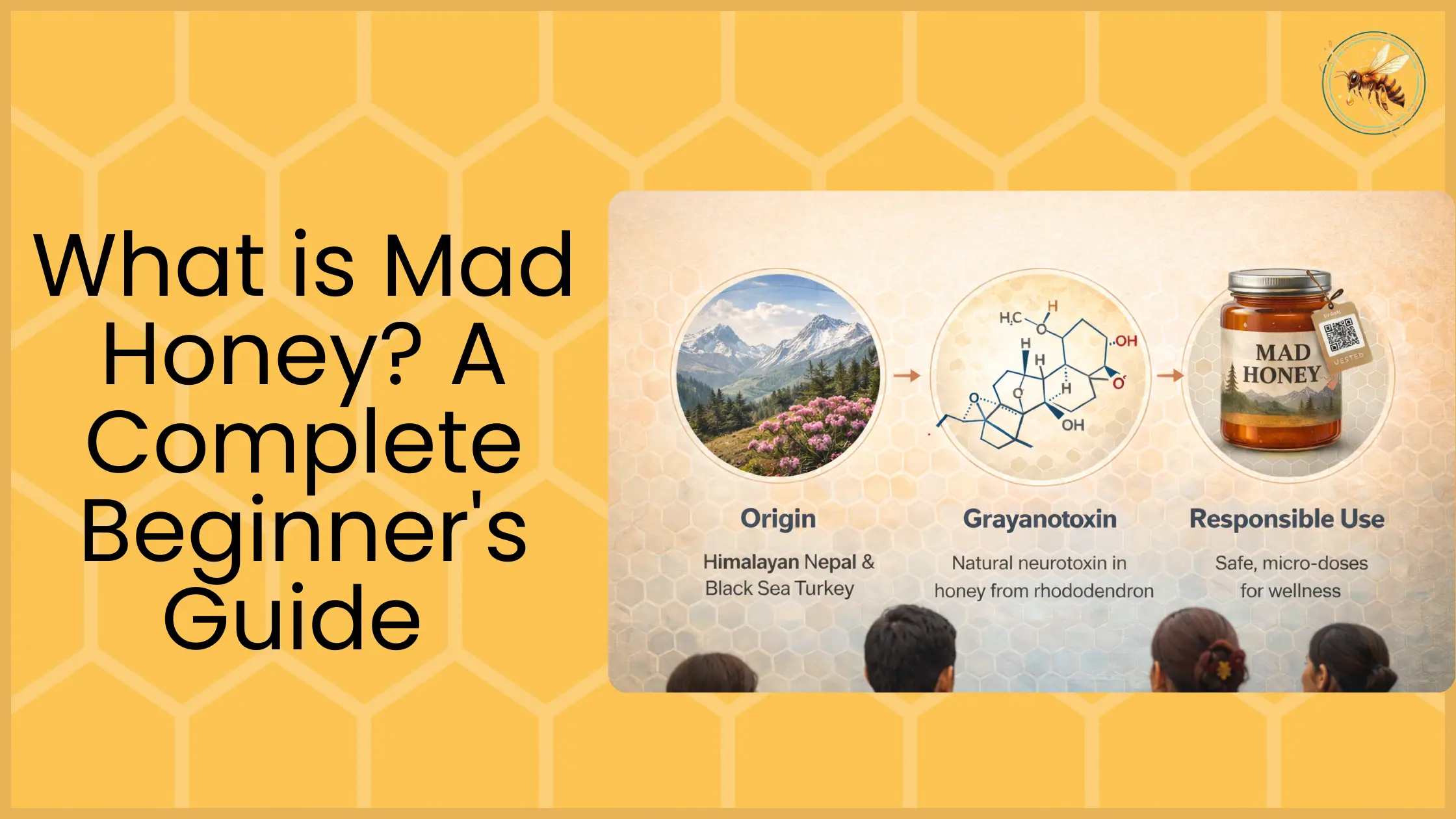
In modern usage, “mad honey” usually refers to honey associated with noticeable physiological effects, often described as relaxing at low doses and unpleasant at higher doses, linked to naturally occurring compounds (commonly discussed as grayanotoxins) in some batches.
That means a honey becomes “mad honey” in practice when:
- the relevant nectar sources contribute enough to matter,
- the batch contains meaningful levels of those naturally occurring compounds, and
- the consumer uses it in a way that reveals the dose-response curve (i.e., not just a tiny drizzle).
This is why one of the most honest ways to define “mad honey” is not a romantic one. It’s a practical one: a niche honey category where dose and variability matter.
Why the same term can mean different things in different countries
The phrase “rhododendron honey” can mean:
- a regional honey with a botanical identity (like many monofloral or seasonal honeys), or
- a shorthand for “mad honey” effects in places where that association is culturally established.
Local naming also changes what people think the product is. In the Black Sea region, the traditional label “deli bal” (“mad honey”) is part of common lore. In Nepal, “Himalayan mad honey” is often the globalized label that outsiders recognize, even though local context may be more nuanced than the internet suggests.
If you want a clean baseline definition for beginners, this section should send readers to:
- Internal link: /basics/what-is-mad-honey/
- (Optional if you publish it) /basics/what-is-rhododendron-honey/
The Earliest Famous Historical Account (Xenophon and the “Mad Honey” Story)
If you’ve read even five articles about mad honey, you’ve seen the same ancient reference recycled, often with dramatic language and minimal nuance. That’s because one story became the template for nearly everything written later.
The story in brief (what happened, where, why it’s cited)
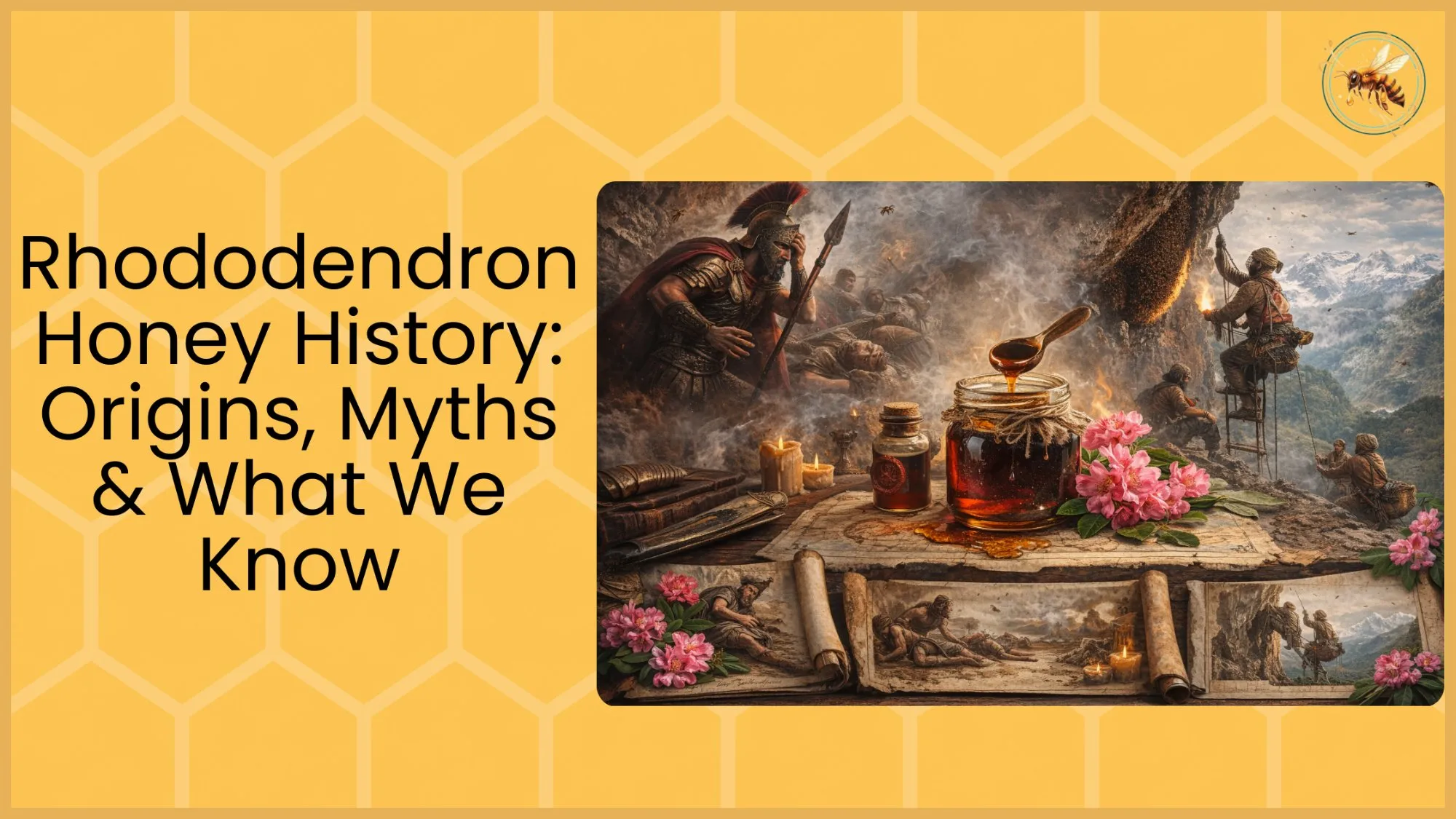
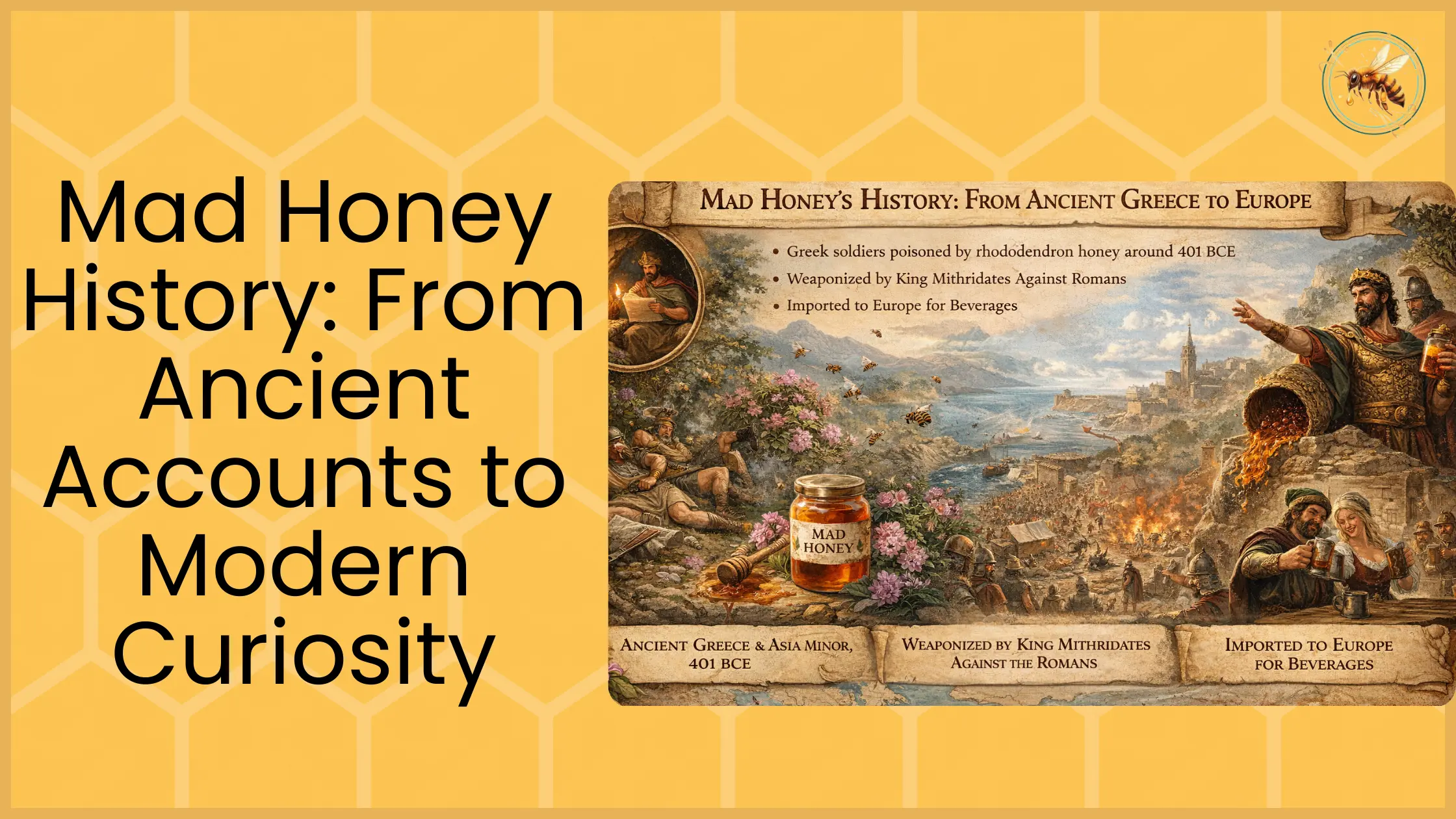
The famous account is associated with Xenophon, an ancient Greek author. In short: soldiers encountered honey in a region near the Black Sea, consumed it, and many became severely unwell, described in ways that modern readers often interpret as intoxication. The episode is cited because it looks like an early written description of what people now call “mad honey intoxication.”
The lasting importance of this story isn’t just “wow, ancient people got sick from honey.” It’s that it anchors the idea that:
- this wasn’t invented by social media, and
- the phenomenon is old enough to have appeared in historical record.
What people get wrong (modern interpretations vs what’s actually described)
Modern retellings often make two leaps:
Leap #1: “hallucinogenic honey”
Many articles imply that the soldiers experienced classic hallucinations or psychedelic-like visions. But historical descriptions are not always that specific, and modern “hallucination” language often reflects what readers expect rather than what the text clearly proves.
A more conservative interpretation is that the episode describes a severe intoxication-like event with strong physical symptoms and impaired functioning.
Leap #2: “used as a weapon”
Some versions frame it like an intentional honey trap strategy, armies “weaponizing” honey. While there are stories and interpretations that lean in this direction, history is rarely as clean as a meme.
It’s more accurate to say: there are accounts suggesting honey played a role in incapacitating troops, but turning it into a guaranteed battlefield tactic oversimplifies what we can prove from text alone.
Why it became the template for every “mad honey” article online
Because it’s perfect internet material:
- ancient source = instant credibility
- soldiers collapsing = vivid image
- “mad honey” phrase = click magnet
- easy to summarize in one paragraph
So it gets repeated, stripped of nuance, and used as a shortcut to imply that every jar sold today is part of that same story. The more responsible approach is to treat Xenophon as one early data point, a historical anchor, not a full explanation.
(If you publish a dedicated page for this story, link it here.)
- Internal link: /history/xenophon-mad-honey-story/ (if published)
Rhododendron Honey in the Black Sea Region (Turkey / “Deli Bal”)
If you want the most consistent regional thread connecting ancient references, local tradition, and modern case reports, it’s the Black Sea region. This is where “deli bal” (often translated as “mad honey”) is widely discussed, and where the tradition is not primarily a tourist story, it’s a known regional product with a known caution: dosage matters.
Why this region shows up repeatedly in historical + modern accounts
Part of the reason is ecological: the region’s flowering landscape includes rhododendron species associated with the classic “mad honey” discussion. Another part is cultural continuity: local naming and local stories persisted, meaning the product remained legible as a distinct category in the region.
Then modern medicine adds a final layer: when patients show up with certain symptom patterns after honey ingestion, case reports have historically often pointed back to this geographic context.
How local naming and folklore shaped the narrative
“Deli bal” is not a modern branding invention. It’s a cultural label that signals: this honey is not used the same way as everyday honey. That kind of naming matters because it trains local expectations: people treat it as something that requires restraint.
Online, however, folklore often gets flattened into “crazy honey that gets you high.” In reality, local tradition often contains a more practical message: it’s powerful in the sense that it can make you feel bad if you misuse it.
How it differs from the “Himalayan” framing
The Black Sea tradition is often discussed as a regional food phenomenon with a cautionary edge. The Himalayan/Nepal framing is often discussed through the lens of harvesting culture and dramatic visuals (cliffs, ropes, giant combs, “wild honey hunting”). Both are real in their own contexts, but they become different narratives online.
That difference matters because buyers often assume:
- “Himalayan” automatically means “the real original mad honey,” and
- Turkish deli bal is a separate thing.
In practice, they’re better understood as two major regional storylines in a broader category, each shaped by local ecology, naming, and global media.
Linking suggestion:
- Internal link: /culture/turkish-mad-honey/
- Internal link: /comparison/nepal-vs-turkish-mad-honey/
The Himalayan/Nepal Tradition (A Different Storyline)
The Nepal/Himalayan story is the one most modern audiences recognize visually. But it’s important not to force it into the Xenophon template. It deserves its own framing: harvesting culture + seasonal wild honey + global media attention.
Cliff harvesting and how tradition preserved the product
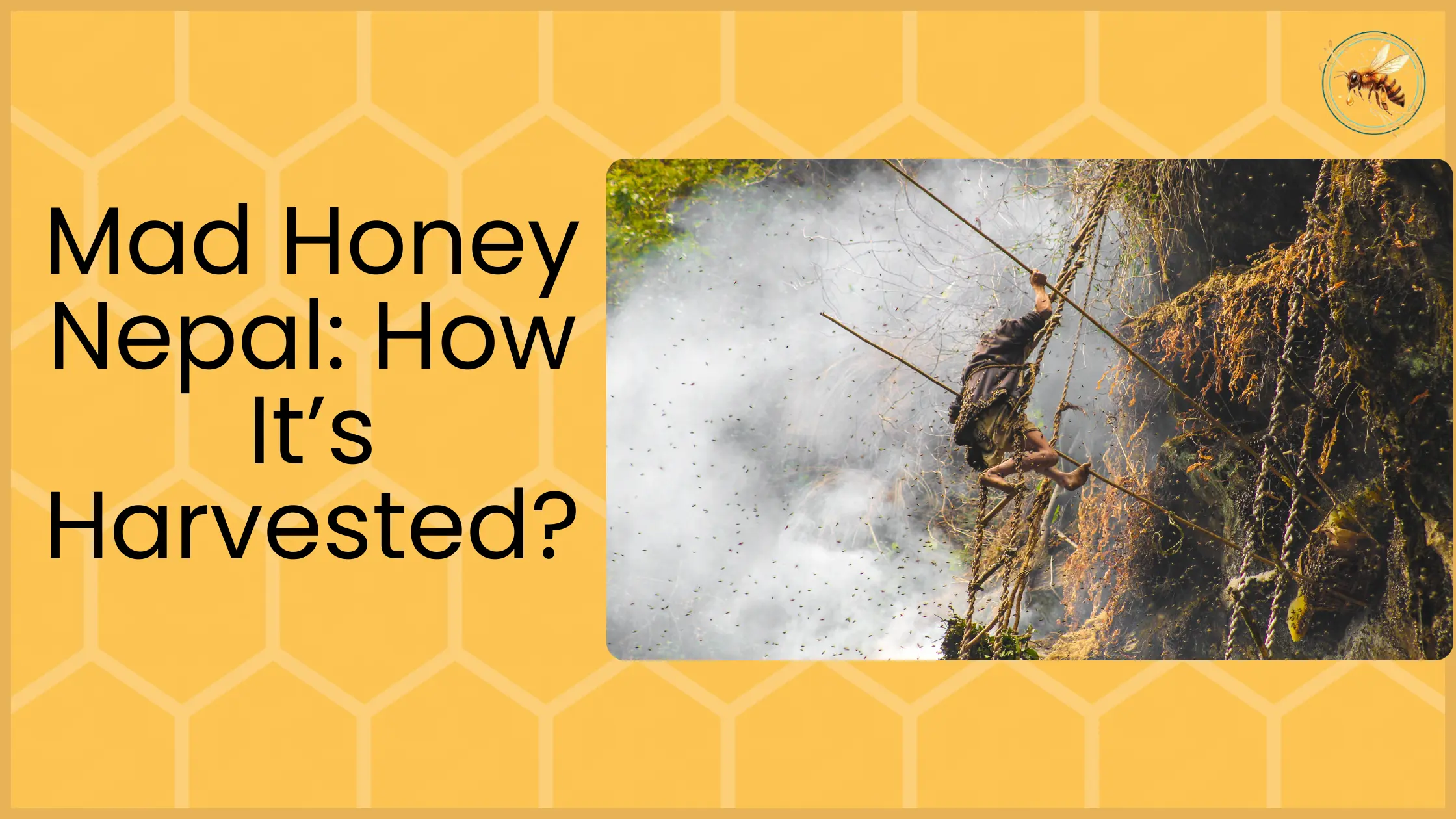
In Nepal, mad honey is often discussed alongside harvesting traditions, especially the dramatic cliff or steep-hillside harvesting imagery that outsiders associate with “honey hunting.” Whether the harvesting is done on cliffs or rugged terrain, the key point is that the practice is physically demanding, seasonal, and culturally rooted. It isn’t just a stunt for YouTube. It’s a livelihood and a tradition tied to specific landscapes and bloom cycles.
This is one reason Himalayan mad honey became a modern global label: the story is visually unforgettable, and visuals travel faster than nuance.
(If you have a culture/harvest page, link it here.)
- Internal link: /culture/how-mad-honey-is-harvested/
How “Himalayan mad honey” became a modern global label
“Himalayan” became the global shorthand because it bundles:
- origin mystique,
- “wild” authenticity, and
- a premium narrative.
Over time, “Himalayan” has also become a marketing adjective used by sellers far outside Nepal. That’s why this history matters for today’s buyer: if you don’t understand how the label became a global brand term, you’re more likely to be misled by it.
- Internal link: /culture/mad-honey-nepal/
What outsiders often miss about the culture
Outsiders often misunderstand two things:
First, they assume the tradition exists primarily to produce an extreme “drug honey.” In reality, local relationships with the product can be more pragmatic and context-driven, something used carefully, not casually.
Second, they assume the danger starts when someone tastes the honey. But in many harvesting stories, the risk starts before that: terrain, access, weather, and physical labor are hazards long before honey enters the picture. Internet framing often turns that into “crazy guys on cliffs,” which can disrespect the reality of the tradition.
Myth vs Reality! What History Can and Can’t Prove
History is not a lab report. It can show that people noticed patterns and wrote about them. It can show that certain regions developed names and cautionary folklore. But it cannot give you modern precision: exact doses, exact concentrations, exact compounds.
This is where most myth-making happens, when people use “ancient story” to claim certainty about modern products.
Common myths that appear in historical retellings
Myth: “It was used like a weapon.”
More accurate: there are narratives that suggest honey played a role in incapacitating people in conflict contexts, but the certainty and repeatability of “weaponized honey” is often overstated. It’s a compelling story, not a guarantee of intent or method.
Myth: “It causes true hallucinations.”
More accurate: historical accounts often describe impairment, weakness, collapse, or intoxication-like states. Modern writers frequently upgrade that into “hallucinations” because it sells. A conservative read is that severe physiological intoxication can look “mind-altering” without being a classic psychedelic state.
Myth: “It’s always red / always strong.”
More accurate: color and strength vary. Honey color can be influenced by floral sources and handling. “Strong” is dose-sensitive and batch-sensitive. History supports variability more than it supports uniform potency.
Why dose + batch variability matter in historical stories too
When ancient texts say “they ate honey and became unwell,” they rarely specify:
- how much honey,
- how concentrated that particular honey was,
- whether it was mixed with other foods,
- or whether the affected people had individual vulnerabilities.
So we should be careful about reading historical accounts as proof that all rhododendron honey is consistently “mad honey,” or that a particular modern region produces identical effects across time.
If you have a “why it varies” science page, this is the natural bridge:
- Internal link: /science/why-mad-honey-varies-by-batch/
What Modern Science Adds to the Historical Record (Without Overclaiming)
Modern science doesn’t “prove the legends,” but it can explain why certain patterns repeat across stories: honey from certain contexts can contain naturally occurring compounds that can produce dose-dependent physiological effects. That framework helps us interpret history more responsibly.
Grayanotoxins explained simply (why the body effects match historical accounts)
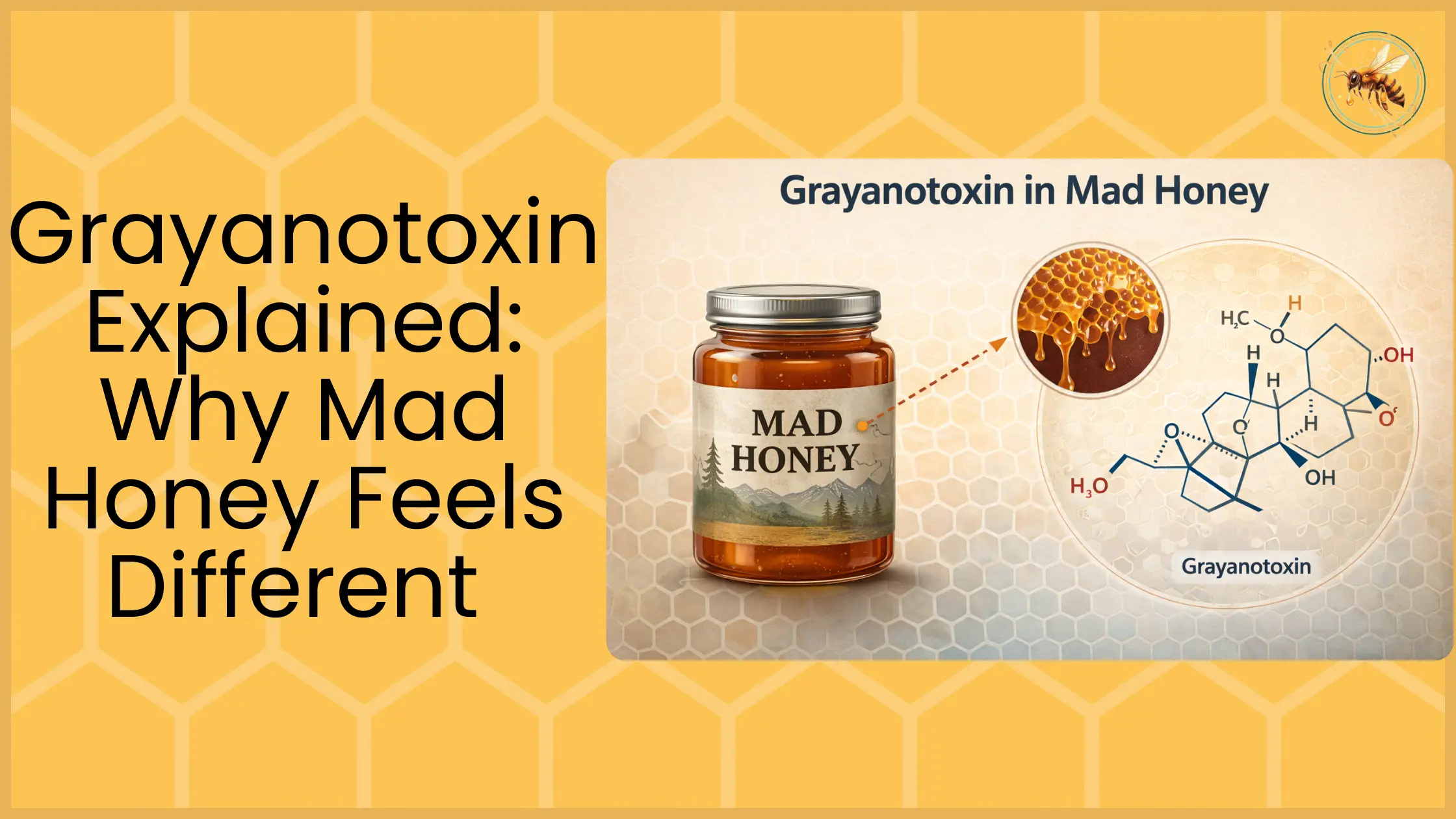
Modern discussions often focus on grayanotoxins because they offer a plausible mechanism for why some people report a body-forward, intoxication-like response at higher exposures. This helps explain why historical accounts often emphasize physical collapse or incapacitation rather than mystical visions.
If you want the mechanism explained cleanly, link:
- Internal link: /science/grayanotoxins-explained/
Why modern case reports resemble old stories (symptom pattern + timing)
Modern accounts often highlight a similar arc: people consume a honey, effects show up after a window of time, and higher intake correlates with worse symptoms. That doesn’t mean every historical story is literally the same thing, but it makes it easier to interpret “they became incapacitated” as a physiological intoxication event rather than a supernatural one.
The key safety takeaway history supports: more isn’t better
This is the simplest bridge between ancient and modern: across stories, the “mad” outcome tends to appear when intake is high, expectations are careless, or the honey is treated like ordinary honey.
That’s why your safety content should always be part of the history ecosystem:
- Internal link: /safety/mad-honey-poisoning-symptoms/
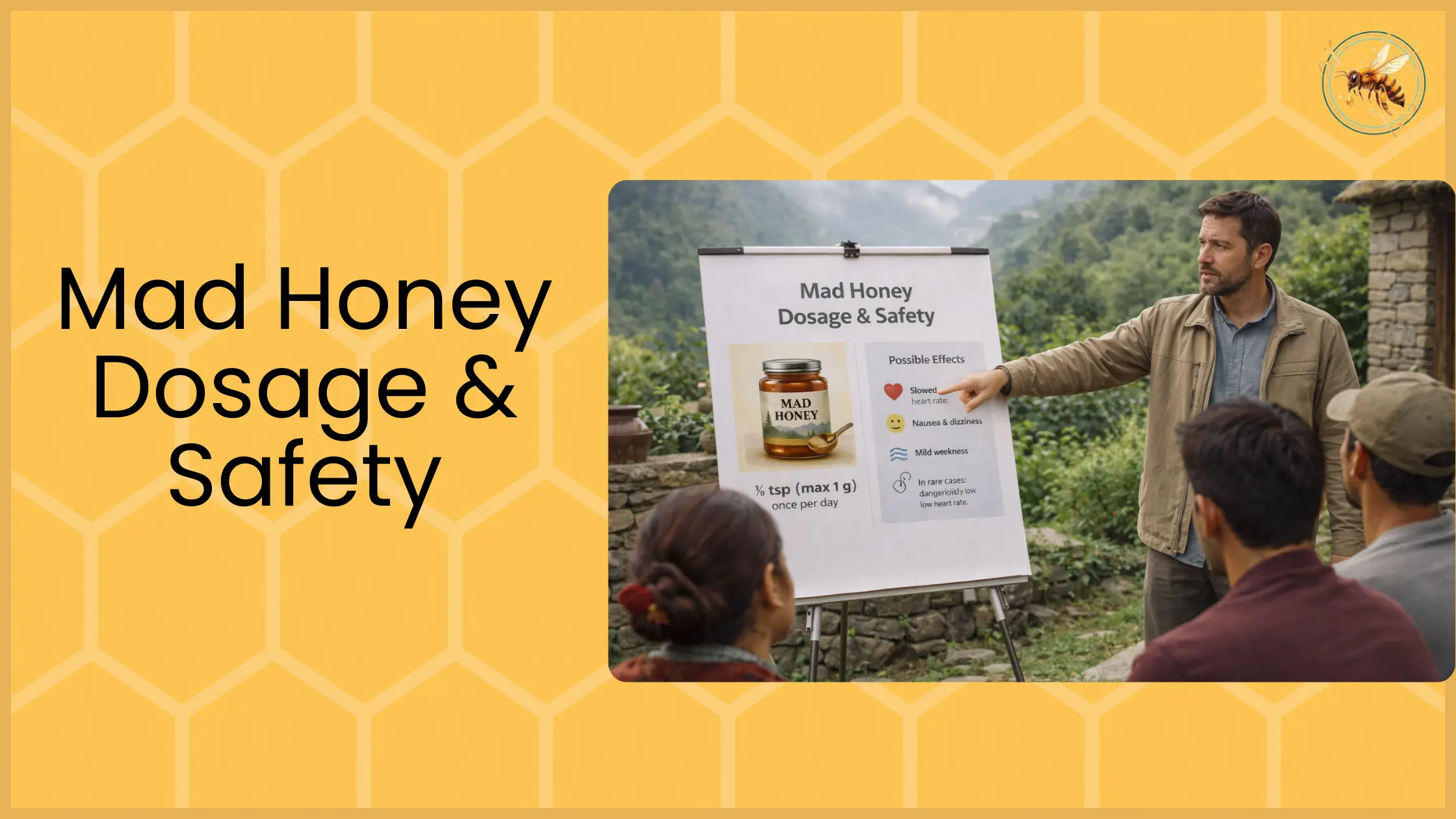
- Internal link: /safety/mad-honey-dosage/
Why Rhododendron Honey History Matters Today
A history page isn’t just trivia. In this niche, it has real buyer value because it filters out sensationalism.
Helps buyers avoid sensationalism and scams
When you understand that the story is bigger than one viral “psychedelic honey” narrative, you become harder to manipulate. Scammers rely on simplified myths: “ancient honey that gets you high.” History, told correctly, replaces that with nuance: region, variability, dose sensitivity, and responsible use.
Sets realistic expectations
History does not promise guaranteed effects. If anything, it supports the opposite: variability, unpredictability, and the idea that the same product can be mild in one context and severe in another. That expectation calibration is one of the strongest trust tools a site can offer.
Encourages responsible sourcing and safer consumer education
The safest market is the one where brands compete on transparency and education, not on “strongest honey” claims. History helps that because it shows how the “mad honey” label emerged as a cautionary idea in some regions, not just an adrenaline product.
This is where you send readers next:
- Internal link: /guides/how-to-tell-if-mad-honey-is-real/
- Internal link: /guides/where-to-buy-mad-honey/
Conclusion
Rhododendron honey history is best understood as a timeline of context, not a promise of a guaranteed modern experience.
- Ancient references (like Xenophon) show early recognition of honey-linked incapacitation events.
- Regional traditions (especially in the Black Sea) carried local naming and cautionary framing forward.
- The Himalayan/Nepal story became the modern global label through real tradition plus visual storytelling.
- Modern science helps explain the mechanism and reinforces the most practical takeaway: dose matters, batches vary, and “more isn’t better.”
FAQs on Rhododendron Honey History
Is rhododendron honey the same as mad honey?
Not always. “Rhododendron honey” can describe botanical influence, while “mad honey” usually refers to honey associated with noticeable effects (and higher misuse risk). Some rhododendron-influenced honeys may be mild; some may fit the “mad honey” pattern more strongly depending on species, season, and concentration.
Did ancient armies really use it as a weapon?
There are stories and interpretations that suggest honey played a role in conflict-related incapacitation, but certainty and intent are often overstated online. It’s better framed as: historical accounts exist where honey consumption is followed by incapacitation, and later retellings sometimes interpret that as intentional use.
Why does Turkey appear so often in the history?
Because the Black Sea region has a strong overlap of regional tradition (“deli bal”), recurring historical references, and modern case report attention. It’s one of the most consistently cited regional contexts for this topic.
How did Nepal become associated with “Himalayan mad honey”?
Through a combination of real tradition and modern media amplification. The visual story of harvesting culture traveled globally and became the modern shorthand for “authentic mad honey,” even though the broader historical record spans other regions too.
Does history prove it’s safe or effective?
No. History can show that it existed and that people noticed effects. It cannot give modern safety guarantees. Modern safety comes from responsible sourcing, realistic education, and conservative use.
Why do stories mention people “acting drunk” or collapsing?
Because severe physiological intoxication, especially when dose is too high, can look like drunkenness or incapacitation. That doesn’t automatically imply hallucinations or a psychedelic experience.