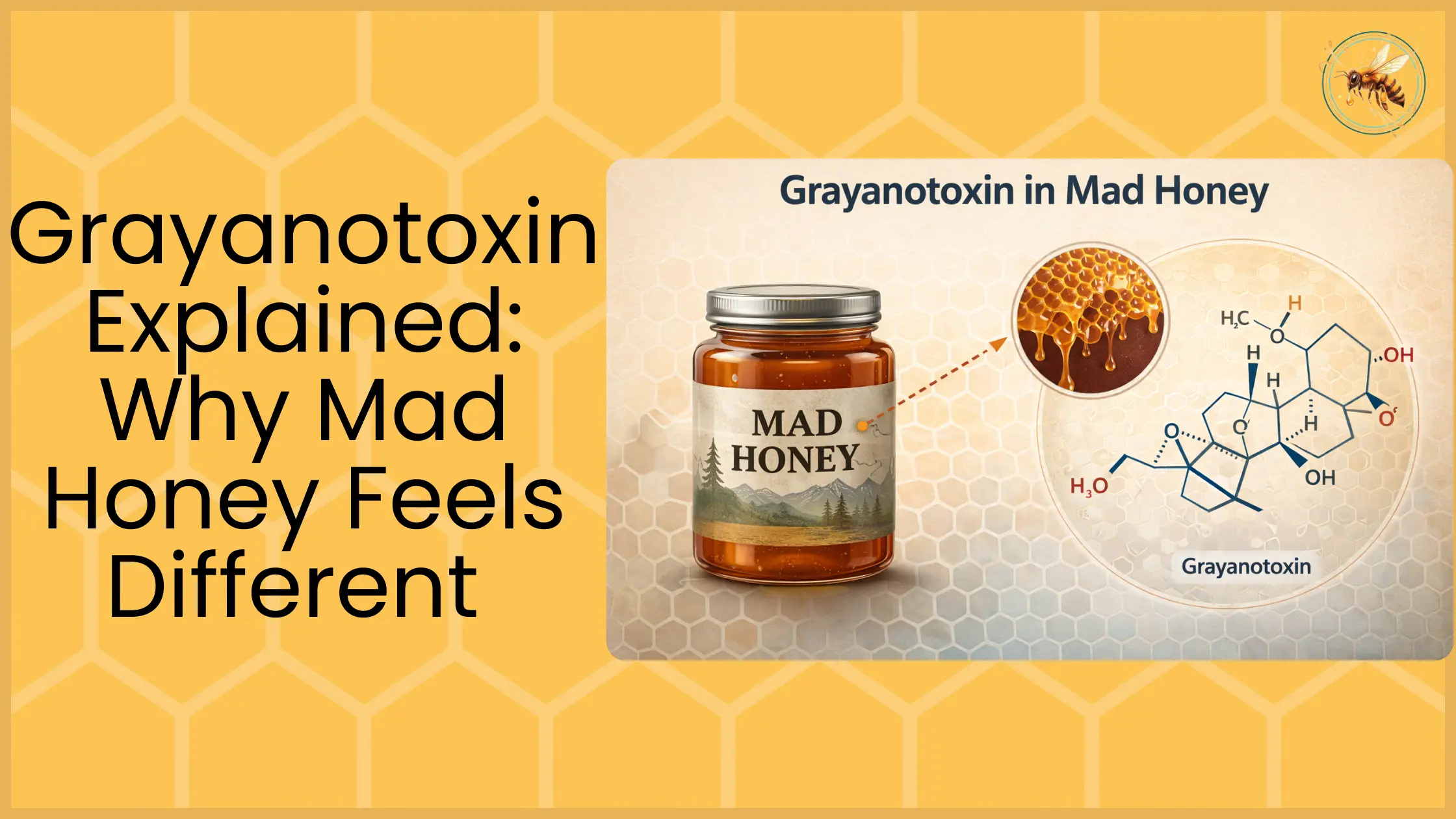
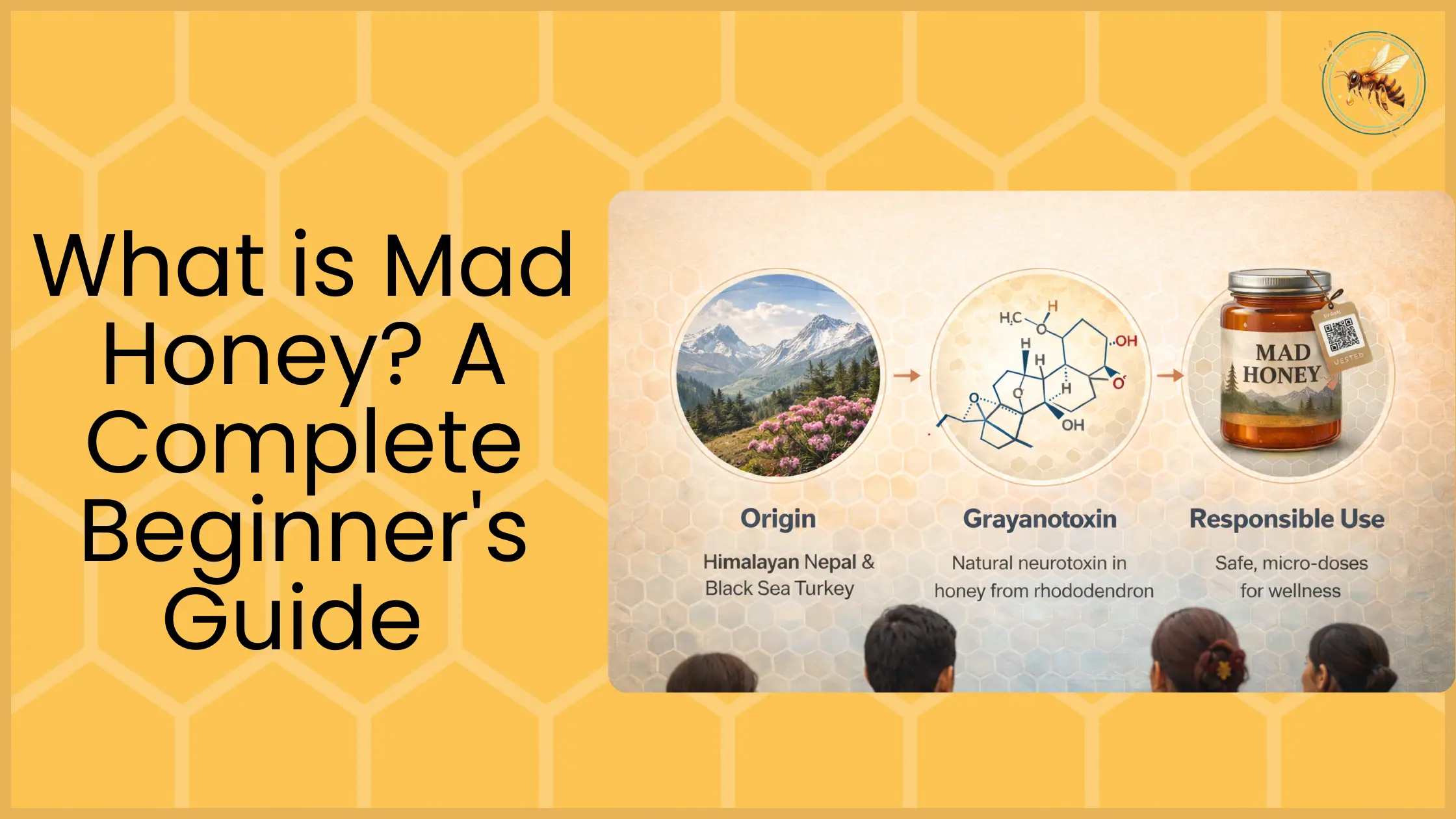
Mad honey is honey that contains grayanotoxins, naturally occurring toxins found in certain rhododendron plants. When bees gather nectar from these plants, the compounds can enter the honey.
It is best known for its association with Nepal’s Himalayan regions and Turkey’s Black Sea coast. Its traditional harvesting methods and unusual effects have made it a subject of curiosity, but understanding mad honey means looking beyond the stories.
Unlike ordinary honey, grayanotoxin-containing honey can affect heart rate, blood pressure, and the nervous system. Its composition varies, and its effects are not reliably predictable.
tl;dr
- Mad honey is produced when bees gather nectar from certain rhododendron plants, resulting in honey that contains naturally occurring grayanotoxins found primarily in parts of Nepal and Turkey.
- Unlike ordinary honey, it can dangerously affect blood pressure, heart rate, and the nervous system, potentially causing symptoms such as dizziness, confusion, vomiting, and a slow heartbeat.
- Grayanotoxin concentrations vary unpredictably between different jars and individuals, meaning that visual appearance, taste, or a small initial portion cannot serve as a reliable guarantee of safety.
- While it has a history of traditional use, there is a lack of reliable clinical evidence supporting claims that mad honey provides health benefits or safely treats medical conditions.
- Determining authenticity requires examining traceable sourcing records and detailed laboratory reports with specific batch identifiers rather than relying on unverified reviews or product descriptions.
How is Mad Honey made?
Bees make mad honey through the same basic process used to produce other honey. They collect nectar, bring it back to the nest, and process it into honey.
The difference comes from the nectar source.
Certain rhododendron species contain grayanotoxins. When their nectar contributes to honey production, these compounds can be present in the finished honey. The botanical sources and their contribution to a particular harvest influence its composition.
This is why “Himalayan honey,” “wild honey,” and “mad honey” are not interchangeable terms. A geographical label or harvesting method alone does not establish grayanotoxin content.
Why is it called “Mad” honey?
The name refers to the intoxicating and disorienting effects associated with its consumption.
Descriptions of unusual honey appear in historical accounts, including stories of people becoming ill after eating it. Today, the physiological effects are understood in terms of grayanotoxin exposure.
The name can sound playful, but the symptoms can be serious. Dizziness, confusion, fainting, and changes in heart rate are signs of toxicity rather than evidence of a desirable or harmless experience.
Where does Mad Honey come from?
Nepal
Nepalese mad honey is associated with Himalayan cliff harvesting and the giant Himalayan honeybee, Apis laboriosa.
Some Gurung communities have longstanding traditions of collecting honey from exposed cliff nests. Harvesting can involve rope ladders, specialised tools, and knowledge passed between generations.
The cultural significance of this practice is an important part of the story. However, not all Nepalese honey is mad honey, and cliff harvesting does not establish the composition of a particular jar.
Turkey
Turkey’s Black Sea region is another well-known source. Locally called deli bal, mad honey has a history of traditional use in the region.
Its floral sources and production methods can differ from those associated with Nepalese cliff honey. These differences do not justify assuming that one country’s honey is always stronger or safer than another’s, a point covered in more detail in our Nepal and Turkey comparison.
Origin provides context. Testing is needed to describe the composition of a specific sample.
What Does Mad Honey Look and Taste Like?
Mad honey is often described as amber, reddish-brown, or dark brown. Some descriptions mention an earthy, floral, or bitter taste.
These characteristics are not universal. Honey varies with its floral sources, water content, storage, and processing.
Colour and flavour also overlap with other types of honey. A dark appearance, bitter taste, or thick texture cannot prove that a product contains grayanotoxins. Tasting honey to check its “strength” is not a reliable safety or authenticity test.
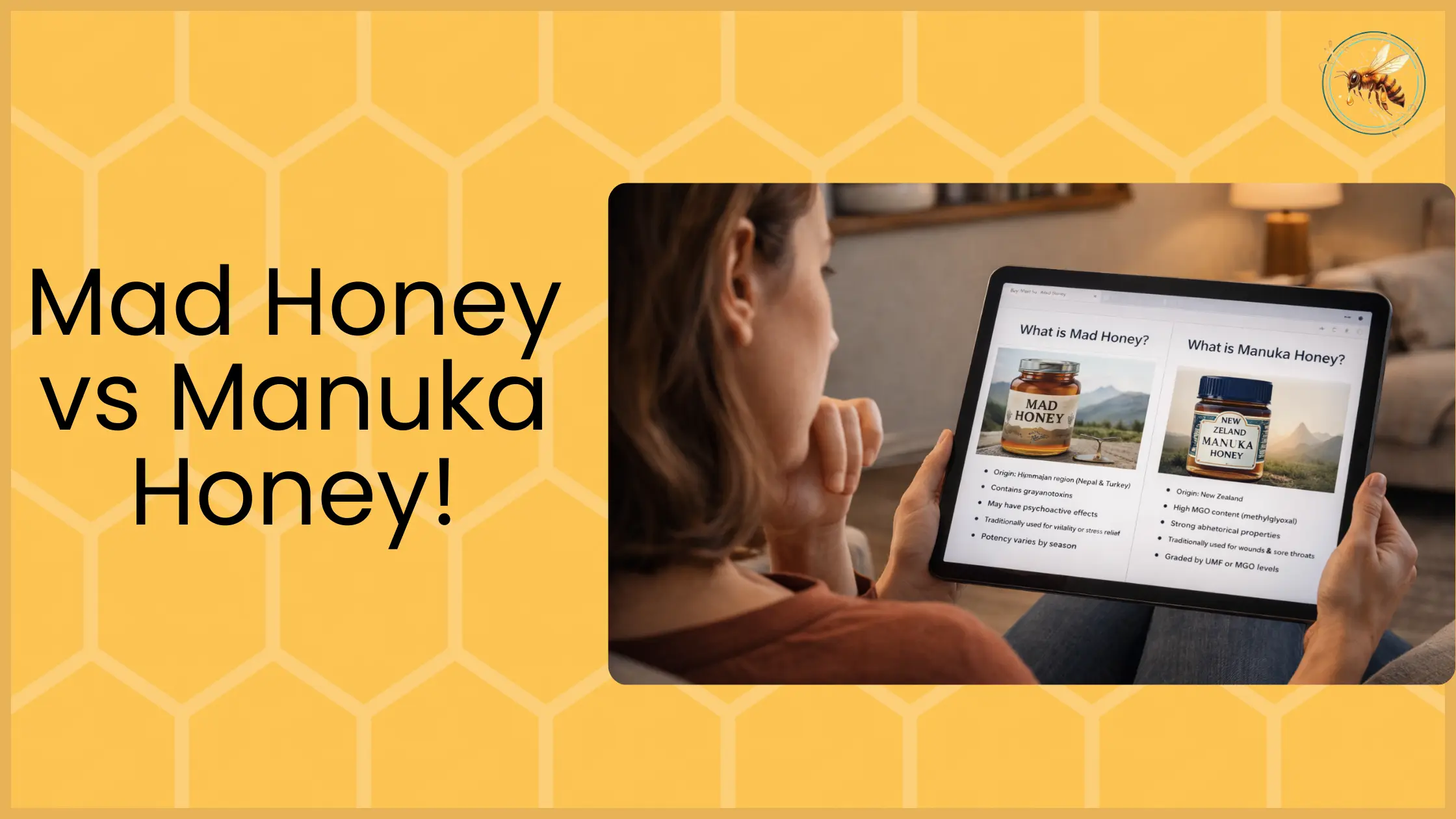
Mad Honey vs Regular Honey
| Feature | Mad honey | Regular honey |
| Defining characteristic | Contains grayanotoxins | Not characterized by grayanotoxin content |
| Botanical source | Associated with certain toxin-containing plants, particularly rhododendrons | Many different flowering plants |
| Appearance | Variable | Variable |
| Taste | Sometimes described as earthy or bitter | Depends on the floral source |
| Health considerations | Additional risk of grayanotoxin poisoning | Usual food considerations |
| Can appearance verify it? | No | Appearance alone also cannot establish purity or origin |
The important distinction is chemical composition, not how unusual the honey looks.
What causes Mad Honey’s effects?
Grayanotoxins affect voltage-gated sodium channels, which help nerves and muscles transmit electrical signals. Interference with these channels can affect the nervous and cardiovascular systems.
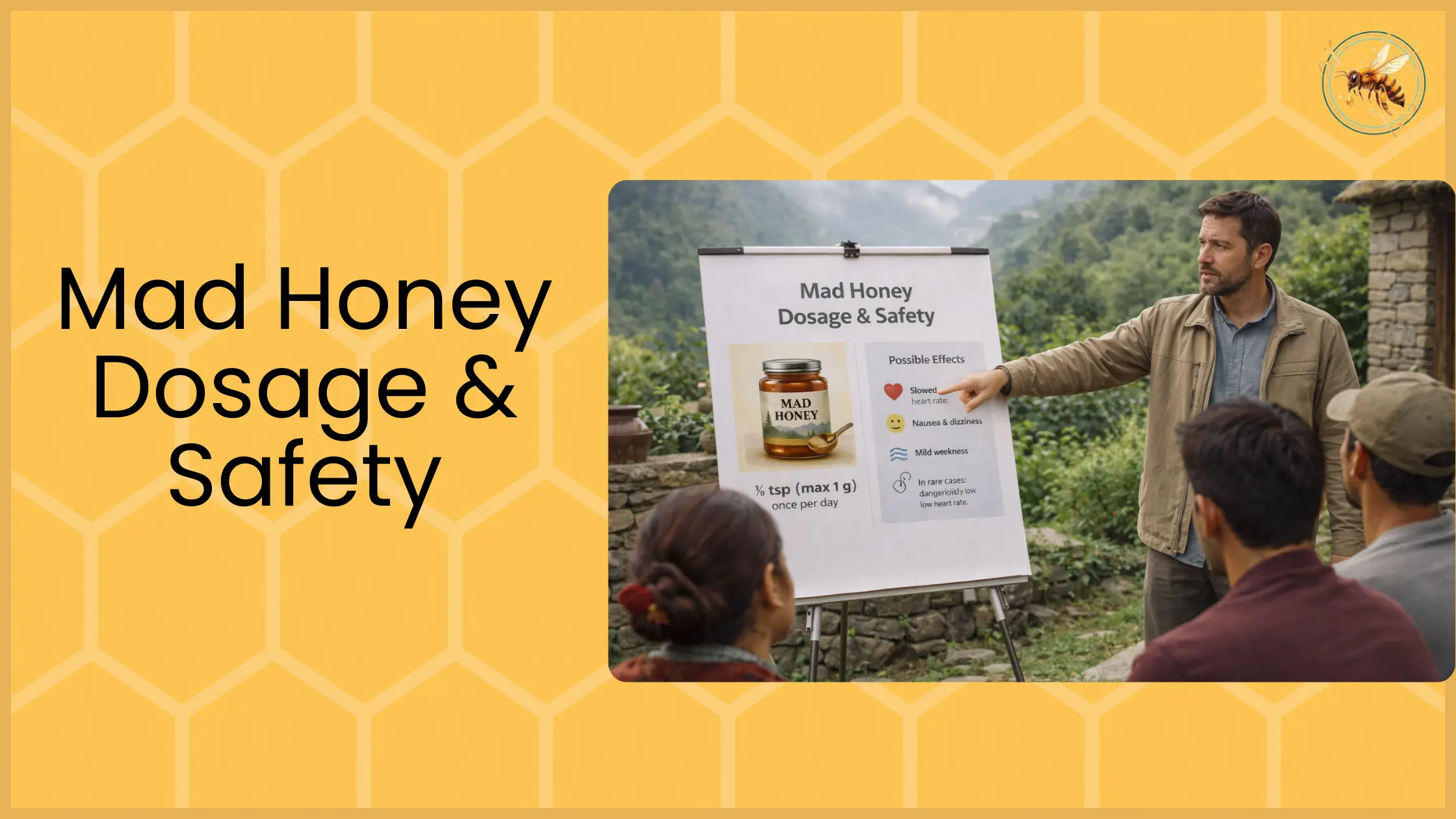
Documented symptoms of poisoning include:
- Dizziness and weakness.
- Nausea and vomiting.
- Sweating.
- Low blood pressure.
- A slow heartbeat.
- Fainting or confusion.
Severe cases can require hospital treatment, as described in the University of Utah Poison Control case files. A 2025 review of grayanotoxin toxicity and clinical management, led by researchers including authors affiliated with Tribhuvan University in Kathmandu, sets out the same mechanism and the supportive care used in hospital (Aryal et al., Journal of Applied Toxicology, 2025).
Does Mad Honey cause relaxation?
Some people describe warmth, relaxation, or an altered body sensation. These are personal reports, not dependable outcomes.
A feeling described as “relaxing” does not demonstrate that heart rate or blood pressure is unaffected. Consumer experiences should therefore be distinguished from evidence that a product is safe or beneficial.
Is Mad Honey hallucinogenic?
Mad honey is sometimes marketed as “psychedelic honey.” That description can create misleading expectations, and we set out the differences in our comparison with other so-called recreational products. It is also the first of the five things most people get wrong about mad honey.
Confusion and altered consciousness can occur during poisoning. These symptoms should not be interpreted as a predictable psychedelic experience or a reason to seek more potent honey.
Why can the effects vary?
The quantity of honey consumed is only one part of the exposure.
Differences Between Products
Grayanotoxin concentrations can differ between honeys. A spoonful from one jar may contain a different amount of toxin from the same-sized spoonful taken from another. This is batch variability, and it is the normal state of the product rather than a defect in a particular jar.
Differences Between People
Health conditions, medications, and individual susceptibility can influence the consequences of exposure. Our guide to who should not take mad honey covers the groups where the risk is highest.
Limited Product Information
Without relevant analysis, neither the buyer nor the seller can reliably infer toxin concentration from colour, taste, country of origin, or a description such as “premium.” One published analysis of Nepali mad honey samples found grayanotoxin I or III detected in roughly half of the samples tested, which is a measurement problem before it is an honesty problem (Ahn et al., Analytical Science and Technology, 2022).
These uncertainties make general serving advice unreliable as a guarante5e of safety. EFSA’s assessment identifies acute toxicity concerns and substantial limitations in the available exposure data.
Does Mad Honey have proven health benefits?
Mad honey has been used in traditional medicine. That history is worth understanding, but traditional use does not establish that a retail product safely and effectively treats a medical condition.
Claims about sleep, pain, sexual performance, or blood-pressure control require reliable clinical evidence. Research on ordinary honey or individual compounds cannot automatically support those claims for mad honey. Our summary of what the studies and case reports actually show sets out where the evidence stands, and our review of animal research explains why findings in rats are not statements about people.
Long-term safety is also uncertain. EFSA could not derive a reference point for long-term effects because chronic toxicity studies were lacking.
Mad honey should not be presented as a replacement for prescribed treatment.
What should you know about safety?
There is no universal safe spoonful
A spoon measures the amount of honey, not the amount of grayanotoxin.
Advice to begin with a small portion cannot guarantee safety and previous use without obvious symptoms also does not establish that another exposure will be safe. What repeated use does and does not do is covered in is mad honey addictive?
Health conditions and medicines matter
The cardiovascular effects make individual medical advice particularly important for people with heart conditions, low blood pressure, or medicines that affect heart rate and blood pressure.
Safety should not be assumed during pregnancy, breastfeeding, or for children.
Symptoms need medical attention
If someone becomes unwell after consuming mad honey, contact a poison centre or medical service promptly. Our page on poisoning symptoms and what to do sets out the steps.
Seek emergency help for fainting, chest pain, breathing difficulty, severe weakness, confusion, or a very slow heartbeat. Do not drive while symptomatic. Keep the jar and any batch information available for the medical team.
How can you evaluate authenticity?
Authenticity involves several different questions:
- Is the product genuinely honey?
- Does it come from the stated region?
- Does it contain grayanotoxins?
- Does the available documentation apply to the jar being sold?
One piece of evidence may not answer all four. Our guide to telling whether mad honey is real works through each question in order.
Sourcing records
A named region, harvest details, and traceable batch information are more useful than a broad “Himalayan” label.
Laboratory reports
A useful report identifies the laboratory, sample, testing date, substances measured, and results with units. Our guide to reading a mad honey lab report shows what each field means, and our explainer on how scientists test honey toxicity covers the methods behind the numbers.
Check whether the report relates to the current product. A report for an older or unidentified sample offers limited information about a different jar.
Testing also has a defined scope. A grayanotoxin measurement does not, by itself, verify geographical origin, rule out adulteration, or establish safety for every consumer.
Reading a seller, and reading reviews
Most people meet mad honey through a shop rather than a paper, so the practical question becomes which sellers to trust, and reviews are usually the first thing people reach for. Our guide to buying authentic mad honey covers the wider market.
Reviews are good evidence about some things and poor evidence about others. They reliably describe whether the parcel arrived, whether the packaging held up, whether the seller answered messages, and whether a refund request was handled decently.
They cannot describe grayanotoxin content, because no reviewer measured it. A five star review saying the honey was strong and a one star review saying nothing happened can both be true of the same seller and even the same product, if the batches differed. Read reviews for the transaction. Do not read them for the chemistry.
Two further limits are worth knowing. Ratings shown on a seller’s own site are curated by that seller, so they sit on a different evidential footing from listings on a platform the seller does not control. And a small review count, common across this whole category, means a handful of experiences can move an average considerably.
How we checked one seller
To show what the checklist above looks like in use, we ran it against a single Nepal based seller. We have left its name out: we picked one listing rather than compiling a ranking, because the method is the transferable part. The same four steps work on whatever tab you currently have open.
Here is exactly what we did, and what we did not do. We read the seller’s published claims about origin and testing. We opened the certificates rather than accepting that certificates exist. We checked whether the analytes we care about were the analytes actually measured.
Then we read the public review record on a platform the seller does not control. We did not buy, consume, or independently test any product, we did not contact the laboratory to confirm the documents, and we hold no sample from any batch. This is a documentation and public record check. It is not laboratory verification, and no desk review of this kind can tell you what is in a jar that ships next week.
What the documentation showed.
The listing names a specific harvest district rather than a country or a mountain range. It names spring and autumn harvests, and it identifies the bee and the rhododendron by species. When we first checked, its lab reports page carried downloadable certificates of analysis attributed to a named laboratory in Germany, described as working to ISO/IEC 17025:2018.
Grayanotoxin I and grayanotoxin III are both named as analytes, and results are attached to batch identifiers with analysis dates. That combination clears the failure mode described earlier, where “lab tested” appears with no analyte, no issuer, no batch, and no date, and it is not the norm in this category.
What we could not confirm
The analytical method is not stated on the page, so the published figures cannot be placed alongside literature values on a like for like basis, and most published values are generated by LC-MS/MS. At the time we checked, the certificates on display carried 2024 analysis dates, and a batch certificate only does its work if it corresponds to the batch in the parcel you receive. When we went back at the end of September 2026, the page no longer named the laboratory, and the certificates had become undated images on the seller’s own template, which is exactly why this check is worth repeating before each order rather than once.
None of this proves the documentation is wrong. These are questions we would put to any seller publishing certificates, this one included, and the answers are the reason to ask before ordering rather than after.
What the reviews showed
The seller’s own site displays an aggregate customer rating, which is a figure the seller controls, so we went to the records it does not. On its Google Business Profile, checked in September 2026, the listing stood at 4.5 out of 5 across 85 reviews, attached to a physical address in Kathmandu.
A business claims its own profile and can reply to reviews and flag them, but it cannot delete them, which is what makes the listing worth reading. The address is worth noting for a separate reason: it is checkable, and a seller with verifiable premises is a different proposition from a listing with no address at all, which is the common pattern in this category.
Google generates topic tags from the text of those reviews, and the tags on this listing are a useful illustration of why reviews are not evidence about the product. The most frequent were mad honey, sleep aid, fast support, and arthritis relief. Sleep aid and arthritis relief are descriptions of what a handful of buyers believed they experienced.
They are not findings. There is no controlled human trial evidence that mad honey treats arthritis, any sleep disorder, or any other condition, and the heavy calm reported at low exposure comes from the same vagal mechanism that produces hypotension and fainting at higher exposure.
A tag also flattens scale: each of those sat on a small number of reviews out of 85, so what looks like a pattern in the interface is a few people’s wording. Fast support is the tag to take seriously, because service is the thing reviewers are actually positioned to judge.
We cross-checked against a second independent record. The Trustpilot listing stood at 4.0 out of 5 across 25 reviews, with entries running from August 2025 to April 2026. The two records do not agree, and that is normal rather than suspicious: they collect from different populations, and a smaller sample moves further on a single bad experience.
The Trustpilot pattern is more informative than either average. Most reviewers describe the product as authentic and the service as responsive, citing texture, color, and packaging. The low ratings are not mild. One reports no perceptible effect and poor value. Another reports an adverse reaction, headache and anxiety persisting into a second day, together with dissatisfaction over how the refund request was handled.
What we take from it
That spread is not a verdict on one company. It is what an honest public record looks like for a grayanotoxin product: the same seller, the same listing, and outcomes at both ends.
It is the batch variability described earlier on this page showing up in customer experience instead of in a laboratory, which is precisely where it will show up when nobody measures the jar that shipped. Any seller in this category whose public reviews show no such spread is either very small, very new, or curating.
None of the above is a recommendation to buy from this seller or from any other. It is a worked example of a check you can run yourself in about ten minutes: read what the seller documents, open the documents, note what they do not say, then read the record the seller does not control, and treat a polarised record as informative rather than disqualifying.
Understanding Mad Honey beyond the stories
Mad honey connects flowering plants, bees, and longstanding harvesting traditions. Its unusual chemistry is what distinguishes it from ordinary honey, and what makes accurate information essential.
Understanding the difference between tradition, customer experience, and scientific evidence provides a clearer picture of what mad honey is. If you choose to investigate products further, use sourcing records, relevant documentation, and balanced feedback to assess the claims.
Frequently Asked Questions
Is all rhododendron honey mad honey?
The name of a floral source alone does not establish grayanotoxin content. Species, nectar contribution, and the particular honey matter.
Is all Nepalese honey mad honey?
No. Nepal produces different types of honey. Country of origin is not proof of composition.
Is stronger mad honey better quality?
Higher toxin concentration is not a general measure of quality. It should not be treated as a product advantage without considering the associated risks.
How long does mad honey take to affect someone?
Timing varies. An absence of immediate symptoms does not establish safety and should not be used as a reason to consume more. Our safety and side effects guide explains why the delay is the part people misread.
Can mad honey be taken every day?
Daily use is not an established safe routine. Uncertainty about long-term effects makes regular-use recommendations difficult to justify.
Does “natural” mean safe?
No. Grayanotoxins are naturally occurring toxins. Their botanical origin does not remove the risk of poisoning.