Mad honey is usually treated as honey/food in the Netherlands, not as a controlled drug. Most “legal” concerns come down to two practical areas:
- Import compliance (EU + Dutch rules for animal products/foods)
- Selling/marketing compliance (labeling and health/medical claims)
The Netherlands enforces EU food and import rules through Dutch authorities (especially the NVWA). If you’re buying for personal use, the main risks are border friction (especially when ordering from outside the EU) and misleading marketing (“psychedelic/trip/guaranteed high”). If you’re reselling, the risks are mostly about labeling accuracy and claims compliance.
tl;dr
- Mad honey is generally treated as a food, but importing honey from outside the EU can trigger official controls at an approved Border Control Post, and Dutch import rules for animal products apply.
- “Legal” has three layers in the Netherlands: possession, importing, and selling/marketing, and most real problems happen in importing + claims.
- Honey sold in the EU must meet the EU Honey Directive rules on composition/definitions and labeling/origin information.
- EU and Dutch regulators draw a hard line between health claims (strictly regulated) and medical claims (“treats/cures/prevents disease”), which are not allowed for foods.
- The lowest-risk approach is transparent sourcing, clean labeling, conservative guidance, and no hype claims, especially if ordering from abroad.
Quick Answer – Is it illegal like a controlled drug in the Netherlands?
In practice, no, mad honey is normally handled as honey/food, not as a controlled substance. The main compliance issues are not “drug illegality,” but import and marketing rules.
Can you import/order it online?
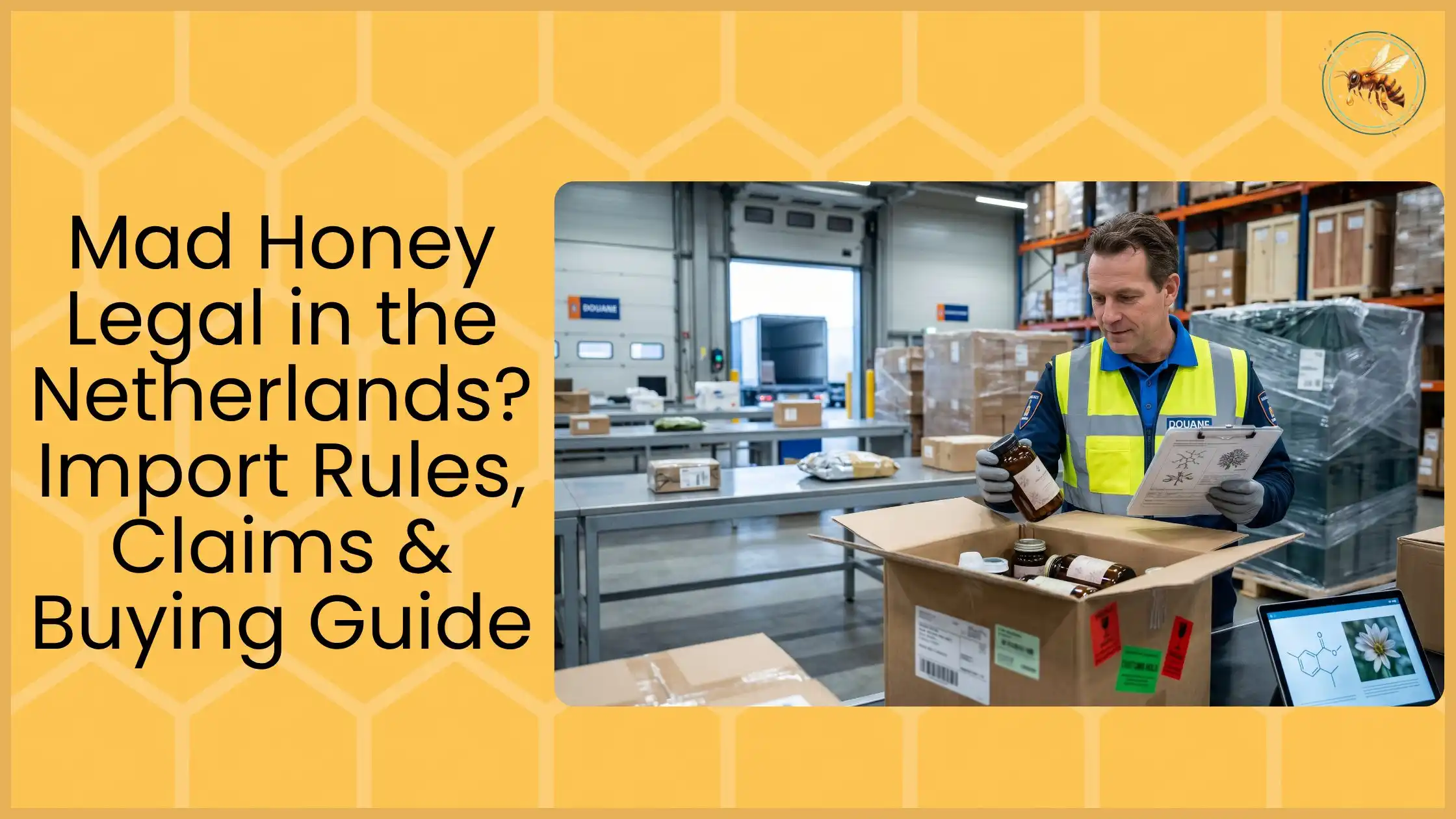
Yes, people order honey online, but if it’s coming from outside the EU, it can fall under EU import controls for products of animal origin. Dutch guidance on importing animals and animal products notes that imports into the EU must come through an approved Border Control Post, and you must check requirements via NVWA’s import systems.
Why you’ll see conflicting answers online (blogs vs customs reality)
Many blog posts treat “legal” as “will always clear customs.” In reality, clearance depends on where it ships from, how it’s declared, how it’s labeled, and whether it looks like personal use or commercial activity.
What “Legal” Means in the Netherlands (3 Layers)
Understanding these layers removes most confusion.
Possession (owning mad honey)
Possession is usually not the enforcement focus. The friction stories tend to be about import clearance or misleading marketing.
Importing (customs checks + EU animal product rules)
Honey is an animal product (apiculture product). If the honey is imported from outside the EU, it can fall under EU official controls and may need entry through a Border Control Post, depending on the shipment and category.
Travelers arriving from outside the EU can bring up to 2 kg of honey and similar animal products per person, and the Dutch government adds that honeycomb is not allowed. See the EU row of our honey customs table.
Dutch business guidance explains that animal products entering the EU must come via an approved Border Control Post and that NVWA tools help determine if importing is possible and what requirements apply.
Practical meaning for buyers:
- If you order from within the EU, the process is usually simpler (intra-EU trade rules).
- If you order from outside the EU, the shipment is more likely to face documentary/inspection steps.
Selling/marketing (claims, labeling, classification)
Selling (or reselling) makes you responsible for:
- correct labeling and product presentation
- compliant nutrition/health claims (if any)
- avoiding medical claims
- ensuring the product meets EU composition standards for “honey.”
EU rules on honey labeling and composition come from Directive 2001/110/EC (Honey Directive) and its updates.
Health and nutrition claims are controlled by EU rules (Regulation 1924/2006 and the EU register), and the NVWA provides Dutch guidance on using claims.
Also read: Is Mad Honey Legal in the UK?
Why Mad Honey Can Get Flagged (Even If It’s “Just Honey”)
Mad honey draws scrutiny for a few predictable reasons, most of them avoidable.
Sensational marketing (“psychedelic,” “trip,” “guaranteed high”)
This language pushes a food product into drug-like territory and increases platform risk, consumer protection concerns, and regulatory interest. It also tends to correlate with low-quality sellers and fake listings,so it’s a buyer red flag as well.
Food vs supplement/drug framing confusion
If a seller markets honey like a medicine (“treats anxiety,” “lowers blood pressure,” “cures insomnia”), that becomes a medical claim, which is not allowed for foods. Dutch government guidance on supplements explains that medical claims (prevent/treat/cure disease) are not allowed, and health claims are only allowed under strict conditions.
Safety incidents increase attention (dose matters)
Mad honey is dose-sensitive and can produce strong physiological effects at higher exposure. That’s why serious sellers provide conservative guidance and warnings rather than pushing “strongest” narratives.
Importing/Ordering Online in the Netherlands (Practical Reality)
Most border delays happen because shipments look unclear or non-compliant.
What customs/inspectors typically care about
- Clear product description and labeling: If it’s honey, it should be described as honey, with clear labeling. Vague declarations raise questions.
- Declared contents and documentation: For animal products, border control and documentation matter. EU consignments of honey and other apiculture products entering the EU can be inspected at approved Border Control Posts, and pre-notification/document submission timelines are often required for official processing.
- Quantity and intent (personal vs commercial): Large quantities, multiple jars, or repeated shipments can look commercial. Commercial-looking shipments often face more scrutiny.
What can reduce friction?
- a label that reads like a food label (not drug-like)
- origin clarity (country/region)
- batch/lot information
- conservative guidance (and no “guaranteed” claims)
Common reasons shipments get delayed/stopped
- vague descriptions (e.g., “herbal extract” or “psychedelic honey”)
- packaging or inserts that imply drug/medical effects
- missing origin information
- commercial quantities without proper importer readiness
Labeling & Claims (How to Stay on the Safe Side)
The Netherlands follows EU rules closely, and claims are one of the fastest ways to get into trouble.
Claims to avoid
Avoid any wording that implies disease treatment or cure. These are medical claims, not allowed for foods. The Dutch government guidance explicitly warns that medical claims are not allowed (prevent/treat/cure disease).
Also avoid:
- “guaranteed high/trip”
- “psychedelic honey”
- “works every time”
- anything that implies a predictable psychoactive result
Safer language
A compliant, consumer-friendly approach usually looks like:
- “honey,” “rare honey,” “traditional honey”
- “effects vary,” “start low,” “wait before taking more”
- clear warnings about who should avoid
Why “lab tested” should be specific
Vague “lab tested” stickers can become misleading. If testing is mentioned, it should be verifiable:
- batch/lot-linked COA
- lab name + report number
- what was tested (GTX levels and contaminants)
Safety Note for Netherlands Buyers (Short but Clear)
Dose sensitivity + batch variability
Mad honey can vary from batch to batch, and small increases can feel big. Conservative dosing is the safest approach.
Who should avoid (conservative)
Avoid or use extreme caution if you have:
- blood pressure or heart rhythm issues
- relevant medications affecting BP/HR
- pregnancy/breastfeeding (conservative avoidance)
Red flags that require medical help
- fainting or near-fainting
- chest pain/pressure
- trouble breathing
- persistent vomiting (can’t keep fluids down)
Buying Safely in the Netherlands (Authenticity + Scam Avoidance)
A lot of “legal” anxiety is really “fake product” anxiety.
What responsible sellers provide
- clear origin (country/region; not just “Himalayan”)
- batch/harvest information
- conservative guidance and warnings
- consistent packaging and traceable documentation
Red flags
- “strongest,” “guaranteed trip,” “instant high”
- vague origin and no harvest context
- no safety guidance anywhere
- “lab tested” with no report
- suspiciously cheap listings for a rare import product
EU honey labeling rules also emphasize origin information and product naming rules, another reason vague “mystery honey” listings are a bad sign.
📖 Also read: Is Mad Honey Legal? What “Legal” Actually Means
Conclusion
In the Netherlands, mad honey “legality” usually comes down to import compliance + truthful labeling + claims discipline, not criminal possession. Honey sold in the EU must comply with the EU Honey Directive’s definition and labeling/origin rules.
For imports of animal products from outside the EU, Dutch guidance points to Border Control Posts and NVWA import systems for requirements.
For claims, EU rules and NVWA guidance make clear that you can’t market foods with medical claims, and health claims must be authorized and correctly used.
The lowest-risk approach stays the same:
- buy from transparent sellers
- avoid hype and drug-like claims
- prefer batch info and verifiable testing
- follow conservative safety guidance
FAQs – Mad Honey Legal in the Netherlands
Is mad honey banned in the Netherlands?
Mad honey is generally treated as honey/food. The practical issues are import compliance and marketing/claims, not a blanket “ban.”
Can I order mad honey online in the Netherlands?
Yes, but shipments from outside the EU can face additional import controls for animal products and may need entry through an approved Border Control Post, depending on the case.
Can customs stop it?
Shipments can be delayed or refused if they’re poorly declared, mislabeled, look commercial without proper compliance, or use drug/medical-style language.
Is it legal to resell?
Reselling triggers responsibilities: honey must meet EU labeling/composition rules, and claims must comply with EU claim rules.
Is it legal to advertise effects?
Health claims are tightly regulated, and medical claims are not allowed for foods. NVWA guidance emphasizes EU rules for nutrition and health claims.
Is Turkish “deli bal” treated differently?
It’s still honey as a product type; what matters is origin clarity, compliance, and how it’s marketed/labeled.
Is mad honey safe for beginners?
Safety depends on dose, batch variability, and risk factors. Beginners should follow conservative dosing guidance and avoid sellers pushing “strongest” marketing.