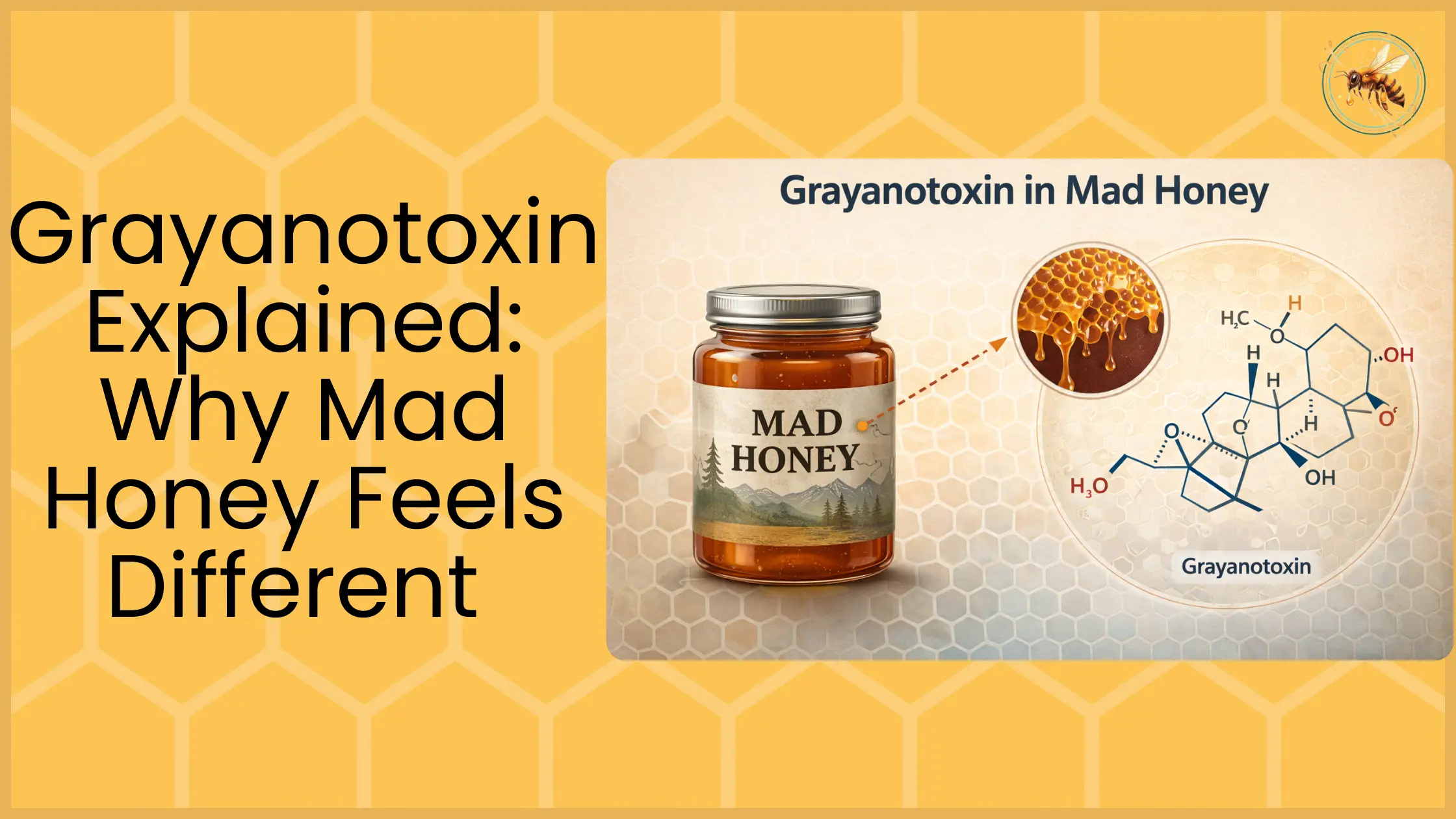
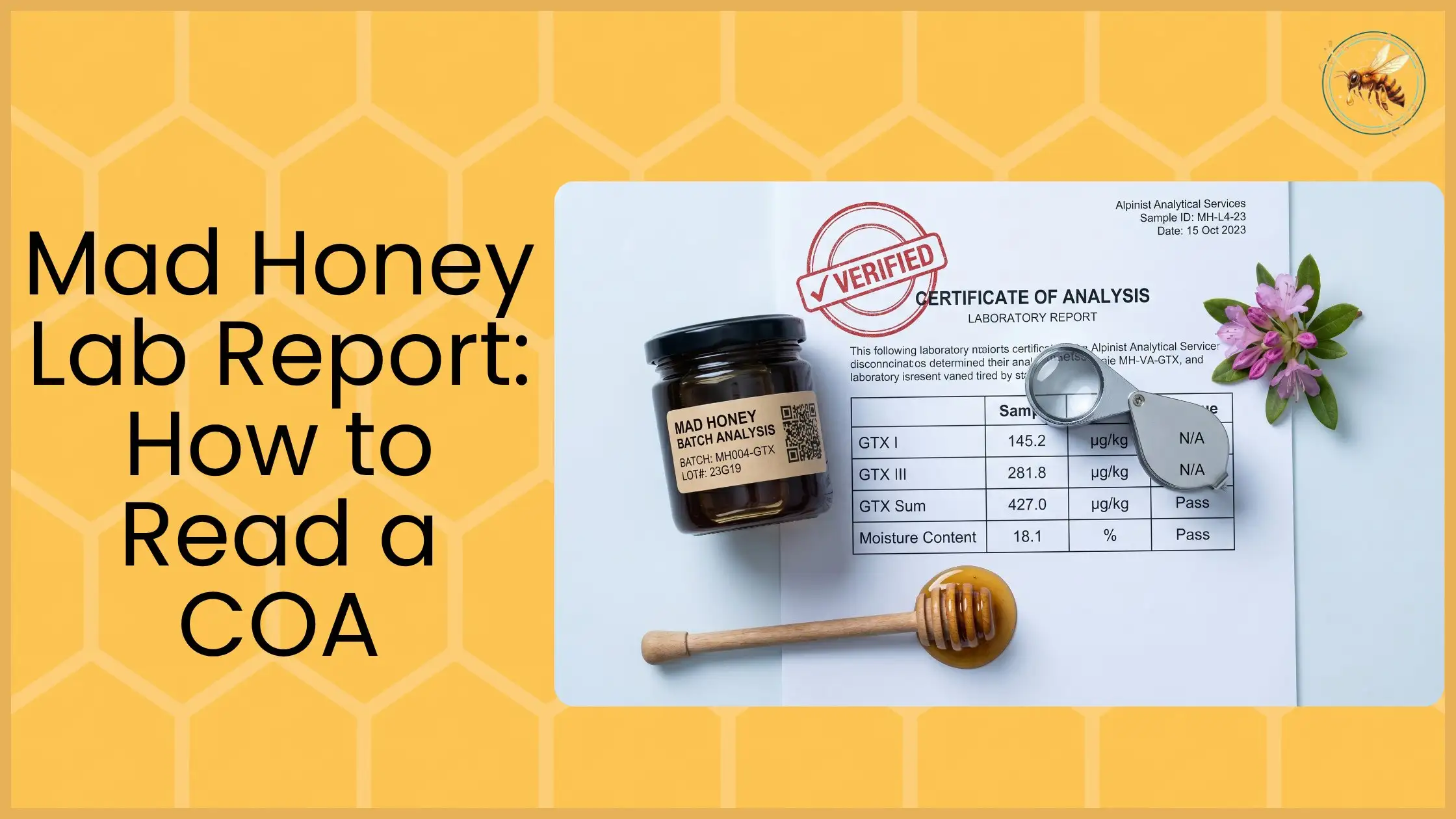
A “lab tested” label doesn’t mean much unless you can see a real, batch-matched report and understand what it says. With mad honey, this matters even more because the category is dose-sensitive and batch-variable, so you want proof of what’s in that jar, not a generic claim.
This guide explains what a strong mad honey lab report (COA) includes, how to read the grayanotoxin (GTX) section, what other safety panels should be tested (pesticides, heavy metals), how to spot fake or recycled documents, and how to verify a COA before you buy.
tl;dr
- A real mad honey COA is batch-specific and includes a sample/batch identifier you can match to the jar.
- The most important mad honey number is the measured grayanotoxin level (often GTX I and GTX III), shown with units and ideally with LOQ/LOD.
- “Higher GTX” isn’t a quality trophy; it usually means higher risk and less room for dosing mistakes.
- A strong safety COA also includes contaminant testing (at least for pesticides and heavy metals), not only for GTX.
- The easiest way to spot fake “lab tested” is missing basics: no batch ID, no lab name, no report number, no method, no units, and no PDF you can verify.
Quick Answer – What a “Good” Mad Honey Lab Report Includes
A strong report has these six must-have fields (if one is missing, treat it as a red flag):
- Product + sample/batch identifier: Batch/lot number, sample ID, and a jar label that matches it.
- Collection/production date range (or harvest/batch date): Enough timing detail to show the report is relevant and not recycled.
- Lab name + lab reference number: A report number you can quote and a lab you can look up.
- GTX I + GTX III quantification (and total, if provided): Measured values with units (often µg/kg or ppb).
- Contaminant panel (at minimum pesticides + heavy metals): The safety basics many sellers skip.
- A link/QR to the original report (PDF): Something verifiable, not a cropped screenshot.
The three biggest red flags
- “Lab tested” but no PDF, no report number, no lab contact
- A COA with no batch/lot ID (can’t match to the jar you’re buying)
- GTX shown as “pass/fail” or “safe” with no numbers and no units
COA vs Lab Report vs “Lab Tested” (Definitions)
A lot of confusion comes from people using these interchangeably.
COA (Certificate of Analysis)
A COA is usually a summary of results for a specific sample. It should still contain identifiers (batch/lot/sample ID) and the key numbers, but it may not include every method detail.
Full lab report
A full report often includes:
- methods and instruments (example: LC-MS/MS)
- sample preparation notes
- calibration, quality controls, and sometimes uncertainty or acceptance criteria
- a structured format that looks like a real lab document, not a marketing flyer
“Lab tested” claim
“Lab tested” without a batch-matched report is marketing language. It only becomes meaningful when it points to a specific document you can verify.
Section-by-Section: How to Read a Mad Honey COA
Most COAs look intimidating because they’re formatted for labs, not consumers. The trick is knowing where to look first.
1) Header and Identity (Traceability)
Start at the top. You want to answer one question:
Is this report clearly about the jar I’m holding (or about the batch I’m about to buy)?
Look for:
- Product name and sometimes product form
- Sample name and sample number
- Batch/lot number
- Client name (the brand or exporter)
- Lab report number
- Date received and date reported
- Matrix (it should say, honey)
✅ Good sign: the jar label shows a lot/batch number that matches the COA.
❌ Bad sign: no batch/lot field anywhere.
2) The Core Result: Grayanotoxins (GTX)
This is the part most people care about, and also the part most people misunderstand.
What you might see listed
Mad honey reports commonly quantify:
- GTX I
- GTX III
- sometimes GTX II or additional GTX compounds, depending on the lab panel
- sometimes a total (“GTX sum”)
Units: what they mean and why they matter
You can’t interpret a number without units. Common units include:
- µg/kg (micrograms per kilogram)
- ppb (parts per billion), often equivalent to µg/kg in food contexts
- less commonly mg/kg (milligrams per kilogram)
A report that lists GTX without units is not usable.
Why “higher” isn’t automatically “better”
Higher GTX generally means:
- stronger physiological effect potential
- lower margin for error
- higher chance of dizziness/nausea and cardiovascular symptoms if someone overdoes it
So a “high GTX” jar is not a quality badge. It’s closer to a risk marker.
3) Batch Comparison: Why Numbers Vary (and why that’s normal)
Two different COAs from the same brand can show different GTX values for legitimate reasons:
- different harvest windows
- different regions or plant mix
- different blending choices
- different handling and storage factors
That’s why batch ID matters. A COA is only meaningful if you can link it to the exact product lot you’re buying.
A good seller will say something like: “This batch tests at X; other batches may differ, so start low and don’t re-dose fast.” That’s a trust signal because it reflects how the category works.
What GTX Numbers Mean in Real Life (Without Becoming a “How To” Guide)
The goal here isn’t to help people chase intensity. It’s to help people understand risk. For how these numbers translate to risk, see the grayanotoxin rat studies.
Dose sensitivity and the “steep line”
Mad honey is dose-sensitive. The experience often doesn’t scale smoothly:
- a small amount might feel subtle
- a bit more can feel “much stronger”
- too much can shift into nausea, dizziness, weakness, and “my heart feels slow” territory
That’s why a COA matters: it gives you a better picture of where a batch sits on the risk spectrum.
Why “GTX categories” exist (and how they get misused)
Some sellers group batches into “low/medium/high” categories. That can be useful if it’s based on real measurements. It becomes misleading when:
- Categories are used without showing actual numbers
- “high” is marketed as superior rather than riskier
- The category isn’t tied to the batch you’re buying
The safest interpretation
Treat GTX results like this:
- A measurement reduces uncertainty.
- A higher number increases the need for conservative dosing behaviour.
- No number means you’re trusting marketing.
Contaminants: What Else Should a Mad Honey COA Test For?
A COA that only shows GTX answers one question (“how bioactive might this be?”) but ignores another big one: general food safety. A strong safety approach includes testing for contaminants that matter in real-world supply chains.
Pesticides (multi-residue panels)
Look for:
- “multi-residue pesticide screen”
- methods commonly listed as GC-MS/MS and LC-MS/MS (or similar)
- a list of analytes tested and whether each is ND (not detected) or quantified
What matters:
- Which residues were tested
- LOQ/LOD (limits of quantification/detection)
- whether the results are per batch
A single “pesticide-free” line without a panel is not informative.
Heavy metals (ICP-MS panels)
Look for:
- lead (Pb)
- arsenic (As)
- cadmium (Cd)
- mercury (Hg)
Common method: ICP-MS (Inductively Coupled Plasma Mass Spectrometry)
A good report shows:
- the metal name
- result value (even if ND)
- units
- LOQ/LOD
Honey quality markers (optional but trust-building)
These don’t replace safety testing, but they build confidence that the product is real honey and handled properly:
- HMF (heat/storage marker)
- diastase activity (enzyme activity; can drop with overheating)
- moisture content
- basic purity/adulteration screens
Authenticity/adulteration screening (advanced)
For higher-trust brands, you might see:
- pollen analysis (botanical and geographic signals)
- NMR or other fingerprinting methods are used in honey authenticity
- IRMS (isotope ratio testing) is used in some food authenticity contexts
- targeted sugar adulteration screening
You don’t need every advanced test for every purchase, but if a brand claims “authentic single origin,” these tests support that claim better than vibes.
How to Verify a COA Is Real (Buyer Verification Steps)
A COA should be verifiable in minutes.
Step 1: Match batch/lot on the jar to the COA
The label should have a batch/lot ID (or harvest code) that appears on the report. If the seller can’t provide batch matching, treat the COA as generic marketing.
Step 2: Check lab name + report number
Look up the lab (basic credibility check). A report number should exist and look consistent with lab formatting.
Step 3: Verify the link/QR goes to the original PDF
✅Best-case: a lab-hosted portal or a direct PDF that looks like a lab document.
❌Caution: A Google Drive screenshot folder is easier to edit.
Step 4: Scan for editing signs and missing fundamentals
Red flags include:
- cropped screenshots with missing headers/footers
- no signatures or authorisation fields where the lab normally includes them
- inconsistent fonts/spacing
- no method/instrument information anywhere
- missing sample matrix (should clearly be honey)
Common COA Mistakes (and What They Usually Mean)
“Pass/Fail” with no limits stated
If the report says “pass” but doesn’t say pass against what standard, it’s not useful for decision-making.
No units
A GTX number without units is meaningless. It may indicate a fake, a sloppy summary, or a seller who doesn’t understand the report.
Old COA reused for new batches
A COA dated far earlier than the batch you’re buying is a common misuse. Batch dates and report dates should make sense together.
Only GTX shown, no contaminant panel
Not always a scam, but it’s incomplete. GTX is only one part of safety; pesticides and heavy metals matter too.
Extra Trust Signals (Optional but Strong)
These aren’t mandatory, but when you see them, they usually correlate with a serious operator.
1) Batch-to-batch reporting history
A brand that publishes multiple COAs over time shows they’re not hiding variability. It also lets buyers see realistic ranges.
2) Conservative safety guidance aligned with the report
If a batch tests higher, the brand should lean more conservative in messaging (start low, wait, who should avoid). “Stronger = better” messaging is the opposite of responsible.
3) Clear chain-of-custody story
Not a novel, just a credible flow: source region → harvest → handling → testing → jar labelling.
Conclusion
A real mad honey COA isn’t marketing. It’s traceability + batch identity + measurable GTX values + contaminant safety testing, with a report you can verify.
The safest buying standard looks like this:
- the jar has a batch ID
- the COA matches that batch
- GTX is quantified with units
- contaminants are tested (at least pesticides + heavy metals)
- the original PDF is verifiable
That combination reduces uncertainty and helps you avoid two common problems at once: fake listings and unpredictable first experiences.
FAQs – Mad Honey Lab Report
What should a mad honey lab report include?
Batch ID, lab name and report number, GTX I/III with units, dates, and ideally contaminant testing plus a verifiable PDF link.
Are higher GTX numbers “better”?
Not as a quality metric. Higher GTX generally increases risk and reduces the margin for dosing mistakes.
Can a COA prove authenticity?
It helps, but it’s not absolute. A COA supports authenticity when it is batch-matched, verifiable, and paired with traceable origin and consistent labelling. Advanced authenticity screens (pollen/NMR/isotopes) strengthen the case.
Why do batches vary so much?
Botanical source, season, region, and blending/handling all affect composition. That’s why batch IDs and batch-specific testing matter.
What tests matter most for safety?
GTX quantification (for bioactive risk) plus pesticides and heavy metals (for general food safety). Quality markers like HMF/moisture are useful secondary indicators.
How do I verify a COA isn’t fake?
Match batch IDs, verify lab identity and report number, confirm the PDF link/QR, and watch for missing fundamentals (units, method, dates, matrix).