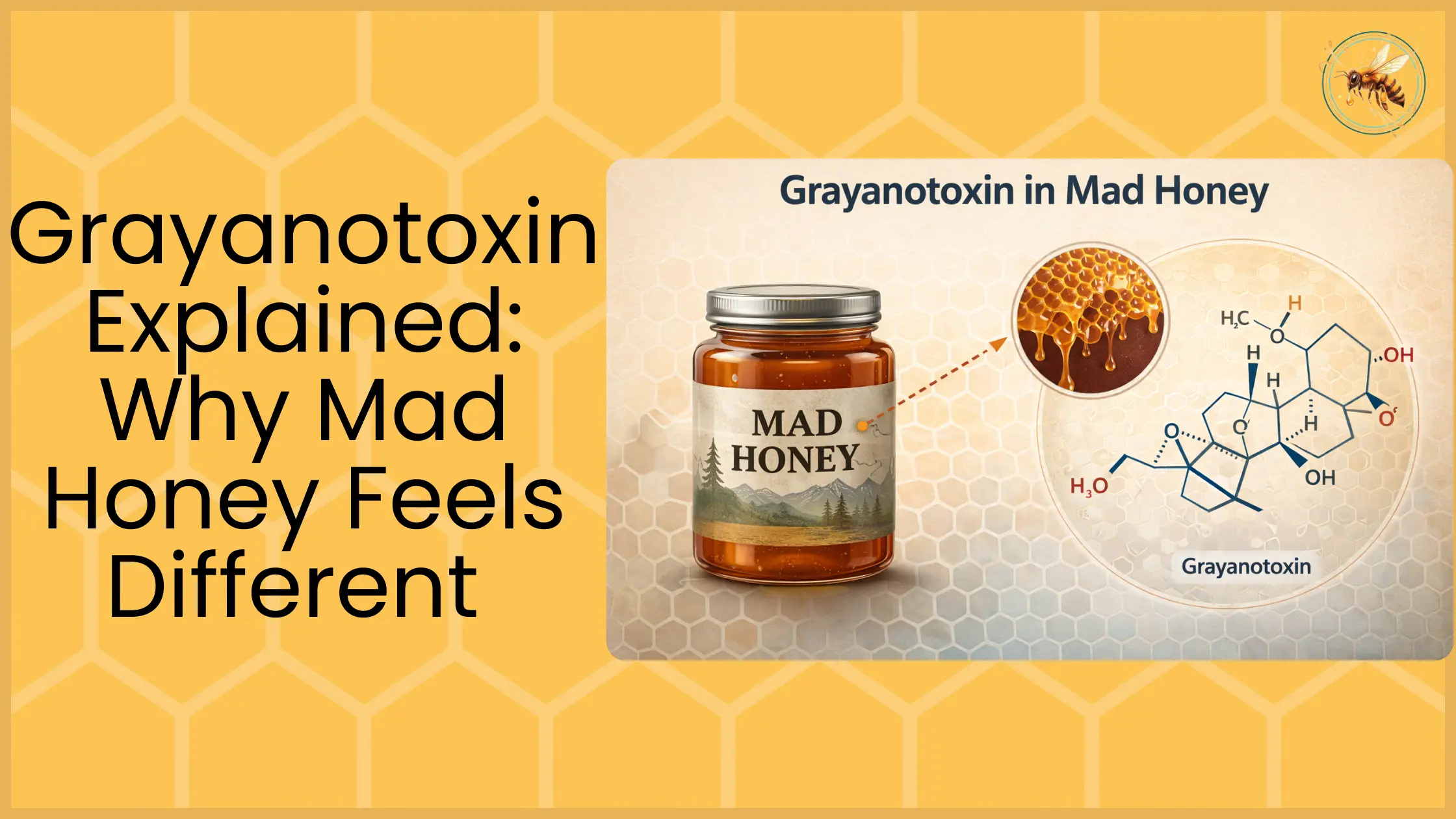
Grayanotoxins are the compounds behind what most people call “mad honey.” They’re not a mystery ingredient, and they’re not a psychedelic. They’re naturally occurring chemicals produced by certain Rhododendron species that interact with how nerve and muscle cells fire, producing a very specific, dose-dependent pattern of effects.
Online, the framing is often dramatic: “hallucinogenic honey,” “legal high,” “ancient weapon.” In clinical toxicology, the framing is more precise: bradycardia (slowed heart rate), hypotension (lowered blood pressure), dizziness, nausea, and weakness, a recognizable poisoning profile that’s been documented in case reports across multiple countries and has a consistent, predictable structure.
Most people land on this page for one of two reasons: they want to understand the mechanism before they make a decision, or they’ve already consumed mad honey, and they’re trying to figure out whether what they’re feeling is normal. Both are legitimate questions. This page addresses both, with the safety layer front and center.
tl;dr
- Grayanotoxins bind to voltage-gated sodium channels and prevent them from closing normally; that one mechanism drives every effect downstream, from heart rate to nausea to dizziness.
- The most clinically significant effects are cardiovascular: slowed heart rate + lowered blood pressure, and the lightheadedness or fainting that follows when those combine.
- At low exposure, many people feel only a mild body shift (calm, heaviness, tingling); at higher exposure, the same mechanism produces a recognizable intoxication pattern: nausea, disorientation, weakness, and near-fainting.
- The dose-response is steep. A small increase from a potent batch can shift the experience dramatically, and there’s no reliable “safe spoon” across batches because potency varies by season, region, and even position in the jar.
- Red flags, fainting, chest pain, breathing difficulty, and persistent vomiting are not part of the expected experience. They require medical attention.
Quick Answer – What Are Grayanotoxin Effects?
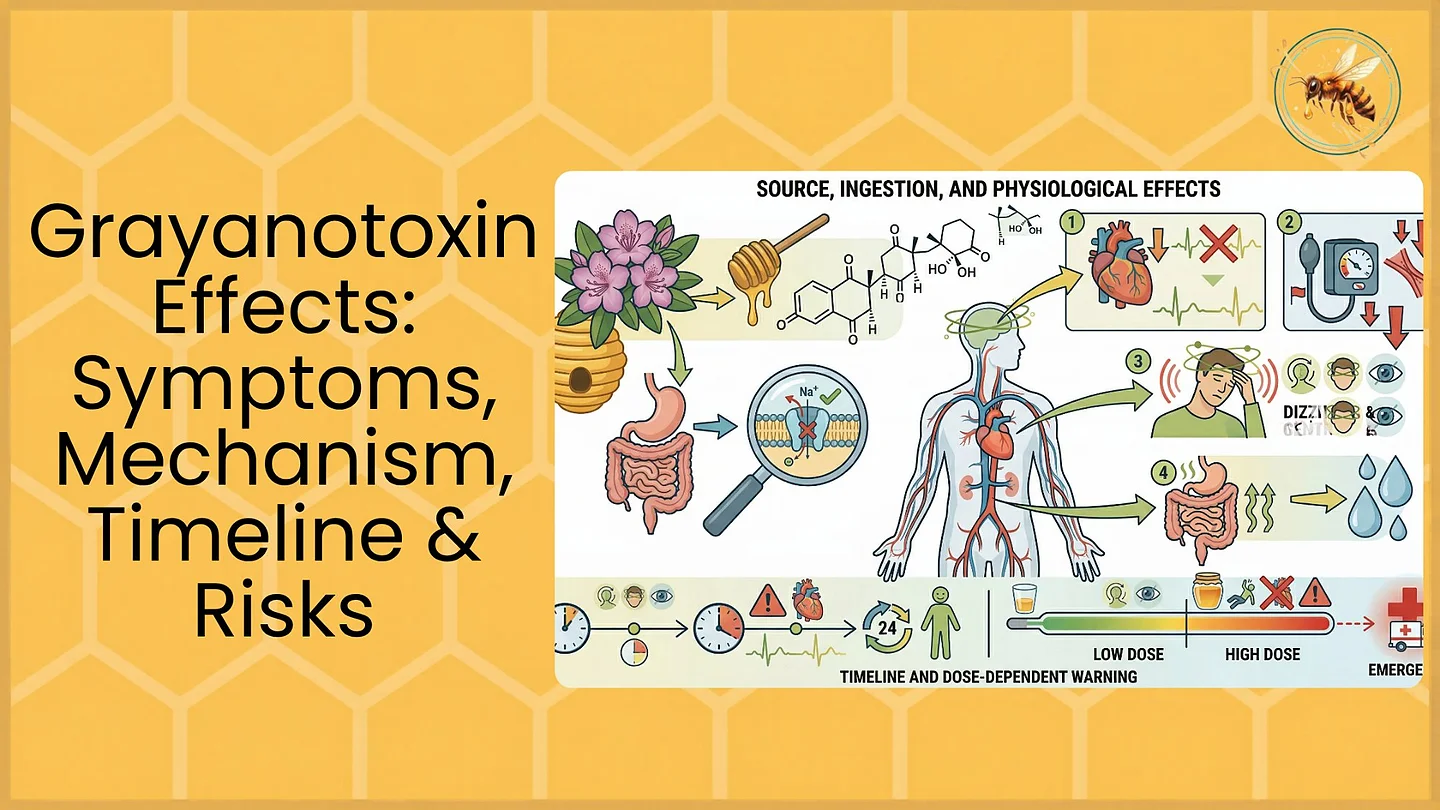
Grayanotoxins produce a set of effects that span the cardiovascular, neurological, and gastrointestinal systems. The common thread is that all of them trace back to the same mechanism: disrupted sodium channel activity in excitable cells (nerve and cardiac muscle). What that produces in the body depends almost entirely on how much was consumed.
The short list of the most common effects people notice
At low-to-moderate exposure, the most frequently reported effects are a tingling or heavy sensation in the limbs, mild dizziness, a noticeable slowing of the heart, nausea, warmth in the chest, and a general drop in energy or alertness.
These are the body’s expected response to a pharmacologically active compound at a level it can still largely compensate for. “Common” does not mean comfortable for everyone, and it does not mean safe at any dose.
The short list of the most important medical red flags
The effects that cross into clinical concern are different in character, not just in intensity. Fainting or near-fainting, chest discomfort, breathing difficulty, severe vomiting, and extreme muscle weakness are the markers that separate an uncomfortable but manageable experience from one that needs prompt medical evaluation.
Escalation from moderate to serious can happen quickly, particularly when doses exceed what the cardiovascular system can absorb without intervention.
Why “high” is the wrong mental model for most cases
Grayanotoxins don’t produce a psychedelic or euphoric state. There are no visual distortions, no altered reality, no mood elevation. What they produce is better described as a pharmacological disruption: the nervous system slows, the heart rate drops, the body becomes heavy.
When people label this a “high,” they’re usually describing the intensity of a physiological reaction, not a recreational experience. This matters practically: people expecting a “high” sometimes misread early signs of toxicity as the intended effect, and delay recognizing when something has actually gone wrong.
Where Grayanotoxins Come From (Rhododendron species and related plants)
Grayanotoxins are produced by plants in the Ericaceae family, most notably certain Rhododendron species, but also Kalmia (mountain laurel) and Leucothoe. The compounds serve as a herbivore deterrent and are present in leaves, stems, flowers, and nectar.
Not every rhododendron species produces them in meaningful quantities. Concentrations vary substantially across species, altitude, and seasonal conditions, which is why geography alone doesn’t predict potency.
Why do they show up in “mad honey”
When bees forage on grayanotoxin-producing rhododendron flowers, the compound carries through into the honey. In regions where these species dominate the flowering season, such as Turkey’s Black Sea highlands and Nepal’s mid-altitude zones, the conditions for high-concentration honey exist naturally.
These are the regions most commonly associated with mad honey in both traditional use and modern clinical reports.
Why does not all “rhododendron honey” produce the same experience
“Rhododendron honey” tells you the floral source. It doesn’t tell you the grayanotoxin concentration. A commercial honey produced in mixed-flora conditions may contain negligible amounts; wild-harvested honey from a high-altitude monofloral site may contain enough to produce significant effects from a single tablespoon.
The plant species, bloom density, and foraging exclusivity all drive the actual concentration, which is why origin context, not just the floral label, matters.
Mechanism of Grayanotoxins (Simple, No Jargon)
You don’t need the full biochemistry to understand the practical implications. But the mechanism explains why the effects follow such a predictable pattern.
What they do to nerve and muscle signaling
Voltage-gated sodium channels open briefly to let a nerve or muscle cell fire, then close, resetting the system. Grayanotoxins prevent those channels from closing properly.
Cells remain partially activated, which disrupts normal electrical signaling across the nervous system and in cardiac muscle. The result is the characteristic pattern: slowed cardiac conduction, altered sensory processing, and reduced muscular tone.
Why effects often look “parasympathetic/vagal.”
The pattern of grayanotoxin effect, slowed heart rate, lowered blood pressure, gastrointestinal activity, and sometimes increased salivation, mirrors what happens when the parasympathetic nervous system is strongly activated. Clinicians call this a “vagal” response.
This is why atropine, a medication that blocks parasympathetic activity, is used to manage severe mad honey poisoning. The sodium channel disruption cascades through the autonomic nervous system in a way that amplifies parasympathetic output.
Why the dose-response can feel steep (small increases → big change)
This is the most practically important thing about grayanotoxins: the relationship between dose and effect is not reassuringly gradual. At low doses, effects may be barely perceptible. A modest increase, sometimes just a half-teaspoon more from a potent batch, can shift the experience from mild and manageable to disorienting and physically distressing.
Once enough sodium channels are affected in cardiac tissue, heart rate and blood pressure changes compound quickly rather than scaling linearly. That steepness is why “the same spoon” logic fails across batches.
Grayanotoxin Effects by Body System
This is the core of what grayanotoxins actually produce. The cardiovascular effects are the most clinically significant; all other systems follow from, or run alongside, that primary disruption. The table below gives a quick-scan reference; the sections underneath go deeper.
Normal vs Warning Signs (Quick Reference)
| What you feel | Usually manageable (monitor + don’t take more) | Warning signs (stop + seek help) |
| Overall feeling | Calm, heavy, “wind-down”, stable, and not escalating | Feeling unstable, “something is wrong,” symptoms worsening over time |
| Dizziness/lightheadedness | Mild, brief, improves with sitting or lying down | Strong dizziness, trouble standing, repeated near-fainting |
| Heart rate | Noticeable slowing, but no chest pain or pressure | Very slow pulse sensation, chest pain, irregular feeling |
| Nausea | Mild stomach unease that doesn’t progress | Persistent vomiting, can’t keep fluids down, worsening |
| Weakness | Heavy limbs, low energy, you can still move | Extreme weakness, can’t stand, arms/legs feel non-functional |
| Mental state | Foggy, relaxed, slow, thinking intact | Confusion, disorientation, altered consciousness |
| Breathing | Normal | Any difficulty breathing, treat as urgent |
A useful rule: normal effects stay stable or fade. Effects that worsen over time are not normal.
Cardiovascular (most important)
These mechanisms are supported by rat studies on grayanotoxin exposure.
The heart and vascular system are where grayanotoxin effects matter most medically. The consistent picture across case reports includes:
- Slowed heart rate (bradycardia): Rates as low as 30–40 beats per minute have been documented in poisoning cases, compared to a normal resting range of 60–100. The slowing is caused directly by prolonged sodium channel activation in cardiac conduction tissue.
- Lowered blood pressure (hypotension): The drop can be significant enough to impair blood flow to the brain, producing the characteristic lightheadedness and near-fainting. In severe cases, hypotension requires clinical intervention.
- Lightheadedness and fainting risk: The combination of bradycardia and hypotension reduces cerebral perfusion. Fainting risk is highest when the person is standing or exerting themselves during the peak window. If fainting has occurred, the appropriate response is lying down and calling for emergency assistance, not waiting to see if it resolves.
It’s the cardiovascular picture, not altered cognition, that drives the serious risk in genuine mad honey intoxication.
Neurological
The neurological effects are partly a downstream consequence of reduced cerebral perfusion and partly a direct result of grayanotoxins on sensory nerve channels. The most commonly reported neurological symptoms are dizziness, confusion, disorientation, and tingling or numbness, particularly around the mouth and extremities. Limb weakness and a “weighted down” feeling are also frequent.
In severe exposures, more extreme weakness, loss of coordination, and altered consciousness have appeared in case reports. Any progression toward those symptoms warrants medical evaluation rather than waiting it out.
Gastrointestinal
Nausea and vomiting are common companions to grayanotoxin exposure, especially at higher doses or when honey is consumed on an empty stomach. GI symptoms can appear early, sometimes before cardiovascular effects become prominent, and persistent vomiting raises the risk of dehydration if not managed. Mild nausea that stays mild and doesn’t progress is different from worsening vomiting: the former is a reason to stop taking more, the latter is a reason to seek help.
Respiratory (severe cases)
Breathing difficulty is rare but should be treated as an unambiguous red flag. In severe poisoning, extreme bradycardia and hypotension can reduce perfusion enough to affect respiratory function, and respiratory depression has been documented at very high exposures.
Any chest tightness, inability to draw a full breath, or sense of respiratory compromise after consuming mad honey should be treated as an emergency.
What It Feels Like at Low vs High Exposure (Expectation Setting)
The low-exposure and high-exposure experiences aren’t just different in intensity; they’re qualitatively distinct enough that people sometimes struggle to recognize they’re on the same continuum.
Low exposure: what people commonly report
At doses well within the body’s compensatory capacity, the experience is quiet and body-oriented. People commonly describe a slow exhale feeling: warmth or heaviness in the limbs, a perceptible but not alarming slowing of the heart, a calm or settled state, sometimes a mild tingling around the lips or fingertips.
The experience is not cognitively altered, thinking stays clear, even if the body feels different than usual. In the right setting, some people find low exposure relaxing; in the wrong setting (standing, active, anxious), even mild effects can feel destabilizing.
Higher exposure: when it shifts into “poisoning syndrome.”
When the dose exceeds what the body can offset, whether because the batch is potent, the quantity was too high, the person is sensitive, or doses were stacked, the picture changes character. Nausea intensifies. Dizziness becomes significant enough to make standing difficult. Blood pressure drops enough to produce graying vision or actual fainting. Heart rate, if measured, is meaningfully slowed.
This constellation of nausea, dizziness, faintness, sweating, and weakness is what toxicologists and emergency physicians recognize as mad honey intoxication. It resolves on its own in most cases once absorption plateaus, but the process can take several hours, and the peak can be physically distressing.
Why some people feel nothing (batch + sensitivity + food timing)
Not everyone who consumes mad honey notices an effect, even from batches that have caused significant reactions in others. A low-concentration batch, consumed with food, by a person with higher body weight or individual channel sensitivity may produce no noticeable effect at all.
The absence of effect from one serving is not evidence that a larger dose would also produce nothing. It’s one reason re-dosing based on “not feeling anything yet” is the most common way people accidentally overshoot.
Timeline, Onset, Peak, and Recovery
Here’s what you need to know about how long does mad honey last
Onset window (why it varies)
The first effects typically appear within 20 minutes to 2 hours of ingestion, though documented cases extend in both directions. On an empty stomach, the onset can be 20–30 minutes. After a meal, the stomach slows absorption, and the onset may not register for an hour or more.
The biggest danger in the onset window: people assume nothing is happening and re-dose too early. Most “it lasted forever and made me sick” stories begin with “I didn’t feel it, so I took more.”
Peak window (what typically intensifies at peak)
Peak, when heart rate slows, blood pressure drops, and symptoms like nausea and dizziness are most pronounced, typically arrives 1 to 3 hours after onset. This is when cardiovascular effects are most significant, and the risk is highest. At peak, the practical guidance is simple: stay seated or lying down, avoid exertion, have someone present, don’t consume more of anything.
Recovery window (back to baseline)
In self-limiting cases, effects begin to resolve within 4–6 hours of peak. Most people return to a functional baseline within 12–24 hours. The recovery is gradual, not sudden; heart rate and blood pressure normalize incrementally.
Residual fatigue for the rest of the day is common, even after the acute phase has passed. If symptoms are still worsening after the expected peak window, that is not a normal recovery trajectory.
What prolongs it (stacking doses, mixing, empty stomach, sensitivity)
The factors that consistently extend duration: consuming multiple servings without waiting long enough between them; mixing with alcohol or other substances that also lower blood pressure or slow the heart; individual variation in metabolic clearance (especially in older individuals or those with reduced kidney or liver function). An empty stomach accelerates absorption but doesn’t necessarily prolong total duration.
Why Effects Vary So Much (The Variability Section)
Two people can consume the same honey from the same jar and have meaningfully different experiences. This is not an inconsistency in the science; it’s the expected outcome of several overlapping variables stacking.
Plant species + nectar mix
Different Rhododendron species produce different grayanotoxin variants, GTX I, GTX II, and GTX III, with varying binding affinities and potencies. A honey sourced predominantly from one species behaves differently from one reflecting a mixed-flora season, even when both come from the same general region and both carry the “mad honey” label.
Seasonality and region
Spring harvests, when rhododendrons are in peak bloom, and bees forage heavily on a single floral source, tend to produce higher-concentration honey than later-season harvests, when competing flora dilute the sourcing. High-altitude sites with fewer competing plants produce more monofloral honey and typically more consistent (and higher) grayanotoxin content.
Processing/storage
Heat processing can degrade some grayanotoxin compounds. Extended storage and light exposure may reduce potency, though storage-related degradation isn’t well-standardized in the research.
Raw, minimally processed honey from a recent harvest is more likely to retain its original compound profile than honey that has been filtered, heated, or stored for extended periods.
Why “the same spoon” isn’t a stable dose
Even within a single jar, grayanotoxin concentration isn’t uniform. Honey isn’t a homogeneous liquid; compounds distribute unevenly depending on how the comb batches were blended and how the honey has settled over time.
A spoon from the top of the jar may contain a different concentration than one from the bottom. This is an underappreciated source of dose variability and one of the structural reasons “same spoon, same result” logic fails repeatedly.
Safety First: When to Seek Medical Help
Mild vs concerning symptoms
Mild symptoms, noticeable but not distressing dizziness, a perceptibly slowed heart rate without chest pain, mild nausea, tingling in the extremities, don’t typically require emergency care.
The appropriate response is to stop consuming, sit or lie down somewhere safe, avoid alcohol and other substances, stay hydrated if nausea allows, and wait. Having someone present who knows what was consumed is a sensible precaution.
Red Flags, don’t wait for these to come out.
- Fainting or loss of consciousness
- Chest pain or pressure
- Significant breathing difficulty
- Persistent vomiting that prevents hydration
- Heart rate that feels unusually slow or irregular
- Severe weakness that prevents normal movement
- Confusion or an altered mental state that does not resolve
What to do immediately (basic, non-medical supportive steps)
If concerning symptoms develop: get the person lying down with legs slightly elevated if blood pressure is low, call emergency services if fainting has occurred or is imminent, and be direct with medical staff about what was consumed. Grayanotoxin intoxication is a recognized clinical condition with an established protocol. The sooner it’s identified correctly, the more straightforwardly it’s managed.
Who Should Avoid Grayanotoxin Exposure (High-Risk Groups)
Blood pressure/heart rhythm issues
Anyone with an existing arrhythmia, heart block, sick sinus syndrome, or blood pressure instability should treat grayanotoxin exposure as contraindicated. The compound’s primary mechanism acts directly on cardiac conduction, and even a modest dose can push a borderline-stable rhythm into a clinically problematic one.
People on BP/HR-affecting meds
Beta-blockers, calcium channel blockers, digoxin, and antihypertensives that lower blood pressure or slow the heart all interact with the same physiological pathways that grayanotoxins act on. Stacking grayanotoxin exposure on top of these medications creates a compounding cardiovascular effect that can produce severe bradycardia or hypotension at doses that would be tolerable in an otherwise healthy person.
Pregnancy/breastfeeding (conservative avoidance)
There is no studied evidence on grayanotoxin exposure during pregnancy or breastfeeding. The absence of safety data is not equivalent to evidence of safety. The pharmacological activity of these compounds on smooth muscle and vascular tone creates enough theoretical concern to justify a precautionary position.
If you’re unsure: treat it like a pharmacologically active product
That’s what it is. Grayanotoxins are not a food supplement or a traditional tonic in any sense that exempts them from dose-dependent pharmacological logic.
If any medical condition or medication would make you cautious about a substance that slows the heart and lowers blood pressure, that caution applies here. There’s no exception for “natural” or “traditional.”
“Therapeutic” vs “Toxic” Effects (How to Explain the Duality)
The same compound appears in toxicology literature as a poison and in ethnobotanical literature as a traditional remedy. Both are pointing at the same mechanism from different points on the dose curve.
Same mechanism, different point on the dose continuum
The cardiovascular effects of grayanotoxins, slowed heart rate, lowered blood pressure, are, at low and controlled doses, the same effects that certain cardiac medications produce intentionally.
Historical use of low-dose deli bal in Turkey’s Black Sea region for hypertension management is well-documented for exactly this reason. What separates a pharmacological effect from a toxic one is quantity and consistency of delivery, neither of which is achievable with a naturally variable, unstandardized product.
Why self-experimentation is risky without standardization
The therapeutic framing becomes dangerous when applied without the preconditions that make pharmaceuticals safe: standardized dosing, known compound concentrations, and clinical monitoring. A naturally variable substance whose grayanotoxin content can’t be determined without laboratory analysis doesn’t become safe because the theoretical mechanism is medically interesting.
The absence of standardization is exactly why the evidence base for therapeutic application remains limited, and why researchers are cautious about endorsing self-directed use.
Why responsible messaging avoids medical claims
This page doesn’t describe grayanotoxins or mad honey as treatments, remedies, or health products. That’s not legal caution; it reflects the genuine state of the evidence. Research is ongoing.
But “this compound does something interesting to the cardiovascular system” and “this product treats condition X” are separated by a gap that responsible content can’t bridge without misrepresenting what’s actually known.
FAQs – Grayanotoxins Effects
What are grayanotoxins?
Naturally occurring chemical compounds produced by certain Rhododendron and Ericaceae family plants. They interfere with voltage-gated sodium channels in nerve and muscle cells, disrupting normal electrical signaling and producing a characteristic set of cardiovascular and neurological effects when consumed in sufficient quantity.
Do grayanotoxins cause hallucinations?
No, not in the way that word implies. Grayanotoxins don’t produce visual or auditory distortions. At high doses, confusion and disorientation can occur as a consequence of reduced blood flow to the brain, not a direct psychedelic mechanism. The framing of mad honey as “hallucinogenic” is misleading and driven more by viral content than by clinical documentation.
How long do grayanotoxin effects last?
Onset is typically within 20 minutes to 2 hours. Effects peak 1–3 hours after onset. Most self-limiting cases resolve within 12–24 hours, with residual fatigue possible for the rest of the day. Stacking doses, mixing with alcohol, and individual metabolism all extend the timeline.
Why do some people feel nothing?
Because the effective dose depends on body weight, individual sodium channel sensitivity, stomach contents, and the batch’s actual grayanotoxin concentration, all of which vary independently, it is difficult to predict the effective dose. The absence of effect from one serving is not evidence that a larger dose would also produce nothing, and it’s not evidence that the batch is weak.
Can grayanotoxins be measured in honey?
Yes. HPLC (high-performance liquid chromatography) and LC-MS (liquid chromatography-mass spectrometry) are the standard analytical methods used to measure grayanotoxin concentrations. These are the methods referenced in the COA documentation for commercially sold mad honey.
What’s the safest approach if someone chooses to try mad honey?
Start with no more than a quarter teaspoon from an unknown batch. Wait the full onset window, at least 2 hours, before considering more. Don’t combine with alcohol or cardiovascular medications. Have someone present who can recognize the red flags above. Understand that batch variability means the same approach can produce different results on different occasions.
Are grayanotoxin effects permanent?
In the vast majority of cases, no. Grayanotoxin effects are fully reversible once the compound clears. There are no well-documented cases of permanent physiological harm from a single acute exposure in an otherwise healthy adult. In rare, severe cases involving extreme bradycardia or cardiac events, complications are theoretically possible, which is one reason high-risk individuals should avoid exposure entirely.