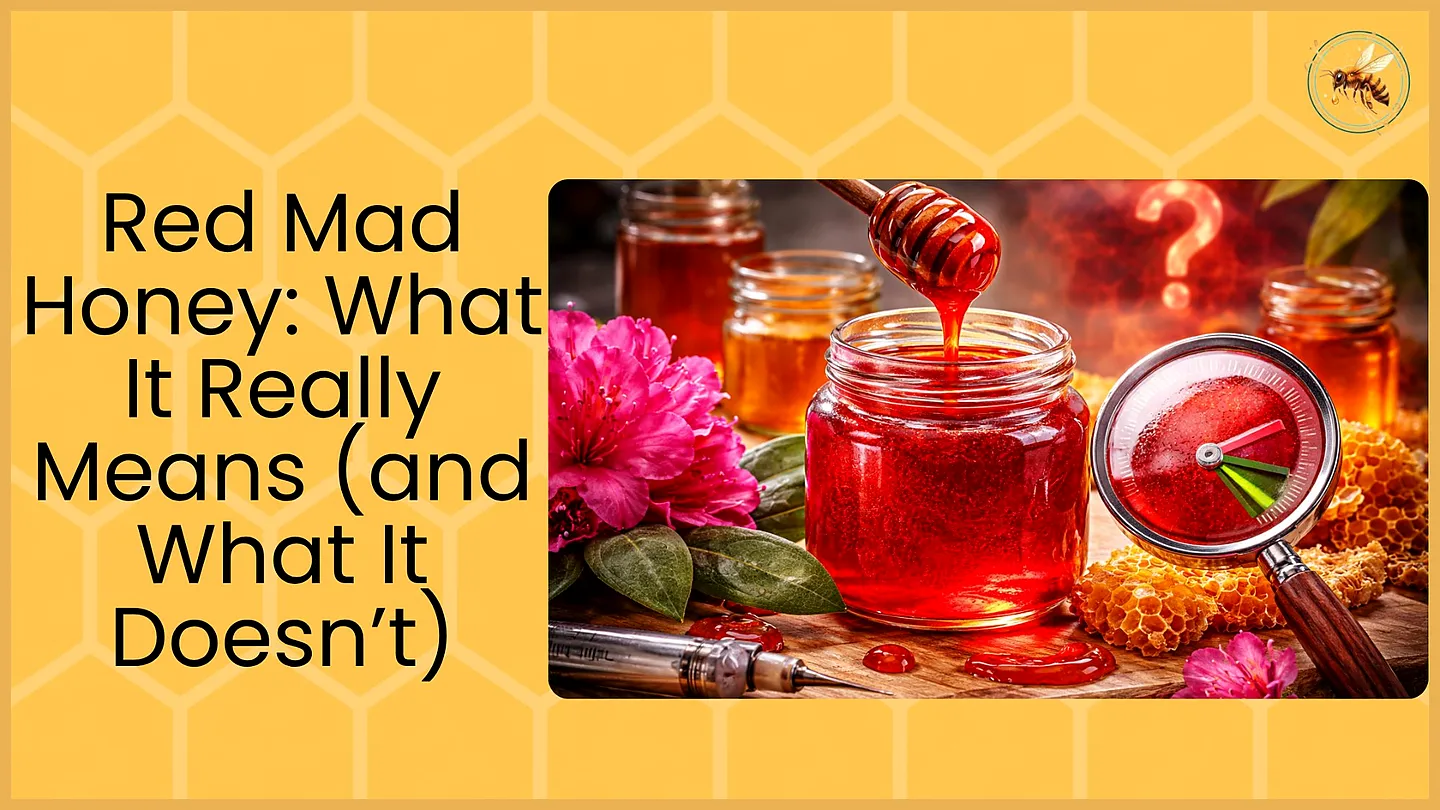
“Red mad honey” is one of those phrases the internet loves because it sounds like a guarantee: red = rare = stronger = more “real.” In reality, colour is a visual descriptor, not a potency certificate, not an authenticity stamp, and definitely not a safety shortcut. Real mad honey can be dark red-brown and bitter, but those traits alone can’t prove what’s in the jar.
This guide is here to do two things at once:
- explain why mad honey can look red in the first place, and
- keep you out of the most common trap, buying based on colour, and accidentally increasing your scam exposure or your overdose risk.
Mad honey already has dose-dependent effects driven by grayanotoxins; chasing “red” often pushes buyers toward the least transparent listings.
tl;dr
- “Red” does not reliably mean “stronger.” Mad honey’s effects come from grayanotoxins transferred from rhododendron nectar, not from colour itself.
- Colour can shift for normal honey reasons (nectar mix, concentration, storage/oxidation, lighting/photos), so using red as a buying metric increases the odds you’ll get fooled by marketing.
- Potency varies by batch, season, and region, and the dose-response can be steep, meaning small changes can feel big.
- The highest safety risk is cardiovascular at higher exposure (bradycardia + hypotension). That’s why “strongest” marketing is a red flag, not a flex.
- The safest way to buy is transparency-first: origin clarity + batch/harvest info + conservative dosing guidance + specific lab testing language (not vague “lab tested”).
Quick Answer – Is Red Mad Honey Stronger?
If you mean “stronger” as “more grayanotoxins/stronger effects,” the honest answer is: sometimes it can be different, but it’s not reliably stronger, and colour alone can’t tell you. Grayanotoxins are the bioactive drivers, and they depend on the nectar source, region, season, and how much blending/dilution happens after harvest.
Why people think “red = strongest”
Most buyers first encounter mad honey through viral clips and marketplace listings. Sellers learn quickly that “red” and “strong” convert, because it creates a simple visual rule the buyer can use. The problem is that the rule is too simple for a product category where variability is the main story, and where being “stronger” can mean “more likely to make you sick.”
The real risk: colour-based buying increases scam exposure
When buyers shop by colour, they’re easier to manipulate: photos can be edited, lighting can be staged, and “red” can be used as a label even when the origin is vague or batch info is missing. A high-value product with weak verification incentives attracts fake listings; Fake/adulterated products are a major market problem.
What Makes Mad Honey Look ‘Red’
To make sense of “red mad honey,” start with a simple truth: honey isn’t a standardised substance. It’s a botanical product whose colour can naturally range from very light to very dark depending on nectar sources and handling. Mad honey can be dark and reddish-brown in many authentic cases, but “red” is still a result of multiple factors, not a single quality lever.
Nectar source and pigment profile (high-level)
Different flowers contribute different pigments and polyphenols. If a honey is dominated by a certain nectar mix in a specific season, it can appear darker. With mad honey, the nectar story is often tied to rhododendron-rich environments (Nepal and Turkey are the best-known production contexts), but “rhododendron presence” does not automatically equal one consistent colour or one consistent potency.
Seasonality (spring vs later harvest differences)
Even in the same region, nectar flow changes across the year. Toxicity peaks in certain blooming windows, and seasonal factors are a major driver of batch variation. That same seasonality can also shift how a jar looks and tastes.
Concentration, oxidation, and storage effects
Over time, honey can darken. Temperature, light exposure, and storage conditions can influence appearance. This is one reason “photo shopping” is so misleading: a jar photographed under warm lighting can look far redder than it looks on your counter.
Why lighting/photos make it look redder than it is
Phone cameras exaggerate amber/red tones. Add a backlight, and a dark honey looks “blood red.” That’s not proof of GTX content; it’s proof of marketing competence.
Bottom line: colour can be real, but it isn’t diagnostic.
Red Mad Honey vs ‘Regular’ Mad Honey (What Actually Changes)
If “red” isn’t a reliable potency marker, what does it usually signal? Most often, it signals one of these:
- A darker nectar blend that produces a deeper amber/red-brown look
- A different seasonal harvest
- Storage/age effects
- A listing strategy designed to trigger “stronger = better” instincts
Taste notes people often report
Mad honey is often described as “dark, reddish-brown” and “slightly bitter,” sometimes with throat irritation (often called “bitter honey”). A “red” listing will often lean heavily on bitterness as proof, but bitterness is not a lab result.
Texture/consistency differences
A thicker or more viscous texture is sometimes presented as “more pure.” But viscosity also changes with temperature and moisture content. It’s useful as a descriptor, not a proof.
Why sensory cues can’t confirm authenticity
Even if a jar looks red-brown and tastes bitter, that still doesn’t tell you:
- which region it came from,
- what season it was harvested,
- whether it was blended/diluted,
- whether it was adulterated,
- or what the GTX I/III levels actually are.
That’s why authenticity has to be built around transparency and verification, not “vibes.”
Does Red Colour Mean More Grayanotoxins?
This is the key myth to break cleanly:
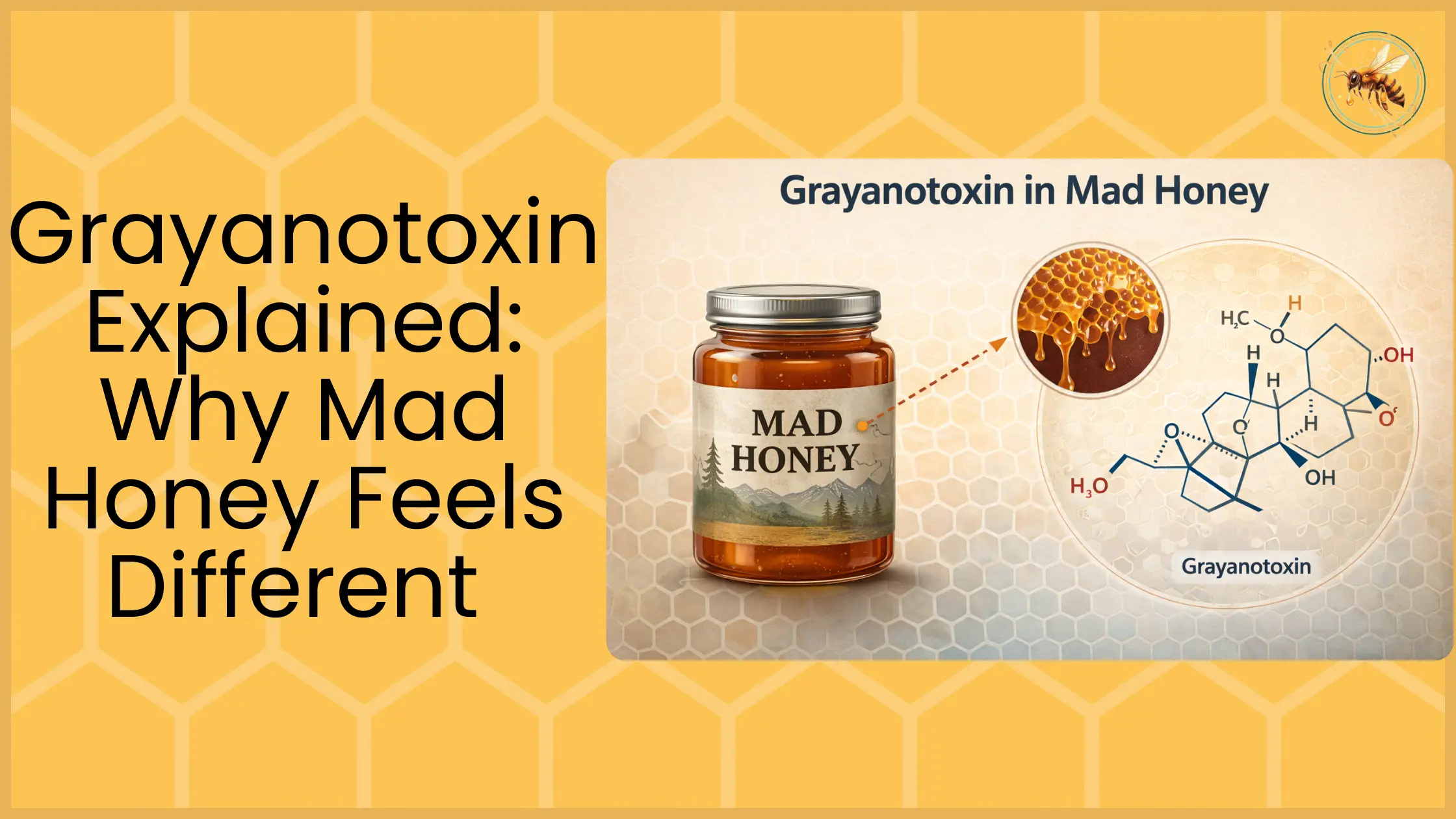
Grayanotoxins are compounds; colour is an appearance. The mechanism is about the presence and concentration of specific toxins (often GTX I and GTX III in discussions), not how red a jar looks.
The mechanism is about compounds, not colour
Grayanotoxins originate from rhododendron nectar, and their effects come from sodium-channel interaction, leading to vagal (parasympathetic) effects, bradycardia and hypotension are the hallmark risks.
The variability problem: region + season + nectar mix
No two batches are identical and that GTX levels fluctuate with seasonal blooming, regional plant differences, and processing/blending practices.
This is why “red = stronger” fails as a rule. Even if some strong batches happen to be darker, the relationship isn’t reliable enough to use as a buying filter.
“The dose makes the poison” reminder
It’s worth repeating because it’s the most important safety framing: more isn’t better. Higher exposure can quickly move from “mild calm” to severe dizziness, nausea, low blood pressure, slow heart rate, and fainting.
Where “Red Mad Honey” Is Most Commonly Marketed From
A lot of confusion comes from the fact that “red mad honey” gets used as a marketing label across different origin stories, sometimes accurately, often vaguely.
Nepal/Himalayan listings: what’s real vs what’s vague
Nepal is frequently highlighted because of the cliff-harvest narrative and the giant Himalayan honeybee (Apis laboriosa). Himalayan mad honey is a rare product tied to high-altitude rhododendrons and labour-intensive harvesting.
Where listings go wrong is using “Himalayan” as a substitute for specifics. “Himalayan” without a region/harvest context is not verification; it’s branding.
Turkey/deli bal listings: how “red” gets used differently
Turkey’s Black Sea region and Pontic mountains are a well-known source context for “deli bal,” and this positions Turkey and Nepal as the dominant production contexts.
Some Turkish honeys may be darker; some may not. Again: origin is not a colour.
Why “Himalayan” is often a marketing label
“Himalayan” sells because it feels exotic and “ancient.” But the institute’s transparency-first posture exists for a reason: the category needs clearer standards, traceability, and lab verification because of variability and counterfeit risk.
The Scam Problem: Why “Red Mad Honey” Attracts Fake Sellers
Whenever buyers latch onto a simple “tell,” scammers build listings that mimic it. Colour is one of the easiest tells to fake, because it’s visual, subjective, and photo-based.
Common marketing red flags
If a listing leans hard on intensity rather than transparency, assume it’s riskier. Words and claims that correlate with bad actors include “strongest,” “guaranteed high,” “psychedelic,” “trip,” and aggressive urgency.
A second red flag is a vague origin. “From Himalayas” without region/season/harvest detail is the online equivalent of “trust me, bro.”
Product/listing red flags
These are the patterns that show up in fake or sloppy listings:
- inconsistent jar photos or labels across listings,
- no batch information, no harvest context,
- no safety guidance at all,
- “lab tested” with no mention of what was tested or for which batch.
“tested” should mean something specific, ideally, GTX I and III quantified with methods like LC-MS/MS, plus origin verification options like pollen analysis.
What responsible sellers do instead
Responsible sellers don’t try to win with “red.” They win with:
- origin clarity (country + region + harvest season),
- batch transparency (batch ID/harvest date),
- conservative dosing guidance (because variability is real),
- specific testing language and willingness to share results.
That aligns with the institute approach: build safety through standardisation, traceability systems, and lab-verified COAs.
Also read: Best Mad Honey in 2026: Nine Brands Ranked by What They Can Actually Prove
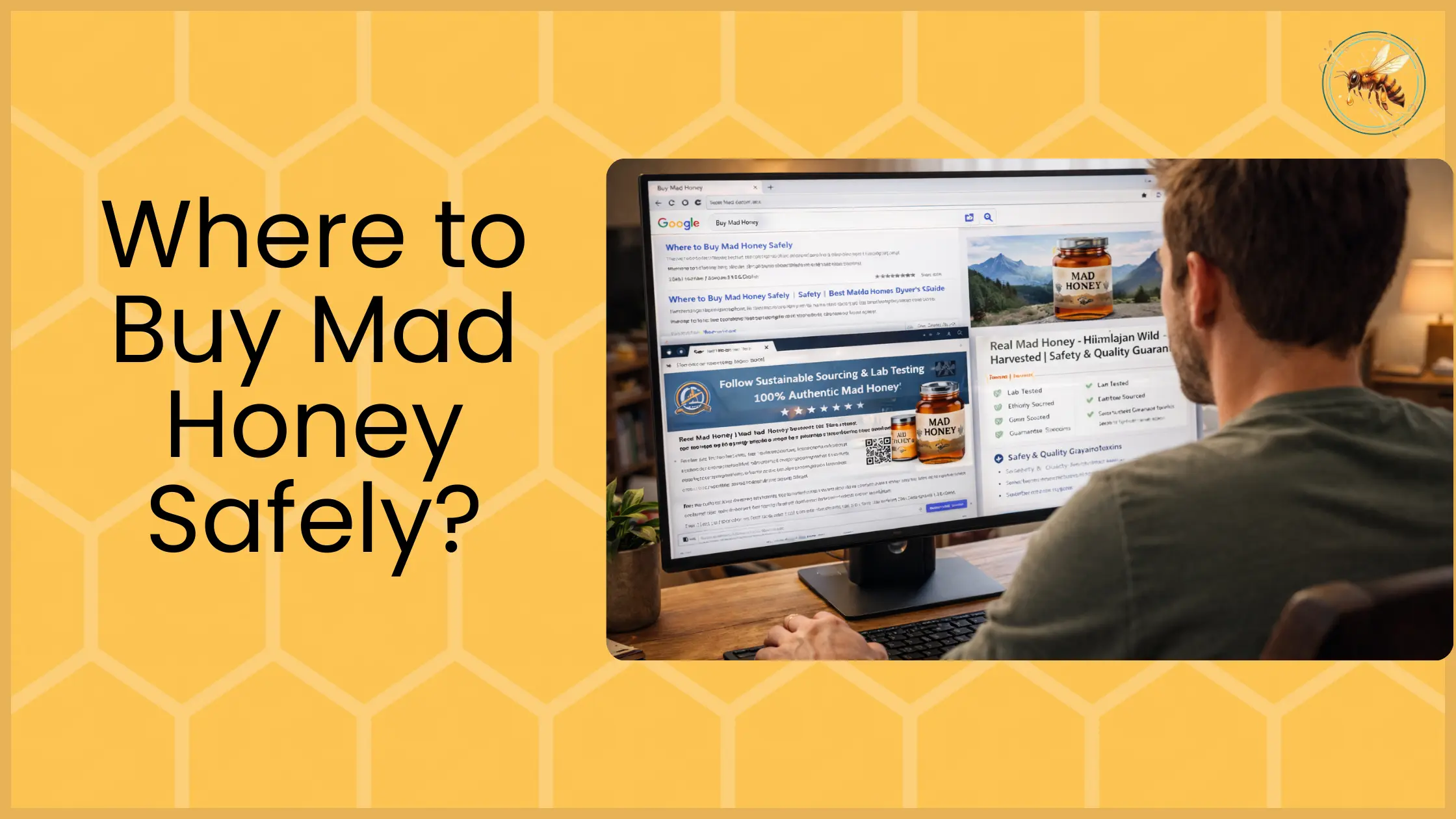
How to Buy Red Mad Honey Safely (Checklist)
This section is meant to be practical. Read it like a pre-flight check, not a shopping hack before buying mad honey.
1) Verify origin (country + region + harvest season)
“Nepal” or “Turkey” is a start; “Himalayan” alone isn’t. Region and season are key drivers of GTX variability.
2) Look for batch transparency
Batch/harvest info is a credibility signal because it admits the truth: every jar can differ. GTX variation depends on region, season, and floral source, making controlled consumption difficult without standards.
3) Check for safety guidance (this is a credibility test)
Real sellers don’t pretend mad honey is a toy. Mad honey is dose-sensitive, so start small and wait before re-dosing.
4) Don’t chase “strongest” claims
“Strongest” is not a consumer benefit in a category where adverse effects escalate with exposure and where the serious risk pattern is cardiovascular depression (slow heart rate, low blood pressure).
5) Prefer sellers who educate, not sensationalise
Education-first sellers talk about:
- why effects vary,
- what “tested” should mean,
- who should avoid it,
- and how to use conservative boundaries.
Sensational sellers talk about: “red,” “trip,” “strongest,” and urgency.
Safety Note: If You’re New, Don’t Start With “Chasing Red”
A lot of “red mad honey” searches come from people who are new and want the “best” jar. The safest advice is the opposite: don’t start by optimising intensity. Start by optimising control and transparency.
Beginner approach: start low + wait
Start tiny, wait long enough, and don’t re-dose fast.
Don’t mix with alcohol or stack doses quickly
Mixing and stacking turn a dose-sensitive product into a confusion machine. If something feels “off,” you want to be able to interpret it early, not wonder which substance is causing what.
Red flags for overconsumption
Severe dizziness, fainting, irregular heartbeat sensations, persistent vomiting, chest pain, or breathing trouble are not “part of the vibe.” There are reasons to seek help. Severe cases can require monitoring and supportive measures like IV fluids and atropine.
Conclusion
Red mad honey is a visual descriptor, not a quality guarantee. The smartest buying strategy is to ignore “red = strongest” marketing and instead choose based on transparency + conservative safety guidance + authenticity signals, because mad honey’s real story is variability.
You might find this interesting: Mad Honey Benefits and Risks: What’s Real, What’s Unproven, and How to Approach It Safely
FAQs – Red Mad Honey
Why is some mad honey red?
Usually, because of nectar mix and natural variation in honey colour (plus handling/storage and photo lighting). “Red” is a descriptor, not a lab reading.
Is red mad honey stronger than normal mad honey?
Not reliably. Potency is about grayanotoxin concentration, which varies by batch, region, season, and processing/blending, not by colour alone.
Does red colour mean it’s more authentic?
No. Authentic mad honey is often described as dark red-brown and bitter, but fakes can imitate its appearance. Authenticity comes from traceability and verification.
Can fake honey be dyed to look red?
It’s possible for sellers to manipulate appearance (especially in photos). That’s why you should prioritise batch info and testing language over visuals.
Does red mad honey taste different?
Sometimes. Many describe authentic mad honey as bitter with a throat “bite.” But taste varies, and it can’t prove authenticity by itself.
Is it legal to buy/import?
Often treated as a food, but rules vary by country and by marketing claims. For more information, read our dedicated guide, Is Mad Honey Legal? What “Legal” Actually Means (US, UK, Canada, and More)
What’s the safest beginner dose?
Start low, wait, don’t stack. For more information, read our dedicated guide, How Much Mad Honey Should I Take? A Practical Dosage Guide for Beginners