If you’re searching “mad honey legal in UK” or “mad honey UK law,” you almost certainly want a clear answer to one of these worries: will a jar get stopped at the border, is it treated like a drug, or is the scary framing online actually true?
Here’s the honest, direct version.
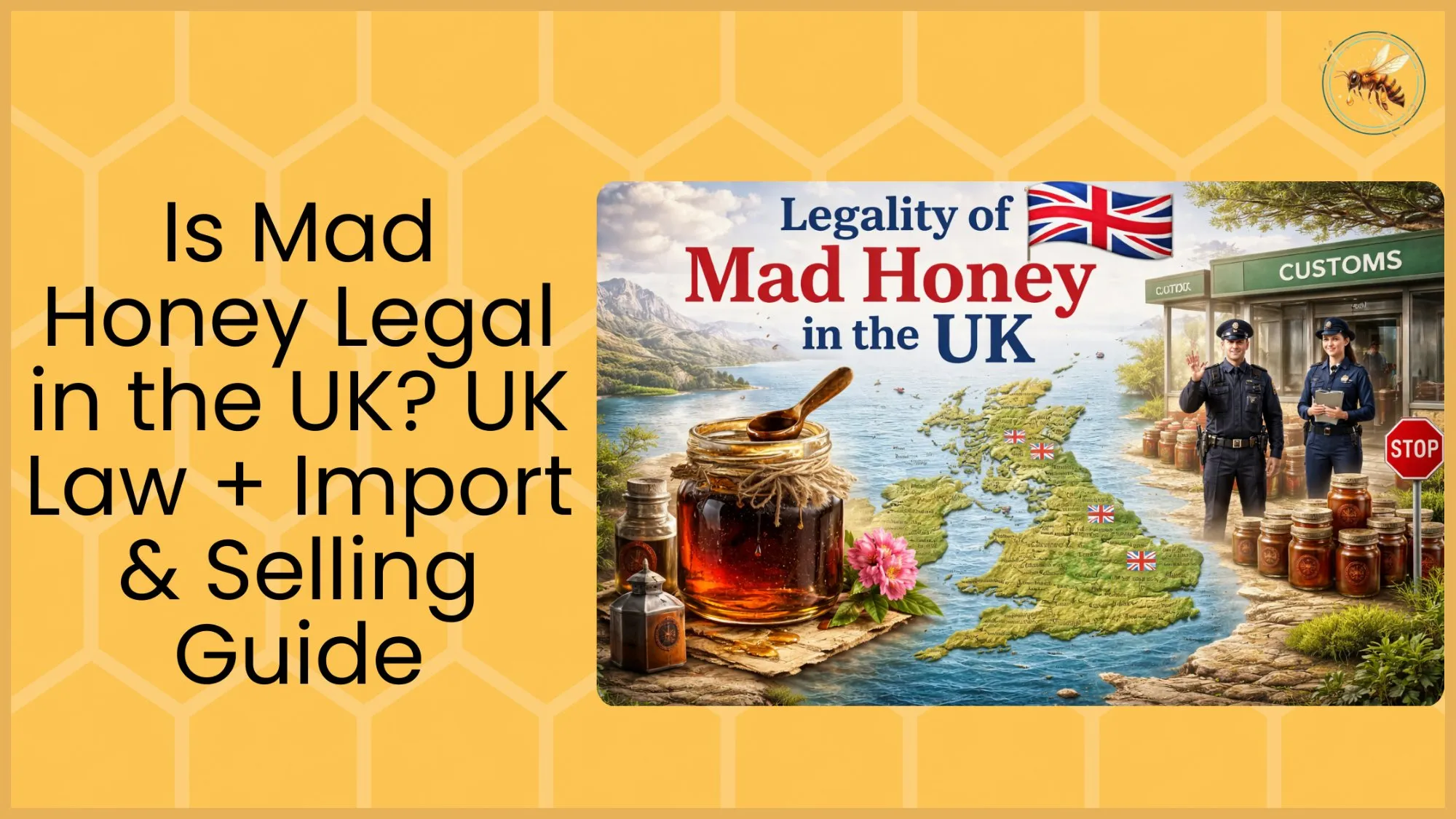
In the UK, mad honey is legal. It’s treated as a food product, not a controlled substance. For an ordinary buyer, there is no criminal issue with owning or consuming it. The real friction in UK law sits in three narrower places: how the product is imported, how it’s labelled, and, above all, how it’s marketed. Almost every genuine legal problem in this category comes from sellers making drug-like or health claims, not from anyone possessing honey.
This guide breaks “is it legal?” into the parts that actually behave differently in practice: buying and owning it, importing it, and selling or advertising it.
Also read: What is mad honey?
tl;dr
- Buying and owning mad honey in the UK is legal. It’s regulated as a food, so the friction points are import rules, labelling, and marketing claims, not possession.
- Honey is a legally defined food category. Under the Honey (England) Regulations 2015, “honey” is a reserved description with strict compositional standards, designed to prevent misleading or fraudulent sales.
- Personal import has a specific allowance. UK guidance permits up to 2kg of honey per person for personal use from most countries, in commercially branded, unopened packaging.
- The real legal tripwire is advertising. Under CAP Code rule 15.6.2, any claim that a food can treat, prevent, or cure disease is prohibited, and the ASA now actively monitors and enforces this, even without a complaint.
- “Psychedelic” or “hallucinogenic” marketing is a compliance magnet. It invites scrutiny, platform bans, and consumer-protection risk. The lowest-friction approach for buyers and sellers alike is simple: treat mad honey as food, describe it as food.
Can you buy mad honey in the UK?
Yes, as a food. Under UK food law, honey is regulated as a defined food category with rules about what may legally be sold as “honey.” Mad honey falls under that same framework. There is no UK legislation classifying grayanotoxin-containing honey as a controlled drug, and possession is not a concern for consumers.
Whether you can buy it is a different question from whether it is legal, and it is the one most people arriving on this page actually have. No seller we have checked holds stock inside the UK, so every route is an import. Our guide to buying mad honey in the UK sets out the routes, the realistic landed cost and what to check before you pay, and our comparison of nine mad honey brands ranks the sellers on what each one can actually prove.
Why do “UK law” searches spike?
Because the internet doesn’t talk about mad honey like food, it talks about it like a “legal high.” That framing triggers fear-based searches and the assumption that drug law must be involved. But in reality, the two genuine legal tension points in the UK are import controls and marketing claims, not criminal possession. If you buy a jar and eat it, you are not doing anything illegal.
Related: Is mad honey legal in New Zealand?
Mad honey UK law, explained in three layers
People compress UK “legality” into one anxious question, but it works as three separate layers that behave very differently.
Layer 1: Possession (owning it)
If you buy a jar of mad honey in the UK, or receive one shipped to you, and it’s treated as a food product, the legal system is not concerned with you “possessing” it. The narcotics-style fear that drives these searches simply isn’t the real-world friction point for consumers.
Layer 2: Importing (the customs reality)
This is where most buyer anxiety actually lives, and it’s worth being precise. UK import checks exist to protect food safety and stop misdeclared products from entering the market. Honey is classed as a product of animal origin, and there are specific personal-import allowances (covered in detail below). What matters at the border is whether the item looks like a legitimate, correctly described food.
Layer 3: Selling and marketing (the sensitive layer)
If you sell mad honey in the UK, your biggest legal risk is not that honey is illegal, it’s that your marketing makes the product look like a medicine or a drug. This is where real enforcement happens, and it’s driven almost entirely by claims. Serious brands behave differently from hype sellers precisely because they understand this: they publish conservative safety guidance, avoid cure claims, and drop the “psychedelic” framing.
Importing mad honey to the UK: the actual rules
If you’re a buyer, the fear is “will customs seize it?” The reassuring reality is that there’s a defined allowance.
UK government guidance on bringing food into Great Britain sets out that honey is treated as an “other animal product” (alongside eggs and some fishery products), and permits up to 2kg per person for personal use, provided the product does not require refrigeration before opening and is in commercially branded, unopened packaging. That’s a normal food-import rule, not a mad-honey-specific restriction.
For most buyers ordering a jar or two, this sits comfortably inside the personal allowance. The friction, when it happens, comes from shipments that look like something other than properly presented food.
What makes a shipment look higher-risk
A jar is far more likely to be delayed, returned, or flagged when:
- The description is vague or sensational (“psychedelic honey,” “medicine honey”)
- The label doesn’t clearly identify the product as honey
- The country of origin is unclear or inconsistent
- The volume looks commercial but is handled like casual personal mail
Honey also carries specific identity and labelling expectations. Under the Honey (England) Regulations 2015, “honey” and related terms (like “comb honey” or “blossom honey”) are reserved descriptions that can only be used when the product meets defined compositional criteria, and honey must be labelled with its country of origin. The Food Standards Agency describes these regulations as protecting the reserved description “honey” and preventing misleading or fraudulent practices. In plain terms, for smooth imports, you want the product to look like a properly presented food, clear, boring, and normal.
What documentation helps
For a consumer buying a jar, you won’t usually handle formal import documentation, but you can look for brand signals of professionalism: batch or lot identification, a specific origin statement (a named region, not just “Himalayan“), specific testing language rather than a vague “lab tested,” and a general traceability mindset. For sellers importing commercially, honey and apiculture products sit within the broader products-of-animal-origin import framework, and proper documentation is the difference between predictable logistics and repeated customs friction.
If you are bringing honey back in your luggage, Great Britain allows up to 2 kg per person from most countries outside the EU. The UK row of our honey customs table links to the official rule.
Also read: Is mad honey legal in Australia?
Selling mad honey in the UK: what not to say
This is where the real legal risk in the whole category lives, and it’s worth understanding even as a buyer, because the way a seller talks tells you how trustworthy they are.
The medicinal claims rule
The UK is strict about medicinal claims. Under the CAP Code rule 15.6.2, claims that state or imply a food can prevent, treat, or cure human disease are prohibited outright. Such medicinal claims can only be made for products licensed as medicines by the MHRA. Food supplements are legally a type of food, not medicine, so the same prohibition applies to them.
This isn’t a dormant rule. The Advertising Standards Authority now runs active ad monitoring and regularly upholds complaints even where no member of the public complained. In 2024 alone, the ASA ruled against multiple supplement advertisers for implied disease claims, and it has been explicit that softer phrasing, “helps with,” “supports,” or “reduces the symptoms of” a condition, is still treated as a treatment claim. Even claims to treat something like a hangover, or to reduce anxiety, have been ruled prohibited.
Health and nutrition claims
Beyond disease claims, there’s a separate framework: only health and nutrition claims authorised on the GB Nutrition and Health Claims Register may be used, and they must be used in their authorised form without exaggeration. The ASA has ruled against advertisers for using an authorised claim in a stronger wording than the register permits. For mad honey, where there are no authorized health claims on the register, the practical implication is that health benefits shouldn’t be asserted at all.
So the UK “legal question” for sellers really becomes: are you selling honey as honey, or implying it’s a treatment product?
The “food” vs “drug” positioning trap
This is where mad honey marketing gets sellers into trouble. Describe and label it like a food, and you’re in the normal world of food regulation and truthful marketing. That is the same footing manuka honey is sold on. Describe it like a psychoactive product, and you raise the odds of ASA scrutiny, complaint-driven enforcement, platform account bans, and consumer-protection problems.
The predictable trap phrases:
- “psychedelic honey”
- “hallucinogenic honey“
- “legal high”
- “trip” or “microdose” framing
- “guaranteed effects”
Even treated as “just marketing,” these imply irresponsibility, exaggeration, or medicinal positioning, exactly what UK advertising rules target in health-adjacent categories. It’s also worth noting the deeper statutory layer: under the Human Medicines Regulations 2012, advertising an unauthorised medicinal product in Great Britain can be a criminal offence, and aggressive medical claims can even push a product toward being classified as a medicine.
Related: Is mad honey legal in India?
The practical takeaway
Across all three layers, the safe approach is consistent and simple: treat mad honey as food, describe it as food, and be conservative about effects.
For buyers, that means favouring sellers who present the product as food, provide traceability, and offer honest safety and dosage guidance instead of hype. A seller leaning on “psychedelic” language and guaranteed effects isn’t just cutting legal corners, they’re signalling how much (or little) care goes into the product itself.
We applied that exact test to nine sellers in our comparison of mad honey brands, scoring each on lab evidence, sourcing detail, published safety guidance and price per gram.
For sellers, it means describing the honey accurately, labelling it to honey regulations with country of origin, staying entirely clear of disease and health claims, and skipping drug-adjacent framing altogether.
Mad honey isn’t banned in the UK. The category’s legal problems are almost entirely self-inflicted through marketing, which means they’re also entirely avoidable.
Also read: Is mad honey legal in Singapore?, Is mad honey legal in the Philippines?, Is mad honey legal in Canada?, Is mad honey illegal in the US?
FAQs on Mad Honey and UK Law
Is mad honey illegal in the UK?
No. Mad honey is legal in the UK and treated as a food product, not a controlled substance. There’s no criminal issue with buying or consuming it. The real regulatory considerations are import rules, honey labelling standards, and, mainly for sellers, advertising claims.
Can I bring mad honey into the UK from Nepal or Turkey?
Yes, within the personal-import allowance. UK guidance permits up to 2kg of honey per person for personal use, in commercially branded, unopened packaging that doesn’t need refrigeration. A jar or two for personal use sits well inside that limit. Vague or sensational labelling is what raises the risk of a shipment being flagged. Turkish deli bal and Nepali honey are treated identically at the border: both are food.
Is it legal to sell mad honey in the UK?
Selling mad honey as a food is legal, but it must be labelled according to honey regulations (including country of origin), and marketing must avoid any claim that it treats, prevents, or cures disease. Those medicinal claims are prohibited under CAP Code rule 15.6.2 and actively enforced by the ASA. “Psychedelic” or “legal high” framing significantly increases enforcement risk.
Why is mad honey sometimes called a “legal high”?
Because grayanotoxin produces dose-dependent effects, some marketing leans into “legal high” or “psychedelic” language. In the UK, this framing is legally risky rather than accurate, the product is regulated as food, and drug-adjacent marketing invites scrutiny, platform bans, and consumer-protection problems. It’s also misleading about what the honey actually is.
Does mad honey need special labelling in the UK?
It must meet the general honey labelling rules under the Honey (England) Regulations 2015, including the use of the reserved description “honey” only where compositional standards are met, and country-of-origin labelling. It must not carry medicinal or unauthorised health claims. Beyond that, it’s labelled like any other food.
Is buying mad honey online legal in the UK?
Yes. Buying mad honey online for personal use is legal. Stick to sellers who present it as food, provide clear origin and batch information, and offer honest safety guidance rather than “guaranteed effects.” See where to buy mad honey for what to look for.
This guide explains how UK food and advertising law applies to mad honey. It’s general information, not legal advice; sellers building a compliance process should consult the current Honey (England) Regulations 2015, FSA import guidance, and the CAP Code directly, or take professional advice.
Last reviewed: May 2026