If you’re searching “mad honey legal in Australia,” you’re usually worried about one of three things:
- Is it illegal like a controlled drug?
- Can I import/order it without customs trouble?
- What gets products flagged, especially when sellers use “psychedelic” marketing?
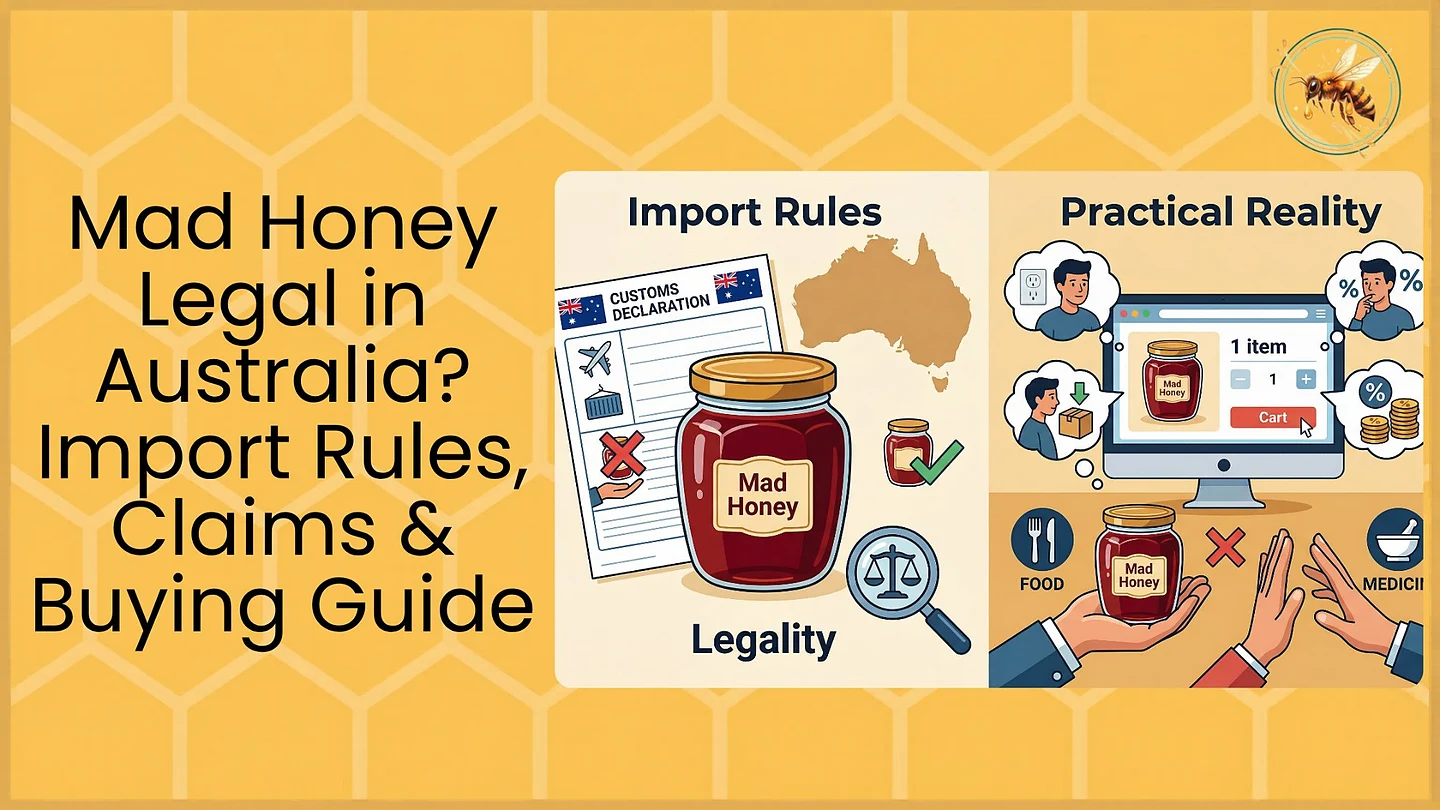
Here’s the plain-English answer up front: Mad honey is generally treated as a food, not a controlled drug, but in Australia, the practical risk is rarely “criminal possession.” It’s import/biosecurity checks, product description/labeling, and marketing claims (food vs therapeutic/drug-like positioning).
Australia’s border and food import system is risk-based and documentation-driven, and the advertising/claims environment is strict when you start implying treatment of disease.
tl;dr
- In Australia, “legal” is usually about import compliance and truthful marketing,not about criminal possession.
- Biosecurity and food import controls matter: DAFF administers border biosecurity requirements and the Imported Food Inspection Scheme is risk-based (not every item is inspected, but some are).
- Claims can trigger scrutiny: “psychedelic,” “trip,” and disease-treatment promises can turn a food into a compliance problem.
- Vague “lab tested” isn’t a shield: Australia’s labelling environment also prohibits misleading representations, and “tested” claims should be specific and not misleading.
- Best buyer strategy: small personal quantities, clear product description and origin transparency, conservative safety guidance, and avoid hype-heavy sellers.
Quick Answer: Is Mad honey illegal in Australia, like a controlled drug?
Usually, no, mad honey is generally handled as honey/food. The “illegal drug” framing is mostly an internet narrative driven by sensational clips and “hallucinogenic honey” headlines, not the typical regulatory classification.
Can you import/order mad honey online?
Sometimes, but it can be delayed/inspected/blocked depending on what it is (pure honey vs honeycomb/other forms), how it’s described, documentation, and biosecurity checks. DAFF publishes honey import requirements and points importers to BICON for current conditions.
Why you’ll see conflicting answers online
Because people mix up different things:
- “Is it illegal to possess?” vs
- “Will customs/biosecurity let this package through?” vs
- “Can a seller legally market it with those claims?”
Those are three separate questions, and Australia treats them differently.
What “Legal” Means in Australia (3 Layers)
This is the most important mental model for this page. When someone asks, “Is mad honey legal in Australia?”, they’re often unknowingly asking about all three layers at once.
1) Possession (owning it)
For most consumers, possession isn’t the core issue. The more common real-world friction is import/border clearance and the way products are represented (labeling and claims).
2) Importing (border checks and restrictions)
Imported food can be subject to biosecurity requirements and a risk-based inspection program. DAFF administers the Imported Food Inspection Scheme (risk-based, not every item is inspected).
Honey specifically has import requirements and is routed through BICON for up-to-date conditions.
3) Selling/marketing (claims, labeling, classification)
Even if a product gets through the border, marketing it in Australia and New Zealand is where many sellers get into trouble, especially with:
- misleading food representations
- implied medical treatment claims
- drug-like promises (“psychedelic trip,” “guaranteed high”)
FSANZ highlights that, beyond the Food Standards Code, representations about food are subject to broader fair trading/food laws that prohibit false or misleading representations.
And once you wander into “therapeutic claims,” Australia’s therapeutic goods advertising rules become relevant; TGA’s framework heavily restricts serious disease representations (“restricted representations”) and prohibits certain claims without approvals.
Why Mad Honey Can Get Flagged (Even If It’s “Just Honey”)
This section is the myth-busting bridge between “it’s a food” and “why did my package get held?”
Sensational marketing (“psychedelic,” “trip,” “guaranteed high”)
When sellers market a food as a drug-like experience, they invite scrutiny. Even if the jar is technically honey, the claims can make the listing look like it’s being positioned as something else.
Food vs supplement positioning confusion
A lot of online shops implicitly position mad honey as a supplement or therapeutic product (“treats anxiety,” “lowers blood pressure,” “cures…”). That creates risk because Australia treats therapeutic representations seriously, and “restricted representations” relate to serious diseases/conditions.
Safety incidents increase scrutiny (dose matters)
Mad honey is sought because it can have noticeable effects linked to grayanotoxins. That’s exactly why the safest long-term category posture is “food + transparency + conservative guidance,” not “psychedelic honey.” When sellers lean into extreme promises, they raise both consumer risk and compliance risk.
Related: Is Mad Honey Legal In Singapore?
Importing/Ordering Online in Australia (Practical Reality)
Here’s what matters in practice. This is not legal advice; this is a realism-based checklist aligned with how Australia frames import biosecurity and risk-based inspection.
What border agencies usually care about
Australia’s border guidance for bringing food into Australia emphasizes that some foods are restricted and that you must know what you can bring and what may require permission.
For commercial importing, DAFF is explicit that biosecurity requirements must be met and that food safety requirements are incorporated into BICON for honey.
Honey you carry in when you fly is handled differently: it must be declared and inspected by a biosecurity officer on arrival. The Australia row of our honey customs table links to the official rule.
In plain terms, packages tend to go more smoothly when:
- the product is clearly described (honey, in sealed packaging)
- the origin is clear
- the quantity looks like personal use, not commercial reselling
- there’s nothing on the label/insert that screams “drug product”
What can help reduce issues?
This is the “reduce risk” package profile:
- Batch/lot information (a sign the seller is organized and traceable)
- Clear origin (country + region context if available)
- Responsible labeling language (food framing, not drug framing)
- No psychoactive claims on packaging or inserts
Common reasons packages get delayed/seized
Even when the product itself isn’t “illegal,” packages can be held up for reasons like:
- vague product descriptions (e.g., “herbal remedy honey,” “psychedelic honey”)
- suspicious or drug-like marketing claims in the box or on the label
- quantities that look commercial
- noncompliance with import/biosecurity requirements
Related: Is Mad Honey Legal in the UK?
Labeling & Claims (How to Stay on the Safe Side)
This is where many sellers accidentally create an Australian compliance problem.
Claims to avoid
Avoid language that implies:
- treatment/cure/prevention of disease
- guaranteed psychoactive outcomes (“trip,” “hallucinations,” “guaranteed high”)
Why: FSANZ notes that representations about food are subject to rules prohibiting misleading representations.
And if marketing implies therapeutic treatment, TGA’s advertising framework becomes relevant, especially around “restricted representations” tied to serious diseases/conditions.
Safer language
The safer posture is:
- ritual/experience framing (without promising outcomes)
- conservative expectation setting (“dose-sensitive,” “start low,” “effects vary”)
- clear warnings on who should avoid (risk management, not selling hype)
Why “lab tested” should be specific (avoid vague claims)
“Lab tested” can help trust, if it’s specific and not misleading. Vague “tested for purity” statements without context can create credibility issues, because “tested” can mean many things. Australia’s labeling environment is sensitive to misleading representations; specificity is a safer approach than broad badges.
Take a look at: Is Mad Honey Legal in the Philippines?
Safety Note for Australian Buyers (Short but Clear)
Even though this is a legality page, safety is part of “practical reality”, especially because dose sensitivity influences how products are marketed and how regulators view risk.
Dose sensitivity + batch variability
Mad honey can vary jar-to-jar. That’s why “start low + wait” matters more here than with normal honey.
Who should avoid
The conservative avoid list includes:
- blood pressure/heart rhythm issues
- certain BP/HR medications
- pregnancy/breastfeeding (conservative safety posture)
Red flags that require medical help
Fainting, chest pain, breathing issues, persistent vomiting, severe weakness/confusion.
Buying Safely in Australia (Authenticity + Scam Avoidance)
Now we connect legality to the buyer’s real problem: avoiding fakes and listings that create both safety risk and customs risk.
What responsible sellers provide
The best sellers for Australia-bound orders usually have:
- clear origin clarity (region/country)
- batch/harvest information
- conservative guidance and warnings
- clean packaging language (food framing)
Red flags
Avoid listings that emphasize:
- “strongest,” “guaranteed trip,” “instant high”
- vague origin with no harvest context
- no safety info at all
- drug-like packaging inserts
Also Read: Is Mad Honey Illegal in the US?
Conclusion
In Australia, the real answer to “Is mad honey legal?” is usually: It’s about import + claims + compliance, not criminal possession.
The safest approach is to buy from transparent sellers, avoid hype-heavy “psychedelic” marketing, keep expectations conservative, and treat legality as a practical system: clear description, clear origin, responsible labeling, and safety-first guidance.
Also read: Is mad honey legal in Canada?
FAQs – Mad Honey Legal in Australia
Is mad honey banned in Australia?
Not typically “banned like narcotics,” but import/biosecurity and claims/label compliance are what drive real-world issues.
Can I order mad honey online in Australia?
Sometimes. Outcomes depend on biosecurity requirements, how the product is described, and what’s in/on the package. DAFF routes honey import requirements through BICON.
Can customs seize it?
Customs/biosecurity can hold or refuse items that don’t meet requirements or are misrepresented. Australia’s border guidance emphasizes knowing what food items you can bring and the need for permission in some cases.
Is it legal to resell?
Reselling increases compliance obligations (food labeling, truthful representations, and risk-based import obligations if you’re importing commercially).
Is it legal to advertise effects?
You need to be extremely careful. Food representations must not be misleading, and therapeutic/disease claims can fall into heavily regulated territory (restricted representations).
Is Turkish “deli bal” treated differently?
“Deli bal” is still honey as a product type; what changes is the story, sourcing, and claims. The same import and claims principles apply.
Is mad honey safe for beginners?
It can be lower risk at very conservative exposure for some people, but it’s dose-sensitive and variable, so beginner safety depends on approach and risk profile.