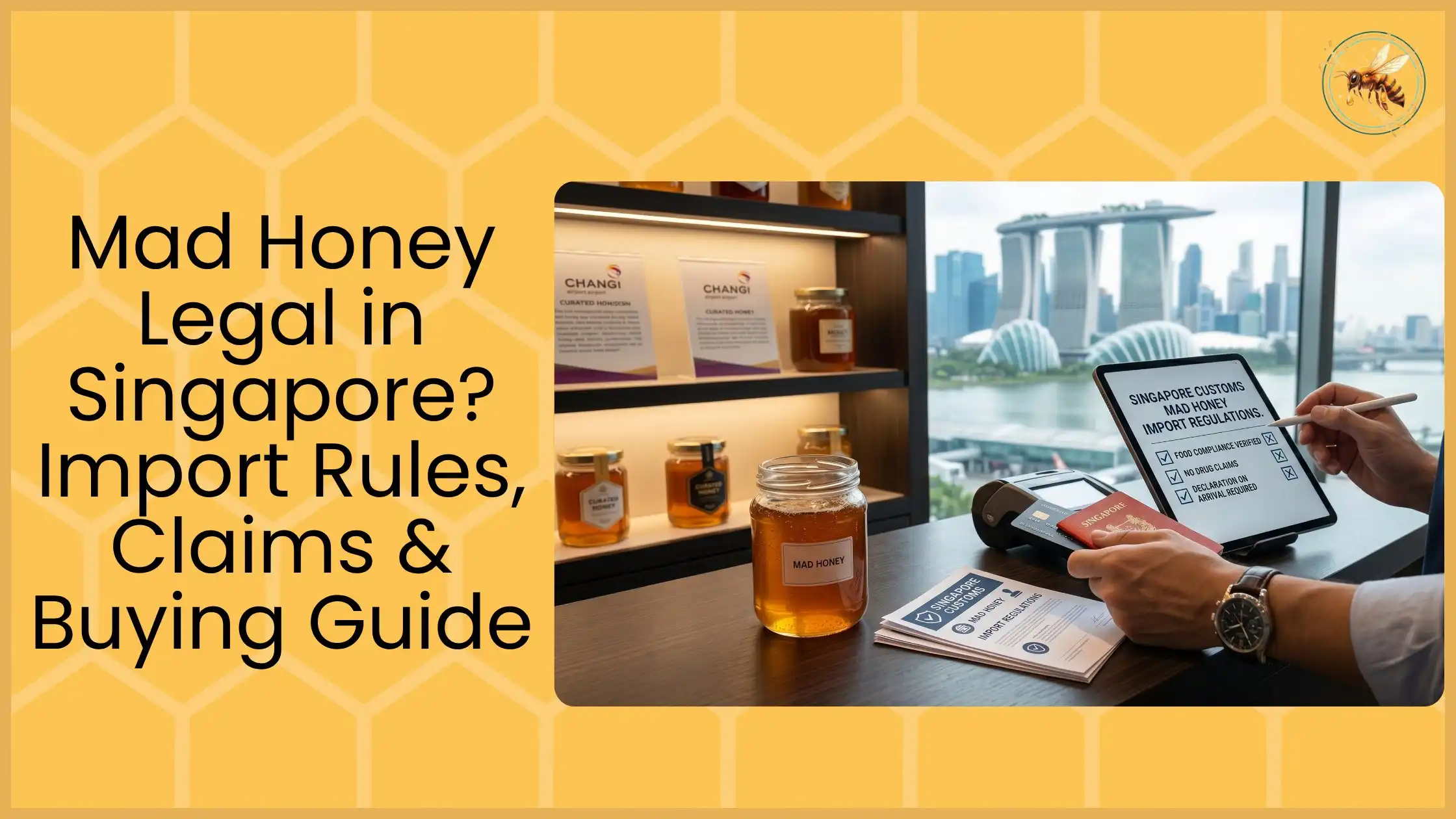
Mad honey is generally treated as a food (honey) in Singapore, not as a controlled drug. Most “legal” issues come from import clearance and how the product is labeled/marketed, not from simple possession. Singapore’s regulatory approach is practical: food must be safe and properly described, imports must comply with controlled-item requirements, and products should not be marketed with misleading or drug-like claims.
Singapore Customs notes that import, export, and transshipment of food (including animal products) are regulated by the Singapore Food Agency (SFA).
This guide explains what “legal” means in Singapore (owning vs importing vs selling), why mad honey shipments get questioned, how to reduce border friction, what claims to avoid, and how to buy responsibly.
tl;dr
- Mad honey is usually treated as food, but importing food items can still involve SFA-controlled item requirements and border checks.
- “Legal” has three layers: possession, importing, and selling/marketing, and the most common problems happen in the last two.
- The fastest way to trigger scrutiny is sensational marketing (“psychedelic,” “trip,” “guaranteed high”) or vague product descriptions that make it look like a drug/supplement rather than honey.
- SFA requires accurate food labeling for prepacked food sold in Singapore; incorrect or misleading labeling is a compliance risk.
- For buyers, the safest approach is: transparent origin + batch/lot info + conservative guidance + no hype claims.
Quick Answer: Is Mad Honey illegal like a controlled drug in Singapore?
In typical practice, mad honey is handled as honey/food, not as a controlled drug. The real-world “illegal” stories usually come from
- border/import friction,
- labeling/claim problems, or
- buying from sellers using drug-like positioning.
Can you import/order it online?
Food imports are regulated. Singapore Customs lists SFA as the competent authority regulating imports of processed food and animal products.
That does not mean “you can’t order it.” It means importers must comply with applicable rules, and shipments can be checked, especially if quantities are large, descriptions are vague, or labeling/claims are problematic.
Why you’ll see conflicting answers online
Many online posts use “legal” as shorthand for “won’t be inspected” or “always clears customs.” In Singapore, clearance and compliance depend on the shipment, labeling, declared contents, and whether it looks like personal use or commercial sale.
What “Legal” Means in Singapore (3 Layers)
Understanding these three layers will prevent most confusion.
Possession (owning mad honey)
Owning a jar is typically not where problems arise. Most concern is about bringing it in or selling it.
Importing (border checks and restrictions)
Food items and animal products can be regulated for safety and controlled-item reasons. Singapore Customs explicitly lists SFA as the authority regulating the import/export/transshipment of animal products and processed food.
For honey in your luggage, the Singapore Food Agency does not name honey. If it counts as processed food, the allowance is 5 kg and S$100 per traveler. See the Singapore row of our honey customs table.
Commercial importers must follow SFA import requirements (registration/licensing and product compliance).
Selling/marketing (claims, labeling, classification)
Selling prepacked food in Singapore is where labeling and claims become central. SFA’s labeling requirements emphasize that prepacked food sold in Singapore must provide adequate and accurate information.
Singapore’s Food Regulations (Singapore Statutes Online) include detailed requirements on ingredient declarations and labeling conventions.
If you sell or market mad honey, the compliance lane is: food positioning + truthful labeling + conservative guidance.
Why Mad Honey Can Get Flagged (Even If It’s “Just Honey”)
Mad honey draws extra attention for two practical reasons: marketing behavior and risk perception.
Sensational marketing language is a compliance magnet
Words like:
- “psychedelic”
- “trip”
- “guaranteed high”
- “instant high”
- “works every time.”
…push the product toward a drug-like framing. Even if the product is honey, those claims invite scrutiny because they imply psychoactive outcomes and often cross into misleading advertising.
Food vs supplement/drug framing confusion
Singapore draws important lines between food and health supplements. HSA explains how health supplement claims are classified and sets principles for permissible and prohibited claims in that category.
If a seller markets a honey product like a psychoactive supplement or a therapeutic product, they create avoidable risk, even if the ingredient is still “honey.”
Safety incidents increase attention (dose matters)
Mad honey is dose-sensitive. When a product category is widely associated online with “strong effects,” agencies and platforms tend to be more cautious about misleading claims. That’s why responsible sellers focus on realistic expectations and safety language instead of intense marketing.
Importing/Ordering Online in Singapore (Practical Reality)
Singapore’s approach is compliance-driven. Border friction usually comes down to clarity, documentation, and intent.
What border agencies typically care about
- Clear product description and labeling: Vague descriptions (“herbal extract,” “psychedelic honey,” “medicine honey”) create immediate questions. If it’s honey, the safest description is simply honey, properly labeled.
- Declared contents: A shipment that looks like “supplements” but is labeled as “food” (or vice versa) creates classification issues. Clear labeling helps.
- Quantity (personal vs commercial intent): Small personal quantities generally look different from bulk. Larger quantities can resemble resale intent and may trigger requirements applicable to commercial importers.
- Packaging and inserts: Even if the jar label is clean, inserts that promise psychoactive effects or medical benefits can create problems.
What reduces friction?
These signals tend to help:
- Clear label: “honey” with country/region of origin
- Batch/lot information
- No drug-like claims anywhere on packaging
- Conservative guidance and warnings
Singapore Customs’ “competent authority” framework is explicit: SFA regulates imports of food products, and controlled-item requirements apply depending on product type and context.
Common reasons shipments get delayed/stopped
- Vague or misleading descriptions
- “Drug-like” marketing language on packaging or product pages included in documentation
- Large quantity suggesting resale
- Missing or inconsistent labeling
For commercial importers, SFA’s import requirements are a structured system designed to ensure food safety and protect consumers.
Labeling & Claims (How to Stay on the Safe Side)
Singapore is strict about accurate labeling and not misleading consumers, especially for prepackaged foods.
Claims to avoid
These categories are high risk:
- Disease treatment or cure claims (“treats anxiety,” “lowers blood pressure,” “heals,” “cures insomnia”)
- Guaranteed outcomes (“guaranteed high,” “works every time”)
- Psychoactive framing that implies illegal-drug style effects
If a product is treated as food, those claims are out of place. If a product is treated as a health supplement, claims still have boundaries; HSA outlines principles and permissible/prohibited claim types for health supplements.
Safer language (food-first, conservative)
If the goal is compliance and trust, use language like:
- “rare honey,” “traditional honey,” “wild honey”
- “experience varies,” “start low,” “wait before taking more.”
- “not for everyone,” “avoid if you have BP/HR concerns or relevant medications.”
This is not only safer legally, but it also aligns better with consumer protection and reduces the risk of someone taking too much because they expected a predictable “trip.”
“Lab tested” must be specific
SFA’s labeling guidance focuses on accurate information for consumers.
If a seller says “lab tested,” the trust standard is:
- batch-linked COA
- lab name + report number
- what was tested (GTX levels, contaminants)
- ability to verify the original document
A “lab tested” sticker with no report is not meaningful.
Safety Note for Singapore Buyers (Short but Clear)
Mad honey’s key safety reality is dose sensitivity + batch variability. That combination is why conservative guidance matters.
Why “start low + wait” matters
Delayed onset is common, and batch potency can vary. People get into trouble most often through re-dosing too quickly after “feeling nothing.”
Who should avoid (conservative)
Avoid or use extreme caution if you have:
- blood pressure or heart rhythm issues
- relevant medications affecting BP/HR
- pregnancy/breastfeeding (conservative avoidance approach)
Red flags requiring medical help
- fainting or near-fainting
- chest pain/pressure
- trouble breathing
- persistent vomiting (can’t keep fluids down)
- severe confusion or extreme weakness
Buying Safely in Singapore (Authenticity + Scam Avoidance)
Most “legal” fears are actually “fake product” fears. Buyers want to avoid scam listings that hide origin and use hype claims.
What responsible sellers provide
- Origin clarity (region/country, not just “Himalayan”)
- Batch/lot info and harvest context
- Conservative guidance and warnings
- Consistent packaging and traceable documentation
Red flags
- “strongest,” “guaranteed trip,” “instant high”
- vague origin with no harvest context
- no safety guidance anywhere
- no batch info
- “lab tested” with no report
SFA’s labeling requirements reinforce why accurate information matters: consumers rely on labels to make informed decisions, and food businesses must provide adequate and accurate label information.
📖 Also read: Is Mad Honey Legal? What “Legal” Actually Means
Conclusion
In Singapore, mad honey “legality” is usually about import compliance + truthful labeling + responsible claims, not criminal possession. Singapore Customs identifies SFA as the competent authority regulating the import/export/transshipment of food products, and commercial importers must comply with SFA import requirements.
For selling, SFA’s labeling requirements and Singapore’s Food Regulations set expectations for accurate, non-misleading food labels.
For claim language, HSA’s health supplement claims guidance shows how claims are categorized and why “therapeutic” style promises are a compliance risk.
The lowest-risk approach is consistent:
- buy from transparent sellers
- avoid drug-like or therapeutic claims
- prefer batch information and verifiable testing
- follow conservative safety guidance
Also read: Is mad honey legal in the UK?, Is mad honey legal in Australia?, Is mad honey legal in the Philippines?, Is mad honey legal in Canada?, Is mad honey illegal in the US?
FAQs – Mad Honey Legal in Singapore
Is mad honey banned in Singapore?
Most issues relate to compliance and border clearance, not “bans.” Food imports are regulated, and SFA is the competent authority for many food categories.
Can I order mad honey online in Singapore?
Food imports may be checked and must comply with applicable requirements; products should be clearly described and labeled as honey, and avoid drug-like claims.
Can border agencies stop it?
Shipments can be delayed or questioned if descriptions are vague, quantities look commercial, or labeling/claims are problematic. Commercial importers must comply with SFA import requirements.
Is it legal to resell?
Reselling triggers labeling and compliance obligations for prepackaged food. SFA’s labeling requirements apply to food offered for sale in Singapore.
Is it legal to advertise effects?
Claims matter. HSA provides guidance on claims for health supplements, and exaggerated “psychedelic/guaranteed” claims are high-risk from a consumer protection and compliance standpoint.
Is Turkish “deli bal” treated differently?
It is still honey as a product type; what matters is compliance, labeling, and how it’s marketed.
Is mad honey safe for beginners?
Safety depends on dose, batch variability, and personal risk factors. Beginners should follow conservative dosing guidance and avoid “strongest” marketing.