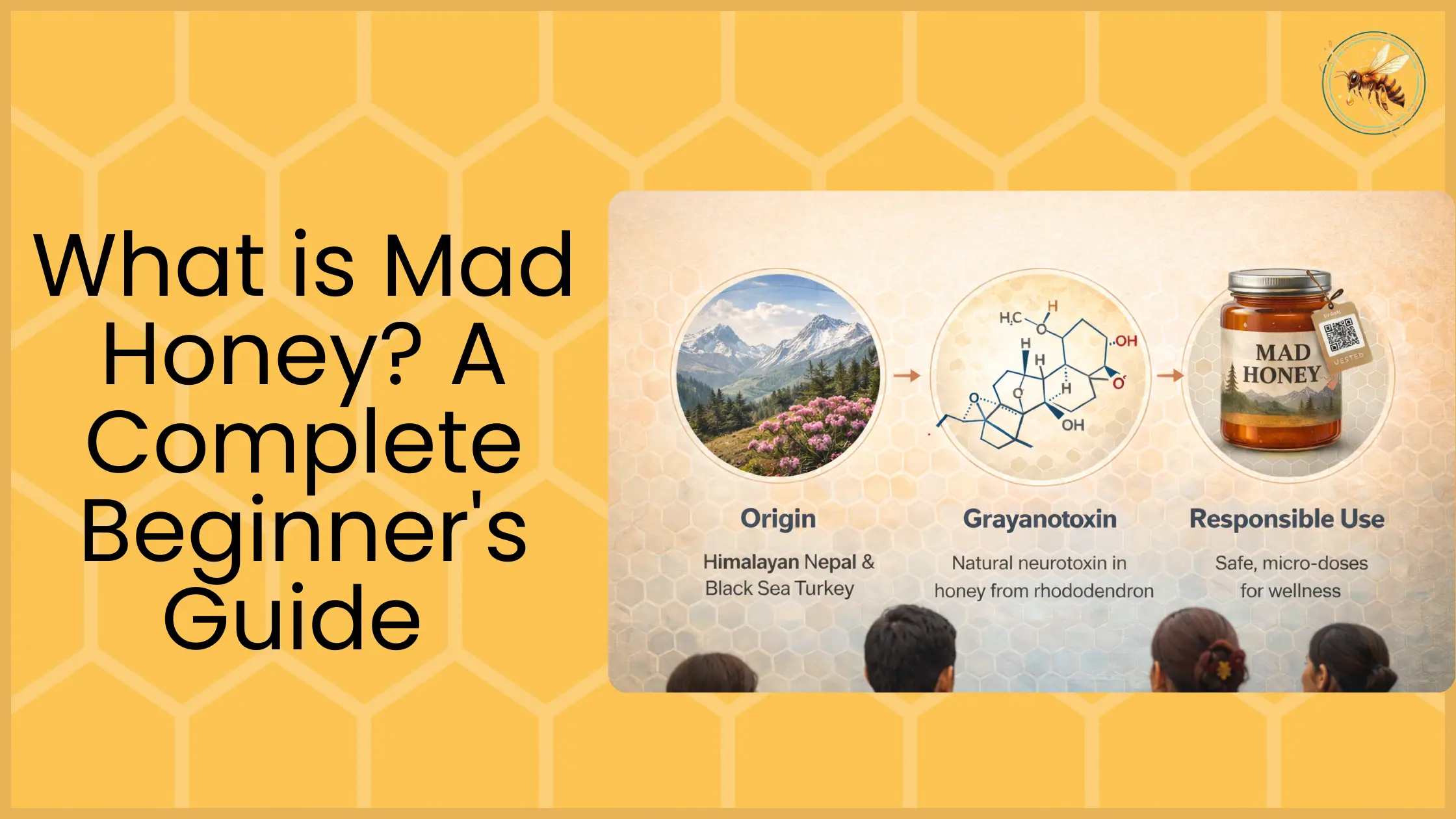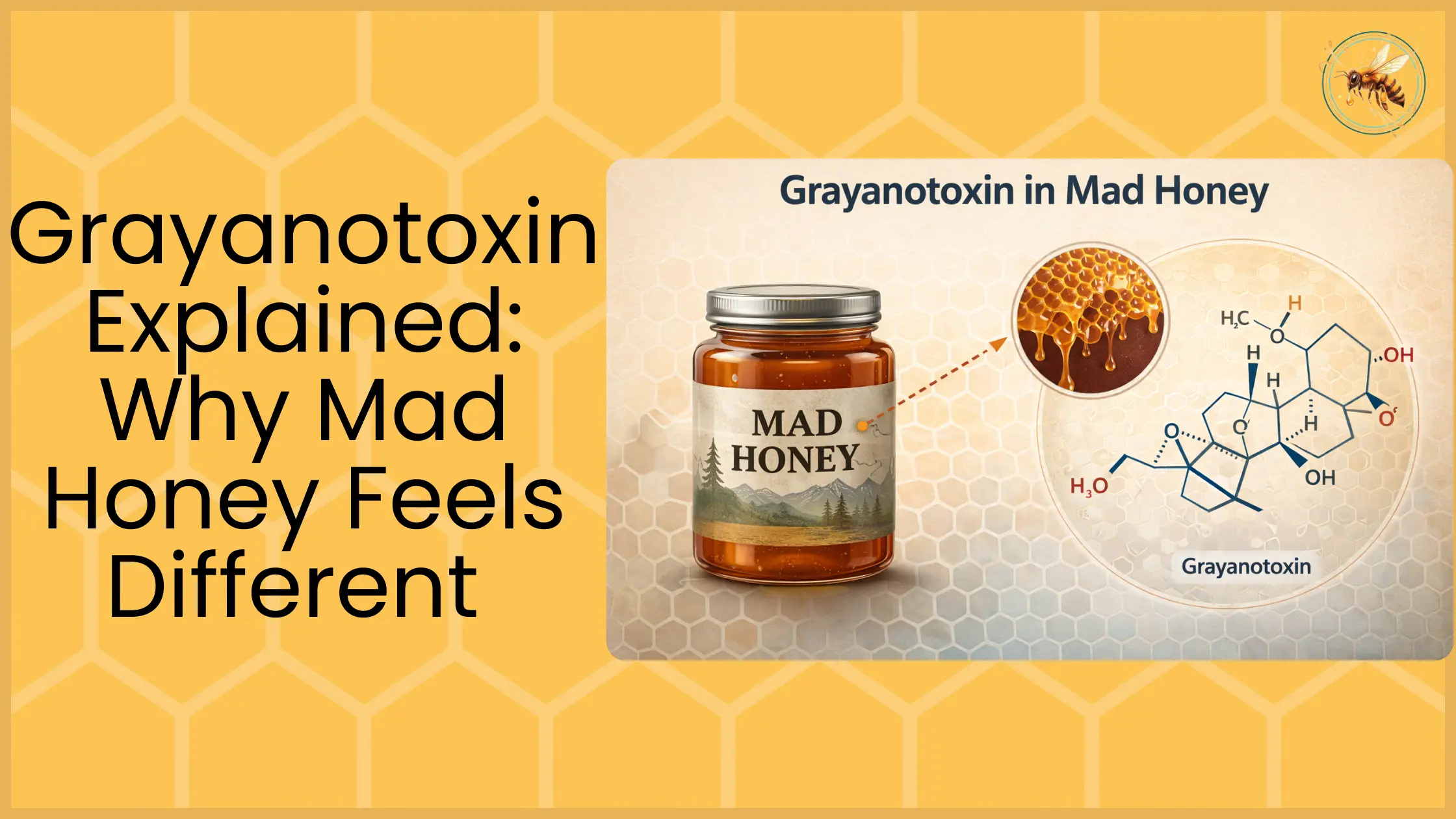
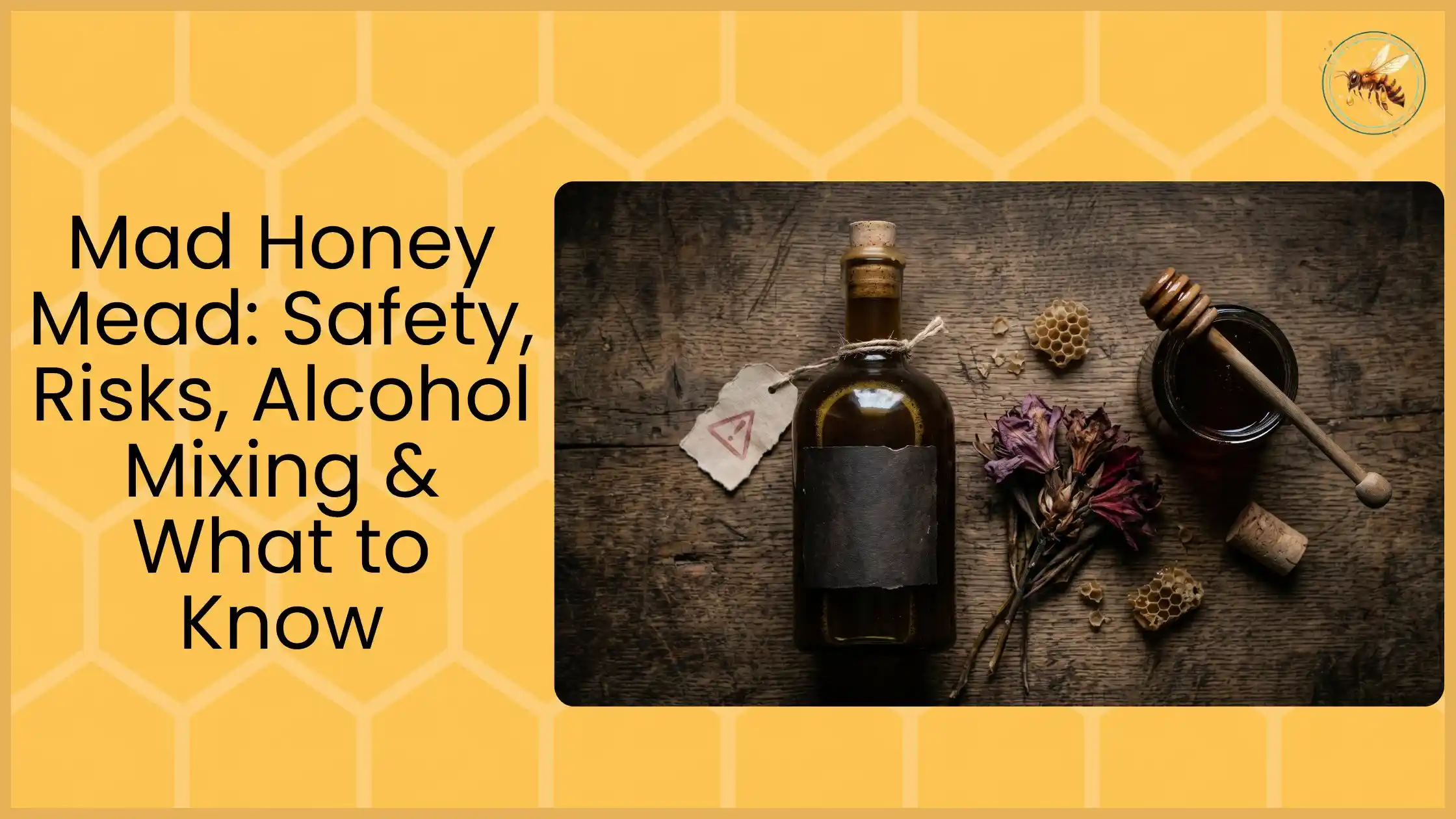
Mad honey mead sounds like a natural pairing: honey, fermentation, tradition, and a rare ingredient with a strong story behind it. But mad honey is not ordinary honey. Certain batches can contain grayanotoxins, naturally occurring compounds from rhododendron nectar that may affect blood pressure, heart rate, dizziness, nausea, and overall body response.
That changes the entire conversation. Regular mead is an alcoholic drink made by fermenting honey. Mad honey mead would combine alcohol with a honey that may already have dose-sensitive physiological effects. That does not mean the idea is impossible in a technical sense, but it does mean it should not be treated as a casual home experiment or a “stronger mead” trend.
tl;dr
- Mad honey mead is technically possible, but it is not recommended as a casual DIY project because alcohol can make mad honey’s risk profile harder to predict.
- Fermentation should not be assumed to remove grayanotoxins or make mad honey safe; without proper testing, the active compound level remains unknown.
- The biggest concern is the combination of mad honey + alcohol, because both can contribute to dizziness, nausea, dehydration, poor judgment, and unsafe re-dosing decisions.
- Batch variability matters even more in beverage form because a mixed batch can make it harder to know how much grayanotoxin is present per serving.
- A responsible commercial mad honey beverage would require batch testing, clear serving limits, contraindication warnings, and careful regulatory review, not just a recipe.
Quick Answer – Can You Make Mead With Mad Honey?
Technically, yes: mad honey can be fermented like other honeys because it contains fermentable sugars. Yeast can convert those sugars into alcohol, which is the basic process behind mead.
But the more important answer is: it should not be approached as a casual experiment. Mad honey is not just a flavoring ingredient. It may contain grayanotoxins, and those compounds are the reason people treat mad honey differently from regular honey.
A standard mead recipe only tells you how to ferment honey into alcohol. It does not tell you whether the grayanotoxin level is safe, whether fermentation changed the risk, how much active compound remains per glass, or whether the final drink is appropriate for consumers.
The safest takeaway is simple: mad honey mead should be treated as a controlled, tested product concept, not as a homebrew novelty.
What Is Mead?
Mead is one of the oldest alcoholic drinks in the world. At its simplest, it is made by fermenting honey with water and yeast. The yeast consumes the sugars in the honey and produces alcohol, along with flavor compounds that can create floral, fruity, dry, sweet, or wine-like notes.
Mead as fermented honey alcohol
Regular mead depends on three basic elements: honey, water, and yeast. Depending on the recipe, producers may also add fruit, spices, herbs, nutrients, or aging techniques to shape the final flavor.
A simple mead can taste light and floral. A stronger or aged mead can taste closer to wine, sherry, or dessert alcohol. The character depends on the honey source, fermentation method, yeast strain, sweetness level, and aging time.
Why regular honey is commonly used
Regular honey is used because it is flavorful, sugar-rich, and fermentable. It contributes aroma, sweetness, mouthfeel, and regional character. Different honeys create different meads: wildflower honey may taste floral and broad, orange blossom honey may taste bright and citrusy, and darker honeys may create deeper, richer flavors.
Why mad honey changes the equation
Mad honey is different because it is not only a sweetener or flavor base. Its defining feature is the possible presence of grayanotoxins. That means a mad honey mead would not only be an alcoholic honey beverage; it could become an alcoholic beverage containing a dose-sensitive bioactive compound.
That is the safety problem.
What Would “Mad Honey Mead” Mean?
The phrase “mad honey mead” can mean a few different things, and each version carries a different risk.
Mead made entirely with mad honey
This would be the highest-risk version. If all fermentable honey in the recipe is mad honey, the final beverage could contain an unknown concentration of grayanotoxins unless the honey and finished product are tested.
The danger is that a drink format can hide the dose. With a jar of honey, someone may think in spoonfuls. With mead, someone may think in glasses. A glass can contain more exposure than expected, especially if the batch was strong.
Mead flavored with a small amount of mad honey
Some people may imagine using a small amount of mad honey as a finishing honey, back-sweetener, or flavor note. This may reduce total exposure compared with a full mad honey ferment, but it does not remove the core issue. The final drink still needs testing to know what it contains.
A “small amount” is not automatically safe when the potency of that amount is unknown.
Commercial “mad honey mead” concepts
A commercial concept would need a much stricter standard than a home recipe. It would need to answer questions such as:
- What is the grayanotoxin level in the honey?
- What is the grayanotoxin level in the finished beverage?
- How much is present per serving?
- Does the alcohol percentage increase risk?
- Who should avoid it?
- What warnings are required?
- How should it be classified and sold legally?
Without those answers, “mad honey mead” is more of a risky idea than a responsible product.
Why this attracts risky curiosity
Mad honey already attracts curiosity because people associate it with unusual effects. Mead adds alcohol, tradition, and craft beverage appeal. That combination can make the idea feel exciting, but it can also encourage exactly the wrong mindset: chasing intensity, mixing effects, and assuming natural ingredients are automatically safe.
The Main Safety Problem: Mad Honey + Alcohol
The biggest concern with mad honey mead is not fermentation itself. It is the combination of mad honey and alcohol.
Alcohol already affects coordination, judgment, hydration, and nausea
Alcohol can cause dizziness, impaired coordination, slower reaction time, dehydration, nausea, vomiting, and poor decision-making. Even moderate drinking can make it harder to notice early warning signs or make conservative choices.
That matters because mad honey also has body-level effects when someone takes too much.
Mad honey can add dizziness, nausea, low blood pressure, or slow heart-rate concerns
Mad honey’s unwanted effects can include dizziness, weakness, sweating, nausea, vomiting, low blood pressure, and slow heart rate. These symptoms can overlap with alcohol-related discomfort, making it harder to know what is happening.
If someone feels dizzy after drinking mad honey mead, is it alcohol? Mad honey? dehydration? low blood pressure? a strong batch? That uncertainty is the risk.
Why combining increases unpredictability
Combining alcohol with mad honey can create several problems at once:
- Alcohol can make someone less cautious.
- Mad honey can be delayed or batch-variable.
- A drink format can make serving size unclear.
- Nausea, dizziness, and weakness can compound.
- If symptoms appear, it is harder to identify the cause.
This is why mad honey and alcohol should not be treated as a clever pairing just because both are natural or traditional.
Does Fermentation Remove Grayanotoxins?
A common assumption is that fermentation “transforms” ingredients and might make mad honey safer. That assumption should not be relied on.
Do not assume fermentation makes mad honey safe
Fermentation changes sugars into alcohol. It can change flavor, aroma, acidity, sweetness, and mouthfeel. But that does not mean it reliably removes grayanotoxins.
Without lab testing before and after fermentation, there is no responsible way to claim that fermentation neutralizes the active compounds.
Why this question requires lab testing
The only meaningful way to evaluate safety is to test:
- the starting honey
- the fermentation batch
- the finished bottled beverage
- the grayanotoxin level per serving
A homebrewer cannot judge this by taste, color, smell, clarity, alcohol percentage, or how “smooth” the mead feels.
Heat, yeast, aging, and alcohol are not a safety guarantee
Some people assume that yeast activity, time, alcohol, acidity, or mild heat will “break down” anything risky. That is not a safe assumption. Even if some changes occur, the only practical question is what remains in the final drink.
Bottom line
Fermentation should not be viewed as a detox method. Until tested, mad honey mead should be treated as potentially containing grayanotoxins.
Batch Variability Makes Mad Honey Mead Hard to Control
Mad honey varies naturally, and that variability becomes more complicated in a beverage.
Mad honey potency varies by region, season, nectar source, and batch
The grayanotoxin level in mad honey depends on factors like rhododendron species, bloom conditions, region, season, and handling. Two jars can look similar and still have different potencies.
This is already important when someone eats mad honey directly. It becomes even more important when mad honey is diluted, fermented, bottled, aged, and served in glasses.
Juice or wine-style thinking does not apply well here
With regular mead, a producer can focus on sweetness, acidity, alcohol percentage, yeast health, and flavor balance. With mad honey mead, there is another variable: active compound exposure.
A recipe can control sugar and alcohol. It cannot control grayanotoxin content unless the ingredient and final product are tested.
Mead concentration uncertainty
If mad honey is used in a batch of mead, grayanotoxins may be distributed throughout the liquid, but the final concentration per serving depends on the starting honey amount, honey potency, dilution, fermentation volume, backsweetening, and bottling consistency.
That makes casual serving advice unreliable.
Why homemade batches are especially risky
Homebrewers can measure gravity, alcohol percentage, pH, and fermentation progress. But most cannot measure grayanotoxin content. That means a homemade mad honey mead may look successful as a beverage while still being unsafe or unpredictable as a mad honey product.
Why a Recipe Is Not the Right Approach
A mad honey mead article should not read like a normal homebrew guide.
A standard mead recipe does not solve the active-compound problem
A normal mead recipe might tell you:
- how much honey to use
- how much water to add
- which yeast to choose
- how long to ferment
- how to stabilize and bottle
But none of that answers the safety question. A perfect fermentation can still produce a risky beverage if the mad honey has unknown grayanotoxin levels.
Spoon-based or cup-based measurements are not enough
With regular honey, a cup is a cup. With mad honey, a cup from one batch may not be equivalent to a cup from another batch in terms of active compounds.
That is why recipes based only on volume are not adequate.
“Stronger” is not a quality goal
For regular mead, “stronger” may refer to higher alcohol content or bolder flavor. With mad honey, “stronger” can mean less predictable and potentially more dangerous.
A responsible approach does not chase strength. It prioritizes measured content, conservative serving, and clear warnings.
Educational value for this article
The useful question is not “How do I make mad honey mead at home?” The useful question is: What would need to be true for mad honey mead to be made responsibly?
What Would Responsible Commercial Mad Honey Mead Require?
A responsible commercial mad honey beverage would need a much higher standard than curiosity or tradition.
Batch testing for grayanotoxins
The producer would need to test both the honey and the finished beverage for relevant grayanotoxins. Testing only the starting honey may not be enough if the final concentration per serving is what matters to the consumer.
Clear serving limits
The bottle would need clear serving guidance based on actual tested levels. “Drink responsibly” is not enough if the product contains a dose-sensitive ingredient.
Adverse/contraindication safety warnings
A responsible label would warn against use by people with:
- low blood pressure
- heart conditions
- fainting history
- pregnancy or breastfeeding
- children or adolescents
- people taking blood pressure, heart rate, sedative, or anxiety medications
- people mixing with alcohol or other substances
Because the product is already alcoholic, the warning burden becomes even more important.
Regulatory classification review
Mad honey mead could raise multiple regulatory questions: alcohol rules, food rules, labeling rules, health claims, import rules, and potentially novel ingredient or safety review issues, depending on the market.
A producer should not assume that because mead is legal and honey is legal, mad honey mead is automatically simple to sell.
Third-party certification review
A serious product would benefit from outside review: lab testing, traceability, quality control, batch documentation, and clear consumer safety standards.
Who Should Avoid Fermented Mad Honey Mead?
Some people should avoid mad honey in general, and even more so when alcohol is involved.
People with low blood pressure
Mad honey can contribute to low blood pressure symptoms. Alcohol can cause dehydration and dizziness. Together, the risk is higher.
People with heart conditions or heart-rate concerns
Mad honey can be associated with slow heart rate and cardiovascular symptoms at higher exposure. Anyone with heart rhythm issues, fainting history, or heart disease should avoid it.
People taking medication or supplements
This includes blood pressure medication, beta blockers, heart rhythm medication, sleep aids, sedatives, anxiety medication, muscle relaxants, and calming supplements. Alcohol already interacts with many medications; adding mad honey increases uncertainty.
Pregnant or breastfeeding women, children, and older adults
These groups should avoid mad honey mead. Alcohol alone is enough reason for some of these groups; mad honey adds another layer of risk.
What If Someone Already Drank Mad Honey Mead?
If someone already consumed mad honey mead and feels unwell, the safest response is to reduce risk and watch for red flags.
Stop drinking more
Do not take another glass. Do not add more mad honey. Do not mix with other substances.
Sit or lie down
If dizziness or weakness appears, fall risk becomes important. Sit or lie down somewhere safe and avoid standing quickly.
Hydrate slowly
Sip water if you can keep it down. Do not force large amounts if nausea or vomiting is present.
Watch for concerning symptoms
Pay attention to:
- strong dizziness
- fainting
- persistent vomiting
- chest pain or pressure
- trouble breathing
- severe weakness
- confusion
- very slow pulse sensation
- symptoms that worsen instead of improving
Seek medical help for red flags
If symptoms are severe, persistent, or worsening, seek medical help. Tell the medical professional that you consumed alcohol made with mad honey or honey that may contain grayanotoxins, and mention the approximate amount and timing.
Mad Honey Mead vs Regular Mead
Mad honey mead and regular mead are not in the same category from a safety perspective.
Regular mead
Regular mead carries the normal risks of alcohol: intoxication, impaired judgment, dehydration, nausea, hangover, and interaction with medication.
Mad honey mead
Mad honey mead may carry normal alcohol risks plus mad honey-specific risks such as dizziness, nausea, low blood pressure, slow heart rate, and batch variability.
Taste difference
Mad honey may add darker, herbal, bitter, earthy, or resin-like notes depending on the batch. But taste cannot prove safety, potency, authenticity, or grayanotoxin level.
Practical comparison
Regular mead is a beverage category. Mad honey mead is a bioactive ingredient question layered onto an alcoholic beverage. That makes safety and testing much more important.
Mad Honey Mead vs Mad Honey Tea
Some people compare mad honey mead with mad honey tea because both involve mixing mad honey into a drink. They are not the same.
Tea is non-alcoholic and easier to keep conservative
A non-alcoholic drink avoids the added alcohol-related risks of impaired judgment, dehydration, nausea amplification, and medication interactions.
Mead adds intoxication and impaired judgment
Alcohol makes conservative use harder. Someone may drink more than planned, judge symptoms poorly, or re-dose because they assume the drink is mild.
A more conservative alternative
Mad honey tea is a more conservative option than mad honey mead. That does not make tea risk-free, but it avoids the alcohol stacking problem.
Conclusion
Mad honey mead is technically possible, but safety is the issue. Regular mead is already alcoholic; mad honey adds possible grayanotoxin exposure, dose sensitivity, batch variability, and cardiovascular risk signals. Fermentation should not be assumed to remove those risks.
The safest position is clear: do not treat mad honey mead as a casual homebrew project. If it is ever made commercially, it should be built around lab testing, batch control, serving limits, clear warnings, and regulatory review. For consumers, the safer choice is to avoid mixing mad honey with alcohol and to approach mad honey through conservative, non-alcoholic use only if they are an appropriate candidate.
FAQs – Mad Honey Mead
What is mad honey mead?
Mad honey mead would be mead made with mad honey, or mead flavored/back-sweetened with mad honey. It combines alcohol with a honey that may contain grayanotoxins.
Can mad honey be fermented into alcohol?
Technically, yes. Honey sugars can ferment into alcohol. The problem is not whether fermentation can happen; the problem is whether the final beverage is safe and tested.
Does fermentation remove grayanotoxins?
Do not assume it does. Fermentation changes sugars into alcohol, but it should not be treated as a guaranteed detox process. Testing would be needed to know what remains.
Is mad honey mead safe?
It should be treated as a higher risk than regular mead because it combines alcohol with a dose-sensitive honey. Without testing and clear serving guidance, it is not a responsible casual product.
Can you mix mad honey and alcohol?
The safest answer is no. Alcohol can increase dizziness, nausea, dehydration, and poor judgment. Mad honey can also cause dizziness, nausea, low blood pressure, and slow heart-rate symptoms in some cases.
Would mad honey mead get you high?
That is the wrong way to frame it. The risk is not a predictable “high.” The concern is body-level effects such as dizziness, nausea, weakness, low blood pressure, or slow heart rate, especially when combined with alcohol.
Can mad honey mead be stronger than regular mead?
It may feel stronger because it combines alcohol with mad honey’s active-compound risk. That does not make it better. It makes it less predictable.
What should I do if I feel dizzy after drinking it?
Stop drinking more, sit or lie down, hydrate slowly if possible, and monitor symptoms. Seek medical help if dizziness is severe, you faint or nearly faint, have chest pain, breathing trouble, persistent vomiting, confusion, or severe weakness.
Is there a safe homemade recipe?
A standard recipe cannot solve the safety problem because it cannot measure grayanotoxin content. Without lab testing and serving controls, homemade mad honey mead is not recommended.