Quick Answer: Typical Mad Honey Duration Range
Before we go step-by-step, here’s what most people mean by “how long it lasts,” stated carefully.
Typical total duration (conservative range)
For many low-dose experiences, the most noticeable effects commonly fall within 2–6 hours. If someone takes more than they should, or re-doses quickly, the experience can stretch longer (often 6–12+ hours), and the uncomfortable physical symptoms can dominate what they remember. Some people also feel mild next-day tiredness or “off” feelings, especially if sleep was disrupted, but the overall trend should be steadily back toward normal.
What “back to normal” usually means
“Back to normal” is usually a functional baseline, not a perfect reset. Most people mean they can stand and walk without dizziness, their stomach feels settled, they feel mentally clear enough for normal tasks, and they don’t get waves of weakness, sweating, or lightheadedness when they move around. If you’re still compensating, moving slowly, needing to sit, feeling unstable, you’re not fully “back,” even if the intense part is over.
Why you’ll see conflicting answers online
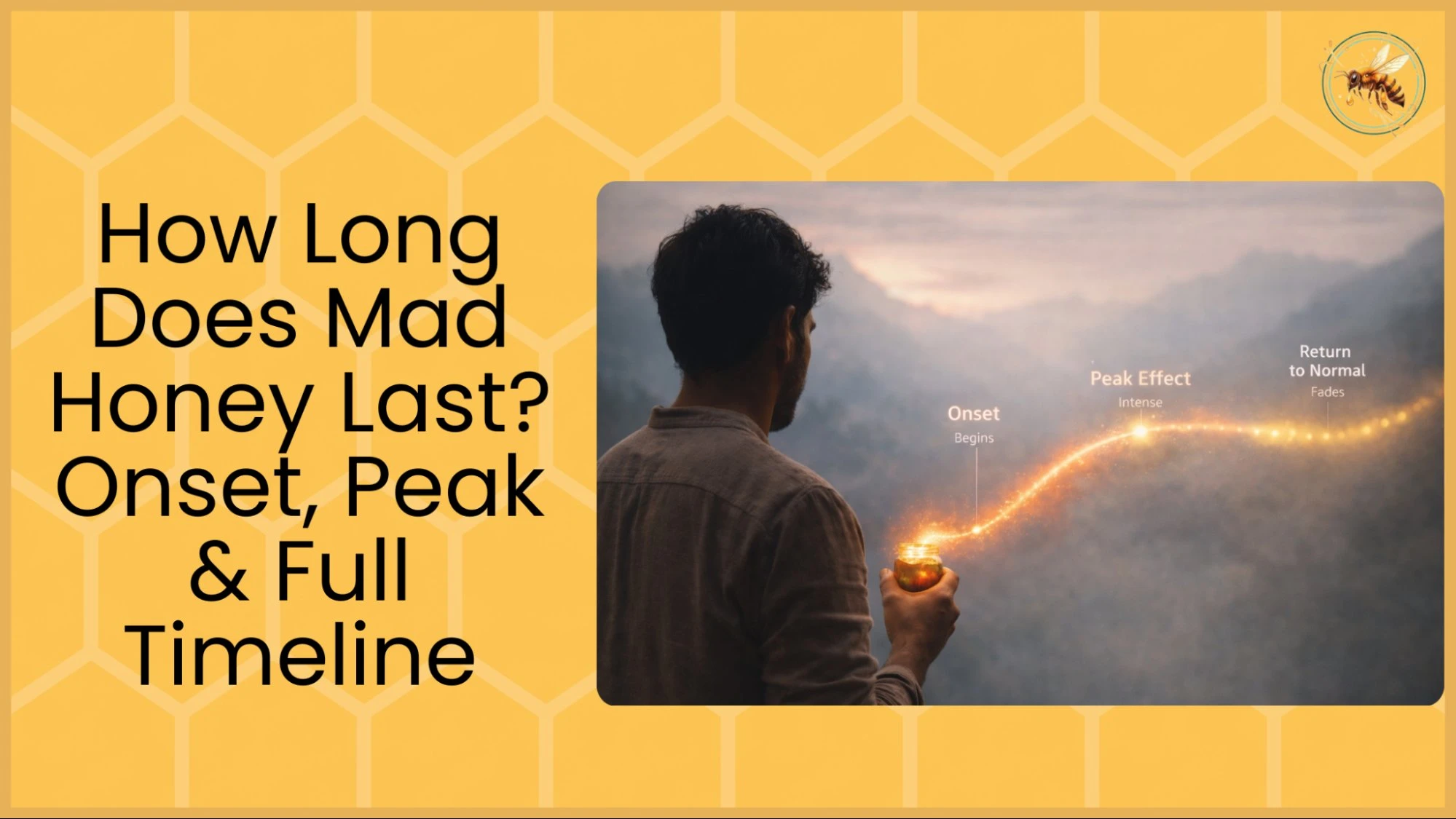
Conflicting answers happen because people mix up different points on the curve. One person is describing onset (“I felt it in 20 minutes”), another is describing peak (“it hit hardest at 90 minutes”), and another is describing total duration (“I felt off for 8 hours”). Add dose differences, whether they ate, and batch variability, and suddenly the internet looks like it can’t agree, even though everyone is describing the same basic timeline at different intensities.
Mad Honey Timeline (Step-by-Step)
This is the core section. Use it like a map: where you are now, what’s likely next, and what choices keep the timeline predictable.
1) Onset: When It Starts
Onset is when you first notice something has shifted. At a conservative dose, onset often feels subtle: a calmer body, warmth in the face or chest, heavier eyelids, or a slightly different body awareness. Some people notice a stronger herbal/bitter finish to the taste, which can be part of the sensory experience rather than a “strength” signal by itself.
Onset timing varies most with food and dose. If you took mad honey after a meal, the onset may be slower and smoother. On an empty stomach, the onset can feel quicker and sharper. The biggest danger in the onset phase isn’t the feeling itself, it’s the decision people make when they don’t feel much yet: they assume nothing is happening and re-dose too early.
Key rule: if you’re unsure, wait. Most “it lasted forever” stories start with “I didn’t feel it, so I took more.”
2) Peak: When It Feels Strongest
Peak is when effects feel most obvious. At a low dose, peak often feels like a stable wind-down: relaxed body, quieter mood, slower pace. It’s typically body-led, not “mind-trippy.”
At higher doses, the peak can become uncomfortable and even scary; this is where people report nausea, sweating, dizziness, heavy limbs, weakness, and a “drunk-like” impairment when standing or walking. The reason the internet sometimes describes this as a “high” is that the intensity can be real. But in many cases, the intensity is physiological and dose-dependent, not a classic recreational intoxication.
The single biggest factor that makes peak worse is stacking. When you add more during the rise, before the first dose has clearly peaked, you can push yourself from mild effects into symptoms, and those symptoms can extend the timeline.
3) Fade-Out: When It Starts Wearing Off
Fade-out is when the experience softens, and your body begins returning toward baseline. The calm becomes more ordinary, the unusual body sensations reduce, and you feel less “inside” the experience. If you had mild dizziness or nausea, fade-out is when those sensations should trend downward.
If you want a predictable end time, this is where you avoid re-dosing. “Topping up” during fade-out is a common reason people feel dragged out for hours longer than necessary.
In this phase, basic self-care usually helps the body settle: rest, slow hydration, and light food if your stomach is calm enough. Nothing here is a cure, just the basics that support normal recovery.
4) After-Effects: The Next Day
Some people wake up feeling completely normal. Others report mild tiredness, a slightly slow morning, or a general “reset” feeling, especially if sleep was disrupted or they took too much. That can be normal as long as the direction is improving.
What isn’t normal is a next-day escalation: severe weakness, persistent vomiting, fainting, chest pain, breathing difficulty, or confusion that doesn’t clear. If symptoms are still strong or worsening the next day, treat it as a safety event and seek help.
What Changes the Duration (The 7 Biggest Factors)
Even when the timeline shape stays consistent, these factors decide whether you land on the short end or the long end.
1. Dose (the biggest lever)
Dose is the primary duration multiplier. The higher the dose, the more likely you are to extend the peak and prolong the fade-out. This is also why “one spoon” isn’t a useful unit; spoon sizes vary, honey density varies, and people define “spoon” differently.
2. Empty stomach vs after food
Food usually slows the rise and can make the onset feel later and smoother. An empty stomach typically makes the onset feel faster and the peak sharper. Neither guarantees safety, but food can change how sudden the experience feels, and that changes how likely people are to panic or re-dose.
3. Batch variability (season/region)
Mad honey can vary by harvest, season, region, and handling. That variability affects how strong the same amount feels and can shift both intensity and perceived duration. This is why one jar can feel “milder,” and another can feel more noticeable, even with identical dosing habits.
4. Body size + sensitivity
Individual response matters. Hydration status, baseline blood pressure sensitivity, sleep quality, and stress can all change how intense the experience feels. And intensity often determines perceived duration: a mild experience feels shorter; a rough one feels longer.
5. Alcohol / mixing substances
Mixing alcohol or other sedatives can amplify dizziness and impairment and make the timeline less predictable. If your goal is control and clarity, especially around driving or work, mixing is the opposite of helpful.
6. Sleep deprivation/dehydration
If you’re tired or dehydrated, the experience can feel harsher, and recovery can feel slower. Many unpleasant “long-lasting” experiences have dehydration, poor sleep, or both in the background.
7. Frequency of use (tolerance isn’t reliable here)
Because mad honey varies by batch and your body varies day to day, “tolerance” is not a dependable safety strategy. The conservative approach doesn’t change: start low, wait, and don’t stack.
Low Dose vs Too Much (How Duration Shifts)
This section is here because it explains why two people can have completely different timelines from the same jar.
Low dose: shorter, smoother, more predictable
A conservative dose tends to produce a clearer timeline: gentle onset, manageable peak, and a fade-out that doesn’t drag. It’s also less likely to produce unpleasant symptoms that extend the “I don’t feel normal yet” window.
Too much: longer, more uncomfortable, higher risk
Higher doses don’t just make it “stronger.” They can make it messier: nausea, dizziness, sweating, weakness, and the kind of instability that forces you to lie down. Those symptoms tend to extend the time it takes to feel steady again, and they increase the risk of unsafe decisions (like trying to walk around or drive).
The “I felt nothing, so I took more” trap
This is the most common pathway to a longer experience. Onset can be delayed, especially after food, so people assume nothing is happening, re-dose, and then both doses rise together. Instead of one controllable wave, they create a double-wave that peaks higher, feels worse, and lasts longer.
Safety: When to Be Concerned?
This guide is safety-first, because duration questions often come from anxiety: “Is this normal?”
Normal vs concerning symptoms
Mild calm, heaviness, and a subtle mood shift can be normal at low doses. Mild stomach unease can happen, especially if you’re sensitive or took more than you should. But symptoms that impair basic function, like significant dizziness, inability to stand steadily, or repeated vomiting, are no longer “just effects.” They’re warning signs that you overdid it.
Red flags (seek medical help)
If you experience fainting, severe weakness, persistent vomiting, chest pain, breathing difficulty, or symptoms that feel like a very slow heart rate or very low blood pressure (extreme lightheadedness, near-collapse), treat it as urgent. If something feels wrong in a way that is escalating instead of improving, don’t wait it out alone.
Practical Planning (The “Can I…” Questions)
This is the part that helps people act responsibly once they understand the timeline.
Can I drive?
If you feel any dizziness, weakness, slowed reaction, or “body heaviness,” do not drive. The risk isn’t only mental impairment; it’s sudden lightheadedness or instability when you stand or move. Drive only when you feel fully steady and clear.
Can I go to work?
If your work is physical, safety-sensitive, or involves machinery, treat it like driving: wait until baseline returns. If it’s desk work, a mild experience may not interfere much, but don’t force it, if you’re foggy or unstable, you’re not ready.
Can I sleep?
Many people can sleep normally, especially at a low dose. If you feel nauseated or dizzy, focus on comfort and hydration and avoid re-dosing. If symptoms are severe or scary, don’t rely on sleep as your only plan, use the safety guidance above.
Can I mix with caffeine or alcohol?
Mixing alcohol is a bad idea if your goal is safety and predictability. Caffeine is less dramatic, but it can raise anxiety and make body sensations feel more intense. The conservative approach is to avoid mixing while you’re learning your response.
Conclusion
Mad honey duration isn’t one number; it’s a pattern that changes with dose, food, and batch variability. Most low-dose experiences fall into a few-hour window, while higher or stacked doses are what make it feel long, rough, and unpredictable. The safest way to keep the timeline controlled is simple: start low, wait, and don’t stack.
FAQs: How Long Does Mad Honey Last?
How long until mad honey kicks in?
Often within 30–90 minutes, but it can be faster on an empty stomach and slower after food.
Why does it last longer for some people?
Usually because of dose, re-dosing too soon, food timing, batch variability, dehydration, poor sleep, or individual sensitivity.
Does stronger honey last longer?
Higher-intensity experiences often feel longer because the peak is rougher and the fade-out takes longer, but “stronger” is hard to define because batches vary and “spoonful” isn’t standardized.
Can food reduce the duration?
Food usually smooths and slows the rise, which can reduce “sharpness,” but it can also delay the onset and make the experience feel more gradual. It’s not a shortcut, it’s a timing modifier.
Can mad honey show up on a drug test?
Standard drug panels aren’t designed for honey compounds, and the bigger concern is not “failing a test” but having symptoms that impair judgment or stability. If your job is safety-sensitive, treat any impairment seriously.
How do I sober up faster?
There’s no instant off-switch. The safest approach is rest, hydration, time, and not stacking more. If symptoms are severe or worsening, seek help.