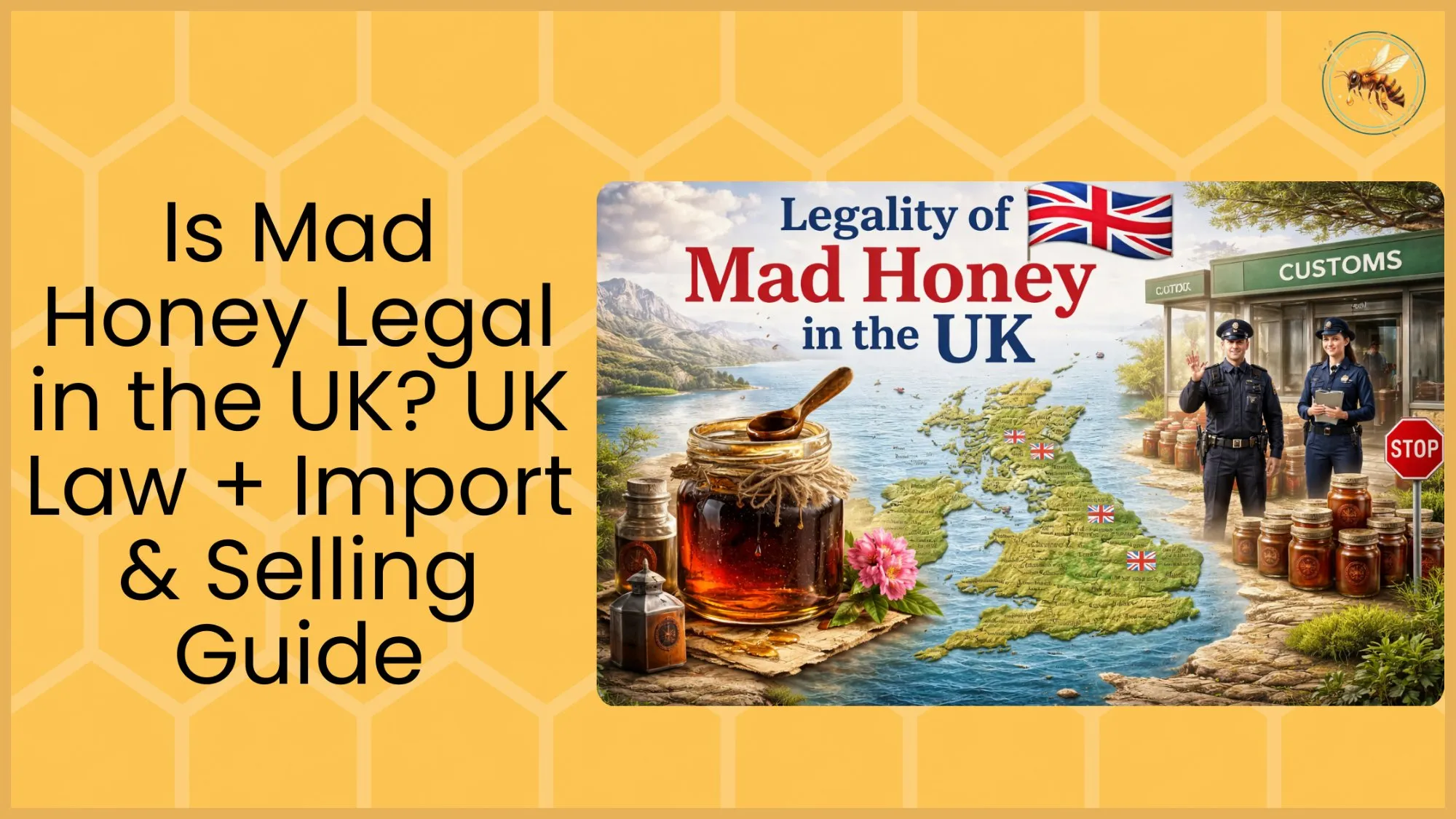
Is it legal to buy in the UK? A Quick Answer
Usually, yes, as a food. In UK law and food standards practice, honey is regulated as a food product category with a defined meaning and rules around what can be sold as “honey.”
Why do “UK law” searches spike (fear + misinformation)?
Because the internet doesn’t talk about it like food. It talks about it like a “legal high,” which triggers fear-based searches and bad assumptions. When people hear “psychedelic honey,” they assume “drug law.” But in the UK, the most common legal tension points are import controls and marketing claims, not criminal possession.
Mad Honey UK Law (Explained Simply)
To make this simple, think of UK “legality” as three separate layers. People mash them together into one anxious question, but they behave differently in practice.
Possession vs importing vs selling
Here’s what you need to know
Layer 1: Possession (owning it)
If you buy a jar of Mad Honey in the UK or receive one shipped to you and it’s treated as a food product, the legal system is not typically concerned with you “possessing mad honey.” The legal issues people imagine (“is it like narcotics?”) aren’t the real-world friction point for consumers.
Layer 2: Importing (customs/border reality)
This is where stress lives. Import checks exist to protect food safety and prevent misdeclared products from entering the market. That means what matters is whether the item appears to be a legitimate, correctly described food product, and whether it fits the rules for bringing food into Great Britain.
Layer 3: Selling/marketing (the most sensitive layer)
If you’re selling mad honey in the UK, especially online, your biggest risk isn’t that honey is “illegal.” Your biggest risk is that your marketing makes the product look like a medicine or drug, or that your claims breach advertising rules and food-claims rules.
This is why serious brands behave differently from hype sellers: they publish conservative safety guidance, don’t promise cures, and avoid “psychedelic” framing.
Why advertising/claims matter in the UK
The UK is strict about “medicinal claims.” The ASA/CAP guidance is clear: claims that a food or food supplement can treat or prevent human disease are prohibited (and enforcement/rulings regularly reflect this principle).
There’s also a separate framework around nutrition and health claims, where only authorised claims (with proper conditions of use) are permitted. CAP’s Section 15 explains that marketers should rely on the relevant registers and guidance, including the GB nutrition and health claims register.
So the UK “legal question” often becomes: Are you selling honey as honey, or are you implying it’s a treatment product?
“Food” positioning vs “supplement/drug” positioning traps
This is where mad honey gets messy online.
If you label and describe it like a food, you’re in the normal world of food regulation and truthful marketing. If you label and describe it like a psychoactive product, you raise the chance of scrutiny, complaint-driven enforcement, account bans on platforms, and “consumer protection” problems.
The trap phrases are predictable:
- “psychedelic honey”
- “hallucinogenic honey”
- “legal high”
- “trip”/“microdose” framing
- “guaranteed effects”
Even if a seller thinks these are just “marketing words,” in practice, they can imply irresponsibility, exaggeration, or medicinal/drug-like positioning, exactly what UK ad guidance tries to control in health-adjacent categories.
Importing Mad Honey to the UK: Common Friction Points
If you’re a buyer, the fear is “will customs seize it?” If you’re a seller, the fear is “will shipments get delayed, returned, or flagged?”
The UK’s public guidance on bringing food into Great Britain shows the bigger picture: rules vary by type of food, origin, and quantity, and certain categories have tighter controls.
The Food Standards Agency also provides business guidance for imports/exports and emphasises that importers need to understand product-specific regulations and general rules like labelling.
That means “mad honey legality” at the border is usually not a special case. The friction points are mostly normal food compliance issues, made worse by bad marketing language.
Border checks: labelling, description, origin
The fastest way to increase friction is to make the shipment look like a mystery item.
Imports tend to look higher-risk when:
- The description is vague or sensational (“psychedelic honey/medicine honey”),
- The label doesn’t clearly identify the product as honey,
- The origin is unclear or inconsistent, or
- The shipment volume looks commercial while being handled like casual personal mail.
Honey also has specific identity and labelling expectations in UK guidance. Business Companion explains that “honey” and related terms are reserved descriptions and can only be used when the product meets compositional requirements set out in the relevant honey regulations.
The Food Standards Agency likewise describes the honey regulations as protecting the reserved description “honey” and preventing misleading or fraudulent practices.
So, for smoother imports, you want the product to look like a properly presented food: clear, boring, normal.
What Mad Honey documentation helps (batch ID, COA/testing language, traceability)
For consumer shipments, you won’t always see “documentation,” but you can still look for brand signals of traceability and professionalism. For sellers, documentation can be the difference between predictable logistics and constant customs friction.
Helpful signals include:
- Batch/lot identification (even a simple batch code on the jar or order confirmation)
- Clear origin statement (not just “Himalayan,” but specific sourcing context)
- Testing language that is specific (avoid vague “lab tested” with no detail)
- Traceability mindset (the brand explains batches, variability, and responsible use)
If you’re importing in a business context, the UK also publishes more specific import notes for honey and apiculture products in the broader “products of animal origin” import framework, useful for serious operators building compliance structures.
Selling Mad Honey in the UK (What Not to Say)
If you’re selling mad honey in the UK, this is the section that matters most.
Claims to avoid (disease/treatment promises)
UK advertising guidance draws a bright line around medicinal claims. ASA/CAP guidance explicitly states that foods and food supplements can’t claim to treat or prevent human disease.
So avoid phrases that imply medical outcomes, even if you personally believe them.
Examples of high-risk claim types include:
- “treats anxiety/depression/insomnia”
- “lowers blood pressure”
- “cures inflammation”
- “treats ED”
- “prevents disease”
- “works like a medicine”
Even softer versions like “clinically treats” or “medical-grade relief” are asking for problems because they imply a medicinal effect.
Safer alternatives (ritual framing + conservative language)
The safe UK lane is: food + experience + responsibility.
You can talk about:
- taste and sensory notes,
- cultural context and origin story,
- realistic expectation setting (“varies by person and batch”),
- conservative guidance (“start low; don’t re-dose fast”),
- who should avoid it (without making medical promises).
This style isn’t just “safer.” It’s also more credible because it matches the reality of a natural, variable product.
Why “psychedelic/hallucinogenic” marketing is a compliance magnet
Because it does three harmful things at once:
- It reframes a food as a drug-like product.
- It encourages irresponsible expectation setting (people chase intensity).
- It often accompanies exaggerated claims, exactly what ad regulators focus on.
UK CAP Code guidance around food and health claims exists to prevent misleading marketing and protect consumers, and ASA guidance repeatedly warns against medicinal framing for foods/supplements.
So even if the words themselves aren’t “illegal,” they can be strategically stupid for UK compliance and brand longevity.
UK Mad Honey Buyer Checklist
This section is for people who want the lowest-drama way to buy mad honey in the UK.
Transparency signals
A trustworthy seller doesn’t rely on mystique. They give you checkable details.
Look for:
- a clear explanation of what the product is (as honey),
- a consistent origin story with specificity (not just “Himalayan”),
- batch/lot signals or at least a traceability mindset,
- realistic wording about variability (no “guaranteed high”),
- clear contact details and a real business footprint.
This aligns with UK honey guidance that emphasises reserved descriptions and the goal of preventing misleading practices.
Safety guidance signals
Good sellers teach restraint. They don’t treat first-timers like adrenaline customers.
Green flags:
- “start low and wait” language
- warnings about mixing with alcohol/sedatives
- reminders that effects vary by person and batch
- a calm tone that prioritises control over intensity
Red flags
Red flags are almost always marketing behaviour, not jar appearance:
- “psychedelic/hallucinogenic” branding
- disease claims or “medicine-like” outcomes
- “guaranteed effects” or “strongest on earth”
- zero origin detail, zero safety guidance, only hype
- aggressive urgency/scarcity language with no traceability
Conclusion
In the UK, the “mad honey legal” question is mostly misunderstood. For most buyers, the issue isn’t possession. It’s whether the product is handled like a properly described food, and whether sellers avoid the compliance traps that come from drug-like positioning and medicinal claims.
A safe, long-term UK approach looks like this:
- treat it as honey (food),
- label and describe it clearly,
- avoid disease treatment/prevention claims (ASA/CAP is strict here),
- respect the honey category rules and reserved descriptions,
- and for imports, follow the UK’s food import guidance and build traceability signals
FAQs about Mad Honey UK
Is mad honey legal to sell online in the UK?
Generally, honey can be sold legally as a food, but sellers must comply with food labelling rules and advertising/claims rules. Honey terminology includes reserved descriptions, and UK guidance emphasises preventing misleading practices.
Is it legal to import into the UK?
Often yes, but it depends on the product type, origin, and how it’s declared. The UK provides guidance on bringing food into Great Britain, and the FSA provides import/export guidance for food businesses.
Can customs seize it?
Customs can detain or refuse goods for various reasons (declaration problems, controls, unclear description, non-compliance). You reduce risk when the product is clearly described as honey (food), not marketed like a drug, and comes from a seller that looks traceable and legitimate. The UK’s official food import guidance is the right baseline reference.
Is it legal to advertise “effects” in the UK?
You can describe taste, origin, and responsible-use guidance. But medicinal claims for foods and food supplements (treating/preventing disease) are prohibited, and health claims must align with authorised frameworks and registers.
Is “hallucinogenic honey” legal?
Even when words aren’t explicitly banned, this phrasing is high-risk because it positions a food like a psychoactive drug and often implies exaggerated outcomes. UK ASA/CAP guidance focuses heavily on preventing misleading medicinal claims and ensuring compliant health-related advertising.