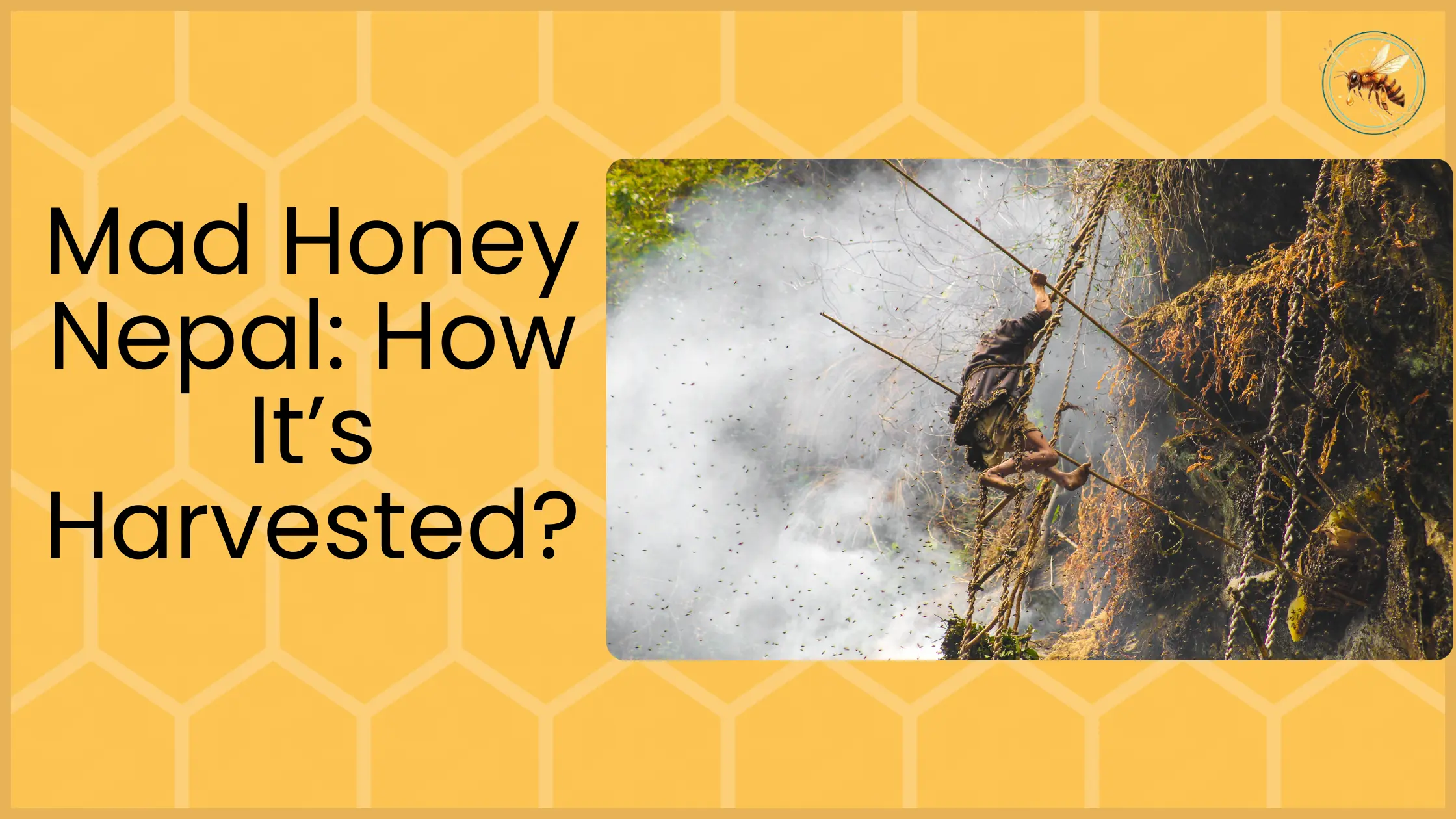
When people search “mad honey Nepal,” they’re usually looking for the real story behind the viral clips: honey hunters on rope ladders, enormous cliff hives, and a honey said to feel “different.”
That story is real. But the internet compresses it into one misleading idea: “Himalayan honey = crazy honey.” The truth is more specific and more interesting.
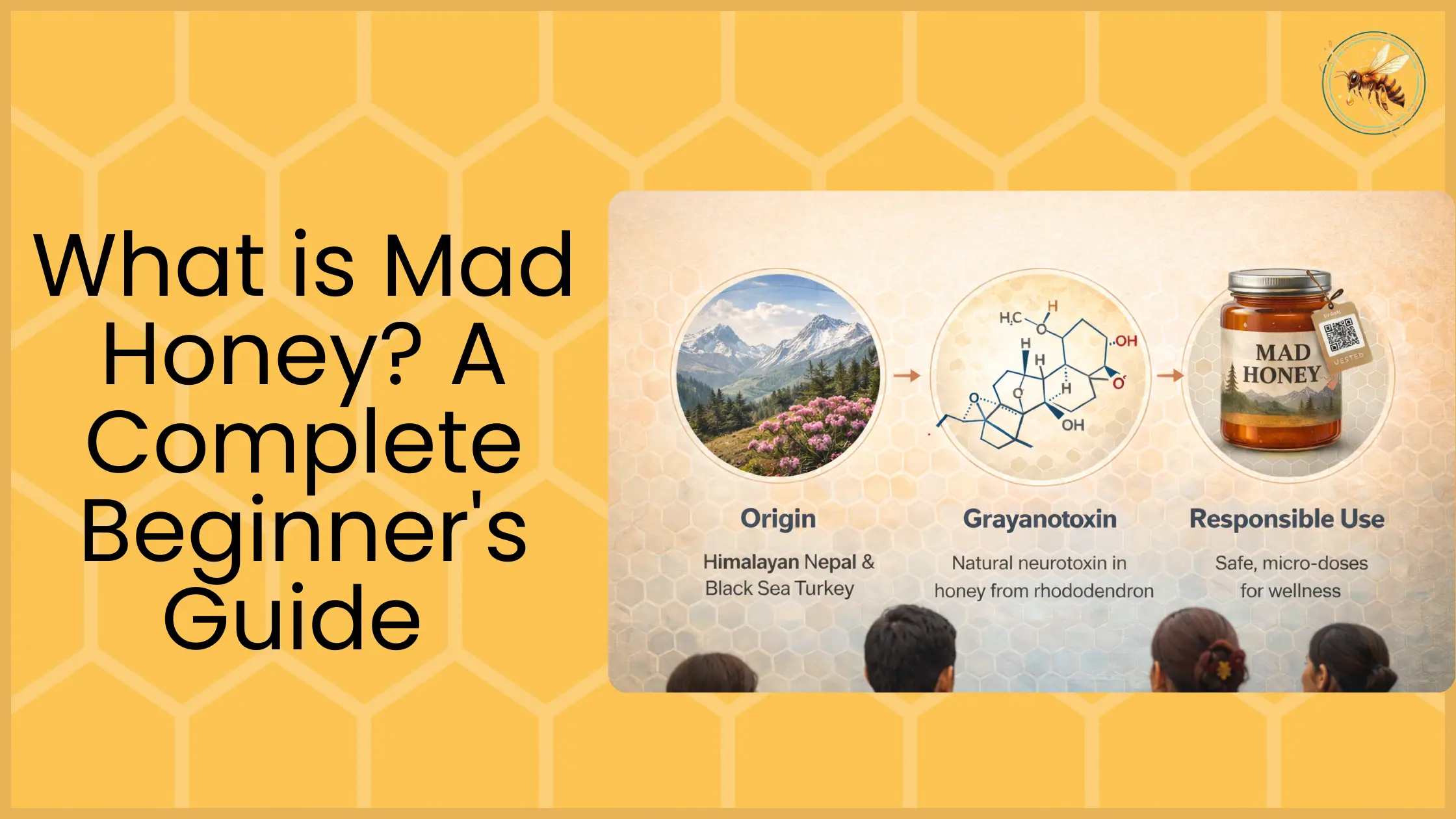
Nepal’s mad honey is best understood as a seasonal, location-specific honey created when two things happen at once: bees foraging in rhododendron-rich mountain zones where grayanotoxins enter the nectar, and wild harvesting from cliff-nesting bees in some of the hardest-to-reach terrain in the world. The result is rare, inconsistent, and frequently misrepresented online, which is exactly why it needs the same mindset as any potent natural product: curiosity, respect, and traceability.
tl;dr
- Mad honey forms when bees collect nectar from certain rhododendron species containing grayanotoxins. Nepal and Turkey are the two most-referenced origin regions.
- Nepal’s version comes from wild cliff harvesting by indigenous Gurung honey hunters, collecting from the giant Himalayan cliff bee, Apis laboriosa, the largest honey bee on Earth.
- Not all cliff honey is mad honey. The intoxicating effect is seasonal and localized. The potent, psychoactive honey is the spring harvest, when high cliffs turn red with rhododendron bloom, and bees forage on little else.
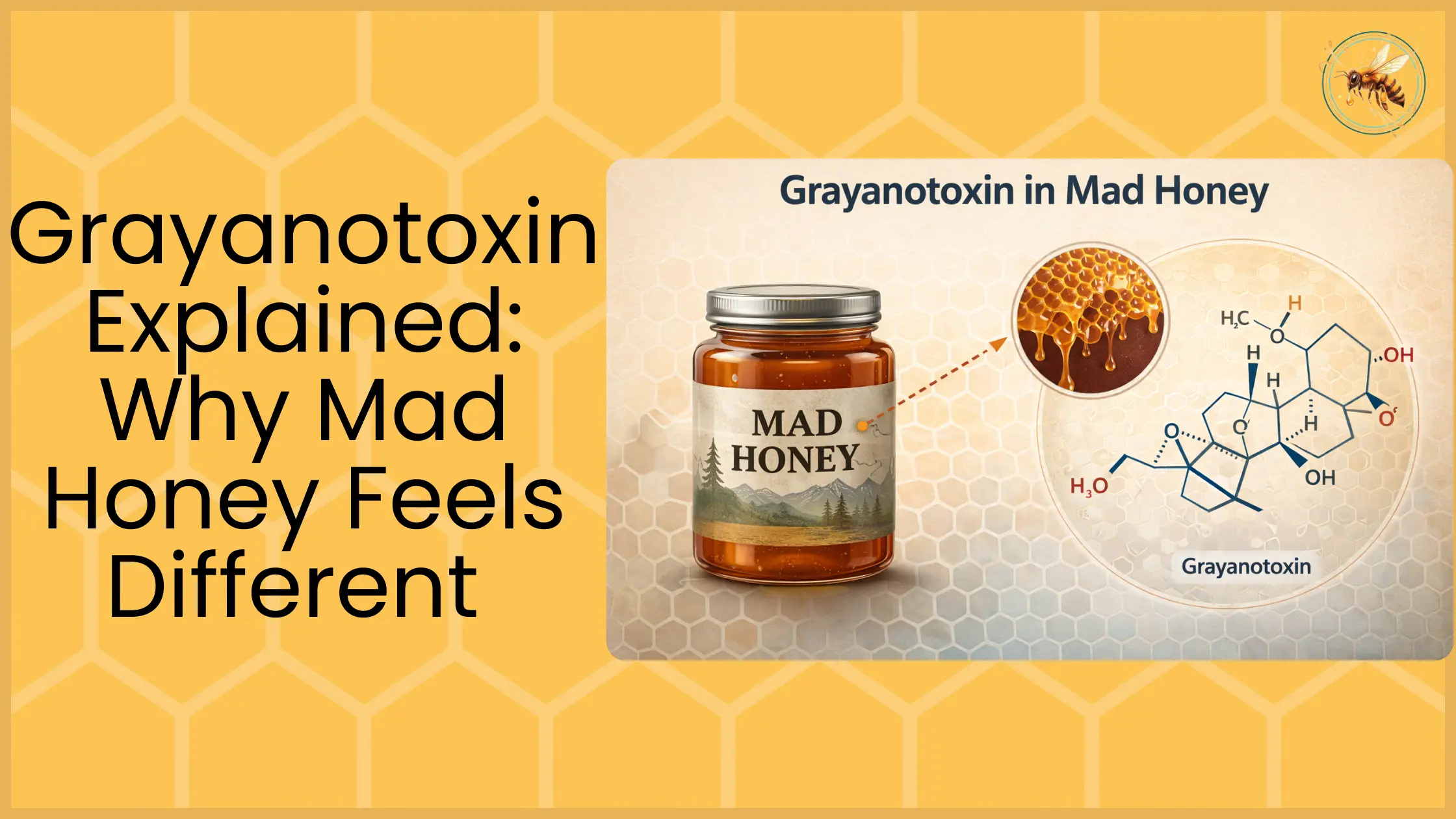
- Grayanotoxins work by binding to voltage-gated sodium channels, increasing vagal tone. At higher doses, this causes bradycardia (slow heart rate) and hypotension, plus dizziness and nausea.
- Apis laboriosa populations have declined sharply in recent decades, which, combined with the seasonal window and dangerous harvest, is why genuine Nepali mad honey is genuinely limited and expensive.
- “Himalayan” is a region label, not a potency label. The only reliable way to buy responsibly is to look for traceability, safety guidance, and testing transparency, not dramatic photos.
Where in Nepal does mad honey come from?
The simplest definition: mad honey comes from places where the right flowers bloom, and the right bees forage. In Nepal, that means specific mid-altitude mountain zones, not the whole country.
The rhododendron bloom zones
Mad honey forms when bees forage heavily on grayanotoxin-bearing rhododendron during the bloom period. Nepal has roughly thirty rhododendron species, but only a handful carry meaningful grayanotoxin, and the toxin enters the honey only while those specific plants are flowering. This is why mad honey isn’t evenly distributed across Nepal; it’s tied to particular ecological pockets where these species dominate.
The two species most associated with Nepali mad honey are Rhododendron arboreum (Nepal’s national flower) and Rhododendron campanulatum, both of which grow densely in the mid-Himalayan belt.
The regions where honey hunting is documented
Field research on Nepali honey hunting, including the well-known ICIMOD study of the honey hunters of Kaski, has focused on districts across three provinces:
- Gandaki Province, Lamjung, Kaski, and Gorkha are the best-known districts, with dense rhododendron forests at 2,500–3,500 metres. Lamjung in particular is renowned for its traditional honey-hunting practices.
- Karnali Province: Dolpa and Jumla contain higher-altitude harvesting areas from 3,000–4,000 metres, with later flowering seasons due to elevation.
- Eastern Nepal: districts such as Khotang also produce cliff honey.
Why “Himalayan” is used loosely
Online, “Himalayan” becomes shorthand for “exotic, wild, strong.” But Himalayan honey covers many types, and most of it is not grayanotoxin-linked. Apis laboriosa forages on a wide range of mountain flora, and outside the rhododendron bloom, cliff honey from the same bees has no intoxicating effect at all. So “Himalayan” tells you the region, not the potency.
The bee behind it: Apis laboriosa
You can’t understand Nepali mad honey without understanding the bee that makes it. Apis laboriosa, the Himalayan giant honey bee, known locally as Bhir Mauri, is the world’s largest honey bee, and it behaves nothing like a managed hive bee.
Modern genetic and behavioral research recognises it as a fully distinct species, not a subspecies of the tropical giant honey bee. It builds massive exposed combs under overhangs on the southwestern faces of vertical cliffs, typically nesting between 2,500 and 3,000 metres and foraging at altitudes up to 4,100 metres. A single nest can hold as much as 60 kilograms of honey.
This matters for two reasons. First, the bee’s high-altitude foraging is what brings it into contact with grayanotoxin-bearing rhododendron. Second, the fact that it nests only on remote cliffs and cannot be domesticated or hived is a large part of why the honey is so difficult and dangerous to collect.
There’s a conservation dimension too. Experts estimate Apis laboriosa numbers in Nepal have fallen by more than half in recent decades, driven by habitat loss and a warming climate. This decline directly affects the scarcity and price of authentic mad honey.
How mad honey is harvested in Nepal
If you know Nepali mad honey only through YouTube, you’ve seen the most dramatic part: the cliff harvest. Here’s the reality without the romanticism.
The cliff harvest
Wild harvesting involves honey hunters descending steep cliffs on handmade rope ladders to cut comb from Apis laboriosa colonies, often more than 100 metres above the valley floor. It happens twice a year, in spring and late autumn, and is managed with smoke to calm the bees.
Two communities are most associated with the tradition: the Gurung of the central mid-hills, in districts such as Lamjung and Kaski, who have hunted these cliffs for generations, passing the techniques down through families.
Why it’s dangerous:
- Fall risk from height is the single biggest hazard
- Dense bee defence around exposed combs
- Sudden mountain weather shifts
- The sheer logistics of extracting and lowering heavy comb safely
This difficulty is a core reason Nepali mad honey has a limited, unpredictable supply, commands a high price, and is a frequent target for fakes and mislabeling; demand consistently outstrips genuine access.
What happens after the comb is collected
Most people imagine the process ends at “comb collected,” but a lot of variability happens afterward:
- Straining and filtration change the texture and affect how “raw” the honey feels
- Storage and handling influence taste and stability
- Blending vs. single-batch is the biggest factor in consistency
Scientific summaries of mad honey are consistent on one point: commercial honey rarely contains significant toxin levels because nectar from many sources is mixed and diluted, whereas wild single-origin honey from rhododendron-rich zones can reach much higher concentrations. For a buyer, this means more blending equals more consistency and fewer extreme highs or lows, while less blending means more variability, sometimes a feature, sometimes a risk, depending entirely on how honestly it’s sold.
Why Nepali mad honey varies so much
Many articles call it “rare” without explaining why. Here’s the actual mechanism.
Season is everything
Mad honey potency is tied to the rhododendron bloom, and that makes the spring harvest the potent one. In spring, the high cliffs turn red with rhododendron flowers, and the bees forage on little else, concentrating grayanotoxin in the honey. Spring-harvested honey (typically March–May) carries the highest grayanotoxin content, which is the psychoactive “red honey.”
Honey gathered in the autumn harvest, from a wider mix of later-flowering plants, is milder and far less active. So even though honey hunting happens twice a year, the “mad honey” phenomenon itself is seasonally concentrated, not constant. A seller who cannot tell you the harvest season cannot tell you what you’re actually buying.
Altitude, region, and batch
Even within Nepal, conditions shift the outcome. Altitude changes bloom timing, different valleys have different plant mixes, and foraging patterns vary by area. Karnali’s higher-altitude zones (3,000–4,000m) flower later than Gandaki’s mid-altitude belt. This is why “same country” never means “same honey”, and why batch variability is the defining characteristic of the entire category.
Not all cliff honey is mad honey
This bears repeating because it’s the single most misunderstood point. Nepal produces exceptional cliff honey in general; “mad honey” is one seasonal, localized expression of that broader category, not the whole thing. In areas or seasons without grayanotoxin-bearing blooms, the same bees produce honey with no intoxicating effect whatsoever.
What Nepali mad honey is known for
Most people arrive expecting either a guaranteed “trip” or a horror story. Both are oversimplifications.
The low-dose relaxation tradition
At low exposure, grayanotoxins modulate the nervous system in a way many people interpret as warmth and calm. The honest framing isn’t “psychedelic honey”, it’s a ritual honey that can feel noticeably different. Nepali mad honey also carries traditional aphrodisiac and vitality associations. Indigenous honey hunters have long held that consuming it supports heart health, eases gastrointestinal complaints, and acts as a sexual stimulant, though tradition alone doesn’t prove benefit, and these uses sit outside clinical evidence.
Why dose and individual sensitivity matter
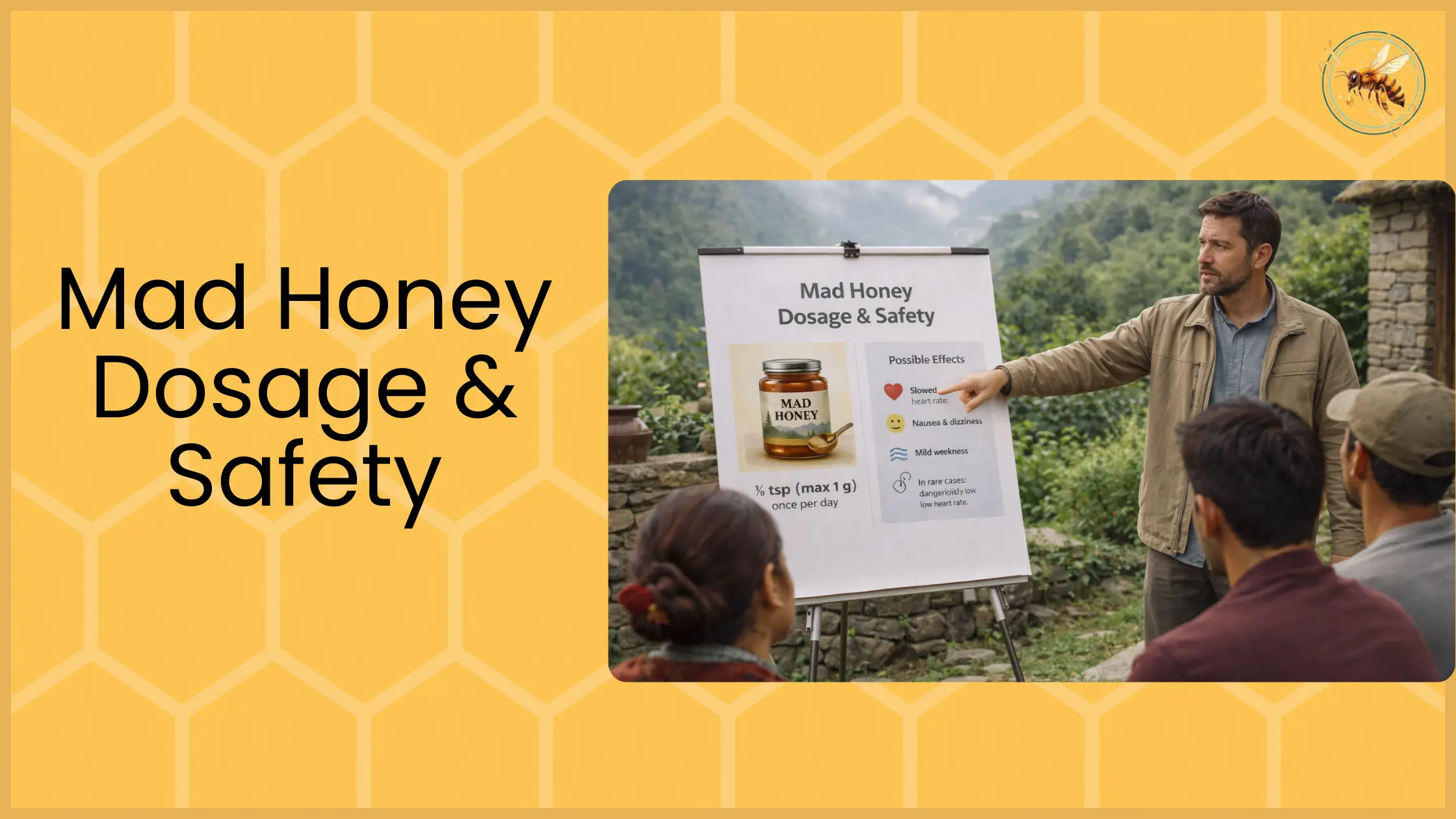
At higher exposure, grayanotoxins produce a clear and well-documented pattern: bradycardia, hypotension, dizziness, nausea and vomiting, sweating, and in some cases, syncope (fainting). Clinical case data from patients treated after consuming Nepali mad honey found a mean onset of symptoms around 36 minutes after ingestion, though onset can range from roughly 20 minutes to a few hours, with effects potentially lasting up to 24 hours.
This physiology also explains the “legend” stories. When someone becomes dizzy, weak, confused, and collapses, it’s easy for observers to describe it as “madness” or “visions”, even though the underlying cause is a measurable cardiovascular and neurological response. For the full breakdown, see what mad honey does to the body and the dosage guide.
“Red honey” and what the colour means
Spring-harvested honey from Apis laboriosa combs is often reddish and is the type traditionally linked to intoxication when consumed in quantity, because of the grayanotoxin from wild rhododendrons. But colour alone is not a reliable potency indicator; it varies with floral source and processing, and even when grayanotoxin is present, it can be a minor component of the honey overall. Red mad honey covers this in more detail.
How to buy Nepali mad honey safely
Planning a trip to source it directly? See traveling for mad honey first.
Buying Nepali mad honey means navigating a high-risk marketplace: high demand, high price, low consumer knowledge, and a lot of mislabeling. Your job as a buyer is to apply a practical filter.
Authenticity checklist
1. Origin proof beyond “Himalayan”
Look for sellers who provide:
- Specific source region, a named district (Lamjung, Kaski, Myagdi), not just “Nepal” or “Himalayan”
- The harvest season window (spring vs autumn)
- Batch or lot labeling
Even basic traceability signals meaningfully reduce risk.
2. Education is a green flag
A trustworthy seller openly discusses the “start low, go slow” dosing mindset, what negative symptoms look like, and why batches vary. If a store only sells the fantasy, that’s a warning sign.
3. Testing and transparency
Serious sellers can answer: Do you test for grayanotoxins (GTX I, II, III)? What were the results in mg/kg? What region and season? Do you blend batches? “Safe” should mean low, consistent, lab-verified grayanotoxin levels, though it’s worth being honest that no unregulated natural product is ever fully risk-free. See how to read a lab report for what a real COA should show.
Red flags
Avoid sellers who promise guaranteed “trips,” claim to sell the “strongest” honey without any testing data, hide sourcing details, or provide no safety guidance at all. Anything potent enough to go viral should come with enough responsibility to educate.
Is Nepali mad honey legal to buy and import?
Mad honey is fully legal to buy in Nepal, and legal to import into countries like the US and UK, where it’s treated as a food. A few countries apply tighter restrictions. Rules vary, so check your own country’s position before ordering or traveling with it. The full legality guide has the country-by-country breakdown.
FAQs on Mad Honey Nepal
Is Nepali mad honey stronger than Turkish mad honey?
Often, but it’s not a fixed rule. Nepal’s mad honey comes from wild Apis laboriosa colonies foraging on Himalayan rhododendrons and tends to be darker, earthier, and higher in grayanotoxin, particularly the spring harvest. Turkey’s deli bal comes from managed hives working on Rhododendron ponticum and is generally milder and more floral. Both share the same grayanotoxin chemistry, but “strength” depends more on batch factors, season, floral dominance, and blending than on the country label. See the full comparison.
Why is some Nepali mad honey red?
Colour varies with floral source and processing. In Nepal, “red honey” is associated with the spring harvest and rhododendron-linked potency, but colour alone isn’t a reliable strength indicator. Red mad honey explains what the colour does and doesn’t tell you.
How do I know mad honey is actually from Nepal?
Look for a named district and harvest season, batch or lot identification, consistent educational content, and transparent testing claims. If all you get is “Himalayan,” cliff photos, and hype, assume higher risk. Genuine traceability is specific.
Which regions of Nepal produce mad honey?
The best-known are Lamjung, Kaski, and Gorkha in Gandaki Province (2,500–3,500m), plus higher-altitude areas in Dolpa and Jumla in Karnali Province (3,000–4,000m) and districts like Khotang in the east. Lamjung is especially renowned for its honey-hunting tradition.
How much should a beginner take?
Start with a very small amount, wait at least three hours before considering more, and never redose quickly. Batch potency varies enormously, so treat every new jar as a fresh calibration. The beginner dosage guide covers the full framework.
Is Nepali mad honey legal to import?
It’s legal to buy in Nepal and to import into most countries, including the US and UK, where it’s treated as food. Some countries restrict it. Check the legality guide for your specific country before ordering.
This guide draws on field research into Himalayan honey hunting and published clinical literature on grayanotoxin. It is not a substitute for medical advice. Mad honey is not approved for therapeutic use by any regulatory body.
Last reviewed: May 2026