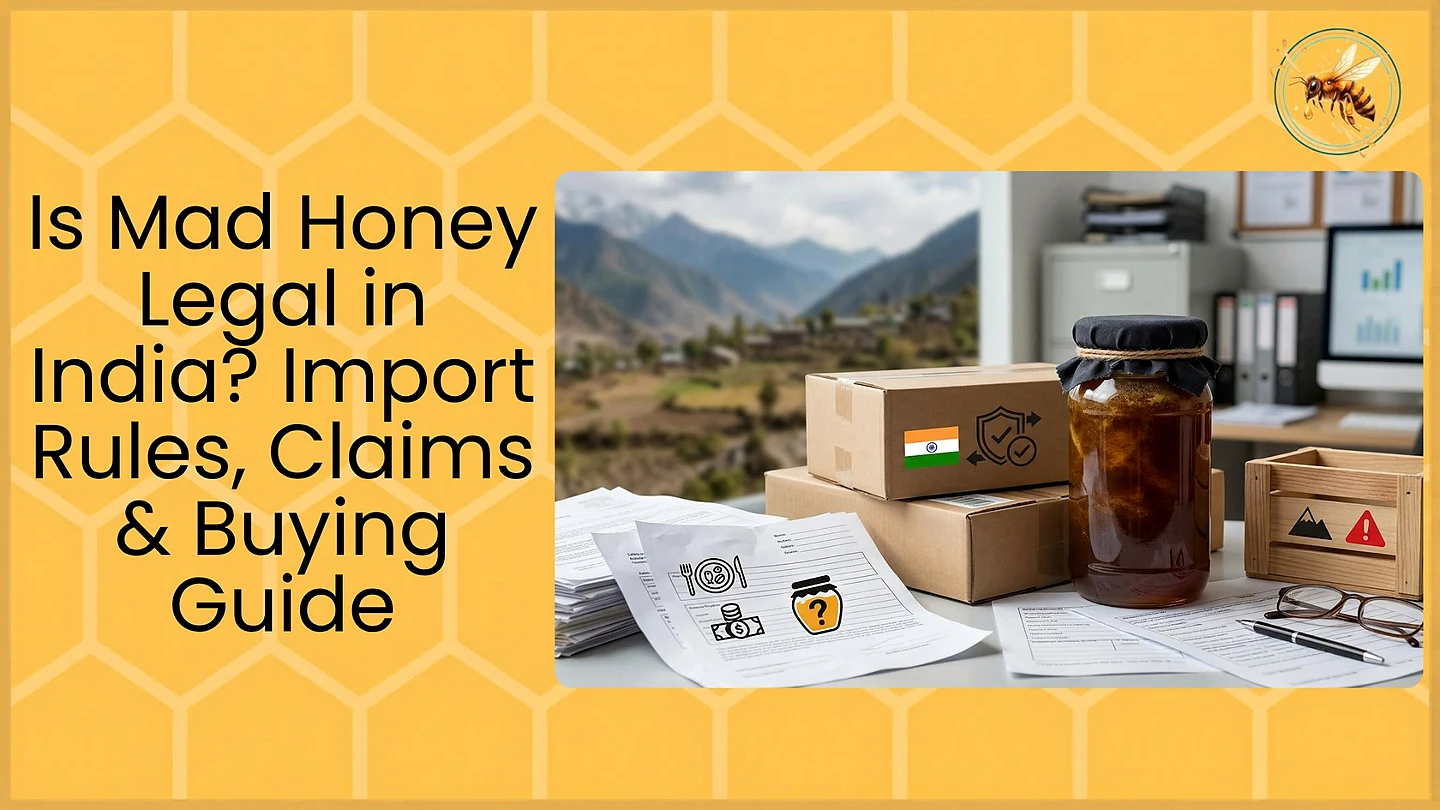
“Is mad honey legal in India?” usually means three different questions at once:
- Can I possess it?
- Can I import/order it online without customs trouble?
- Can someone sell/market it in India, and what claims are allowed?
The practical answer is:
Mad honey is generally treated as a food product, not a controlled narcotic, but importing and selling it can still trigger scrutiny because India regulates imported foods through FSSAI, and marketing/labeling claims can create compliance problems.
The biggest “legal risk” for most buyers is customs/FSSAI clearance + risky product positioning, not criminal possession.
Note: Not legal advice. Laws and enforcement can vary by situation and may change. This page is written to reduce confusion and help you buy/market more responsibly.
tl;dr
- Mad honey is not “illegal like a controlled drug” by default; the real friction is usually import clearance and compliance (labeling + claims).
- In India, “legal” has three layers: owning, importing, and selling/marketing, and each has different rules and failure points.
- Customs scrutiny tends to spike when the product is positioned as “psychedelic,” “medical cure,” or ambiguously labeled, because claims and classification matter.
- For imports, FSSAI runs the Food Import Clearance System (FICS) integrated with Customs ICEGATE under SWIFT, and imports can be subject to document review, inspection, and risk-based sampling/testing.
- Safest buying approach: treat mad honey like a dose-sensitive, batch-variable specialty food, choose transparent sellers, avoid hype claims, and expect that customs clearance is never guaranteed.
Quick Answer – Is Mad honey illegal in India like a controlled drug?
Usually, no. India’s drug control framework is built around scheduled “narcotic drugs” and “psychotropic substances” under the NDPS Act. Mad honey (a food) and grayanotoxins are not typically discussed as scheduled narcotics in that framework.
Is mad honey allowed to import/order online?
Sometimes, but it can be delayed, sampled, or stopped depending on labeling, documentation, claims, and how the shipment is presented. Imported foods can fall under FSSAI import clearance procedures through FICS/ICEGATE, and risk-based sampling/testing is part of the system.
Why do people see conflicting answers online?
Because people mix up different “legalities”:
- Someone ordering a small personal-use jar might have a smooth experience.
- Someone importing larger quantities, with medical-style marketing, or with vague labeling, may get stopped.
- Sellers might say “legal” meaning “not a narcotic,” while buyers mean “will customs clear it every time.”
Those are different questions.
What “Legal” Means in India (3 Layers)
This section matters because it explains why “Yes, it’s legal” and “No, it got seized” can both be true.
1) Possession (owning mad honey)
For most people, possession isn’t the main issue. The NDPS Act focuses on controlled narcotic/psychotropic substances and their regulation. Mad honey, as a food item, is generally not framed in that category by default.
2) Importing (customs checks)
Importing food into India can involve FSSAI clearance processes. FSSAI explicitly states it has an online system (FICS) integrated with Customs ICEGATE under SWIFT for clearance of food imports, including selective sampling/testing based on risk profiling.
3) Selling/marketing (claims, labeling, classification)
This is where many brands get into trouble, because claims can change classification and scrutiny. FSSAI labeling rules govern pre-packaged food labeling requirements, and FSSAI import regulations define terms like prohibited foods, inspection, sampling, NOC, etc.
For travelers, India’s official baggage guide does not mention honey at all. The India row of our honey customs table shows what it does cover.
You might also like: Is Mad Honey Legal in Canada?
Why Mad Honey Can Get Flagged (Even If It’s “Just Honey”)
This isn’t about paranoia. It’s about the reality that mad honey is often marketed in ways that trip compliance wires.
Sensational claims (“psychedelic,” “trip,” “medical cure”)
If a product is marketed as “psychedelic honey” or implies drug-like effects, it invites attention. It can also create confusion about whether the product is being positioned as a food, a supplement, or something else. In India’s system, positioning and labeling matter.
Food vs supplement positioning confusion
Even without explicit “drug” claims, implying treatment or cure can push a product out of normal “food” framing. The safest way to think about India compliance is: foods must be labeled and marketed like foods, not like medicines.
Safety incidents increase scrutiny (dose matters)
Mad honey has well-described dose-dependent risk patterns in toxicology literature (the same compounds can be discussed as “effects” at low exposure and “intoxication” at higher exposure). That’s why responsible sellers emphasize conservative guidance and avoid reckless promises.
Take a look at: Is Mad Honey Legal in Singapore?
Importing/Ordering Online in India (Practical Reality)
Even with perfect paperwork, customs clearance is never a “guarantee.” But there are predictable friction points.
What customs typically care about (high-level)
For imported food items, the practical review tends to focus on:
- Labeling clarity (what is it? honey? specialty honey?)
- Declared contents (description and documentation)
- Quantity vs intent (personal use vs commercial import signals)
- Compliance history/risk profiling (risk-based sampling/testing exists in FSSAI’s framework)
Documentation that helps (when sellers provide it)
When a seller is well-run, they often provide documents that reduce confusion:
- Clear invoice and product description
- Country/region of origin details
- Batch/lot information
- Testing language/COA if available (the key is specificity and batch-match)
FSSAI import regulations describe processes like pre-arrival document scrutiny, visual inspection, sampling, and issuance of a No Objection Certificate (NOC) when compliant.
Common reasons packages get delayed or stopped
Some repeatable triggers:
- Vague or misleading descriptions (“psychedelic honey,” “medicine,” “cure”)
- Packaging inserts or marketing materials with medical promises
- Unclear labeling compliance for pre-packaged foods
- Large quantities that look like commercial intent without importer compliance steps
Related: Is Mad Honey Legal in the UK?
Labeling & Claims (How to Stay on the Safe Side)
This is the “make your life easier” section. If you want less friction, avoid language that turns a food into a medical/drug-shaped product.
Claims to avoid
Avoid language that implies:
- Disease treatment or cure
- Guaranteed psychoactive outcomes (“instant high,” “guaranteed trip”)
- “Strongest/highest toxin” style claims (these are both unsafe and compliance-magnet wording)
FSSAI’s labeling framework is meant to ensure essential information is displayed on pre-packaged foods; the import regulations define compliance checks and consequences for non-compliance.
Safer language
If you want responsible positioning:
- Cultural/traditional framing (without medical claims)
- Conservative expectation-setting (“effects vary by batch and person”)
- Safety guidance and “who should avoid” signals
- Plain “food product” language rather than drug-like framing
Why “lab tested” must be specific
“Lab tested” as a vague badge is not persuasive to regulators or careful buyers. If testing is mentioned, the clean version is:
- what was tested
- which method
- batch/lot match
- what the results mean (and don’t mean)
Take a look at: Is Mad Honey Legal in the Philippines?
Safety Note for India Buyers (Short but Clear)
Even though this page is about legality, safety drives enforcement attention and buyer outcomes, so it deserves a clear paragraph.
Dose sensitivity + batch variability (why “start low + wait” matters)
Mad honey’s key risk is not “it’s illegal,” it’s that the effects can scale quickly with dose, and batches can vary. That’s why responsible guidance emphasizes starting low and waiting, especially for first-time users.
Who should avoid (conservative)
A conservative “avoid” list includes:
- Blood pressure/heart rhythm issues
- Medications affecting BP/HR
- Pregnancy/breastfeeding (conservative stance)
Red flags requiring medical help
If someone experiences fainting, chest pain, breathing issues, severe weakness/confusion, or persistent vomiting, treat it as urgent.
Buying Safely in India (Authenticity + Scam Avoidance)
Because India’s import friction is real, buyers are often tempted by cheap listings. That usually backfires.
What a responsible seller provides
Look for:
- Origin transparency (country + region, not just “Himalayan”)
- Batch/harvest information
- Conservative dosing guidance + warnings
- Real support contact details and consistent labeling
Red flags
Be skeptical if a listing has:
- “Strongest / guaranteed trip / instant high” language
- No origin info beyond vague buzzwords
- No safety guidance at all
- Inconsistent product photos/labels
- “Lab tested” with no details
Also Read: Is Mad Honey Illegal in the US?
Conclusion
In India, mad honey legality is usually about import + claims + compliance, not criminal possession. India’s FSSAI import system (FICS) is integrated with Customs ICEGATE under SWIFT, and imported foods can be inspected, sampled, and tested based on risk profiling.
The smartest long-term approach is simple:
- Buy transparently (origin + batch info)
- Avoid hype/medical claims
- Use conservative safety guidance
- Expect that “ordering online” has real-world customs variability
FAQs – Mad Honey Legal in India
Is mad honey banned in India?
It’s more accurate to say the main issues are import compliance and claims, not blanket criminal banning. Imported foods can be subject to FSSAI clearance procedures.
Can I order mad honey online in India?
Sometimes, shipments can be delayed or stopped depending on labeling, documentation, and how customs/FSSAI risk profiles the consignment.
Can customs seize it?
Customs can detain or reject consignments if they don’t meet requirements or trigger inspection/testing outcomes. FSSAI import regulations describe non-conformance processes and NOC issuance for compliant consignments.
Is it legal to resell?
Selling/importing commercially is more complex than personal ordering, because food importers and food businesses have compliance obligations under FSSAI’s regulatory framework.
Is it legal to advertise effects?
You can describe a food, but medical/drug-like claims are where risk rises. Safer approach: conservative language, no cure promises, no “psychedelic trip” marketing.
Is it the same as Turkish “deli bal”?
They’re related as a category (rhododendron-linked “mad honey”), but origin and ecology differ. The main buyer lesson: don’t trust vague labels, trust traceability.
Is mad honey safe for beginners?
Some people tolerate low exposure, but beginners are also the most likely to re-dose too soon. Safety is behavior: start low, wait, don’t mix.