“Hallucinogenic honey” is one of those phrases that spreads because it’s exciting, not because it’s accurate. Online, it’s usually shorthand for mad honey: honey linked to nectar from certain rhododendron species that can contain grayanotoxins, naturally occurring compounds that can cause dose-dependent intoxication in humans.
Here’s the clean truth: most of what people call “hallucinogenic honey” is better described as toxic/intoxicating honey at higher doses. Some people may report confusion or unusual perception when they overdo it, but the hallmark medical pattern centers on dizziness, nausea/vomiting, sweating, weakness, low blood pressure, and slow heart rate, not a predictable psychedelic-style trip.
This guide explains what the term means, what honey people are referring to, why effects happen, what it can feel like in practice (without hype), how long it lasts, warning signs, who should avoid it, why “potency” varies, and how to avoid fake “hallucinogenic honey” listings.
tl;dr
- “Hallucinogenic honey” is usually internet slang for mad honey, a dose-sensitive honey associated with grayanotoxins, not a standardized psychedelic product.
- The most consistent risk pattern in medical summaries is low blood pressure + slow heart rate + GI symptoms (dizziness, weakness, nausea/vomiting, sweating).
- Effects usually begin within ~20 minutes to 3 hours, and symptoms may persist 1–2 days in some cases, especially after larger intakes.
- “Strongest honey” marketing is a red flag because dose response is steep and batch variability is real; chasing intensity is how people end up sick.
The safest approach is conservative: start low, wait, don’t stack, don’t mix, and treat fainting, chest pain, breathing trouble, or persistent vomiting as urgent.
Quick Answer: Is “Hallucinogenic Honey” Real?
Before we go deep, it helps to answer the question the way people actually mean it.
The honest definition (what people mean online)
When most people ask “is hallucinogenic honey real,” they usually mean: Is there a honey that can noticeably alter how you feel, enough that people compare it to getting high? The answer is yes, some batches of mad honey can produce noticeable effects, especially at higher amounts.
But the term “hallucinogenic” is misleading because it implies a reliable psychedelic-style hallucination experience, which is not what the best-documented pattern looks like.
The reality: “psychedelic” vs “toxic/intoxicating”
The more accurate framing is that this honey can be intoxicating and, at higher doses, medically risky. The reason the internet calls it “psychedelic” is because severe intoxication can look dramatic: people can become very weak, dizzy, sweaty, nauseated, and unable to stand; some can become confused or feel “not themselves.”
That outward drama gets translated into “trip,” even when the underlying pattern looks closer to poisoning than to a controlled psychoactive journey. If you take only one idea from this section, make it this: the risk isn’t that you’ll “see dragons.” The risk is that your body can become unstable.
Why the term spreads (TikTok/YouTube framing + shock value)
The phrase spreads for the same reason “mystery mushroom gummies” spread: it’s click-efficient. “Hallucinogenic honey” is a stronger hook than “dose-sensitive honey that can cause bradycardia and hypotension.”
Short videos also remove the details that matter, how much was taken, whether the person re-dosed, whether they ate, whether they mixed alcohol, and whether the symptoms were actually enjoyable or just scary.
Also read: How mad honey compares to kratom?
What Honey Are People Talking About?
Now let’s get specific, because a big part of online confusion comes from mixing three different ideas: a botanical label, a cultural harvesting story, and a medical intoxication pattern.
Mad honey (rhododendron honey) as the main culprit
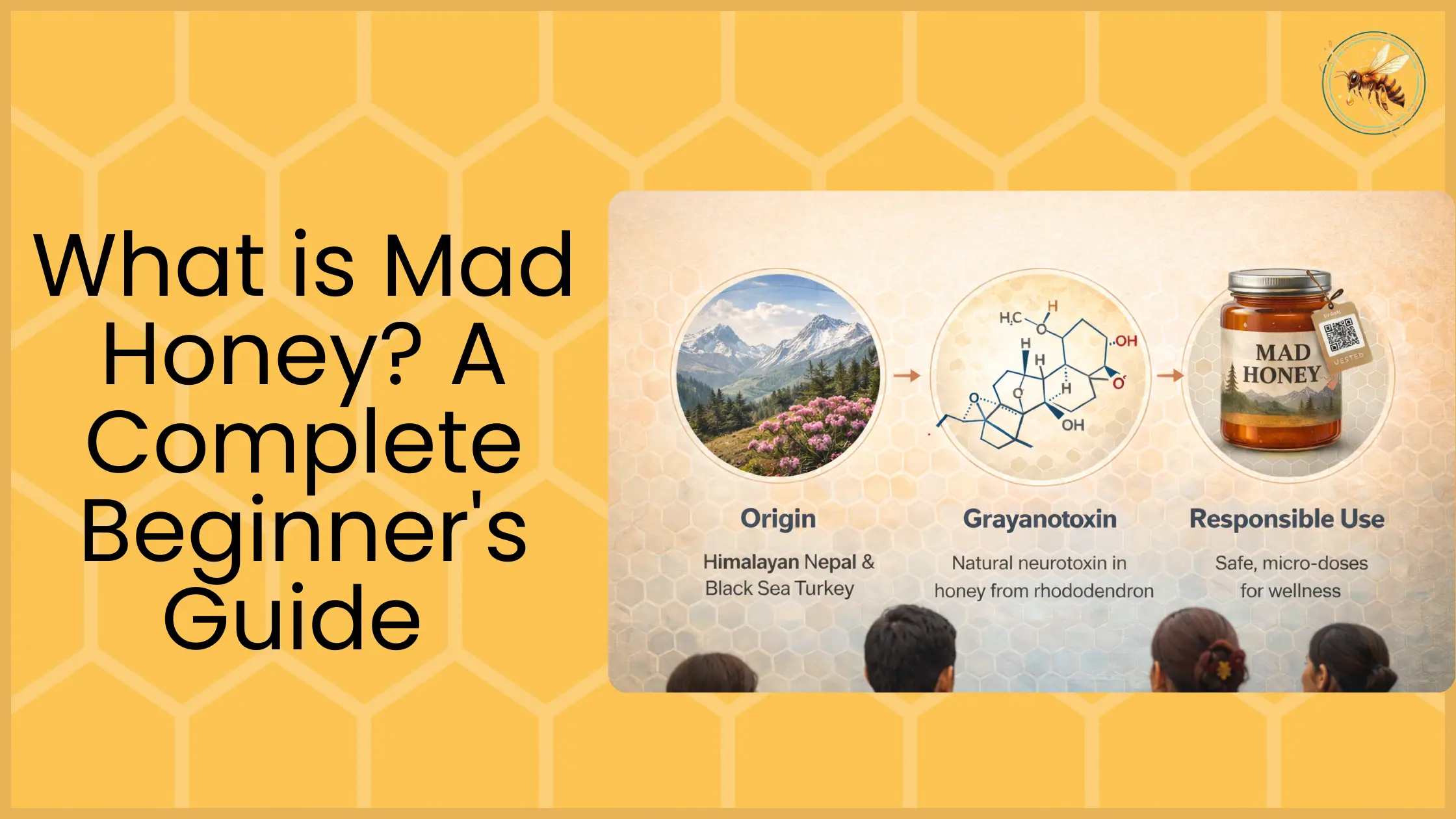
When the internet says “hallucinogenic honey,” it’s usually pointing toward mad honey, honey associated with nectar from certain rhododendron species and the presence of grayanotoxins in some batches. In clinical and toxicology writing, it’s often framed as “mad honey intoxication” or “grayanotoxin poisoning.”
A subtle but important point: “rhododendron honey” can be used loosely, and not every honey with rhododendron influence is guaranteed to be “mad.” The term becomes meaningful when the honey actually produces the intoxication pattern people associate with it.
Where it’s most associated (Nepal + Turkey/Black Sea region)
Two regional storylines dominate the modern conversation:
- Mad honey from Turkey’s Black Sea region shows up repeatedly in historical accounts and modern clinical reports (often referred to as “deli bal”).
- Mad honey from Nepal/Himalayan regions show up repeatedly in cultural narratives and documentaries, especially around cliff harvesting traditions, so they’ve become the global visual identity of “mad honey.”
Both are real contexts. What’s not real is the idea that “Himalayan” automatically means “strongest” or “guaranteed hallucinogenic.” Geography is not a potency certificate.
“Rhododendron honey” vs “mad honey” vs “cliff honey” (terminology clarity)
Here’s the clean separation:
- Rhododendron honey describes nectar influence (botanical context).
- Mad honey is a consumer/clinical label for a honey linked to noticeable intoxication effects in some cases.
- Cliff honey/Himalayan cliff honey often describes the harvesting story (process/culture), not a chemical promise.
That matters because marketing often hijacks the harvesting story and uses it as “proof” of effects. But the cliff story doesn’t guarantee grayanotoxin content, and grayanotoxin content doesn’t guarantee a “trip.” It mainly guarantees one thing: dose matters and risk increases when you chase intensity.
What Causes the Hallucinogenic Effects? (Simple Science)
You don’t need a biochemistry degree to understand the mechanism, but a little clarity goes a long way in de-mystifying the hype.
Instead of thinking “this honey has magic,” think “this honey can contain compounds that change how the body’s systems behave.”
Grayanotoxins: the bioactive compounds behind “mad honey intoxication”
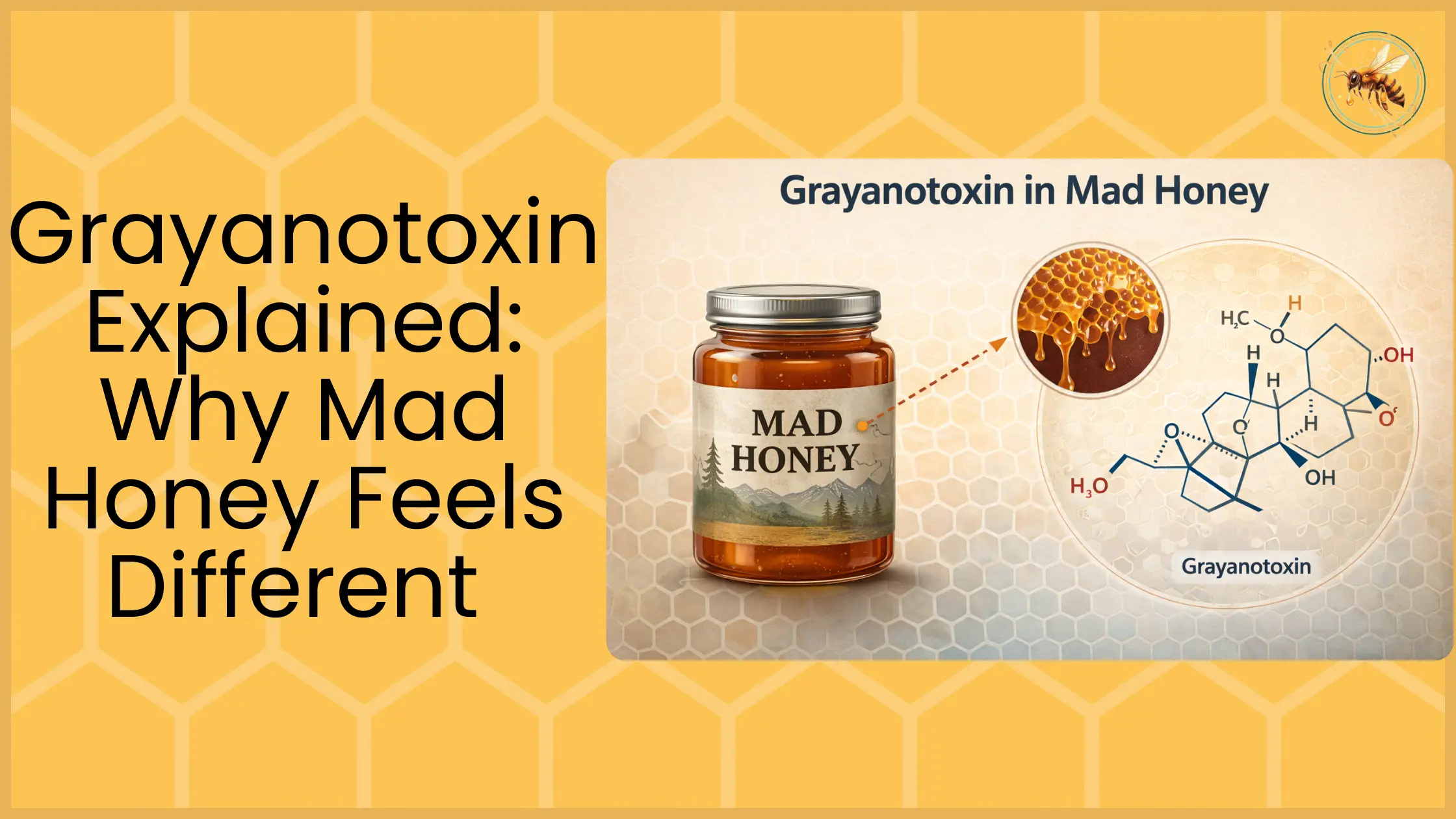
Grayanotoxins are naturally occurring compounds associated with certain rhododendron species. When present in honey, they can produce a recognizable intoxication pattern in humans.
The reason this matters isn’t just “effects.” It’s that the grayanotoxins’ effects can involve the cardiovascular system, meaning it can move beyond discomfort into danger for some people.
How they act in the body (high-level: sodium channels → autonomic effects)
At a high level, grayanotoxins influence voltage-gated sodium channels, which affect how cells maintain and reset electrical signals. That can cascade into autonomic effects, systems that regulate heart rate and blood pressure.
The takeaway is not “cool science.” The takeaway is: this is one reason low blood pressure and slow heart rate show up as hallmark risks.
Why it’s dose-sensitive (small increases can feel big)
Mad honey is notorious for a steep dose curve: “a little” can be subtle, while “more” can flip quickly into dizziness, nausea, sweating, weakness, and a scary drop in how steady you feel. This is also why people create their own bad experiences: they don’t feel much early, assume it’s weak, and take more, then both doses rise together.
If you’ve ever seen someone describe it as “it hit me all at once,” that’s often not magic. That’s timing plus dose escalation.
What Does “Hallucinogenic” Feel Like in Practice?
This section is the most important to write carefully, because readers often want a “what will it do” answer, but you don’t want to create a trip-guide. The best way to handle it is to explain what people commonly report at low amounts, what “too much” looks like, and why the word “hallucinogenic” gets used at all.
Most real-world descriptions are not “visions.” They’re a spectrum from subtle wind-down to physical intoxication.
Low dose: what people commonly report (calm/relaxation, “body heaviness”)
At low amounts, many people who notice anything describe a slower body: calmer mood, heavier limbs, more “settled” feeling, quieter mind. It can feel like a ritual wind-down, especially in a calm setting. This is where expectation plays a big role: if someone expects fireworks, they may interpret ordinary relaxation as “high,” while someone else feels nothing and assumes it’s fake.
That’s also why you’ll see contradictory testimonials: some are describing mild shifts amplified by expectation; others are describing higher-dose intoxication.
Too much: when it becomes uncomfortable (nausea, dizziness, weakness)
When people overdo it, the story changes fast. This is where the consistent symptom cluster shows up: dizziness, sweating, weakness, nausea/vomiting, and a strong urge to lie down. Some people describe it as “drunk-like,” not because it feels like alcohol socially, but because their body becomes unstable and they can’t move normally.
This is also where anxiety spikes, because the symptoms feel unfamiliar and out of control. That anxiety can make disorientation worse, and disorientation can get labeled “hallucination” in casual storytelling, even when the core driver is physical instability.
Why some people call it “hallucinogenic” (disorientation during intoxication)
Here’s the nuance: altered perception can happen when you are severely dizzy, hypotensive, nauseated, exhausted, or panicked. That doesn’t make it a psychedelic in the classic sense. It means your nervous system and circulation are under stress, and your brain’s interpretation of reality can get weird. People later compress that into “I hallucinated,” even when it’s closer to intoxication + disorientation.
That’s why “hallucinogenic honey” is a misleading name: it frames a potential safety event as a recreational goal.
Timeline: Onset, Peak, and How Long It Lasts
Time is the lever that causes most mistakes. People re-dose because they don’t understand the onset window.
You’ll see conflicting timelines online because people mix up onset, peak, and total recovery, and because dose/batch differences are huge.
When it kicks in (range, why it varies)
Onset can be anywhere from relatively fast to delayed, depending on food, dose, and individual sensitivity. If taken after a meal, it may come on later and feel smoother; on an empty stomach, it may come on faster and feel harsher. The mistake is assuming “nothing happened” too early.
Peak window (what changes at peak)
Peak is the moment where you discover whether you stayed conservative or overshot. Low-dose peak can feel like quiet calm. High-dose peak is where nausea/dizziness/weakness and “I need to lie down” feelings tend to appear. This is also where people most often regret stacking.
Recovery (most cases resolve within 1–2 days in clinical context)
Most cases improve with time, especially when exposure stops and the person rests, but more severe cases can take longer to fully resolve, sometimes into the next day. The clinically important trend is direction: you should feel progressively better, not worse.
Safety First: Risks and Warning Signs
This section needs to be unambiguous. The whole point of myth-busting is to replace “trip framing” with “safety framing.”
If you’re going to read one section carefully, read this one, because the real risk is not “hallucinations,” it’s the body’s cardiovascular response.
Common side effects (GI upset, dizziness, sweating, weakness)
At the milder end, people report nausea, dizziness, sweating, weakness, and feeling generally off. These symptoms can still be unpleasant, but they’re most important because they can signal you’re nearing your limit.
The hallmark risks (low blood pressure + slow heart rate)
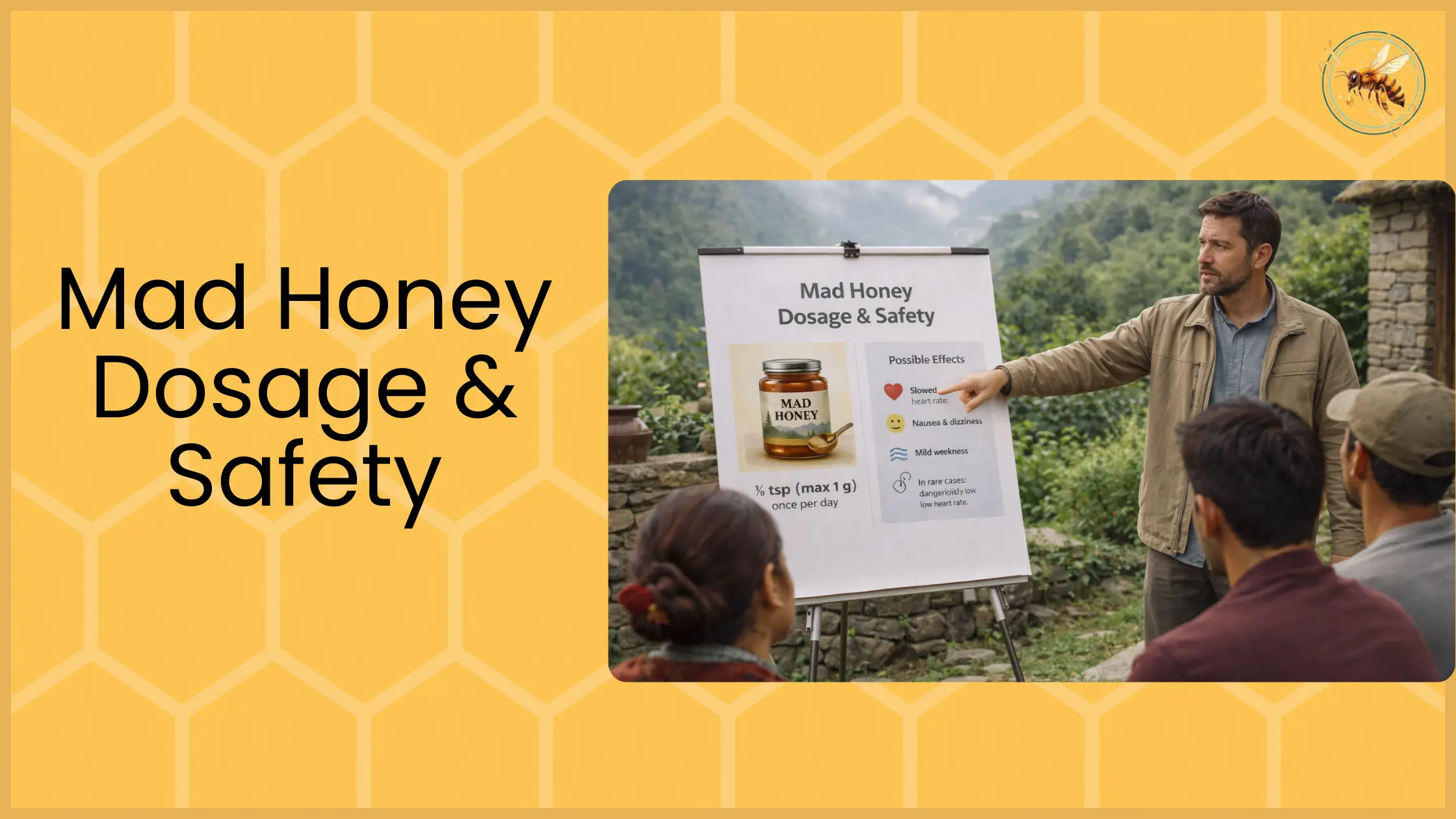
The hallmark pattern discussed in many medical summaries is hypotension (low blood pressure) and bradycardia (slow heart rate), which can lead to fainting, severe weakness, and concerning symptoms. This is why “more isn’t better” isn’t just a slogan; it’s a safety principle.
Red flags (seek medical help)
Treat any of these as a medical emergency and get help right away:
- fainting or repeated near-fainting
- chest pain
- breathing difficulty
- persistent vomiting (can’t keep fluids down)
- confusion that worsens, inability to stay awake
- symptoms that escalate instead of improving
Who Should Avoid Mad Honey (High-Risk Groups)
Curiosity isn’t a reason to roll the dice if your baseline risk is high.
The higher-risk groups are not about “fear.” They’re about having less physiological buffer if blood pressure or heart rate shifts.
Heart conditions / low blood pressure history
If you have cardiovascular issues or a history of fainting, you’re more vulnerable to the hallmark risks and should be extremely cautious or avoid mad honey entirely.
Medication interaction risk (BP/HR-affecting meds)
If you take medications that affect blood pressure or heart rhythm, experimentation becomes unpredictable. This is a “don’t self-test” situation.
Pregnancy/breastfeeding (conservative avoidance)
A conservative safety posture is to avoid during pregnancy/breastfeeding because the product is variable and the downside pattern is known.
Why Potency Varies (and Why That Matters More Than “Strong”)
This is where most internet content fails: it treats “strong” as a quality metric, when in reality “strong” is often a risk multiplier.
Potency varies for reasons that have nothing to do with your willpower and everything to do with botany and batch variability.
Region + season + plant species
Grayanotoxin presence can vary depending on nectar sources and environmental conditions, and that can shift by region and season. That means two jars that look similar can behave differently.
Batch variability = unpredictable experience
Even authentic mad honey can be inconsistent between batches. That’s why responsible sellers talk about variability and why responsible buyers treat dosing conservatively.
The “strongest honey” marketing problem
“Strongest honey” marketing is a red flag because it encourages reckless use, and it often appears in listings that are least transparent. The safest long-term category posture is food + transparency + conservative guidance, not intensity promises.
Authenticity: How to Avoid Fake “Hallucinogenic Honey”
Because “hallucinogenic honey” is a viral phrase, it attracts the worst sellers. If a listing is built on shock value, it’s usually built on weak verification.
What a responsible seller provides
A responsible seller typically provides traceable origin, batch accountability, conservative safety guidance, and specific testing language (not vague badges). They also avoid “guaranteed trip” promises because those promises are irresponsible and often deceptive.
Red flags (guaranteed trip, extreme claims, vague origin)
If the listing is mostly “psychedelic,” “trip,” “instant,” “strongest,” “guaranteed,” and the origin is basically “Himalayan,” you’re in the highest-risk zone for misrepresentation.
Conclusion
“Hallucinogenic honey” is a viral label, not a scientific category. In practice, it usually points to mad honey, a variable, dose-sensitive product where the most important truths are dose, variability, and safety boundaries. If you approach it like a “legal psychedelic,” you increase the chance of doing the exact thing that creates the scary stories: stacking too soon, chasing intensity, and ignoring warning signs.
FAQs on Hallucinogenic Honey
Is hallucinogenic honey the same as mad honey?
Most of the time, yes, online, it usually refers to mad honey and grayanotoxin-linked intoxication patterns.
Does it cause real hallucinations?
Not reliably like a classic psychedelic; severe intoxication can include confusion or altered perception, but the dominant pattern is physical and cardiovascular.
How much is too much?
There isn’t one universal number because batches and people vary; that’s why “start low and wait” is the only consistently safe advice.
How long does it last?
The experience can unfold over hours and may take into the next day to fully resolve in more severe cases; the key is that symptoms should improve, not worsen.
Is it legal where I live?
Often treated as a food, but import rules and marketing claims vary; for more information see Is Mad Honey Legal? What “Legal” Actually Means (US, UK, Canada, and More).
Why do some people feel nothing?
Possible reasons include low dose, mild batch, taking it with food, and individual sensitivity differences.