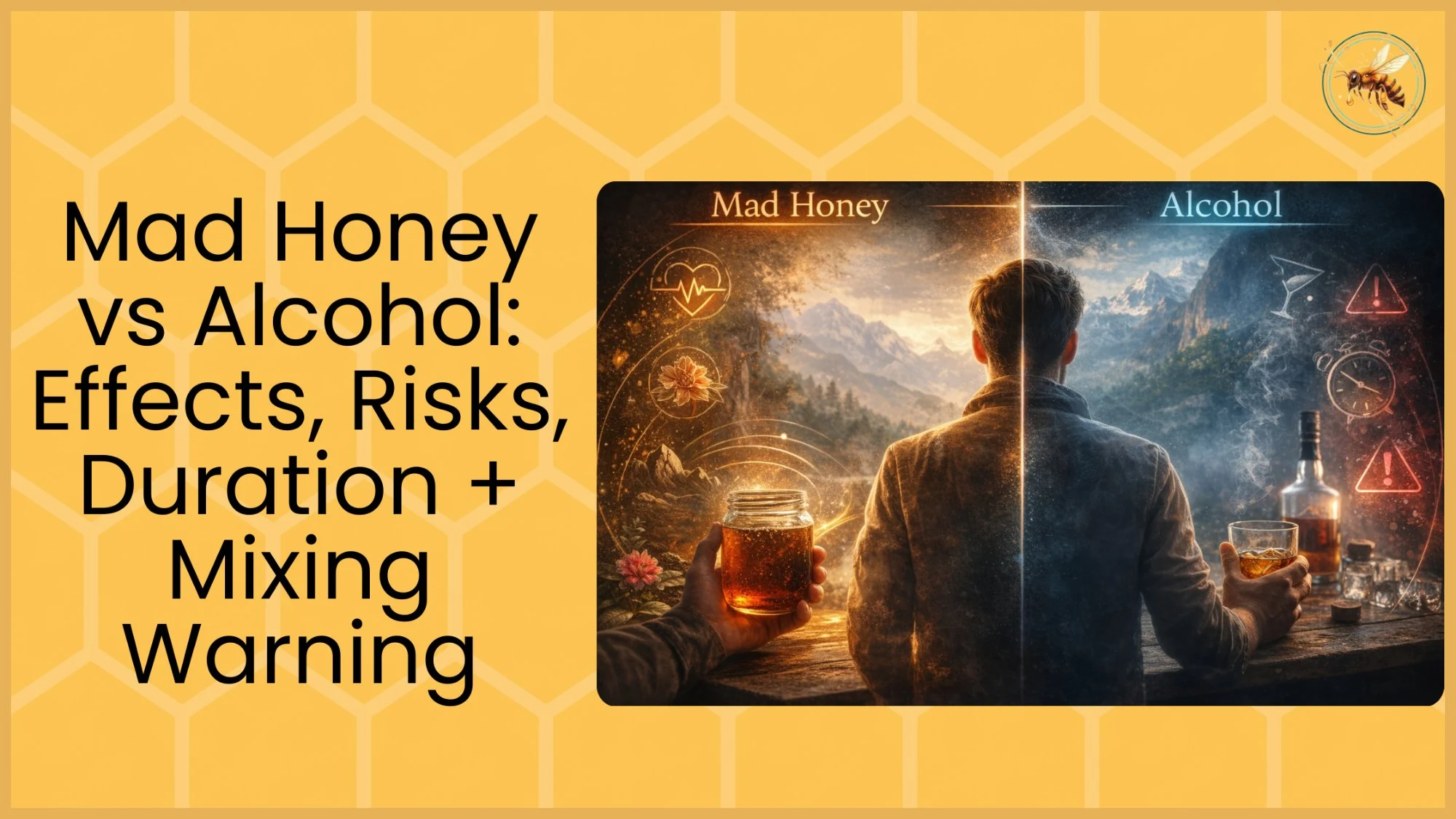
Mad honey and alcohol can both get described as “relaxing,” “warming,” or “a little woozy,” which is exactly why people compare them. But they’re not interchangeable, and they don’t “scale” the same way when you take more.
Alcohol is a predictable social intoxicant. Mad honey is a dose-sensitive, batch-variable food product that can feel subtle at low amounts, and very uncomfortable if you push it.
This guide breaks down what feels similar, what’s fundamentally different, how long each tends to last, and why combining them usually isn’t worth the risk.
tl;dr
- If you want a predictable social buzz, alcohol is the more consistent option, mad honey is not built for predictability.
- If you’re drawn to a low-dose ritual experience, mad honey can be a “start low + wait” product, more is not better.
- Mad honey variability is real (person-to-person and batch-to-batch), while alcohol tends to be more dose-predictable.
- Mixing mad honey and alcohol can amplify dizziness, nausea, and “low blood pressure / weak” feelings, safest answer is don’t.
- If you already mixed them and feel unwell, stop, hydrate, rest, and watch for red-flag symptoms that require urgent help.
Mad Honey vs Alcohol: Quick Answer (If You’re Comparing Them)
If you’re comparing mad honey vs alcohol, you’re usually asking one of two questions: “Which one feels better?” or “Can I mix them?”
If you want a predictable social buzz → alcohol
Alcohol’s effects are broadly familiar: relaxation, lowered inhibition, impaired coordination, and next-day consequences if you overdo it. The predictability is part of why people use it socially.
If you want a low-dose ritual experience → mad honey (with caution)
Mad honey is typically approached like a small, slow ritual, and the experience is more “body-first” than “party buzz.” People often describe it as calming or heavy, not energetic or social. The key is staying conservative, because once you cross your personal limit, it stops being “interesting” and becomes unpleasant fast.
If your real question is “Can I mix them?” → safest answer: don’t
Even if you see people online doing it, combining them stacks risks in the same direction (dizziness, weakness, nausea, coordination issues). If your goal is “feel something,” mixing is a sloppy way to get there.
What “Feels Similar” in Mad Honey and Alcohol (Why People Compare Them)
Let’s be honest: comparisons don’t come from nowhere. There are a few overlapping sensations that can make mad honey feel “alcohol-like” to some people, especially in viral clips.
Relaxation, loosened body feel, wind-down
At low amounts, some people report a slow, heavy calm, like their body wants to sink into the couch. Alcohol can also produce a warm relaxation, especially early in a drinking session.
Why mad honey sometimes gets described as “drunk-like”
A lot of the overlap is not euphoria, it’s body sensations: lightheadedness, warmth, heaviness, and sometimes a slightly “off-balance” feeling. To someone who doesn’t have the language for it, “kinda like being drunk” becomes the easiest comparison.
The internet exaggeration effect
Short clips compress context. You don’t see:
- how much was taken
- whether it was stacked quickly
- whether alcohol was involved
- whether the person was fasting, dehydrated, or sleep deprived
- the part where it becomes uncomfortable
Mad honey content online is often edited to maximize intensity, not accuracy.
Also read: Mad Honey Tea: How to Prepare It, Effects, Safety & Dosage
How Mad Honey and Alcohol Work (Simple Mechanism Comparison)
This section matters because it explains why the experiences diverge, especially at higher doses.
Alcohol: CNS depressant effects (high-level)
Alcohol primarily acts as a central nervous system depressant. In plain terms: it slows brain signaling, affects judgement/coordination, and can cause sedation. Effects tend to rise with dose, and “more” usually means “more impaired.”
Mad honey: grayanotoxins + dose-dependent body effects (high-level)
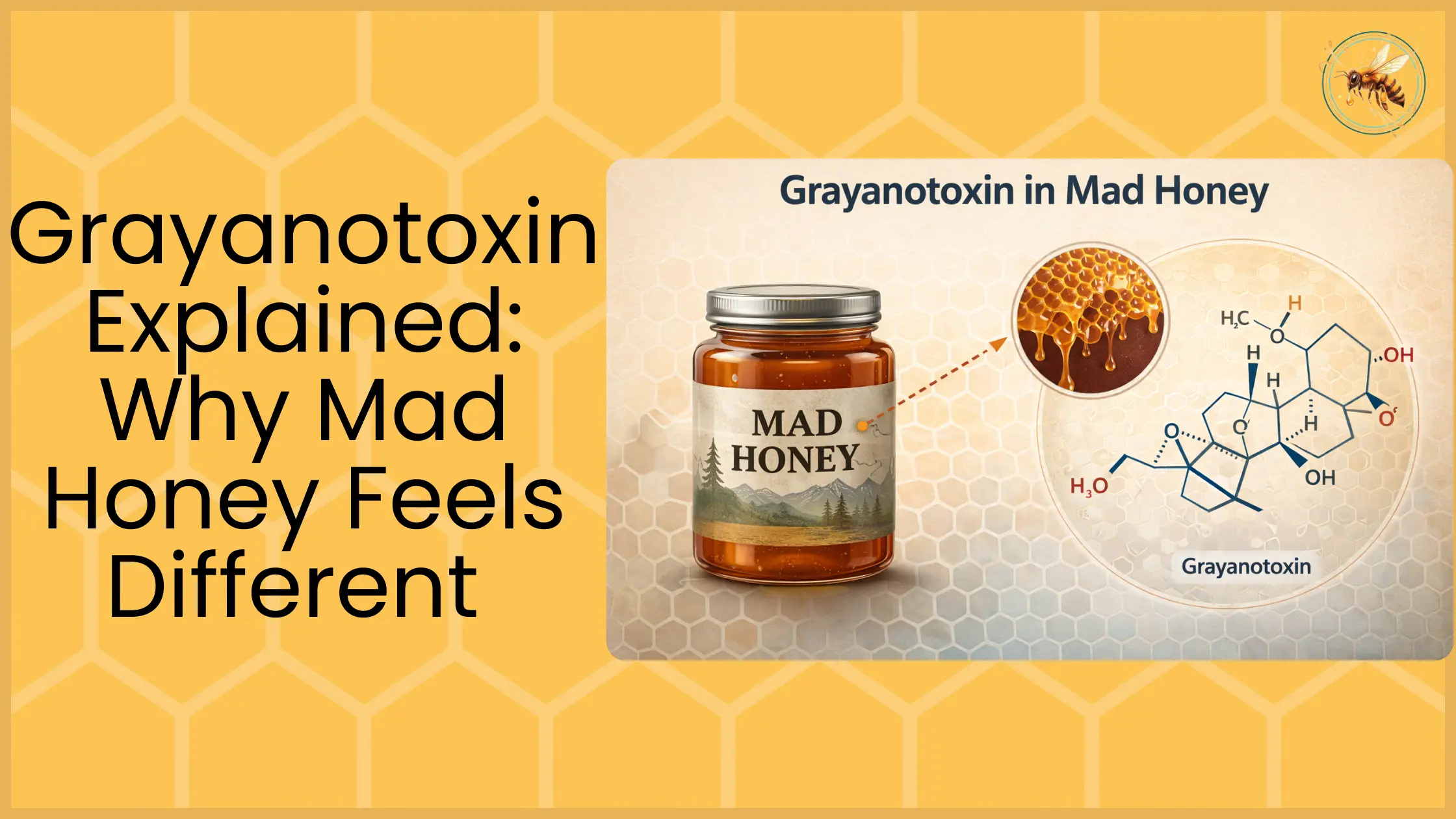
Mad honey’s distinctive effects are linked to naturally occurring compounds (grayanotoxins) that come from certain rhododendron nectar sources. The experience is often described as body-led: lightheadedness, weakness, nausea, sweating, “my blood pressure feels weird,” and sometimes a slow, heavy calm, depending on dose and sensitivity.
Why mad honey is more batch- and person-variable
This is a core difference: alcohol is standardized. Mad honey is not.
Two people can take the same spoon and report different effects because of:
- individual sensitivity
- body size
- whether they ate
- hydration and sleep
- batch differences (season/region/nectar mix)
That variability is why responsible sellers emphasize dosing discipline.
Effects Comparison of Alcohol and Mad Honey (Low Dose vs Higher Dose)
Instead of a rigid table, here’s a clean “side-by-side” in normal language, because context matters more than categories.
Mood and mental state
Alcohol: Often shifts mood socially, looser, more talkative, more impulsive. At higher doses, emotional swings and poor judgement are common.
Mad honey: Reports skew toward calm/slow/grounded, or “odd body feeling.” People chase “euphoria” online, but many real reports are more subtle and physical than celebratory.
Body sensations
Alcohol: Warmth, relaxation, reduced tension; higher doses bring nausea, flushing, and “spin.”
Mad honey: More likely to be described as heaviness, lightheadedness, sweating, nausea, weakness, and a “sit down” feeling when someone takes too much.
Coordination and clarity
Alcohol: Clear dose-related impairment, slower reaction time and worse coordination are expected.
Mad honey: Some people feel mentally normal but physically off; others feel foggy. The risk is that you can underestimate it because it’s not always the same kind of “obvious impairment.”
After-effects (next day)
Alcohol: Hangovers are well-known: dehydration, headache, nausea, and poor sleep.
Mad honey: Some people feel fine after a conservative amount; others feel drained or “off” if they pushed it. If someone experiences strong symptoms, the “after” can be more about recovery from discomfort than a classic hangover.
Why “more” behaves differently for each
Alcohol tends to scale in a familiar way: more drinks = more impairment.
Mad honey can flip quickly: a little might feel mild, but too much can jump to nausea + dizziness + weakness without giving you a “fun middle zone.”
Duration Comparison of Mad Honey and Alcohol (Timeline)
Duration is one of the biggest decision factors because people want to know: “How long will I feel it, and can I function afterward?”
Alcohol duration basics (depends on amount, time, metabolism)
Alcohol duration is shaped by how much you drink, how fast you drink it, whether you ate, body size, and sleep/hydration. The social “buzz” can come early, with impairment lasting longer than people admit, and after-effects lingering into the next day.
Mad honey timeline: onset → peak → fade-out
Most discussions of mad honey describe a general arc:
- a noticeable onset window (not instant)
- a peak period where body sensations are most obvious
- a fade-out back toward baseline
The exact timing varies (again: person + batch + food/hydration), which is why you’ll see conflicting timelines online.
Which one lasts “longer” in practice (and why it varies)
Alcohol can last longer in terms of impairment and next-day impact, especially if you drink late. Mad honey can feel shorter or longer depending on dose and sensitivity, but the key is: if you push mad honey too far, the time feels longer because discomfort stretches it out.
Also Read: Mad Honey vs Kratom: Effects, Risks, and Legality
Safety: Key Risks (What Can Go Wrong)
This is the part most comparison posts skip, yet it’s what actually matters.
Alcohol risks (impairment, dehydration, etc.)
Alcohol’s risks are mostly about:
- impaired judgement and accidents
- dehydration and sleep disruption
- increased risk when mixed with other depressants
- overconsumption patterns that escalate quickly
These are widely understood, which can create false confidence.
Mad honey risks (dizziness, nausea, BP/HR discomfort)
Mad honey’s common “too much” pattern is often described as:
- dizziness/lightheadedness
- nausea/vomiting
- sweating, weakness
- feeling faint or “blood pressure drop” sensations
- uncomfortable heart-rate / low-energy feelings
This is why “start low + wait” is not just advice, it’s the product category reality.
Who should be extra cautious with mad honey
A conservative approach matters more if someone has:
- blood pressure issues
- heart rhythm concerns
- sensitivity to dizziness/fainting
- is taking medications that interact with blood pressure/heart rate
- pregnancy or other higher-risk contexts
Mixing Mad Honey and Alcohol
If you take one thing from this article, make it this: mixing stacks the risks, not the benefits.
Why combining increases side-effect risk
Both can push people toward:
- dizziness/balance problems
- nausea and vomiting
- dehydration and “I feel weak” sensations
- poor decision-making (which increases the chance you take more of either)
Even if the mechanisms differ, the lived experience can compound in the same direction: less stable, more uncomfortable, harder to control.
If someone already mixed them: safety-first steps
This is not medical treatment advice, just practical, conservative steps that reduce risk:
- Stop consuming more. Don’t “fix it” by adding more alcohol, more honey, caffeine, or anything else.
- Hydrate slowly and rest. Sit or lie down somewhere safe.
- Avoid driving or doing anything risky. Even if you feel “mentally fine,” your body and balance can be off.
- Use the red-flag filter: if symptoms are severe or escalating, especially fainting, chest pain, breathing difficulty, confusion, repeated vomiting, or inability to stay awake, seek urgent medical help.
Also read: Mad Honey vs Mushroom Gummies: Not the Same Category
Which One Should You Choose? (Decision Guide)
If you’re choosing between mad honey and alcohol, it helps to decide based on your goal and your tolerance for unpredictability.
Choose alcohol if…
You want a predictable social effect, you understand how your body handles it, and you’re in a context where impairment is acceptable (and you’re not driving).
Choose mad honey if…
You want a gentle ritual, and you’re willing to treat it like something you respect: a small amount, patience, and no stacking. It’s not a “party replacement.” It’s a slower, more personal experience for many people.
Don’t choose neither if…
You’re in a high-risk situation: health conditions, certain medications, pregnancy, or you need to be fully functional (driving, operating machinery, high-stakes work). In those situations, “feeling something” isn’t worth the downside.
Conclusion
Alcohol and mad honey can overlap in how people describe them, but they’re fundamentally different in predictability, mechanism, and risk profile. Alcohol is a standardized intoxicant with familiar impairment. Mad honey is a batch-variable product where the experience can be subtle at low amounts, and quickly uncomfortable if you chase intensity.
If you’re thinking about combining them, the clean safety answer is simple: don’t mix. If you want a controlled experience, choose one path and keep it conservative.
See also: Mad Honey vs Kava: What’s Different and Which One Should You Choose?
FAQs: Mad Honey vs Alcohol
Does mad honey feel like being drunk?
Sometimes people describe it that way, but usually because of shared body sensations (heaviness, dizziness). It’s not the same “social intoxication” pattern alcohol creates.
Is mad honey safer than alcohol?
They’re different risk profiles. Alcohol is standardized but widely misused; mad honey is natural but more variable and can cause unpleasant symptoms if you overdo it. “Safer” depends on dose, person, context, and whether you’re mixing.
Can I take mad honey after drinking?
If your goal is safety and control, avoid stacking. Alcohol already increases dehydration and nausea risk for many people; adding mad honey can push those discomforts further.
Can mad honey cause a hangover?
Not in the classic alcohol sense, but if you took too much, you can feel drained, foggy, or unsettled afterward, mostly because the experience was physically uncomfortable.
Does mad honey show up on a drug test?
Mad honey isn’t typically treated like a controlled drug, and it’s not “THC-like.” But drug testing is complex, if you’re concerned, your safest move is to avoid anything you’re unsure about.
What’s the safest beginner dose?
The most consistent beginner rule is: start very small and wait, do not re-dose quickly. Use your body’s response as the guide, not internet bravado.