Mad honey is one of the most misrepresented honey categories online. Some listings are simply regular honey marketed as “mad honey.” Others are blends (mixed with other honeys), misstated origins (“Himalayan” used as a vibe), or products sold with sensational claims that make authenticity and safety hard to trust.
The good news: you don’t need to be a lab scientist to protect yourself. You just need to focus on the signals that are difficult to fake: origin transparency, batch traceability, responsible safety guidance, and credible testing language.
This guide gives you a practical “real vs fake” checklist you can use in 5 – 10 minutes before you buy.
tl;dr
- Taste, color, and thickness are not proof; real mad honey can vary widely, and fakes often copy the “look.”
- The strongest authenticity signal is traceable origin + batch identity (where it came from, when it was harvested, and how it’s handled).
- Responsible sellers educate: clear beginner dosing guidance and safety cautions are a major green flag.
- “Lab tested” only matters if the brand shows what was tested, how, and for which batch; vague badges are easy to fake.
- If the price feels “too good to be true,” it usually is. “Mad honey” is commonly mislabelled, diluted, or not mad honey at all.
Why Fake Mad Honey Is Everywhere?
Before you check authenticity, it helps to understand why the market is messy. That context explains the patterns you’ll see on marketplaces and social media.
Mad honey sits in a weird middle zone: it’s sold like a specialty food, but it’s talked about online like a “viral experience.” That combination attracts copycats fast, especially because most buyers can’t verify origin by looking at a jar.
What sellers commonly mislabel
The most common mislabels fall into a few buckets:
1) Regular honey sold as mad honey.
This is the simplest scam: take ordinary honey (sometimes darker or more herbal-tasting) and name it “mad honey” because it sells.
2) “Himalayan” used as a marketing costume.
“Himalayan” can be used loosely online to mean “mountain,” “Nepal-like,” or “exotic,” without proving Nepal origin or any specific region.
3) Blends that hide inconsistency.
Some sellers mix different honeys to achieve a consistent color or thickness, then present that “uniform look” as proof it’s real.
4) Sensational claims that drown out details.
When a listing is 80% hype (“psychedelic,” “trip,” “instant high”) and 20% specifics (origin, batch, handling), you’re usually looking at a product that’s not built on transparency.
The Mad Honey Authenticity Checklist (11 Checks)
This is the part you’ll actually use. You don’t need all 11 boxes checked to make a purchase, but the more you can confirm, the lower your risk.
To keep it simple: Real mad honey is not proven by one “magic sign.” It’s proven by a pattern of consistency across origin, batch info, safety guidance, and documentation.
1) Origin transparency (country + region, not just “Himalayan”)
A real seller can clearly answer: Where is it from?
“From the Himalayas or harvested by Gurung hunters” is not enough. Look for specifics like Nepal (and ideally a region), or a clearly stated region in Turkey if it’s a deli bal context. If the listing only says “Himalayan mountains” with no details anywhere, assume it’s marketing.
✅ Green flag: “Sourced from Nepal (___ region), harvested seasonally.”
❌ Red flag: “Himalayan mad honey” with no country and no harvest context.
2) Harvest/season detail (when it was collected)
Mad honey is seasonal. Real suppliers usually have at least a basic sense of harvest timing (spring vs autumn, or month/season). If they can’t give any timing context, that often means the product is treated like generic honey.
✅ Green flag: mentions season/harvest window.
❌ Red flag: no mention of season, ever.
3) Batch ID or lot tracking (a real-world traceability signal)
If a brand handles mad honey seriously, it usually treats it like a batch-variable product (because it is). A batch ID/lot number is one of the hardest things to fake consistently across operations and customer support.
✅ Green flag: batch ID on jar, invoice, or product page; customer support can confirm it.
❌ Red flag: everything is “the same batch,” always, with no identifiers.
4) Real supply chain story (simple is fine, vague is not)
You don’t need a movie-level origin story. But you do want a coherent supply chain: where it’s sourced, how it’s exported/imported, where it’s packed, and how they keep track of it.
✅ Green flag: a simple, consistent explanation that doesn’t change across pages.
❌ Red flag: a dramatic story with zero verifiable details (“ancient secret,” “hidden tribe,” “never before seen,” etc.).
5) Seller education is a green flag (especially safety/dosing)
This one surprises people: the safest sellers are usually the most boring.
If a seller gives conservative dosing guidance and acknowledges variability, they’re behaving like someone who understands what they’re selling.
Look for language like:
- “Start small and wait.”
- “Effects vary by person and batch.”
- “Avoid mixing with alcohol/sedatives.”
- “Not for pregnant people / certain risk groups.”
✅ Green flag: clear safety/dosing guidance.
❌ Red flag: “Take 2–3 tablespoons for best results” or “no side effects.”
6) “Testing” language that is specific (not just a badge)
“Lab tested” is everywhere because it’s easy to say and hard to verify. What you want is specificity:
- Is it tested per batch or “once a year”?
- What exactly is tested, purity, contaminants, grayanotoxin ranges, and adulteration indicators?
- Does the seller explain testing in plain language?
✅ Green flag: testing described with scope and batch linkage.
❌ Red flag: a generic “lab tested” stamp with no document, no batch reference, no explanation.
7) COA/report expectations (what to look for, realistically)
Most consumers won’t read a full lab report like a chemist, and that’s okay. But you can look for basic credibility markers:
- The report is linked to a specific batch/lot
- Includes lab name and date
- Shows clear test categories (e.g., contaminants/purity indicators)
- The brand is willing to explain what it means
If a seller refuses to answer basic questions about testing, they likely don’t have meaningful testing.
8) Marketplace behavior: who is actually selling it?
On marketplaces, you often have three possibilities:
- a real brand with a consistent identity
- a reseller sourcing from unknown places
- a rotating set of accounts that disappear and reappear
✅ Green flag: consistent brand presence, real customer support, clear origin info.
❌ Red flag: brand-new accounts, constantly changing names, no off-platform presence.
9) Packaging/branding red flags (the “too many claims” problem)
Packaging can’t prove authenticity, but it can reveal risk. If a jar screams “drug-like effects,” “trip,” “hallucinogenic,” or disease claims, that’s often a sign the seller is optimizing for clicks, not transparency.
✅ Green flag: food-style labeling, clear origin, conservative guidance.
❌ Red flag: extreme claims, “guaranteed high,” “instant effects,” “medical cure” language.
10) Price that’s “too good to be true”
Mad honey is typically expensive because it’s seasonal, niche, and supply-limited. If you see “mad honey” at a price close to regular honey, assume one of these is true:
- it’s not mad honey
- it’s diluted/blended
- origin is misrepresented
- it’s low accountability (no batch, no support, no traceability)
Cheap doesn’t always mean fake, but in this category, it’s a strong risk signal.
11) The simplest verification test: ask one question
If you want a fast filter, message the seller and ask:
“Can you share the country/region of origin and the batch/lot number for the jar being sold?”
A serious seller answers calmly and specifically. A questionable seller dodges, gets defensive, or replies with more hype. Now that you know how to verify, here’s how to choose the best mad honey in 2026.
Real vs Fake: The Biggest Misconceptions
Now that you know what to look for, let’s clear up the myths that lead people to false confidence.
Color myths (“red” doesn’t prove anything)
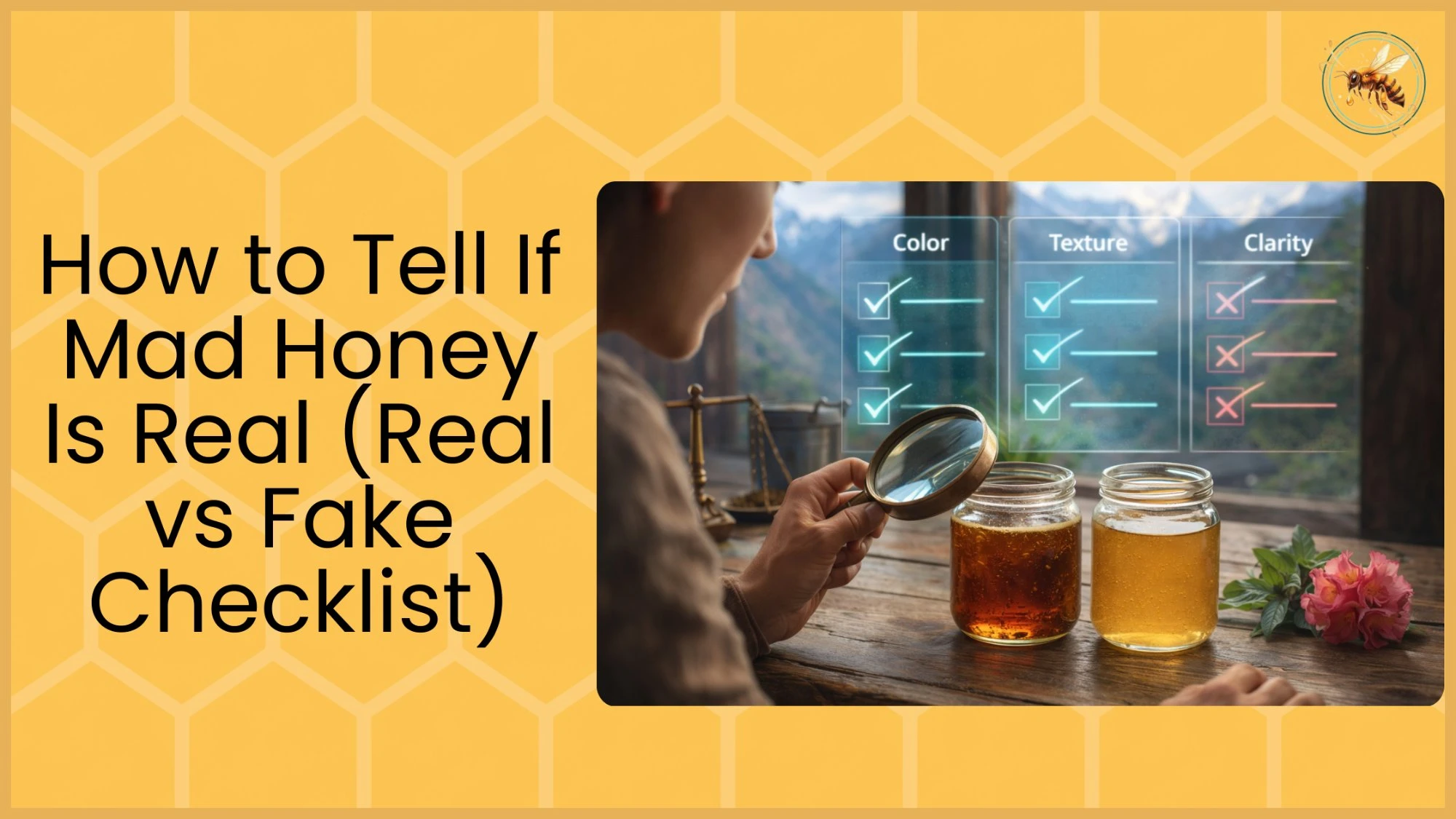
A lot of buyers think “red mad honey” automatically means stronger or more authentic. In reality, color can be influenced by many factors, such as nectar sources, season, storage, filtering, and even lighting in product photos.
Key truth: a fake can be made to look red; a real jar can look amber or darker brown. So color can be interesting, but it can’t be your proof. It is one of the five things most people get wrong about mad honey.
Thickness/crystallization myths
People also assume thick honey = real, runny honey = fake. Not reliable.
Honey texture varies based on moisture content, temperature, floral composition, and time. Crystallization is normal for many honeys and doesn’t automatically signal adulteration. Conversely, a smooth, thick texture can be achieved by blending or handling choices.
Key truth: texture tells you more about handling and storage than authenticity.
Also Read: Is Mad Honey Legal? What “Legal” Actually Means
Conclusion
If you want to tell whether mad honey is real, don’t chase “viral proof” like color, thickness, or dramatic taste stories. Instead, look for the signals that are hard to fake: clear origin, batch traceability, responsible safety guidance, and specific testing language.
Once you’ve run the checklist, the next step is buying from a source that behaves like a real specialty-food supplier, not like a hype account.
FAQs on Authentic Mad Honey
Should it taste bitter?
Sometimes, but not always. Many people describe mad honey as floral/herbal with a more complex finish, and some batches have a slightly bitter or medicinal edge. But bitterness isn’t a “real/fake switch.” A fake can be bitter too.
Should it burn your throat?
Some people report a warming or slight throat sensation, but it’s inconsistent and heavily influenced by expectations, dose, and batch. A strong burn is not a requirement, and it’s not a safety goal.
Can real mad honey feel different every time?
Yes. Two things drive that: individual sensitivity and batch variability. That’s exactly why batch IDs and conservative dosing guidance are so important; real sellers acknowledge variability instead of pretending every jar is identical.