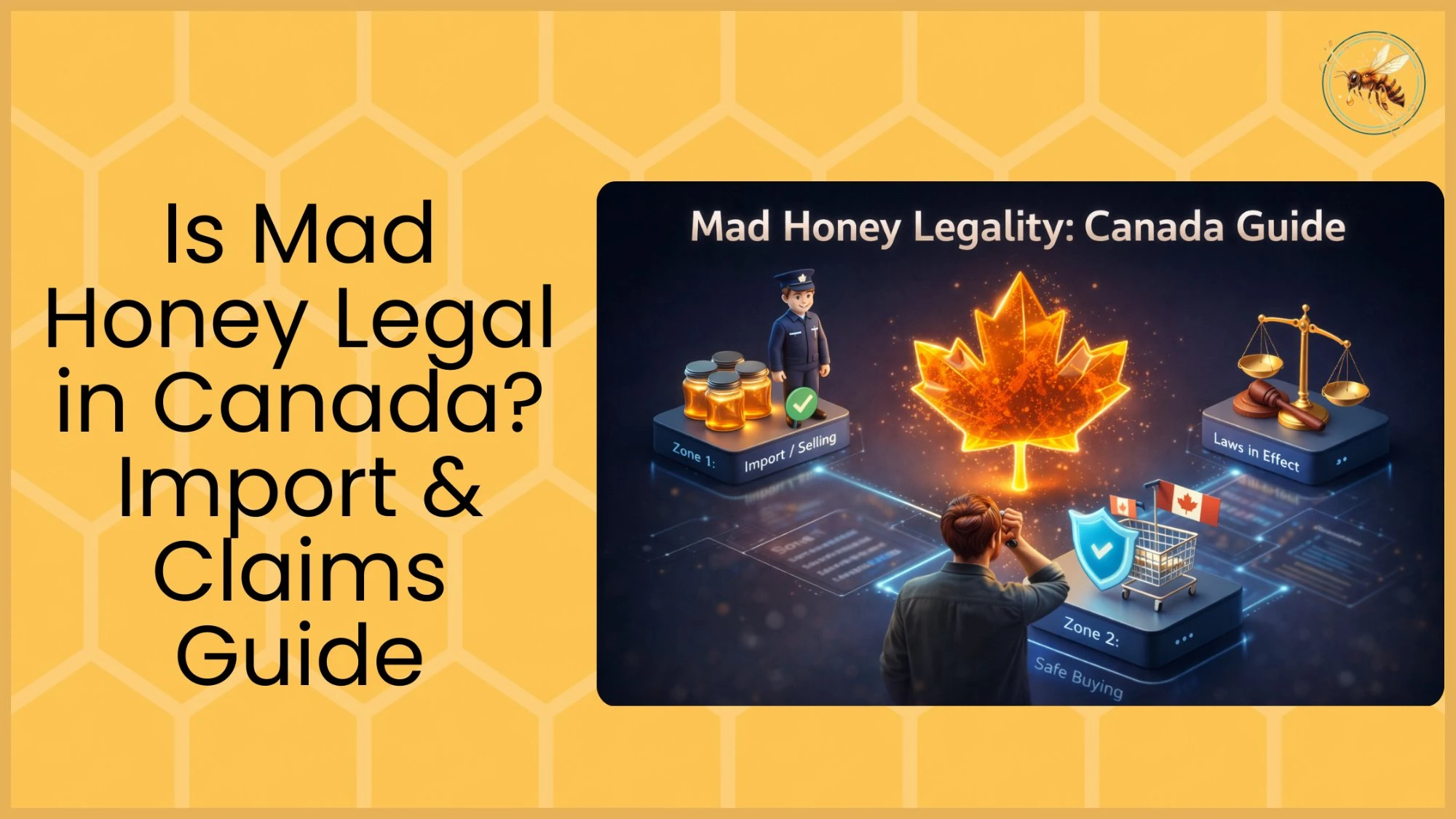
Mad honey is generally treated as honey (a food) in Canada, not as a controlled drug. So the “legal” question usually isn’t “Will I get in trouble for possessing it?”
The real Canadian friction points tend to be import compliance, labelling accuracy, and marketing/health claims, the exact areas regulators care about for any imported food that’s marketed with bold promises.
This guide is written for buyers who want reassurance and for sellers who want a simple, practical compliance mindset, without turning this into legal advice. (If you’re running a business, confirm details with a compliance professional, because rules can change and enforcement priorities vary.)
Also read: What is mad honey?
tl;dr
- In Canada, mad honey is usually legal to buy and possess as a food, but “legal” depends on import + labelling + claims, not internet myths.
- The fastest way to create problems is drug-like marketing (disease-treatment claims, “psychedelic trip” framing, guaranteed effects). Canada has strict rules on prohibited advertising/sales claims for foods.
- Commercial importing is more regulated than personal buying: honey imports have CFIA/SFCR responsibilities, and commercial importers may need a Safe Food for Canadians licence.
- Customs scrutiny is commonly triggered by labelling/origin ambiguity, inconsistent product descriptions, or claims that make the product look like a drug rather than a food.
- The safest buyer approach is simple: choose sellers with origin transparency + batch/lot traceability + conservative safety guidance, because those traits usually align with compliance and lower border risk.
Is Mad Honey Legal in Canada? Quick Answer
Most people mean three different things when they ask, “Is mad honey legal?” So let’s define it clearly before we go deeper.
1) Is Mad Honey legal to buy/possess in Canada?
In most cases, yes, mad honey is treated as a food (honey), not a controlled substance. The bigger issue is whether the product is represented/marketed in a way that triggers drug-style enforcement.
2) Is Mad Honet legal to import in Canada?
Importing honey into Canada is allowed, but importers are responsible for meeting Canadian requirements (labelling, standards, residues, etc.) under the Safe Food for Canadians framework and related rules.
3) Is Mad Honey legal to sell and advertise in Canada?
Yes, you can sell honey, but what you say matters. Canada restricts certain disease treatment/prevention/cure claims for foods and prohibits deceptive marketing.
Also Read: Is Mad Honey Legal In New Zealand?
Canada Practicalities: Buying and Importing Mad Honey
This is where most “legal” confusion actually lives. People read a viral thread, then assume “customs will seize it.” In reality, what typically raises scrutiny is the same stuff that raises scrutiny for other imported foods: unclear labeling, questionable claims, or missing importer-level compliance steps.
What typically triggers scrutiny (labelling, origin, claims)
Labelling and product identity are the first layer. If a shipment is described vaguely (or dramatically), it can invite questions. “Himalayan mad honey, psychedelic” is a very different signal than “honey, food product, proper labelling, country of origin stated.”
Carrying honey with you is simpler: the Canadian Food Inspection Agency allows up to 20 kg per person for personal use. The Canada row of our honey customs table links to the official rule.
Canada has detailed honey labelling requirements (common name, net quantity, business info, country of origin, lot code/traceability elements, etc.). If the label is incomplete or misleading, that’s the kind of thing that can cause delay or enforcement, especially for commercial flows.
Origin ambiguity can also create friction. Honey is a high-fraud category globally; regulators care about truthful identity and origin. A seller who can’t clearly state the country of origin (or uses “Himalayan” as a vibe) increases risk, not because “mad honey is illegal,” but because the product identity is unclear.
Claims are the biggest trigger. If the listing or packaging implies disease treatment or drug-like effects, you shift the product from “food” into “drug representation” territory. Health claim frameworks explain how claims can change how a product is regulated.
Commercial vs personal: why “importing” doesn’t mean the same thing for everyone
If you’re a buyer ordering a jar of mad honey online, you’re usually not acting as a commercial importer. But shipments can still be examined. The risk tends to rise with:
- unusually large quantities (looks like commercial intent),
- inconsistent documentation,
- or highly suspicious marketing language.
If you’re a business importing honey, the compliance obligations are heavier. CFIA guidance makes it clear that importers are responsible for meeting applicable requirements, and for some commodities (including honey/maple products), commercial importers may need a Safe Food for Canadians (SFC) licence.
Documentation that reduces issues (batch ID, traceability, COA/testing language)
You don’t need to ship a science thesis with every order, but documentation and traceability help because they signal “serious food product,” not “mystery intoxicant.”
Strong signals include:
- Batch/lot traceability: Lot coding is part of modern food traceability culture, and it helps both compliance and consumer protection. Labels and systems that support traceability are a practical green flag.
- Clear origin documentation: Even a simple, consistent statement, country of origin, and supplier chain clarity reduces confusion.
- Testing/COA language that is specific (not vague): A COA or test language is only useful if it answers: what was tested, for which batch, and by whom. Vague “lab tested” badges are marketing; batch-linked documentation is operational.
Related: Is Mad Honey Legal in Australia?
Selling/Marketing in Canada (Claims Guidance)
This section matters if you sell into Canada or run ads targeting Canadians. In Canada, the line you must respect is simple: Do not market a food like a drug!
What to avoid
Two big buckets cause trouble:
1) Disease treatment/prevention/cure claims
Canada’s Food and Drugs Act prohibits advertising (and certain sales representations) of foods, drugs, cosmetics, or devices to the general public as treatment/prevention/cure for diseases listed in Schedule A.1, and Health claim guidance explains how “drug representation” and disease claims can trigger regulatory issues for foods.
So avoid statements like:
- “Treats hypertension/diabetes/anxiety/PTSD”
- “Cures insomnia”
- “Prevents heart disease”
- “Reverses depression
Even if the internet is full of those claims, repeating them is the fast lane to compliance problems.
2) Deceptive marketing and “guaranteed” effects
Canada’s Competition Act prohibits false or misleading representations made to promote a product. The Competition Bureau explains the “general impression” concept and the consequences of deceptive marketing.
So avoid:
- “Guaranteed high”
- “Works every time”
- “Strongest on Earth”
- fake countdown urgency + fake social proof
Safer framing and responsible guidance
If you want a Canada-safe posture, position mad honey as:
- a specialty honey/traditional product
- with variable natural characteristics
- used as a low-dose, conservative ritual experience by some consumers
- supported by clear safety guidance and transparency
This matters because the strongest long-term position is:
food + transparency + responsible use education, not “psychedelic honey.”
A practical “safe language” pattern looks like this:
- “Traditionally used in certain regions”
- “Effects can vary by person and batch”
- “Start small and wait”
- “Not recommended for high-risk groups”
- “We focus on responsible guidance and consumer education”
That approach doesn’t just reduce legal risk; it also builds consumer trust.
Take a look at: Is Mad Honey Legal in Singapore?
Mad Honey Buyer Safety Checklist (Canada)
This mad honey buying checklist is Canada-specific in spirit: it prioritizes truthful marketing, traceability, and safety transparency, because those are the same things that tend to reduce customs friction.
Authenticity + transparency
The safest Canadian buyer move is to choose sellers who behave like serious food operators:
- clear country of origin (not just “Himalayan”)
- consistent sourcing story
- batch/lot identification (or at a minimum, coherent batch practices)
- stable brand presence and customer support
If a seller can’t tell you where it’s from beyond a vibe, that’s a risk.
Conservative dosing guidance
A real quality signal in this category is conservative guidance, because it shows the seller understands the product’s risk profile and isn’t selling hype.
Look for:
- “start low + wait”
- “do not stack spoonfuls quickly”
- “avoid mixing with alcohol/sedatives”
- “avoid if you have certain health conditions/pregnancy”
Red flags
In Canada, the red flags that matter most are the ones that look like drug marketing or deceptive marketing:
- psychedelic/trip language on the label or listing
- disease treatment claims
- “guaranteed” or “strongest” promises
- unclear origin + no batch transparency
- pressure tactics and suspicious review patterns
Those listings don’t just risk authenticity; they can also increase border and compliance friction.
Also read: Is Mad Honey Legal in the UK?
Conclusion
In Canada, the practical truth is this: Mad honey is usually legal as a food, but in Canada, “legality” is mostly about truthful marketing + import compliance + safety transparency.
If you’re buying mad honey, your safest move is to choose sellers who make verification easy: clear origin, batch/lot accountability, and conservative guidance.
If you’re selling into Canada, your safest long-term posture is even clearer: avoid drug-like claims, avoid deception, and build trust through education and traceability.
Also read: Is mad honey legal in the Philippines?, Is mad honey illegal in the US?
FAQs (Mad Honey Canada)
Is it legal to order mad honey online in Canada?
Generally, yes, because it’s usually treated as honey/food, but import compliance and marketing representations still matter. If a shipment is clearly labelled as honey with proper origin and a sensible product description, it’s typically lower risk than a “psychedelic honey” novelty listing.
Can customs stop it?
Customs/inspection can examine shipments, especially if something looks non-compliant or misrepresented. The likelihood goes up with vague labeling, large quantities, or drug-like claims. For commercial importing, licensing/compliance expectations are clearer and stricter.
Is it legal to resell in Canada?
Selling honey is allowed, but resellers become responsible for truthful labelling and marketing. Claims that move the product into drug-like territory or that are materially misleading create risk under food advertising rules and deceptive marketing provisions.
Is it legal to advertise “effects” in Canada?
You can discuss general, non-medical, non-disease claims carefully, but you should avoid disease treatment/prevention/cure claims and avoid misleading guarantees. Health-claim guidance explains how claims can shift classification and compliance expectations.
Can I say it “treats” anxiety, blood pressure, or sleep?
Avoid “treat/prevent/cure” framing for diseases/conditions in public advertising for a food product; that’s exactly where prohibited advertising/sales issues show up. Safer framing is education-focused and non-medical (experience/ritual, variability, conservative use).