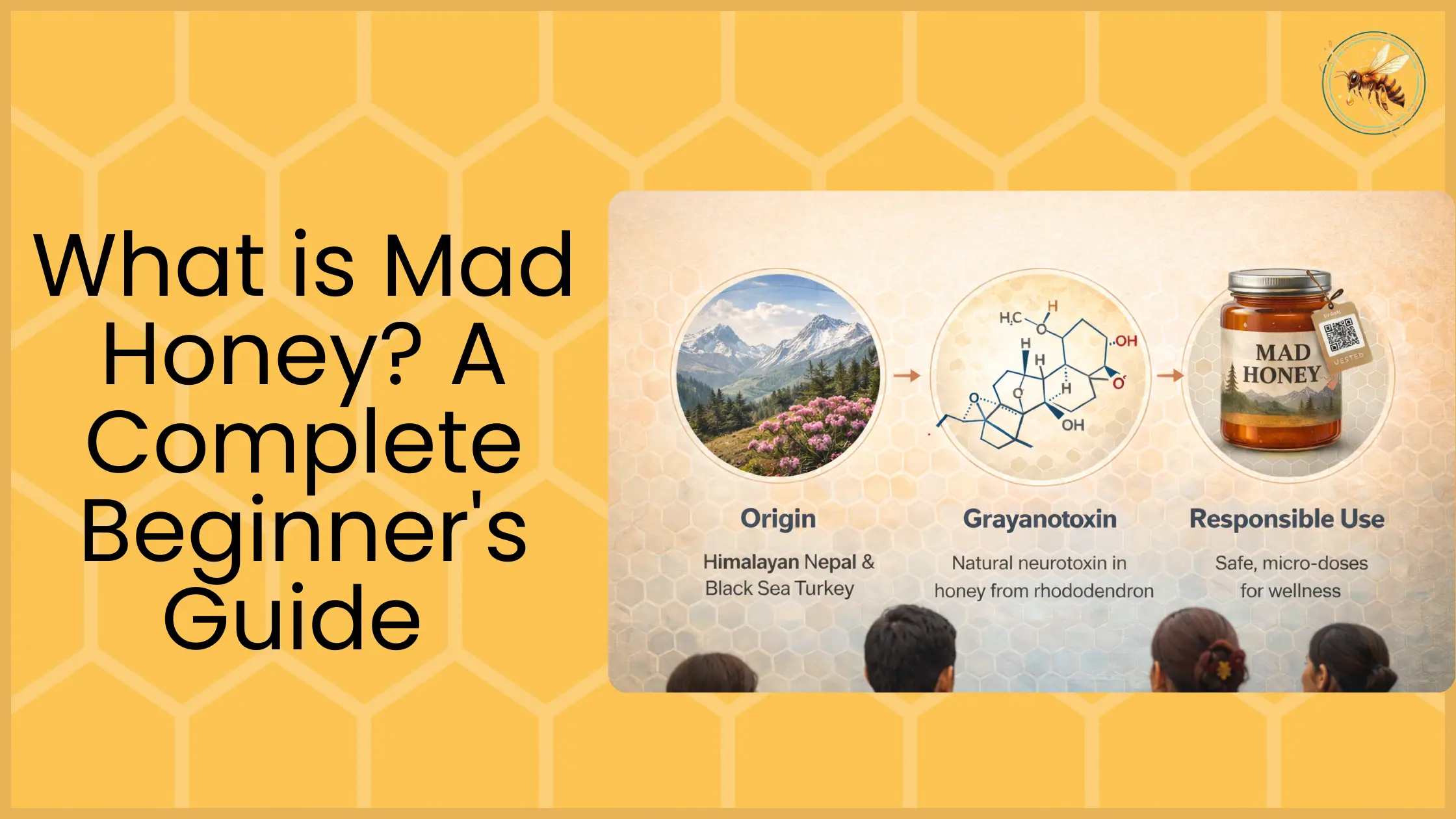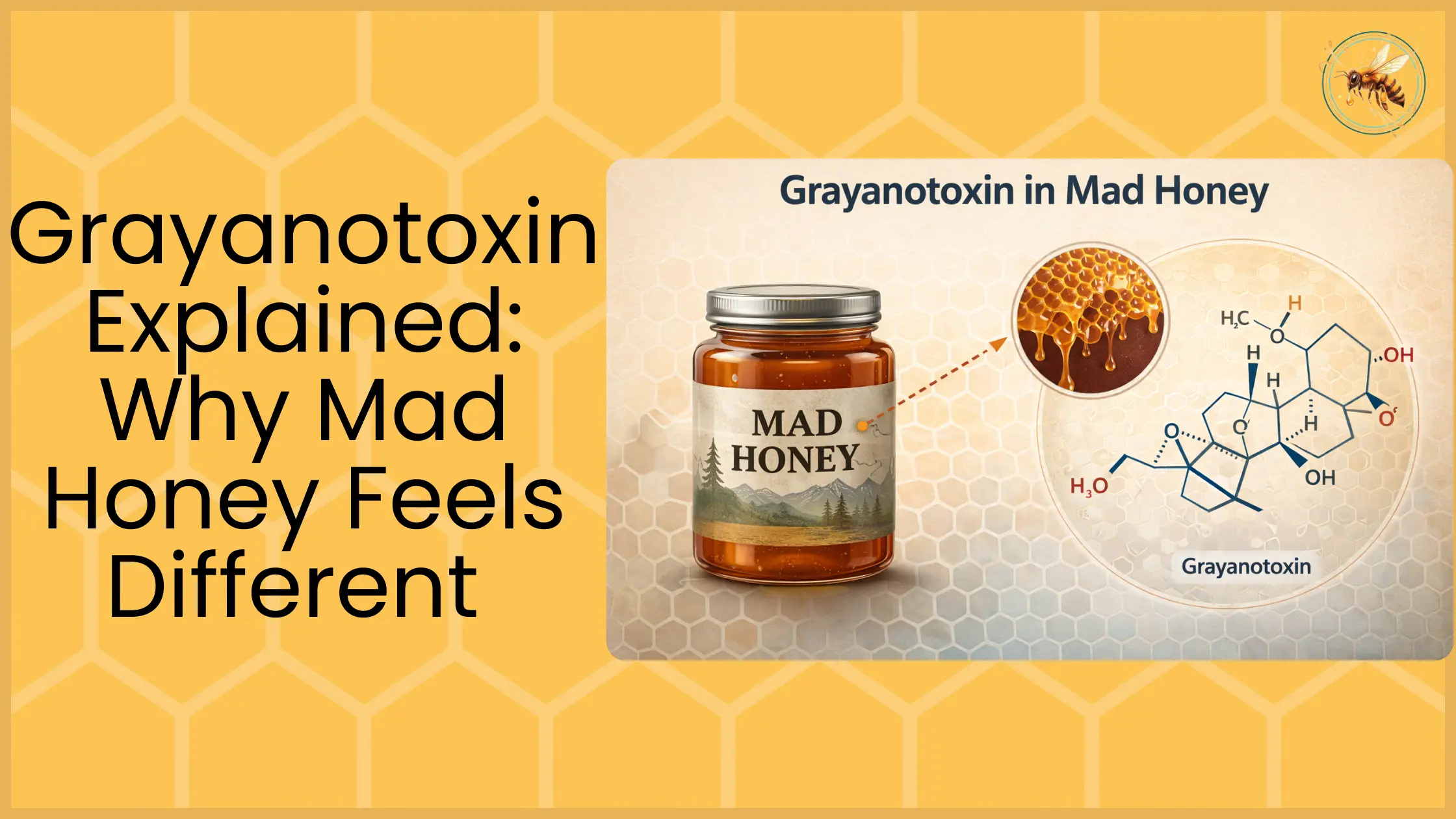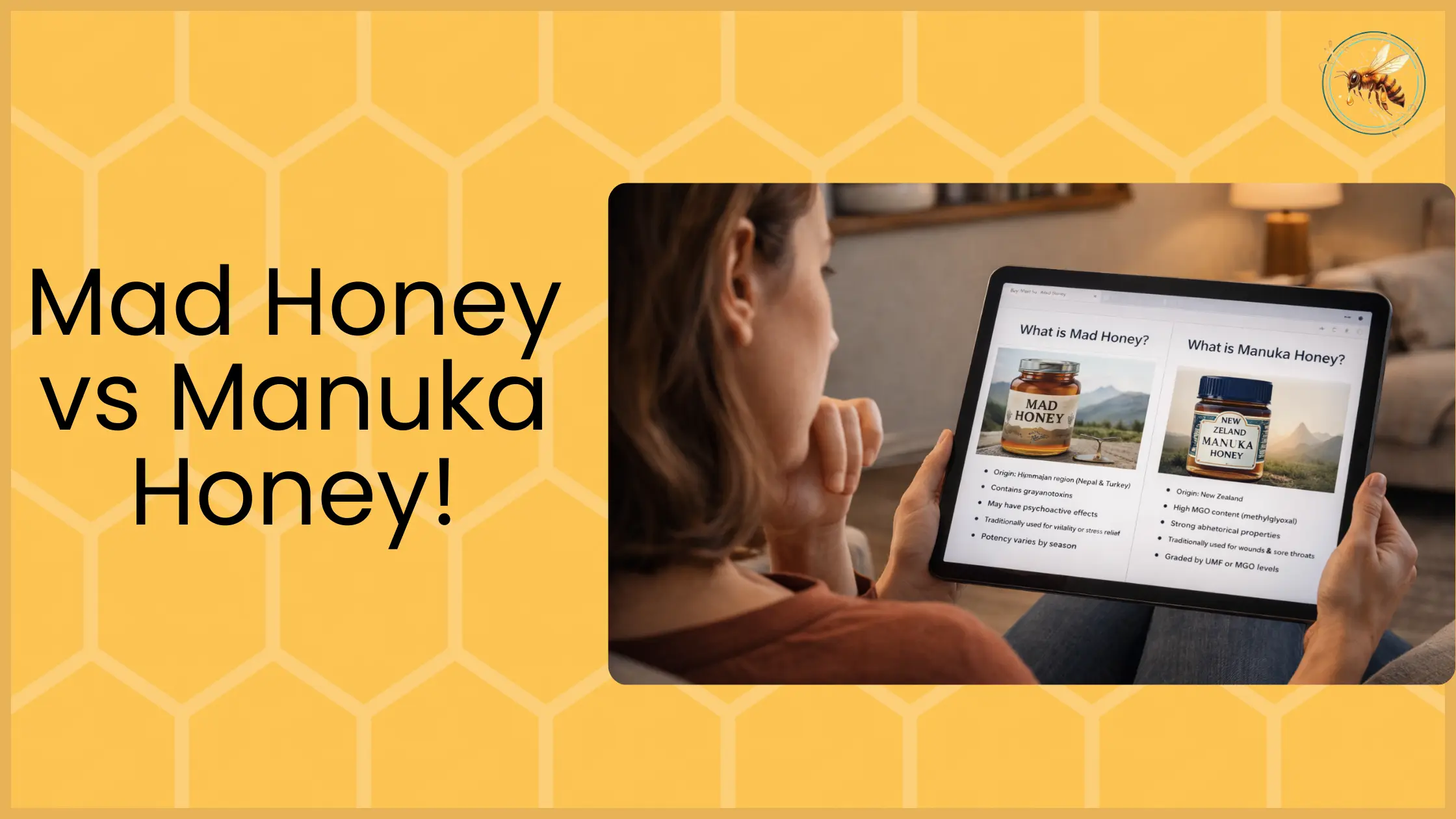

Open nine mad honey shops in nine tabs, and you will read the same four sentences nine times. Wild-harvested from Himalayan cliffs. Collected by Gurung honey hunters. Lab-tested for grayanotoxin. One hundred percent authentic. The wording barely moves from seller to seller, while the prices run from twenty-six cents a gram to a dollar eighty-one. Nothing on the surface tells you which jar is which, and that is the problem this page exists to solve.
The claims cannot separate these brands, because every brand makes them. What separates them is which of those claims arrives attached to something you can open, read, and check. A named laboratory. A batch identifier. A date. A number with a unit. A downloadable certificate.
On the nine seller websites we read in September 2026, that kind of evidence was rare and uneven. On our first check, three sellers published it, and in two of those three cases it was older than most buyers would assume. By our second check, at the end of the month, those two had changed what they show in ways that make it harder to trust, and only the third still published certificates that each stand on their own.
This guide ranks the brands on what they publish, shows you the raw figures side by side, and then teaches you the checks so you can apply them to any seller, including one that is not on this list.
tl;dr
- Potency is a property of a batch and not of a brand, so no single jar can honestly be called the best mad honey.
- Only two of the nine brands we checked publish a named laboratory with batch identifiers, dated analysis, and downloadable certificates: Real Mad Honey and Magaranger. Best Mad Honey did on our first check; its page now names no laboratory, and its certificates are undated images.
- The report Magaranger now shows for its current batch carries exactly the grayanotoxin figures of one of Best Mad Honey’s certificates, under a different date, so the question worth asking is whether a report covers the jar being shipped at all.
- One seller has built an answer into its page. Real Mad Honey publishes four dated certificates and a box that takes an order number and returns one of them. We could not audit that mapping from outside. It now finishes first here, not because it published anything new, but because the two brands above it lost points on lab evidence, and its sourcing and safety disclosure are still thin.
- Published starting amounts run from about half a teaspoon to two tablespoons, and the stated maximums differ by roughly tenfold between two of these sellers.
- Across the nine ranked brands, price per gram spans about sevenfold, from the cheapest thousand-gram jar to the dearest harvest tier, and it appears to track packaging rather than any published measure of strength.
- Five of the nine sellers carry psychedelic, hallucinogenic, or medicinal language, which is worth reading as a signal about the seller rather than about the honey.
Quick Answer – What is the best mad honey to buy?
There is no single best mad honey. Grayanotoxin content can vary between harvests and between batches, so strength is better understood as a property of a batch than of a label. What can genuinely be compared is how much checkable information a seller hands you before you pay.
On that measure, one brand now leads. Real Mad Honey publishes four dated certificates from two named laboratories and offers a lookup that returns one of them against an order number. Best Mad Honey publishes batch figures and dates on its page but no longer names its laboratory, and Magaranger‘s one certificate from a named laboratory covers a batch it says has sold out.
The other six do not publish a named laboratory at all. One twist follows. The report Magaranger now shows for the honey it sells carries exactly the figures Best Mad Honey publishes for one of its own batches, under a date almost two years later, so a reader buying in September 2026 should ask which batch is in the jar, and for a certificate that belongs to it.
And the brand with the most current certificates now tops our table, although our rubric scores the breadth of what a seller discloses and on sourcing it still discloses less than any other brand here. Our page on how much grayanotoxin varies between harvests explains why that question does most of the work.
How we scored
We built the rubric before we opened the shops, and we are publishing it before the table so you can disagree with the weights rather than only with the result. Six criteria, one hundred points.
The six criteria, weighted
- Lab evidence, 25 points: This carries the most weight because it is the only criterion that speaks to what is actually in the jar. Every other criterion describes the company. Points go to a named laboratory, an accreditation standard, a batch identifier, an analysis date, figures with units, and a certificate you can open. A claim of testing with nothing behind it scores near the floor.
- Sourcing transparency, 20 points: Named districts, stated altitudes, the bee species, and dated harvests. This is partly checkable against what is known about Nepali cliff harvesting and about Apis laboriosa, so vague sourcing copy is a choice rather than a constraint.
- Safety guidance, 20 points: What the seller tells buyers about amounts, waiting, alcohol, age, contraindications, and warning signs. We scored the presence, specificity, and conservatism of the published guidance. We did not score whether we agree with the numbers.
- Price per gram, 15 points: Weighted below the first three on purpose, and scored on the cheapest per-gram figure a brand publishes. Price is easy to compare and tells you almost nothing about quality, so it earns a real share of the score but never the decisive one.
- Fulfillment, 10 points: Dispatch time, carrier, tracking, destination coverage, and shipping cost. Real, but a solved problem for most of these sellers.
- Company transparency, 10 points: A published street address, a phone number, and refund or guarantee terms that say what they cover. This is the criterion that tells you who you would be dealing with if something went wrong.
Why customer reviews are not a scoring criterion
On-website reviews are collected, moderated, and displayed by the seller. They are not independent; they are not dated to a batch, and a reader cannot tell a real five-star review from a solicited one.
More importantly, a review reports an experience, and an experience cannot separate a strong batch from a large serving. The key point is that reviews describe people, not honey, so we left them out of the arithmetic entirely.
The ranking
Nine brands, ordered by total score. The score measures how much a buyer can verify before paying.
| Rank | Brand | Price per gram | Lab evidence | Ships from | Guarantee | Score |
| 1 | Real Mad Honey | $0.40 – $0.85 | Tier 1. Nagel of Amsterdam and Eurofins, four dated certificates, LC-MS/MS named but the measurement outsourced, downloadable PDFs, an order-number lookup, no accreditation standard published | Texas for US orders, the Netherlands for everyone else | 60 days from delivery, sealed and unopened jars only | 70 |
| 2 | Best Mad Honey | $0.42 – $1.81 | Tier 2 since our second check. Batch figures and dates on the page, no laboratory named, certificates now undated images | Kathmandu, Nepal | None stated on the homepage | 66 |
| 3 | Strong Mad Honey | $0.36 – $0.52 | Tier 3. Testing claimed, nothing published | Not stated; company address published in Kathmandu | 100% money-back guarantee, no conditions stated | 64 |
| 4 | Magaranger | $1.00 at list price, $0.67 – $0.83 on sale until 31 October | Tier 1 for a sold-out batch only: Nagel of Amsterdam, April 2025. The report for its current batch repeats another seller’s figures | Dallas, Texas | 30 days, money back, keep the pouch | 63 |
| 5 | Sherpa Honey | $0.65 – $1.00 | Tier 2. One certificate reference, no laboratory named, no figures | Las Vegas, Nevada | 30 days, but 80% of product must be returned in the original jar | 59 |
| 6 | Medicinal Mad Honey | $0.26 – $0.48 | Tier 3. Testing claimed, parameters listed, nothing published | Not stated | Refund policy page exists, terms not shown on the pages checked | 57 |
| 7 | Original Mad Honey | $0.40 – $0.48 | Tier 2. Lab page exists and carries no results | Kathmandu, Nepal | 30 days, conditional on “if effects not experienced” | 50 |
| 8 | Royal Mad Honey | $0.46 – $0.80 | Tier 3. Testing claimed, nothing published | Nepal | 30 days, full refund, no questions asked | 39 |
| 9 | Maddest Mad Honey | About $1.00 – $1.14 | Tier 4. Rhododendron pollen share only, which is not a potency test | Not stated | Covers non-delivery only | 32 |
The scores, criterion by criterion
| Brand | Lab /25 | Sourcing /20 | Safety /20 | Price /15 | Fulfillment/10 | Company /10 | Total |
| Real Mad Honey | 21 | 10 | 14 | 11 | 8 | 6 | 70 |
| Best Mad Honey | 12 | 17 | 13 | 9 | 9 | 6 | 66 |
| Strong Mad Honey | 6 | 12 | 16 | 12 | 8 | 10 | 64 |
| Magaranger | 13 | 15 | 16 | 6 | 7 | 6 | 63 |
| Sherpa Honey | 9 | 13 | 17 | 7 | 9 | 4 | 59 |
| Medicinal Mad Honey | 6 | 14 | 7 | 15 | 9 | 6 | 57 |
| Original Mad Honey | 8 | 13 | 6 | 11 | 8 | 4 | 50 |
| Royal Mad Honey | 5 | 11 | 5 | 8 | 7 | 3 | 39 |
| Maddest Mad Honey | 3 | 13 | 1 | 4 | 8 | 3 | 32 |
How to read this table

A high score means a brand is easier to verify. It does not mean the honey is stronger, purer, better tasting, or safer. Real Mad Honey leads because, after our second check, it publishes more checkable lab evidence than anyone else here, not because we know its honey is superior.
The most important change in the table is one we did not make. Real Mad Honey’s score is exactly what it was on our first check, when it finished third. It is first now because Best Mad Honey and Magaranger each lost lab points, not because it disclosed more, and its gaps are unchanged: it publishes no accreditation standard, no figures outside its PDFs, no district, no bee species, no harvest date, and no maximum serving.
We have left the criterion scores visible so that a reader who weighs these things differently can reorder the table. What we were not willing to do is add a criterion after seeing the result, and the second check was scored on the same rubric, published above, as the first.
Strong Mad Honey and Magaranger are separated by a single point, which is not a meaningful gap, and Strong reaches third with almost no lab evidence at all, on the strength of its safety guidance, price, and company detail. Where totals tie, we place the brand that scores higher on more of the three heaviest criteria. Medicinal Mad Honey scores a full fifteen on price because its thousand-gram jar is the cheapest per gram of the nine ranked brands, and that sits alongside a lab disclosure near the bottom of the range.
Two further notes on the arithmetic. Maddest Mad Honey scores below Magaranger on price at roughly the same per-gram figure, because Maddest never publishes a gram weight, so its figure has to be inferred from ounces rather than read off the page.
And the last two places, Royal Mad Honey and Maddest Mad Honey, are both brands where almost nothing can be checked, and they arrive there by different routes. They were a single point apart on our first check; the gap widened to seven because Royal now lists its sizes, which let us score its price. The more useful point is that this table ranks disclosure, and disclosure is the only thing a buyer can assess from a browser.
What the brands tell buyers to take, side by side
This is the most important table on the page. Every figure below is what the seller prints on its own. None of it is our guidance, and we do not issue amounts in our own voice anywhere.
| Brand | Stated starting amount | Stated maximum | Wait time before more |
| Real Mad Honey | “start with half a teaspoon” on its dosage page, “Start with 1 teaspoon” on its product page | Not stated | “Wait a full hour” on its dosage page, “45 to 60 minutes” in its product FAQ |
| Magaranger | “1/2 teaspoon (2-3 g) – start here” | “1 teaspoon (5-6 g) – the maximum” | “Wait 60-90 minutes” |
| Sherpa Honey | “Start with 2.5 grams” | “do not exceed 5 grams per day”, 21+ | Not stated |
| Strong Mad Honey | Beginner, “1/2 to 1 teaspoon (2-5g)” | “1 tablespoon (15g) per 24 hours DO NOT EXCEED” | Not stated |
| Best Mad Honey | “start with 1/2 teaspoon” | Not stated | “45-60 minutes” |
| Royal Mad Honey | “Begin with a single teaspoon (5g)” | Not stated | “Allow 45 minutes for onset” |
| Original Mad Honey | “half-teaspoon” | Not stated | Not stated |
| Medicinal Mad Honey | “begin consumption with one teaspoon” | “slowly increasing it to one tablespoon” | Not stated |
| Maddest Mad Honey | “1 to 2 tablespoons” | “no more than 3 tablespoons per serving” | Not stated |
| Bee-licious Honey | None published | None published | None published |
A US teaspoon of honey is about seven grams and a tablespoon about twenty-one grams, so these are approximate conversions rather than exact ones. Even so, the published figures do not sit anywhere near each other. Magaranger tells buyers that one teaspoon, which it describes as five to six grams, is the maximum.
Maddest Mad Honey tells buyers to start at one to two tablespoons and caps a single serving at three. Maddest’s stated maximum is therefore roughly tenfold or more Magaranger’s stated maximum, and its stated starting amount alone is several times what Magaranger prints as a ceiling.
Strong Mad Honey publishes fifteen grams in capital letters as an absolute twenty-four-hour limit. Measured against Strong’s own conversion of a tablespoon to fifteen grams, Maddest’s stated maximum single serving is about three times what a direct competitor prints as a hard daily cap, and the top of Maddest’s stated starting range sits at or above that cap. These brands are selling the same category of product from the same region. They cannot all be right.
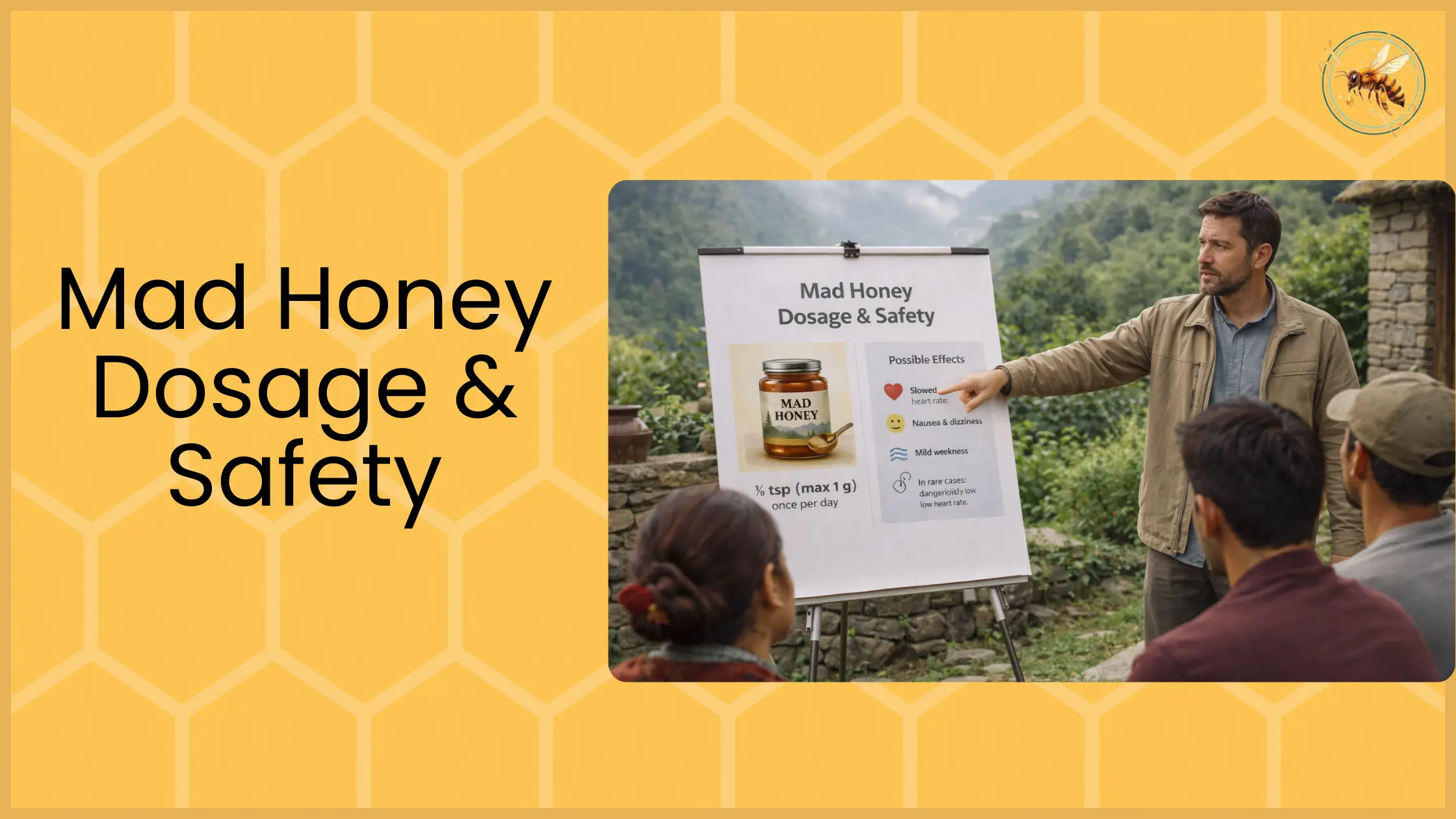
If you want the general picture rather than any one seller’s numbers, our beginner dosage guide sets out how people usually approach a first serving and why cautious approaches exist, and our page on what an overdose looks like describes the reported symptoms at the other end.
Why a spoon is not a dose
A spoon measures honey. It does not measure grayanotoxin. Best Mad Honey’s own certificates make the point better than we could: its published batches range from 3,869.60 to 19,296.17 micrograms per kilogram of grayanotoxin I, which is about a fivefold difference between two jars sold by one seller under one brand.
A fixed half-teaspoon taken from those two batches would deliver substantially different amounts of the active compound. That is why chasing intensity is the wrong approach, and it is why a number in grams, printed with no batch figure beside it, tells you less than it appears to. Our explainer on what grayanotoxin is and how it acts covers the compound itself, and our page on batch variability covers why two spoons of the same brand are not equivalent.
Why “start low” is not the same as a published ceiling
All nine brands print a starting amount. Five print a maximum, and four do not. Those are different pieces of information, and they do different jobs. A starting amount tells a first-time buyer where to begin. A ceiling speaks to the reader who did not feel much after ninety minutes and is thinking about more, which is where the risk of overshooting can sit.
Real Mad Honey, Best Mad Honey, Royal Mad Honey, and Original Mad Honey all give a start and no stated limit. Real Mad Honey is the most striking of the four, because it is otherwise the most thorough safety writer in this comparison: it covers onset timing, an hour of waiting, alcohol, frequency, contraindications, and when to call a doctor, but then never says where to stop.
In plain terms, a brand that says “start with half a teaspoon” and then goes quiet has answered the easy question and skipped the hard one. If anyone develops severe symptoms after eating mad honey, contact emergency services or a poison control center rather than waiting it out, and read what the reported symptoms look like and what to do before you need it rather than after.
What “lab tested” is actually worth
Every brand here says it tests. The phrase is close to meaningless on its own, so we sorted the nine into four tiers by what the testing claim comes with.
Tier 1 – a named laboratory, batch figures, and a certificate you can download
We built the tiers by reading each seller’s website and its dedicated lab page where one exists. Three brands reached this tier on our first check. On our second, two still do, and Best Mad Honey no longer does.
Real Mad Honey
It is the only seller in this comparison that connects a certificate to a specific order. Its lab page carries four dated Nepal certificates and a search box that takes an order number and returns a report.
The ranges are not displayed to the reader; they sit in the page’s own markup, and they run certificate 2505465 for orders 1000 to 5819, 2600568 for 5820 to 9610, Eurofins report AR-26-TH-006085-01-THHGT for 9611 to 19955, and 2602852 from 19956 onward.
Three of the four are from Vereenigde Laboratoria Drs. W.H. Nagel B.V. of Amsterdam, the laboratory behind Magaranger’s April 2025 certificate, and one is from Eurofins Food Integrity Control Services in Germany, the laboratory Magaranger’s current report names. All four are open.
The three Nagel documents each carry a certificate number, a sample-received date, an analysis date, a client batch marking, a jar-filling date, and both toxins with units, and each names the method as LC-MS/MS. The fourth, the Eurofins report covering the widest block of orders, carries no batch marking and no filling date, records the client as the sampler, and describes its method only as an internal one. The most recent sample was analyzed on 24 July 2026, which is the freshest analysis date published by anyone here.
One thing on all three Nagel certificates is easy to miss and worth knowing. The grayanotoxin line carries an asterisk keyed to the footnote “outsourced, not performed on above-mentioned location”. The laboratory named on the document issued it; a different, unnamed laboratory made the measurement. That is not a defect in the result, but it does mean the name on the page is not the name of the analyst. The same footnote appears on Magaranger’s certificate, which comes from the same laboratory, so it applies to both.
Its own four certificates also make this page’s central argument better than our own words do. Grayanotoxin I across them reads 16,737 for the December 2025 batch, 5,055 for February 2026, 2,512.73 for April 2026, and 19,823 for the batch filled in June 2026, all in micrograms per kilogram. That is close to an eightfold spread inside one brand, one origin, and under eight months of analysis dates.
Against it, and this is why it did not lead the table on our first check: none of those figures appear on the lab page itself, only inside the PDFs, so a reader has to download four files to see what we have just tabulated. The page labels each certificate number as an “Accreditation”, which is not what those numbers are; 2602852 is the certificate-of-analysis number printed on the Nagel document, and no accreditation standard is published.
Best Mad Honey, by contrast, publishes DIN EN ISO/IEC 17025:2018 and puts its figures on the page. Two of the four RMH PDFs are scanned images rather than text. And it sells a Turkish honey in its European and Canadian stores, described there as lab-tested, while all four published certificates are for Nepal and every order range maps to a Nepal batch, so the lookup would hand a Turkish buyer a Nepal document. On that product, it is in the same position as the Tier 3 brands below.
Best Mad Honey
On our first check it had the most complete lab disclosure of any brand in this comparison, and its lab-reports page named the laboratory as Eurofins Food Integrity Control Services in Germany. By our second check that name was gone. The page still says its tests are done by an independent third-party laboratory working to the DIN EN ISO/IEC 17025:2018 standard, the only accreditation standard any brand here publishes, but it no longer says which laboratory.
It lists three batches, each with a batch identifier, an analysis date, both toxins with units, and a purity figure. The certificates behind them are now images on the brand’s own template, with no laboratory letterhead, no report number, and no date on the document; the dates exist only in the text of the page. Batch A24, Rare Harvest, analyzed 15 April 2024: grayanotoxin I 19,296.17 and grayanotoxin III 5,356.91 micrograms per kilogram, purity 100%.
Batch B24, Spring Harvest, analyzed 20 May 2024: GTX I 11,409.56, GTX III 2,765.67, purity 100%. Batch C23, Autumn Harvest, analyzed June 2024: GTX I 3,869.60, GTX III 276.15, purity 100%. Its product pages quote figures that match those certificates exactly, which is a genuine consistency mark. The Rare Harvest figures, though, also appear to the second decimal place on the report Magaranger now shows for its own current batch, under a date almost two years later.
Magaranger
On our first check it published one certificate, and published it properly. It names the laboratory as Vereenigde Laboratoria Drs. W.H. Nagel B.V. of Amsterdam, describes it as an independent analytical laboratory founded in the nineteenth century, and identifies the product as Cliff Honey Nepal, Batch 003. Certificate number 2502051, certificate date 30 April 2025. The page now marks that batch as sold out and keeps the certificate “for the record”.
Grayanotoxin I: 35,038 micrograms per kilogram; grayanotoxin III estimated at 13,520. The analytical method is named LC-MS/MS, and the full certificate of analysis is linked as a PDF. Real Mad Honey’s certificates from the same laboratory name the same method, so this is no longer unique to Magaranger, and the same outsourcing footnote applies to both.
Against it: the report it now shows for its current batch does not stand on its own. It is laid out as a Eurofins analytical report dated 2 February 2026, and its two figures, grayanotoxin I 19,296.17 and grayanotoxin III 5,356.91 micrograms per kilogram, are exactly the figures Best Mad Honey publishes for its Rare Harvest batch A24, which Best dates to 15 April 2024. Two separate analyses do not agree to two decimal places on two toxins, so this is one analysis shown by two sellers under two dates. The certificate promised for its shilajit product was still not on the page, with buyers told to email for batch certificates instead.
Tier 2 – a lab page that looks like evidence and carries none
Original Mad Honey
It has a page titled Lab Report that is built to look like proof. It refers to a partner laboratory only as “NAST NEPAL AUTHORIZED”, with no facility address and no registration details. It shows a single batch code, N-LTM-2026-B81, which reads as a sample or a placeholder rather than a customer batch. There are no grayanotoxin figures, no units, and no dates.
The page states that batch-specific laboratory reports are available for download and refers to a certificate of analysis, but on the date checked, the download button and the batch-lookup tool both returned nothing.
Sherpa Honey
It claims third-party testing for grayanotoxin at an internationally accredited laboratory and promises a certificate of analysis with every order. Its public Lab Reports page exists. On the date checked, it carried one certificate reference, “SH000A”, and the remainder of the page was a mandatory-arbitration clause.
No laboratory is named, no grayanotoxin figures appear, there are no batch dates, and there is no viewable certificate. A page titled Lab Reports that carries an arbitration clause and one bare certificate reference is not publishing results, whatever it is titled.
Tier 3 – testing claimed, nothing published
Medicinal Mad Honey, Strong Mad Honey, & Royal Mad Honey
They all assert testing and publish none of it. Medicinal Mad Honey does something useful in listing the parameters it says are tested, including moisture, acidity, HMF, ash, the fructose-to-glucose ratio, sucrose, and grayanotoxin level, and it claims a GMP-certified facility and QR-based traceability to harvest and batch records.
That is a good list. But no lab-report page or navigation on the date checked; no laboratory is named anywhere, and the QR traceability claim cannot be checked from outside. Strong Mad Honey states that every batch is independently tested for grayanotoxin levels, purity, and the absence of added sugars, chemicals, or artificial substances, with no lab page, no laboratory named, no certificate, and no figures. Royal Mad Honey says each batch is lab-tested for purity and grayanotoxin content, with the same absence behind it.
Tier 4 – testing the wrong thing
Maddest Mad Honey
It states that each batch is lab-tested and must pass a minimum 87% rhododendron pollen rating. That is a real test, and it is not a test of strength.
Old certificates, and one analysis on two brands
This is the sharpest point on the page, and no competing comparison we are aware of makes it. On our first check, two of the three brands that published real certificates published old ones: Best Mad Honey’s three were dated April, May, and June 2024, and Magaranger’s single certificate 30 April 2025. By our second check, at the end of September 2026, both had changed what they show, and neither change makes the evidence easier to trust.
Magaranger now lists its April 2025 certificate as a previous batch that has sold out, and shows a new report, laid out as a Eurofins analytical report dated 2 February 2026, as its current batch. Its two figures, grayanotoxin I 19,296.17 and grayanotoxin III 5,356.91 micrograms per kilogram, are exactly the figures Best Mad Honey publishes for its Rare Harvest batch A24, which Best dates to 15 April 2024. Two separate analyses do not agree to two decimal places on two toxins. This is one analysis shown by two sellers under two dates, and at most one of those dates can be right. From outside, a buyer cannot tell which, or whose honey was in the sample.
Best Mad Honey, meanwhile, no longer names its laboratory, and its three certificates are now images on its own template, with no letterhead, report number, or date on the document itself.
Grayanotoxin content is a property of the batch rather than of the brand. A certificate for a batch analyzed in April 2024 describes honey harvested and jarred around that time. It says very little about a jar shipped in the second half of 2026 unless the seller states explicitly that the jar comes from that same batch.
Best Mad Honey’s product pages each quote the figure from one of its three certificates, and Magaranger’s current pouch points to the shared report. Neither states which batch the jar being shipped today comes from, which is the assurance a 2026 buyer needs.
The third brand shows that the assurance is at least possible, and it now tops our table, although its own disclosure did not change between our two checks. Real Mad Honey publishes an analysis from 24 July 2026 and maps its certificates to order-number ranges, so a buyer can establish which document is meant to cover their jar rather than reading one that covers somebody else’s.
What we can say is that RMH is the only seller here that makes the claim in a form a buyer could check at all, and that its own four results, spanning nearly eightfold, show exactly why the distinction matters. So the question that actually separates sellers is not “does this brand have a lab report?” It is “does this brand have a lab report for the jar it is about to send me?”
That is a question you can ask by email before you order, and the answer, or the absence of one, will tell you a great deal. Our guide to reading a mad honey lab report covers what a current certificate should contain, and our page on how scientists actually test honey for toxicity explains why the method name matters as much as the number.
Why a pollen rating is not a potency test
A rhododendron pollen share tells you what the bees foraged on. It is a floral-origin check, and it can be a reasonable authenticity signal, because honey with almost no rhododendron pollen is unlikely to be what it claims to be. What it cannot do is tell you how much grayanotoxin is in the jar.
Nectar composition can vary by species, by location, by season, and by how the honey was handled after harvest, and not all rhododendrons contribute the same compounds. Two jars can both clear 87% pollen and still differ several times over in toxin content. Maddest Mad Honey presents its pollen rating in the position where other brands put a grayanotoxin figure, and a reader skimming quickly may read it as the same kind of number. It is not.
A lab page is not a lab report

The two Tier 2 examples are worth studying because they show how the gap gets papered over. A page titled Lab Report, carrying a batch code, a partner-laboratory mention, and a download button, satisfies the eye.
Original Mad Honey’s download returned nothing on the date checked, and its batch code reads as a template value. Sherpa Honey’s page has one bare reference and then pivots to arbitration terms. In both cases, the furniture of evidence is there, and the evidence is not. The more useful point is that the fix is not to find the brand with the most confident lab page. It is to open the certificate and check that a number, a unit, and a date are in it.
Price, and what you actually pay per gram
Sticker price is close to useless in this market because sizes differ by more than thirty times. Here is every product we could price, with the per-gram figure.
| Brand | Product and size | Price | Price per gram |
| Bee-licious Honey | Himalayan Mad Honey, 1000 g, list $195 | $170 | $0.17 |
| Bee-licious Honey | Himalayan Mad Honey, 500 g, list $125 | $100 | $0.20 |
| Medicinal Mad Honey | 1000 g | $260 | $0.26 |
| Bee-licious Honey | Himalayan Mad Honey, 250 g, list $80 | $70 | $0.28 |
| Bee-licious Honey | Himalayan Mad Honey, 150 g, list $65 | $50 | $0.33 |
| Medicinal Mad Honey | 500 g | $180 | $0.36 |
| Strong Mad Honey | Trip, 500 g | $179 | $0.36 |
| Medicinal Mad Honey | 2 x 250 g | $184 | $0.37 |
| Strong Mad Honey | Medicinal, 250 g | $99 | $0.40 |
| Original Mad Honey | 500 g, list $499 | $199 | $0.40 |
| Real Mad Honey | Nepal, 500 g plus free-gift jars, 600 g total | $239.95 | $0.40 as published |
| Best Mad Honey | Autumn Harvest, 400 g | $169 | $0.42 |
| Best Mad Honey | Autumn Harvest, 600 g | $259 | $0.43 |
| Best Mad Honey | Autumn Harvest, 200 g | $89 | $0.45 |
| Royal Mad Honey | Peak Harvest, 250 g | $115 | $0.46 |
| Medicinal Mad Honey | 250 g, list $140 | $120 | $0.48 |
| Original Mad Honey | 250 g, list $199 | $119 | $0.48 |
| Real Mad Honey | Nepal, 500 g | $239.95 | $0.48 |
| Strong Mad Honey | Trip, 250 g | $130 | $0.52 |
| Real Mad Honey | Nepal, 250 g | $154.95 | $0.62 |
| Sherpa Honey | 300 g | $194.95 | $0.65 |
| Real Mad Honey | Nepal, 150 g | $99.95 | $0.67 |
| Real Mad Honey | Nepal, 100 g | $77.50 | $0.78 |
| Sherpa Honey | 150 g | $119.95 | $0.80 |
| Royal Mad Honey | Ultra Royal Mad Honey Guardians Reserve, 250 g | $199 | $0.80 |
| Real Mad Honey | Nepal, 50 g | $42.50 | $0.85 |
| Bee-licious Honey | 30 g pouch, out of stock | $26 | $0.87 |
| Magaranger | 30 g pouch, list price; $19.99 or $24.99 on sale until 31 October | $29.99 | $1.00 |
| Sherpa Honey | 50 g | $49.95 | $1.00 |
| Maddest Mad Honey | 2 x 3.5 oz Buddy Bundle | $199 | About $1.00 |
| Best Mad Honey | Spring Harvest, 200 g | $199 | $1.00 |
| Maddest Mad Honey | 3.5 oz Personal Set, list $139 | $114 | About $1.14 |
| Best Mad Honey | Spring Harvest, 100 g | $139 | $1.39 |
| Best Mad Honey | Try Pack, 60 g | $89 | $1.48 |
| Best Mad Honey | Try Pack, 30 g, was $68 | $49 | $1.63 |
| Best Mad Honey | Rare Harvest, 220 g | $399 | $1.81 |
| Strong Mad Honey | Rare Harvest, size not stated | $199 | Cannot be computed |
| Magaranger | Dripz single-serve stick, weight not stated | $9.99 | Cannot be computed |
Real Mad Honey is the one seller that publishes its own per-gram figures, printing them beside each size, and its cheapest published figure is $0.40 a gram on a 500 g purchase whose weight is topped up by free-gift jars. It is also the heaviest discounter here, showing struck-through list prices and “53% OFF”, “44% OFF” and “Save $185.05” against four of its five Nepal sizes. It prices in three currencies on three storefronts, and the figures above are the US dollar ones from its main website.
Its European store lists the same Nepal sizes in euros, from 42.95 for 50 g to 215.00 for 500 g, and its Canadian store in Canadian dollars, from 52.50 to 325.00. It also sells a Turkish line in those two stores, priced below the Nepal line, which was not purchasable on the US store on the date checked.
Royal Mad Honey stated no size at all on our first check; on our second it listed both of its products at 250 g, which is what lets us price it now. Sherpa Honey’s homepage advertises a completely different range from its product page: 100 g at $49.99, 250 g at $89.99, 500 g at $139.99, and 1000 g at $229.99.
Those figures do not match the product page’s 50 g, 150 g, and 300 g line-up at all. We are reporting the discrepancy as observed on the date checked, and we are not going to guess which set is current. Maddest Mad Honey never states a gram weight on the pages checked, only ounces, so its per-gram figure has to be inferred, and Magaranger’s single-serve sticks and Strong Mad Honey’s Rare Harvest state no size at all.
Among the nine ranked brands, the spread from cheapest to dearest is about sevenfold, from Medicinal Mad Honey’s thousand-gram jar at twenty-six cents a gram to Best Mad Honey’s Rare Harvest at a dollar eighty-one. Bee-licious Honey, which we list but do not rank, goes lower still, at seventeen cents a gram on its own thousand-gram jar. Typical mid-market sits between thirty-six and fifty-two cents. For comparison, shoppers coming from other premium honeys, our page on mad honey against manuka puts those numbers in context.
Why the expensive jar is not the strong jar
Inside a single brand’s range, price and published figures can move together. Best Mad Honey is the only seller here that publishes measured figures across a range of priced products, and in its case they do: Autumn Harvest is both the cheapest per gram, at $0.42 on the 400 g jar, and the lowest published figure at GTX I 3,869.60, while Rare Harvest is both the dearest at $1.81 and the highest at 19,296.17. That is one company’s pricing decision, though, and not a market rule.
Across sellers, the relationship does not survive, for a plain reason. Six of the nine publish no grayanotoxin figure at all, so for most of this market there is nothing to price against. And the ranking by price is not the ranking by published number: the dearest jar in this comparison, Best Mad Honey’s Rare Harvest at $1.81 a gram, carries a published GTX I of 19,296, while the highest figure anyone here has published, 35,038 on Magaranger’s April 2025 certificate, belonged to a pouch at $1.00 a gram.
Those figures come from different laboratories, in different years, on different batches, so they are not a measurement of one honey against the other. What they show is that the two lists are not the same list. In plain terms, price in this market appears to reflect jar size, positioning, harvest naming, and shipping origin. If strength is what you are trying to buy, the figure to look at is the certificate for your batch, not the receipt.
The nine brands, reviewed

One review each, in rank order. Each one contains at least one thing we think a buyer should hold against it.
1. Real Mad Honey
The only seller here that attempts to connect a certificate to an order, and the one whose own documents best prove this page’s argument. Four dated Nepal certificates, three from Nagel of Amsterdam and one from Eurofins in Germany, all of which open; the most recent sample was analyzed on 24 July 2026, the freshest date anyone here publishes.
A box on the lab page takes an order number and returns a certificate. Its published safety guidance is the widest in coverage of anyone here: an onset window, staying seated for twenty minutes, waiting a full hour, avoiding alcohol on a first occasion, occasional rather than daily use, a symptom list, contraindications for heart conditions and blood-pressure medication, and a stated point at which to seek medical attention. It ships within one business day, from Texas for US orders and the Netherlands for everyone else, prices in three currencies, and its cheapest published figure of $0.40 a gram on a bundle is among the best value here.
It finished third on our first check and is first now only because the two brands above it lost lab points. On our own six criteria, it is thinner than it first looks. It publishes no accreditation standard anywhere; the “Accreditation” line on its lab page prints the certificate number instead, and its Eurofins report describes the method only as an internal one. No grayanotoxin figure; only inside the PDFs, two of which are scanned images.
The Eurofins report, which covers the widest block of orders, carries no batch marking and no filling date, and records the client as the sampler. On all three Nagel certificates, the grayanotoxin line is asterisked to the footnote “outsourced, not performed on above-mentioned location”, so the laboratory named is the one that issued the document rather than the one that made the measurement, and that laboratory is not named. The same caveat applies to Magaranger’s certificate from the same laboratory.
Its sourcing is the weakest in the top half of this table. It names no district, no bee species, and no harvest date. An altitude, “3,500+ meters”, is the whole of it, which is less than Royal Mad Honey publishes, and it sits badly against its own product page promising “Real origin (specific sourcing, not vague ‘Himalayan’ claims)”.
On safety, it publishes no maximum of any kind, no age gate, and its own pages disagree on where to start: half a teaspoon on the dosage page, one teaspoon on the product page and in the FAQ. That gap matters more here than for the other brands with no ceiling, because this seller’s own certificates run from 2,512.73 to 19,823 micrograms per kilogram and its pages show no figures, so a buyer following a fixed teaspoon has no way to scale it to a batch that may be eight times the strength of the last one.
Its overdose copy is also the most relaxed of the nine, telling readers that too much “produces an uncomfortable few hours rather than anything worse for most healthy adults” and that symptoms are “self-limiting”.
And it trips several of the checks further down this page. Its About page, under the heading “How to identify authentic mad honey”, tells readers that “the first thing you should notice is a slight tickle in the back of your throat”, which is the throat-sensation test we warn against, because the way to feel for it is to keep eating.
The same page states that mad honey is “pain relief” for conditions running “from arthritis to depression and ADHD” and is “100% natural”, three named medical conditions on a webpage whose own footer says its products are not intended to diagnose, cure, prevent or treat disease. Its discount framing is the heaviest recorded here, with struck-through list prices and “53% OFF”, “44% OFF” and “Save $185.05” against four of its five Nepal sizes.
Its product page carries two delivery tables that disagree, one quoting 10 to 15 business days for everywhere outside the United States and the other quoting 1 to 2 days for the Netherlands and Belgium and 3 to 5 for the United Kingdom. Its European and Canadian stores sell a Turkish honey described as lab-tested, for which no certificate exists at all, so the order lookup would return a Nepal document for a Turkish jar.
2. Best Mad Honey
It led this table on our first check, with the most complete disclosure in the category. It still lists three batches on a public page, each with an identifier, a date, both toxins in micrograms per kilogram, and a purity figure, and it still states the DIN EN ISO/IEC 17025:2018 standard, though no longer the laboratory. Its product-page numbers match its certificates exactly. Sourcing is specific: Lamjung, 2,500 to 4,000 meters, Gurung honey hunters, Apis laboriosa.
Rare Harvest 220 g at $399, Spring Harvest 100 g at $139 and 200 g at $199, Autumn Harvest 200 g at $89, 400 g at $169, and 600 g at $259, and a Try Pack at $49 for 30 g, down from $68, or $89 for 60 g. It ships from a Kathmandu warehouse to 190 or more countries by FedEx and DHL, three to seven days to the United States and ten to fifteen to Europe, and it publishes both a Nepal and a US phone number. Its dosing line is “start with 1/2 teaspoon”, wait 45 to 60 minutes, and do not mix with alcohol.
Against it: its page no longer names the laboratory, and its certificates are now undated images on its own template, which is one of the red flags listed below. Its dates, all in 2024, exist only as text on the page, and its Rare Harvest figures also appear on Magaranger’s current report under a 2026 date. Nothing states that the jar shipped in 2026 comes from the batch that was analyzed. It is also the most expensive honey here per gram, and it states no returns or guarantee policy on its homepage. A brand that publishes this many batch figures and then does not state a returns policy where a buyer would look for it has an odd gap in it.
3. Strong Mad Honey
The best company transparency in the group by a distance. It publishes a full street address, Balaju-16, Kathmandu, Bagmati, Nepal 44605, and a phone number, which nobody else at this rank does. Its safety copy is unusually explicit: beginner “1/2 to 1 teaspoon (2-5g)”, intermediate “1 to 2 teaspoons (5-10g)”, an advanced maximum of “1 tablespoon (15g) per 24 hours DO NOT EXCEED”, and the all-caps line “MAXIMUM 1 TABLESPOON PER 24 HOURS. SEEK MEDICAL ATTENTION IF HEART RATE DROPS OR VISION BLURS.”
That last instruction is the only one of its kind, and it points to two effects that our pages on blood pressure and heart rate cover. Anyone who does develop severe symptoms should contact emergency services or a poison control center rather than manage it at home, and our page on what to do sets out the signs. Pricing is mid-market at $0.36 to $0.52 a gram, tiered by altitude, with a 100% money-back guarantee stated without conditions and shipping to 90 or more countries.
Against it: nothing is published behind the testing claim. No lab page on the date checked, no laboratory is named, no certificate is linked, no figures exist. The claim rests entirely on its own word. And it sells product tiers called “Trip,” which sit poorly against the caution in its own dosing and medical-attention copy.
4. Magaranger
It finished second on our first check, with a real certificate and the best sourcing detail here after Best Mad Honey. That certificate, from Vereenigde Laboratoria Drs. W.H. Nagel B.V. of Amsterdam, number 2502051 dated 30 April 2025, Cliff Honey Nepal Batch 003, GTX I 35,038 and GTX III estimated at 13,520 micrograms per kilogram, by LC-MS/MS, is still published as a PDF, but for a batch the page says has sold out.
Sourcing names Lamjung, Gorkha, and Kaski districts and credits Gurung honey hunters. It ships from Dallas within one business day, two to five days in transit, with free US shipping over $50, and its guarantee is the friendliest here: thirty days, money back, keep the pouch. Its published amounts are among the most conservative here, quoted verbatim as “1/2 teaspoon (2-3 g) – start here”, “1 teaspoon (5-6 g) – the maximum”, “Wait 60-90 minutes”, and “Leave a few days between servings and skip alcohol that evening”, and it is the only brand that tells buyers to leave days between servings at all.
Against it: the report it now shows for its current batch repeats, to the second decimal place, the figures of Best Mad Honey’s Rare Harvest certificate under a different date, so a buyer cannot tell whose honey it describes. The shilajit certificate its own page promises will be published was still not there, with buyers directed to email instead. Its pouch comes in one size, 30 g, listed at $29.99, which is $1.00 a gram and among the highest entry prices per gram here, though it was on a Halloween sale at $19.99 or $24.99, depending on the harvest, until 31 October. It also sells single-serve Dripz sticks, plain or flavored, at $9.99 each with no weight stated. And its collection page still carries the phrase “hallucinogenic effects when consumed in larger quantities”, which sits badly against the careful dosing copy elsewhere.
5. Sherpa Honey
Strong on safety language and shaky on almost everything a buyer would want to check. Its published guidance is specific and conservative: “Start with 2.5 grams; do not exceed 5 grams per day”, with a 21-plus age gate and a full disclaimer that names real symptoms including seizures and cardiac issues rather than hiding behind vague wording.
On that point, we would add what the disclaimer does not: anyone who develops those symptoms should contact emergency services or a poison control center immediately. Sourcing credits Gurung honey harvesters in the Annapurna district of central Nepal and names Apis laboriosa. It ships from Las Vegas with free USPS Priority and same-day dispatch before 1pm PST.
Against it, in two places. First, the Lab Reports page. It promises third-party testing at an internationally accredited laboratory and a certificate with every order, and on the date checked, the page carried one certificate reference, SH000A, followed by a mandatory arbitration clause.
No laboratory, no figures, no dates, no viewable certificate. Second, on the date checked its own prices did not agree with each other: the product page lists 50 g at $49.95, 150 g at $119.95, and 300 g at $194.95, while the homepage advertises 100 g at $49.99, 250 g at $89.99, 500 g at $139.99 and 1000 g at $229.99. Those are not the same range. Its guarantee also requires 80% of the product back in the original jar, which is a much narrower promise than “30-day money-back” suggests.
6. Medicinal Mad Honey
The cheapest honey per gram of the nine ranked brands, and it states the longest history of any brand here, founded in 2012 with twelve years of stated work alongside honey hunters. A thousand grams at $260 works out to $0.26 a gram, with 500 g at $180 and 250 g at $120, down from $140.
Sourcing copy is rich: Himalayan cliffs, 4,500 meters and above, Apis laboriosa, over thirty species of wild rhododendron, Gurung communities, harvested twice a year. It ships free by DHL Express and USPS worldwide, with dispatch in two business days, publishes a phone number, and lists the parameters it says are tested, including moisture, acidity, HMF, ash, the fructose-to-glucose ratio, sucrose, and grayanotoxin level.
Against it: none of that testing is published. No lab-report page or navigation on the date checked; no laboratory is named anywhere; no figures and no certificates appear, and the QR traceability claim cannot be checked from outside. The brand name itself also does medical work that the seller does not support with evidence.
And its dosing line, “begin consumption with one teaspoon, slowly increasing it to one tablespoon”, puts its stated ceiling at the top of the range among the brands that publish one, second only to Maddest Mad Honey, at a brand that publishes nothing about what is in the spoon.
7. Original Mad Honey
Well-priced at $0.48 and $0.40 a gram, with an appealing sourcing claim of traceability to a specific cliff face and date in Lamjung above 2,500 meters, free tracked worldwide shipping to 180 or more countries, and delivery in five to twelve business days from Kathmandu. That is a reasonable offer on its face.
Against it, three separate things. The lab page reads as marketing furniture rather than evidence. It names no laboratory beyond “NAST NEPAL AUTHORIZED” and shows a single batch code, N-LTM-2026-B81, that reads as a placeholder. It publishes no figures, no units, and no dates. Its download button and batch-lookup tool both returned nothing on the date checked.
The guarantee is conditioned on “if effects not experienced,” which makes it a promise about potency rather than about quality or satisfaction, and a potency guarantee is an odd thing for a seller with no published potency data to offer. And its own numbers contradict each other: it recommends a half-teaspoon start while stating that a 250 g jar contains 15 to 20 servings, which implies a serving of roughly 12 to 16 g. Both cannot be the intended amount. The 40% and 60% discount framing across the two products is aggressive on top of all that.
8. Royal Mad Honey
Two products, both 250 g: Peak Harvest at $115 and Ultra Royal Mad Honey Guardians Reserve at $199, which is $0.46 and $0.80 a gram, with sourcing given as Lamjung at 2,800 meters and Gurung hunters. It ships to 150 or more countries from Nepal, tracked and insured, and offers a thirty-day full refund with no questions asked, which is as unconditional as the wording gets here. Its dosing line is “Begin with a single teaspoon (5g)”, “Consume on an empty stomach in the morning to fully absorb the grayanotoxins”, and “Allow 45 minutes for onset”.
Against it, and there is a lot. On our first check no size was stated anywhere on the shop page, and its range has changed since then. Testing is claimed with nothing published.
The marketing copy is the most extravagant in the group, running to “Hallucinogenic & Grayanotoxin Rich”, “psychedelic honey”, “Pure & Medicinal”, “The Elixir of Kings”, and a list of stated benefits including “Cognitive Ascension – Known to sharpen focus and induce a state of calm clarity”, “Deep Relaxation”, and “Vitality Restoration”.
The instruction to take it in a way that is intended to increase absorption points in the opposite direction to every cautious line on the other sellers. And on the date checked, the FAQ was broken: all four questions, covering what makes it unique, how to consume it, whether shipping is discreet, and whether it is legal, returned the identical answer text about rhododendron flowers and physiological properties. A legality question answered with copy that has nothing to do with legality is not a small oversight.
9. Maddest Mad Honey
It gets one real thing right that nobody else does: it states a harvest date, August 2026, which is the freshest sourcing claim in this comparison and exactly the kind of specificity the rest of the market avoids. Lamjung, Gurung hunters, free DHL Express worldwide in five to seven working days.
Against it, starting with the reason it finishes last. Its published serving guidance is “1 to 2 tablespoons” to start and “no more than 3 tablespoons per serving”. Set against Strong Mad Honey’s capitalized fifteen grams per twenty-four hours and Magaranger’s stated maximum of five to six grams, that is a starting range reaching at or above one competitor’s absolute daily ceiling, and a stated maximum around three times it on Strong’s own conversion.
Its lab claim is a minimum 87% rhododendron pollen rating, which measures floral origin rather than strength, with no lab page, no laboratory named, and no certificate. It never states a gram weight on the pages checked, only 3.5 oz, so its roughly $1.00 to $1.14 per gram has to be inferred. Its “100% Refund Guarantee” covers only the case where you do not receive your order, which is non-delivery coverage rather than a product guarantee, and it separately sells “Insurance: Lost Packages” as an $8 add-on product alongside free express shipping.
A footnote: Bee-licious Honey
Not ranked, because there is not enough published to talk about. A family-owned Oregon company at 1780 NW 113th Ave, Portland, sourcing through a named Nepali partner, Rasmi Kandel and Himalayan Cliff Honey. On our first check its only product was a 30 g pouch, out of stock with no price shown. On our second, the pouch was still out of stock, at $26, and it was also selling a Himalayan Mad Honey from 150 g at $50 to 1000 g at $170, reduced from $195, which at $0.17 a gram is the lowest per-gram price we recorded anywhere.
It makes no lab claims, no potency claims, and gives no dosing guidance, and it states plainly that “no specific characteristics or effects can be guaranteed”. That sentence is more honest than most of the copy quoted above. It also leaves a buyer with nothing at all to evaluate, which is why it sits here as a contrast rather than in the table.
Marketing language that should make you slow down

The wording on a product page is not evidence about honey, but it is evidence about the seller, and on these nine sellers it varied more than anything except the dosing.
Royal Mad Honey carries “Hallucinogenic & Grayanotoxin Rich”, “psychedelic honey”, “The Elixir of Kings”, and stated benefits headed Cognitive Ascension, Deep Relaxation and Vitality Restoration, described as sharpening focus, aiding sleep regulation and enhancing physical stamina.
Medicinal Mad Honey puts a therapeutic word in its brand name. Strong Mad Honey names a product tier “Trip”. Magaranger’s collection page still refers to hallucinogenic effects in larger quantities, despite conservative dosing copy elsewhere. Real Mad Honey, which publishes the most current certificates of the nine, also carries its broadest health claim: its About page describes mad honey as pain relief for conditions running “from arthritis to depression and ADHD”, and calls it “100% natural” in the same breath, at the same time also states its products are not intended to diagnose, cure, prevent or treat disease.
The pattern is worth noticing on its own terms. In most of the markets these brands ship to, claims that a food treats, prevents, or improves a health condition are regulated, and food is generally not permitted to be sold on therapeutic claims without authorization.
Our legality hub sets out how different jurisdictions approach mad honey as a food, and our UK guide covers a market where food health claims are tightly controlled. We are not saying any of these sellers is breaking a law, and we are in no position to judge that. We are describing the claim, describing the rule, and leaving the line for you to draw.
Why a health claim is not evidence
A benefit written on a product page costs nothing to write. A certificate costs money, takes weeks, and can be checked. There is a rough tendency here: the brand with the most elaborate benefit list, Royal Mad Honey, publishes nothing at all, while Best Mad Honey publishes batch figures and writes plainly. It is only a tendency, and two brands break it outright. Magaranger published a real certificate and still carries a hallucinogenic line on one collection page.
Real Mad Honey publishes the most current evidence in this comparison and makes the broadest health claim in it. Careful laboratory work does not license a claim about depression or ADHD, and a reader should hold the two apart. If you are weighing whether the product is appropriate for you in the first place, start with who should not take mad honey and how it can interact with medication rather than with a benefits list written by someone selling it.
Red flags on a listing
Use this on any seller, not only the nine above.
- No size in grams anywhere on the product page, so a per-gram price cannot be worked out.
- A “lab tested” claim with no laboratory named anywhere.
- A lab page with a batch code but no figures, no units, and no analysis date.
- A certificate that exists as an image only, with no downloadable document behind it.
- A published certificate more than about a year old, with nothing linking it to the jar being sold.
- A pollen or purity percentage presented in the position where a grayanotoxin figure should be.
- A starting amount with no stated maximum and no wait time.
- Prices or sizes that differ between the homepage and the product page.
- A guarantee whose stated condition is narrower than its headline, such as non-delivery only, an 80% return requirement, “if effects not experienced”, or sealed and unopened jars only.
- Therapeutic or psychedelic benefit claims presented as product features.
- Advice to judge authenticity by a sensation in the mouth or throat, which is an instruction to keep eating until you feel something.
- An FAQ whose answers do not match its questions.
- No street address and no phone number anywhere, or a published number that turns out not to be a working line.
If a listing clears all of those, you have still only established that the seller is careful with its own page. Our guide to telling whether mad honey is real covers what you can and cannot assess once the jar is in your hand, and how to store it covers what happens after that.
Why a certificate image is not a certificate
A JPEG of a certificate can be cropped, edited, or lifted from another company. A downloadable PDF with a certificate number, a laboratory name, an address, and a date is checkable, because you can contact the laboratory and ask whether that number exists. This is the practical difference between the Tier 1 and Tier 2 brands above, and it is the single check that took us the least time and told us the most.
Which one suits which buyer
Five buyers, five different answers, and none of them is a recommendation of a jar. Each one trades something away, and the tradeoff is named in each case.
If you want a certificate for the jar, you are sent
Real Mad Honey, on the strength of four dated certificates from two named laboratories, an analysis from July 2026, and a lookup that returns a certificate against an order number. It finishes first overall, and it still has trade-offs: no accreditation standard, no figures outside the PDFs, no district or species in its sourcing, no maximum serving.
If you want the most detailed sourcing on one page
Best Mad Honey, on the strength of the most specific sourcing detail here, down to the district, the altitude band, and the bee species, and batch figures on its page that match its product pages exactly. The tradeoff is price, at up to $1.81 a gram, and certificates that no longer name a laboratory or carry a date, so email and ask which batch your jar comes from, and who tested it, before you order.
If you want a small first purchase from a US warehouse
Magaranger, at 30 g for $29.99, or $19.99 on its Halloween sale until 31 October, dispatched from Dallas in one business day, with conservative published amounts. The tradeoff is that $1.00 a gram at list price is among the highest entry prices in this comparison, and its only certificate from a named laboratory covers a batch it says has sold out, while the report for its current batch repeats another seller’s figures.
If knowing who you are buying from matters most
Strong Mad Honey, which publishes a full Kathmandu street address, a phone number, a money-back guarantee with no stated conditions, and the clearest safety ceiling of anyone here. The tradeoff is direct and large: it publishes no laboratory evidence whatsoever, so you are trusting the company rather than the data.
If cost per gram is the deciding factor
Medicinal Mad Honey’s thousand-gram jar at $0.26 a gram, the cheapest of the nine ranked brands by a wide margin, with free worldwide express shipping. Bee-licious Honey’s thousand-gram jar is cheaper still, at $0.17 a gram, but it is not one of the nine we ranked; see the footnote on it above. The tradeoff is that it names no laboratory, publishes no figures, and prints one of the two highest stated ceilings here, which is an uncomfortable combination in a large jar.
Why there is no best jar for everyone
Every one of those four recommendations trades something away, and none of them can tell you how strong the honey in the box will be. If you are new to this entirely, the sequence that makes sense is to read what mad honey is and whether it is safe for you before comparing sellers, not after.
Where this leaves legality

Legal status differs by country, and it is not settled by the seller’s shipping page. Several of these brands advertise delivery to 150 or more countries, and a seller’s willingness to post something to your address is not a statement that it is lawful to import or possess there. Our country-by-country legality reporting tracks the picture as it stands, including the United States, which is the largest single market these shops advertise to.
If you are carrying honey across a border rather than having it posted, the relevant question is declaration and documentation, not concealment. Many countries restrict honey imports on agricultural grounds independently of anything to do with grayanotoxin, so declare it and carry the product labeling. Our travel guide covers what to expect, and our buying guide by country covers the local picture where sellers ship.
Why “discreet shipping” is not legal advice
Royal Mad Honey advertises discreet shipping, and it is not unusual wording in this market. It describes packaging. It does not change what is lawful in your country; it is not a statement by the seller that your import is permitted, and it offers you no protection if it is not. Treat it as a marketing feature and answer the legal question separately.
Conclusion
Nine brands, four identical claims, and a range of actual evidence that runs from four certificates from this year matched to order numbers, through three carefully documented certificates more than two years old, down to a pollen percentage that measures the wrong thing. The ranking above is a ranking of disclosure, because disclosure is the only thing you can assess before your money leaves. Three principles carry over to any seller you look at next.
- Principle one: buy the batch, not the brand: Grayanotoxin content belongs to a harvest. A brand with a good certificate for a batch you are not receiving has told you about someone else’s honey. One seller in this comparison publishes four certificates for its own Nepal honey that differ by nearly eightfold, which is the clearest demonstration of the point available anywhere in this market.
- Principle two: prefer the claim you can open: A named laboratory, an accreditation standard, a batch identifier, a date, a number with a unit, and a downloadable file. Anything that stops short of that is a sentence, and sentences are free.
- Principle three: read the ceiling, not the headline: Starting amounts are easy, and every seller prints one. What separates careful sellers from careless ones is whether they also tell you where to stop, and on these nine sellers the published ceilings differ by an order of magnitude. Four of the nine, including the two that publish the best laboratory evidence, do not state one at all.
Published claims first recorded on 8 September 2026. Prices and laboratory pages re-checked on 29 and 30 September 2026, and scores updated to match.
FAQs – buying mad honey
Is expensive mad honey stronger?
Within one brand it can be, and Best Mad Honey is the only seller here publishing measured figures across a range of priced products, where its cheapest jar per gram also carries its lowest published grayanotoxin figure. Across sellers, the relationship breaks down, because six of the nine publish no figure at all. The dearest jar in this comparison is also not the one with the highest published number.
Does a lab test mean the honey is safe?
No. A certificate reports what was measured in a sample, and it does not establish that a given amount is safe for you or account for your medication, your blood pressure, or your heart. A high measured figure is an argument for more caution rather than less, and anyone who develops severe symptoms after eating mad honey should contact emergency services or a poison control center.
Is Nepali mad honey stronger than Turkish mad honey?
Neither country can be ranked above the other on strength, and we do not frame it that way. Both are produced from rhododendron nectar, and reported grayanotoxin content is associated with the species foraged, the location, the season, and the handling rather than with the country. Our Nepal and Turkey comparison and our page on Turkish mad honey set out the differences that are real, which are mostly about harvesting method and tradition.
What does GTX I mean on a label?
GTX I is shorthand for grayanotoxin I, one of the compounds associated with mad honey’s reported effects, usually reported in micrograms per kilogram. GTX III is a related compound, generally reported at lower levels in these certificates. A figure without a unit, a batch, and a date is not usable information.
Is red mad honey stronger than lighter honey?
Color is not a reliable indicator of potency. It can vary with floral source, mineral content, age, and storage, and dark honey can be weak while pale honey can be strong. Our page on red mad honey covers where the association came from.
Can I trust reviews on a seller’s own website?
Treat them as marketing. The seller controls collection, moderation, and display; reviews are not tied to a batch, and an individual’s experience cannot distinguish a strong jar from a large serving. They are not part of our scoring for those reasons.
Do I need a certificate of analysis for every jar?
You cannot get one from most sellers here, because most publish nothing. One seller, Real Mad Honey, publishes a lookup that returns the certificate for a given order number, which is the closest thing in this market to a per-jar answer. Everywhere else the useful step is to ask by email whether the certificate on the page covers the batch you are being sent. The answer, and the speed of it, is informative in itself.
How can I tell if a jar is authentic once it arrives?
Not by taste, color, or a throat sensation, all of which are unreliable and, in the case of deliberately testing for a sensation, a way of taking more than intended. Real Mad Honey’s About page tells readers, under the heading “How to identify authentic mad honey”, that “the first thing you should notice is a slight tickle in the back of your throat”.
We would not use that as a test, for the reason just given. Documentation is the strongest signal generally available to a buyer. Our guide on checking a jar once it arrives goes through the checks that do and do not work.
Which brand is best if I only want a small amount to start?
On published information, the smallest unit in this comparison is Magaranger’s single-serve Dripz stick, at $9.99 with no weight stated. After it come Magaranger’s 30 g pouch and Best Mad Honey’s 30 g Try Pack, at $1.00 a gram at list price and $1.63, and then Real Mad Honey’s 50 g jar at $42.50, at $0.85. All three are priced at the high end per gram, which is normal for small formats, and of the three only Real Mad Honey offers a certificate matched to your order.
Is it legal for me to order mad honey to my country?
It depends entirely on where you are, and it is not answered by whether a shop will post to you. Check the relevant country page, such as our guides for Canada and Australia, before ordering, and remember that food import rules can apply independently of anything specific to mad honey.