Mad honey and “mushroom gummies” often get grouped together online because both are marketed as relaxing, mind-altering, or “an experience.” But they’re not the same type of product, and confusing them can lead to bad decisions (especially around dosing and mixing).
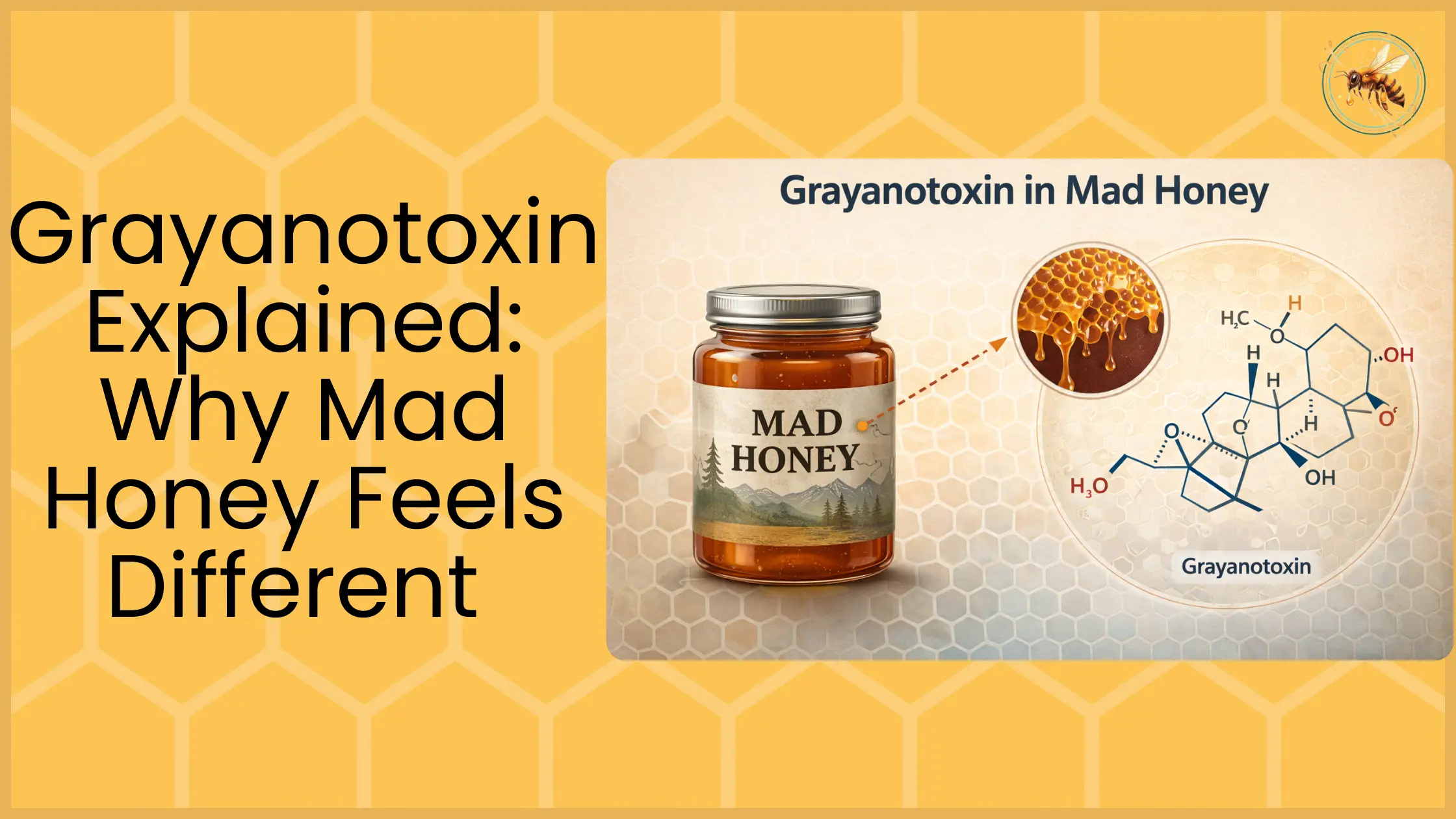
Mad honey is honey that can contain grayanotoxins from Rhododendron nectar. At higher exposures, it can cause dose-dependent body effects, especially a slow heart rate (bradycardia) and low blood pressure (hypotension).
“Mushroom gummies” is a much broader label. Some are simple functional mushroom supplements (lion’s mane, reishi). Others are sold as “trip gummies” with unclear actives, inconsistent labeling, or “proprietary blends,” which makes their effects harder to predict.
This guide compares the two in plain English: what they are, how they work (high-level), what people commonly notice, timelines, safety risks, why mixing increases risk, and how to choose responsibly.
tl;dr
- These are not interchangeable categories. Mad honey is tied to a specific mechanism (grayanotoxins). “Mushroom gummies” can mean many different product types with different actives and risk profiles.
- Mad honey’s “too much” pattern is usually body-first: dizziness, nausea/vomiting, sweating, weakness, often linked to low BP + slow HR in documented poisoning cases.
- The biggest gummy risk is uncertainty: unclear ingredient disclosure, inconsistent dosing per gummy, and blends that don’t tell you what’s doing what.
- If you’re thinking about taking both, the safest approach is to avoid stacking, because it makes side effects harder to predict and harder to interpret.
- For safety, prioritize predictability + transparency, not “strongest.” For mad honey: batch/testing transparency. For gummies: clear labeling, clear actives, and credible third-party testing.
Quick Answer (If You’re Choosing Between Mad Honey and Mushroom Gummies)
If you want a simple decision:
- Choose mad honey if… You want a food-based ritual experience, you’re willing to start low and wait, and you value defined origin and batch transparency (because potency varies by batch).
- Choose neither if… You have BP/HR concerns, take cardiovascular medications, have a fainting history, or are planning to mix substances. Mad honey’s main serious risk pattern is cardiovascular depression (slow HR + low BP).
- If you’re looking for “psychedelic-style effects”… don’t assume gummies are what they claim, and don’t assume mad honey is a psychedelic. Mad honey is more reliably described as a dose-sensitive intoxicant/toxin with cardiovascular effects rather than a classic psychedelic experience.
- If you’re considering taking both… the safest answer is: avoid stacking.
What Each Product Actually Is (Definitions)
Before comparing “effects,” it helps to lock in clear definitions, because online terminology gets messy.
Mad honey (what it is, why it’s unique)
Mad honey is honey produced when bees forage heavily on certain Rhododendron species during bloom, concentrating grayanotoxins in the honey. These compounds affect sodium channels and can increase vagal tone, creating dose-dependent effects, especially on the cardiovascular and autonomic systems.
Two important things to know:
- It’s dose-sensitive. Small increases can feel big.
- It’s batch-variable. Season, region, nectar mix, and handling can shift grayanotoxin levels.
“Mushroom gummies” (why the term is vague)
“Mushroom gummies” can refer to:
- Functional mushroom supplements (lion’s mane, reishi, cordyceps) are marketed for general wellness
- “Mystery blend” gummies marketed with trippy language but unclear actives
- Products that use mushroom branding while relying on other additives
The issue isn’t “mushrooms” as a concept; it’s that many products don’t clearly state what’s actually inside or how consistent the dose is.
Why people compare them
People search both under similar intent: relaxation, calm, “buzz,” “experience,” and questions like “how long does it last?” That overlap leads to a false impression that they’re comparable.
Ingredients & Transparency (The Biggest Difference)
This is where the comparison becomes most practical. You’re not comparing two standardized products.
Mad honey: defined by botanical source + measured variability
Mad honey’s effects trace back to grayanotoxins (GTX I, II, III) from Rhododendron nectar. That doesn’t make it safe; it makes it understandable. In principle, batches can be tested, GTX levels can be reported, and variability can be explained with real drivers (season, region, plant ecology, blending).
A strong mad honey transparency standard looks like:
- origin (region + harvest context, not just “Himalayan”)
- batch/harvest info
- conservative safety guidance
- lab testing language that means something (ideally quantified GTX I/III via LC-MS/MS or similar)
Gummies: the core buyer problem is “unknowns”
With gummies, the biggest consumer risk is often:
- proprietary blends without clear per-gummy actives
- inconsistent dosing (one gummy ≠ the next)
- unclear manufacturing/quality standards
- claims that outpace disclosure
What “transparent” should look like:
- full ingredient list
- clear naming of actives + amounts per serving
- third-party testing with batch/lot IDs (not just “lab tested” as a slogan)
- conservative usage guidance and warnings
If a gummy product can’t explain what’s inside in plain language, it’s not a serious product, regardless of reviews.
How They Feel (Common Patterns)
Effects vary, but there are recognizable patterns. It also helps to be careful with the word “high,” because people use it to mean very different things.
Mad honey: low dose vs too much
At lower exposures, people often describe a wind-down: a calm, subtle mood shift and “wavy” body relaxation.
When it becomes too much, the pattern often shifts to:
- dizziness/lightheadedness
- nausea/vomiting
- sweating/chills
- weakness/heavy-body feeling
- sometimes near-fainting and a “slow pulse” sensation
That “too much” pattern lines up with documented cases where bradycardia and hypotension are hallmark findings.
Gummies: why reports vary so widely
Because “mushroom gummies” isn’t one product type, reports are noisy:
- some people feel nothing (weak actives or underdosed)
- some feel calm/sedated (different ingredients)
- some report disorientation or anxiety (unknown actives, inconsistent dose, set/setting)
That’s why predictability matters so much: without clear contents and dosing, a product can’t responsibly set expectations.
Why “high” causes confusion (for both)
For mad honey, “high” can mask what’s happening: it can be intoxication-like body effects with cardiovascular involvement, not a classic psychedelic mechanism.
For gummies, “high” is meaningless unless you know the active ingredients and their dosing consistency.
Mechanism (Simple, Non-Technical)
Mechanism matters because it predicts risk patterns.
Mad honey mechanism (high-level)
Grayanotoxins bind to voltage-gated sodium channels and prevent inactivation, causing prolonged depolarization and increased vagal tone. The downstream effect can include bradycardia, hypotension, dizziness, confusion, and other autonomic symptoms.
Two practical implications:
- dose-response can be steep
- risk often shows up in heart/BP effects more than people expect
Gummies mechanism (depends on what’s actually in them)
There isn’t one mechanism. A “mushroom gummy” could be:
- functional mushroom extracts (often mild)
- a blend with other compounds
- something marketed ambiguously
That makes risk harder to predict unless ingredients and dosing are truly transparent.
Why predictability is the core concern
With mad honey, predictability is challenged by batch variability, so the solution is transparency + conservative guidance.
With gummies, predictability is often challenged by product opacity, so the solution is full disclosure + testing + reputable manufacturing.
Timeline (Onset + Duration)
People often ask: “How fast does it kick in? How long does it last?”
Mad honey timeline (typical)
A common window described is: symptoms can start 20 minutes to 4 hours after ingestion and can last up to ~24 hours as toxins are metabolized. Clinical reviews also describe many cases resolving within 1–2 days with supportive care, though severity and duration vary.
Key point: delayed onset is why re-dosing too soon is a common mistake. A conservative approach is to start tiny and wait before re-dosing.
Gummies timeline (varies by formulation)
There’s no single reliable onset/duration pattern because formulations and actives vary. The safest general rule is not to assume a predictable timeline and not to stack servings quickly because you “felt nothing.”
Why re-dosing can be risky in both
- Mad honey: delayed onset + steep dose-response can turn re-dosing into accidental overexposure
- Gummies: unknown actives + unknown onset makes stacking guesswork
Safety & Risk Profile (Clear and Practical)
Here’s what can go wrong, and for whom.
Mad honey risks (most important)
Mad honey poisoning has a fairly consistent syndrome in the literature. Typical symptoms include dizziness, nausea, vomiting, sweating, and blurred vision; severe cases can include syncope, AV block, and convulsions. Toxicology reviews highlight cardiovascular and neurological manifestations, with management often involving supportive care and sometimes atropine.
Practical summary:
- primary concern is cardiovascular depression (slow HR + low BP) at higher exposures
- risk increases with batch variability, sensitivity, and mixing substances
Gummies risks (high-level)
Because the category is heterogeneous, the safest way to describe risk is:
- unknown actives → unknown interactions
- inconsistent dosing → unpredictable intensity
- quality control issues → contamination/adulteration risk (varies by product)
If a gummy product is vague about ingredients or dosing, treat it as higher risk because it isn’t transparent enough to be used responsibly.
Who should be extra cautious
For mad honey, higher-risk groups are clearer: low BP, heart rhythm concerns, fainting history, and BP/HR meds.
For gummies, risk depends on ingredients, so transparency becomes the deciding factor.
Mixing Mad Honey + Mushroom Gummies (Important Safety Note)
A common question is whether you can take both together. The safest answer is: avoid stacking.
Why stacking increases risk
Combining two products that can affect balance, nausea threshold, and body signals can:
- increase dizziness and nausea
- make it harder to identify what caused the overdose symptoms
- increase the chance of a “body load” crash (weakness, clamminess, confusion)
If someone already mixed them (conservative steps)
This is not medical advice, but a conservative approach is:
- stop taking more of either
- rest in a safe environment
- hydrate slowly if tolerated
- monitor symptoms
- seek medical help for red flags: fainting/near-fainting, chest pain, trouble breathing, persistent vomiting, severe confusion/extreme weakness
Legality & Buying Reality (Short, Practical)
Rules vary by country and by product claims, but a few practical principles help.
Mad honey: “food” category + claims/import rules
Mad honey is often treated as a food, but marketing claims and import documentation can create friction. A safer long-term approach is conservative language and transparency rather than “psychedelic” positioning.
Gummies: legality depends on ingredients and local rules
Because “mushroom gummies” can mean different products, legal status can vary widely. Buyer rule: trust documentation and transparent labels, not vibe marketing.
Which One Should You Choose?
This comes down to what kind of uncertainty you’re comfortable with.
Choose mad honey if…
- you want a rare, food-based ritual experience
- you’re willing to start low and wait (no stacking)
- you value origin/batch transparency and conservative guidance
Avoid both if…
- you’re risk-averse, have BP/HR concerns, fainting history, or relevant meds
- you need a predictable function (work/driving/complex tasks)
- you’re already mixing other substances that day
If you still want gummies…
Only consider products that meet a basic credibility bar:
- full ingredient disclosure
- clear active amounts per serving
- batch/lot ID + credible third-party testing
- conservative guidance (no “guaranteed trip” language)
If the product can’t meet those basics, it’s not worth the uncertainty.
Conclusion
Mad honey and mushroom gummies get compared because both are sold as “an experience,” but they are not interchangeable.
- Mad honey is a dose-sensitive product tied to grayanotoxins and a clinical risk pattern (bradycardia/hypotension).
- “Mushroom gummies” is a broad category where the main safety question is what’s actually inside and how consistent it is.
The simplest safety rule that applies to both is to choose transparency and predictability over intensity, and don’t stack.
FAQs: Mad Honey vs Mushroom Gummies
Are mushroom gummies the same as psychedelics?
Not necessarily. The term is vague and can refer to functional mushrooms or products marketed with trippy language but unclear active ingredients.
Does mad honey get you high like gummies are marketed to?
Mad honey isn’t best understood as a classic psychedelic. Low exposure may feel calming; higher exposure can resemble intoxication/toxicity with cardiovascular effects (slow HR/low BP) and unpleasant symptoms.
Which is safer?
If “safer” means “more predictable,” it depends on the product. Mad honey has a known mechanism but variable potency; gummies can be predictable only when they’re transparent and well-tested.
Which lasts longer?
Mad honey has a documented onset window (20 minutes to 4 hours) and can last up to ~24 hours in some reports, with many cases resolving within 1–2 days. Gummies vary too much without ingredient details.
Can I take them together?
Safest answer: avoid stacking. If you already did, stop taking more, rest, hydrate slowly, monitor symptoms, and seek help for red flags.
How do I avoid fake mad honey?
Look for origin proof, batch info, conservative safety guidance, and meaningful testing/COA language (not vague “lab tested”).