
Search for where to buy mad honey, and you get a list of shop names. That is rarely the thing you actually need. The question underneath the search is more practical than a brand preference. You want a real jar, from a seller who can describe what is in it. You want it to arrive at the address where you live, without sitting in a customs shed for a month.
A shop name tells you none of that, and two sellers can look identical on a product page while being completely different propositions once you know where their stock physically sits and which border your order has to cross.
So this guide is organized the way the problem is. Mad honey reaches buyers by three routes, and which of them is open to you is decided mostly by the country you live in rather than by your taste in brands. Everything below about prices, shipping windows, refund terms, and lab pages was read off each seller’s own website, and it describes what those pages said on those dates.
Sellers change their pages, and import rules change more often than that. Nothing here is legal advice, and nothing here is medical advice either. Where a country is involved, we link to our own law page for it, which carries the detail and the citations. If you are still deciding whether you want any of this, start with what mad honey actually is before you start comparing checkouts.
tl;dr
- There are three supply routes: sellers holding stock inside your own market and shipping domestically, exporters shipping worldwide by courier, and buying it in person in Nepal or Turkey.
- Which route is realistically open to you is set by your country’s food and biosecurity rules, so the route decision comes before the brand decision.
- Honey is a food and in many countries a product of animal origin, which means it can attract food-safety and biosecurity attention that has nothing to do with drug law. And declaring a honey jar or a parcel is the lower-friction path everywhere.
- Across the sellers recorded, the price ran from about $0.17 to about $1.81 per gram, roughly a tenfold spread, with the bulk of the market between $0.36 and $0.52. Among sellers that state worldwide shipping, the floor is $0.26.
- Some people should not take mad honey at all, and the medication question is worth settling before you order rather than after the box arrives.
Quick Answer – Where can you buy mad honey?
You can buy it in three places. First, from sellers holding stock inside your own market, who ship domestically in a few days with no border involved, and who generally charge more per gram. For most of these sellers, that means the United States only; one of them, Real Mad Honey, also ships intra-EU from a Dutch warehouse.
Second, from exporters who ship worldwide by courier, which gives the widest choice and the best price per gram but means every order crosses a border.
Third, in person in Nepal or Turkey, which is the cheapest and the least documented, and which turns the purchase into a travel question. Most readers outside the United States and the EU have only the second and third routes.
The three ways mad honey reaches a buyer
Every seller you will find sits in one of three supply models. The model, not the marketing, sets your delivery time, your price per gram, and whether you deal with a border at all.
Route one: sellers holding stock inside your own market
A small number of brands import in bulk, hold stock in a warehouse in a consuming market, and ship domestically. Magaranger states that it ships from Dallas, Texas, dispatches within one business day, quotes a 2-5 business day transit, and offers free US shipping over $50. Sherpa Honey states that it ships from Las Vegas, Nevada, by free USPS Priority, with same-day dispatch on orders placed before 1pm PST.
Real Mad Honey is the only seller recorded here that runs this model in two places. It states that US orders ship from a Texas warehouse and that orders outside the United States ship from a Netherlands warehouse, with dispatch within one business day either way, 3-5 business days standard inside the US, 2-3 express, and 10-15 business days standard internationally.
It also runs separate storefronts with pricing in US dollars, euros, and Canadian dollars. For a buyer inside the EU, that second warehouse is the substantive point, because an order dispatched from the Netherlands to another member state is not an import from a third country.
For a US buyer, this is the fastest and simplest route. The importer has already dealt with the border. You are buying a domestic food product from a domestic address, and if something goes wrong, you are dealing with a company inside your own consumer-protection system.
The trade is price and choice. Magaranger lists its honey in one pouch size, 30 g at $29.99, which works out to $1.00 per gram, and on a Halloween sale at $19.99 or $24.99 until 31 October, plus single-serve sticks at $9.99 with no weight stated. Sherpa’s product page runs 50 g at $49.95, 150 g at $119.95, and 300 g at $194.95, which is $1.00, $0.80, and $0.65 per gram. Real Mad Honey’s US range runs from 50 g at $42.50 to 500 g at $239.95, which is $0.85 to $0.48 per gram and undercuts the other two on domestic stock. Even so, this route is broadly more expensive per gram than the exporters below.
A fourth US-based company, Bee-licious Honey, is family-owned in Portland, Oregon, and sources through a named Nepali partner. Its 30 g pouch was still out of stock when we checked again on 29 September, but it now ships a Himalayan Mad Honey from Oregon in 150 g to 1000 g jars at $50 to $170, which is $0.33 down to $0.17 per gram, the lowest per-gram price we recorded anywhere. It publishes no laboratory, potency, or dosing information to set against that price.
Route two: exporters shipping worldwide by courier
The larger group ships by FedEx or DHL and quotes worldwide windows. Best Mad Honey states a Kathmandu warehouse serving 190-plus countries, with 3-7 days to the US and 10-15 days to Europe. Strong Mad Honey publishes a Kathmandu address, states 90-plus countries, dispatch in 1-2 days, 7-12 days to the US and 7-10 to the UK and EU. Original Mad Honey states Kathmandu dispatch, 180-plus countries, and 5-12 business days with free worldwide tracked shipping. Royal Mad Honey states that it ships from Nepal to 150-plus countries, tracked and insured.
Two sellers in this group publish a worldwide service without stating where the parcel actually leaves from. Medicinal Mad Honey states free express worldwide by DHL Express and USPS with dispatch in two business days, and does not state a dispatch origin on the pages checked. Maddest Mad Honey states free DHL Express worldwide in 5-7 working days, and likewise does not state where it ships from.
This route gives the widest product range, every jar size, and the lowest price per gram. It also means the order is an international food shipment. That is not a problem in most of the countries covered below, but it is a step, and it is the step that decides how long you wait.
Route three: buying it in person in Nepal or Turkey
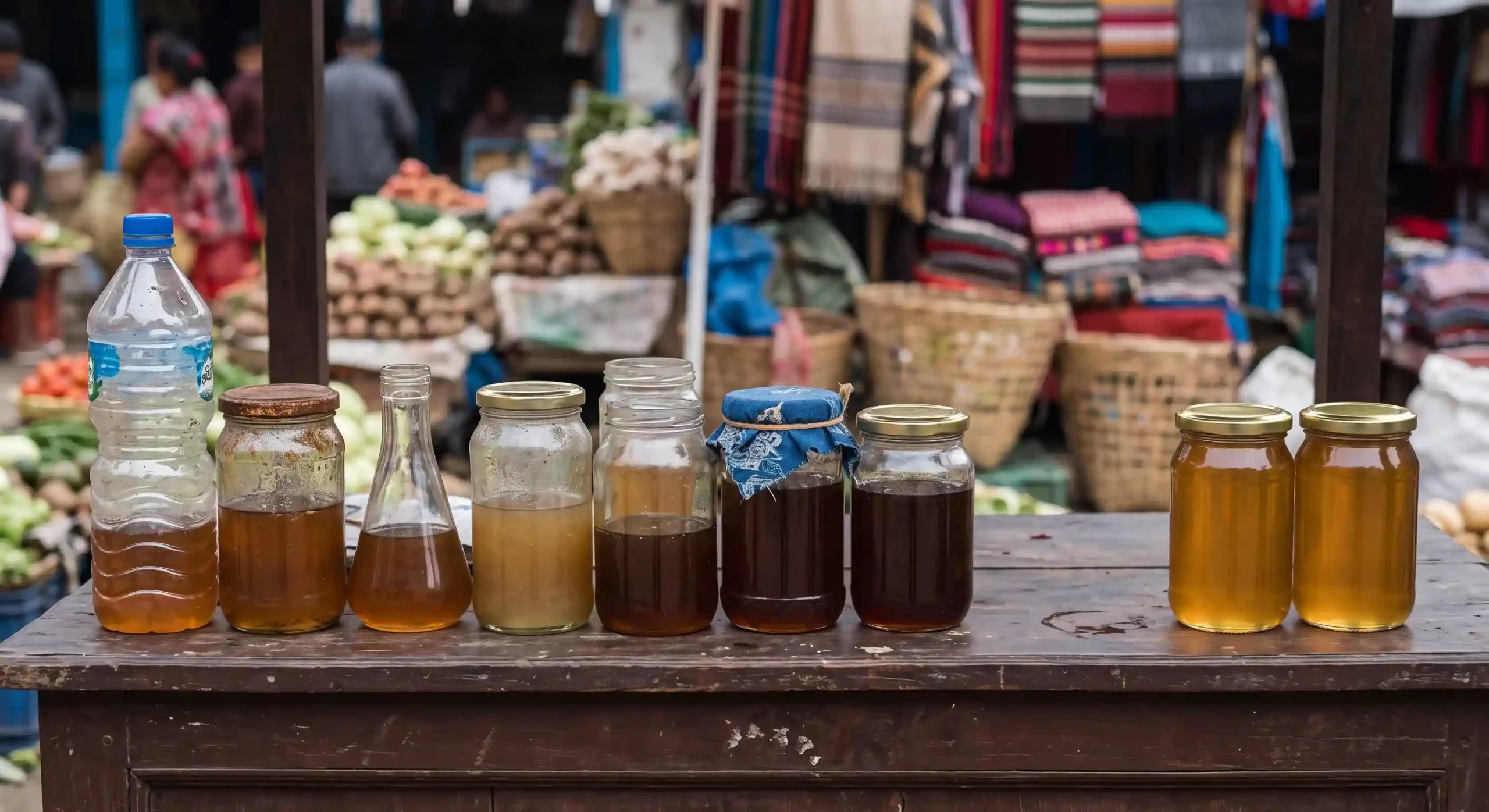
You can buy mad honey over the counter in Nepal, and along Turkey’s Black Sea coast, where it is a regional food product. One seller also lists European resellers, which is a different proposition and is covered in the Netherlands section below. It is the cheapest way to get some, and it is the only route where you can talk to somebody who has seen the comb.
It is also the least documented. Honey sold this way is often in a reused bottle with no label, no stated weight, no harvest date, and no test of any kind. Buying it is the easy half. Getting it home is a separate question governed by your own country’s import rules, which is covered in our guide to traveling with mad honey.
Why the route matters more than the brand
Most buyers compare brands before they consider logistics. The order is worth reversing. If you live in New Zealand, the brand debate is largely academic, because the binding constraint is a biosecurity regime built to protect a domestic apiculture industry. If you live in the United States, the route decision is worth a substantial share of your money, because domestic stock runs at $0.48 to $1.00 per gram and the exporters start at $0.26.
The key point is that route and brand are not independent. Choosing a route narrows the field to a handful of sellers, and only then does the quality question become worth asking. When you get there, the thing to compare is evidence, and our guide to reading a mad honey lab report sets out what a certificate should contain and how to tell a real one from a page dressed up to look like one. Our companion comparison of these sellers goes brand by brand for readers who want the which-brand question answered on its own.
Why a general marketplace listing usually tells you the least
Large general marketplaces do carry mad honey. The problem is not that marketplace sellers are dishonest. It is that a marketplace listing template is built for consumer goods, and it has nowhere sensible to put the information that matters here: the harvesting district, the harvest season, the batch code, the analysis date, the laboratory’s name.
Listings there tend to compress all of that into “Himalayan,” “pure,” and “lab tested,” and there is usually no seller-owned page behind it where the detail lives.
There is also a category problem. Gummy and edible products sold under mad-honey branding, such as Stoned, are manufactured edibles with an added extract rather than harvested honey, so they are a different product category and are outside this comparison.
The more useful point is that you are not looking for a marketplace to avoid. You are looking for a listing that answers questions, and a marketplace listing usually cannot, because the format does not have room for the answers.
What actually happens at a border
This section is written once, in full, so that the country sections below can stay short. Almost everything that happens to a jar of mad honey at a border happens because it is honey.
Honey is a food, and often an animal product
Every country in this guide regulates imported food. Many of them additionally classify honey as a product of animal origin, because it comes from bees, and that brings a second and stricter layer of controls designed to keep bee diseases out of domestic hives.
That is why Australia and New Zealand are difficult, and the United States is not, and it has nothing to do with grayanotoxin. An officer looking at your parcel is far more likely to be thinking about hive disease than about what grayanotoxin does.
Three things shape the outcome: what the product is, how much of it there is, and whether it is for you or for sale. A parcel can be released, held pending information, treated, re-exported, refused or destroyed. Storage and handling fees can apply while it sits.
Declare it
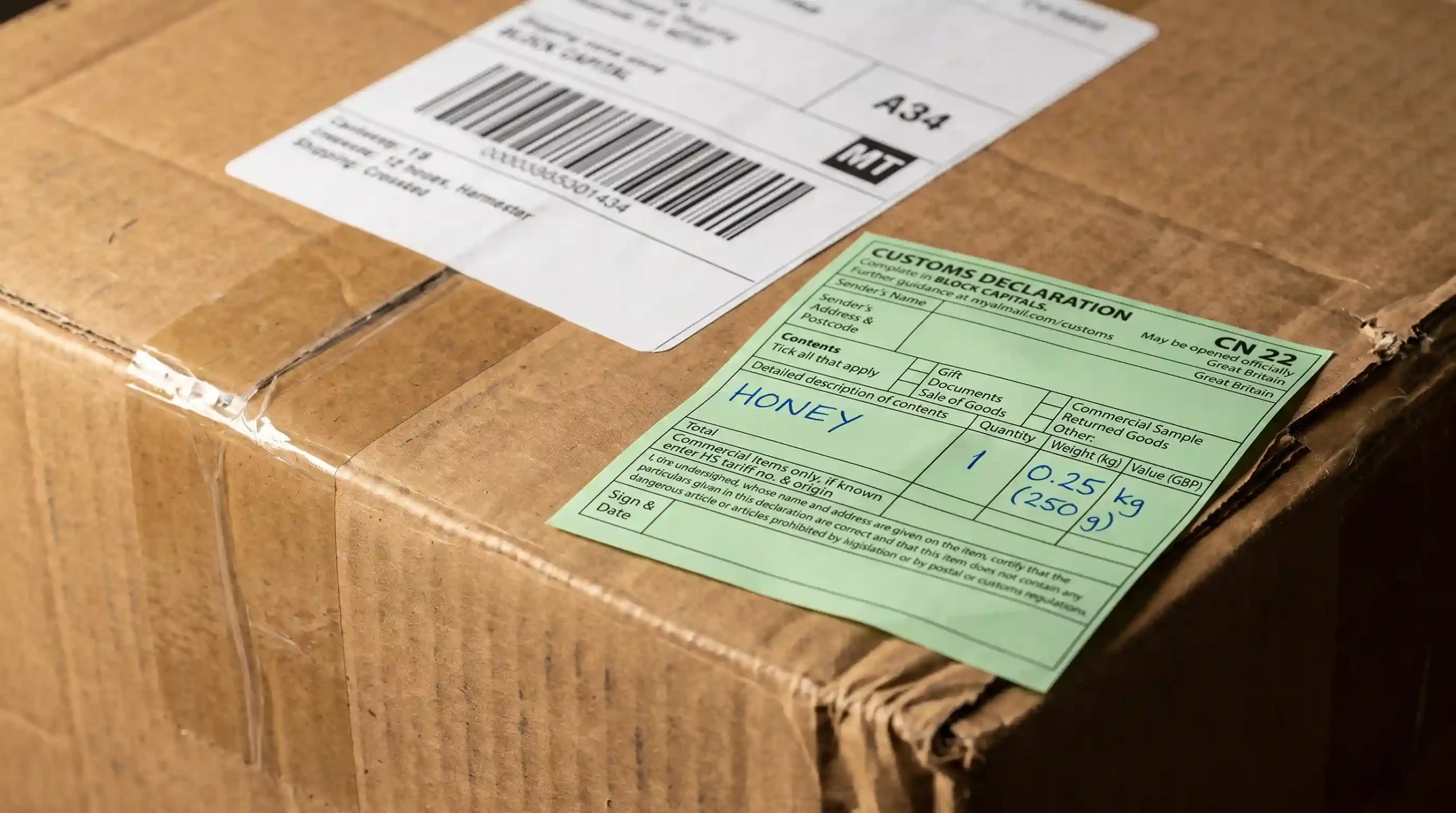
If you are carrying it, tick the food box on the arrival card and say it is honey. If you are receiving a parcel, make sure the seller’s commercial invoice describes the contents accurately, with a weight and a value.
Declaring is the lower-friction path in every country covered here. A declared jar can be asked about, and the conversation is usually short. An undeclared one, if found, is treated as a compliance matter rather than a food matter, and the consequences of that differ from country to country.
We give no advice on avoiding, splitting, mislabelling or otherwise evading inspection, and we would treat a seller who offered such advice as disqualifying.
Personal quantity and commercial quantity are different questions
Most of the rules cited below have two tracks. A small quantity for your own use is usually handled as a personal import, with a size allowance and a declaration. Anything that looks like stock for resale crosses into commercial importation, which typically requires a license, a registered importer, product registration, or all three. Several countries in this guide make that distinction the whole of the answer.
The line is drawn by quantity, frequency, and intent rather than by a single number. Six 1 kg jars arriving monthly to the same address is a commercial pattern, whatever the paperwork says.
Why “discreet packaging” is not a benefit
Several sellers advertise discreet shipping as a feature. Royal Mad Honey lists it among its shipping promises, and as a privacy feature for your neighbors and your postal worker, it is unobjectionable.
It is worth being clear about what it does not do. Discretion on the outer box does not change the commercial invoice, which is the document the border reads. A parcel whose exterior and paperwork disagree is a worse position than a parcel that plainly says, honey. The standard for both is accuracy, not minimalism.
Buying mad honey by country
Each section below gives the legal position in one line, what tends to happen at that border, which route works, what windows the sellers publish, a realistic landed price bracket, and one thing to check before you pay. The bracket excludes tax and duty unless stated, and the law link in each section is where the citations live.
United States
Mad honey is not a federally controlled substance and is handled as a food, as our page on whether mad honey is illegal in the US sets out.
At the border, imported food is subject to FDA Prior Notice, and CBP handles the entry itself. A commercial shipment will normally have Prior Notice filed by the shipper rather than by you. A personal shipment can still be held or refused if the paperwork, the labeling, or the declared value does not match the goods. Honey is also a bee product, so a consignment can be examined for reasons unconnected to grayanotoxin.
All three routes are open, and the United States has the deepest domestic option of any country here. Magaranger states dispatch from Dallas within one business day and a 2-5 business day transit, with free shipping over $50. Sherpa Honey states same-day dispatch from Las Vegas before 1pm PST via free USPS Priority.
Real Mad Honey states that US orders ship from a Texas warehouse within one business day, 3-5 business days standard, or 2-3 express. On the international side, Best Mad Honey quotes 3-7 days to the US, Strong quotes 7-12 days, Original quotes 5-12 business days worldwide, and Maddest quotes 5-7 working days by DHL Express. We have not tested delivery, and clearance time is not included in any of those windows.
Domestic stock runs $0.48 to $1.00 per gram, or down to $0.17 counting Bee-licious Honey’s larger jars from Oregon. Shipped from abroad, the mid-market sits at $0.36 to $0.52 per gram, with the full range running $0.26 to $1.81. The 30 g and 50 g starter sizes carry a large per-gram premium.
Before you pay, check whether the certificate on the seller’s lab page belongs to the batch being shipped, not merely to the brand. On refunds, Real Mad Honey states the longest window of any seller here at sixty days from delivery, but read the condition: it takes back only sealed and unopened jars, so a jar you have tried and disliked is not covered.
United Kingdom
Mad honey is not a controlled drug in the UK and is sold as a food, and our page on whether mad honey is legal in the UK covers the position in full.
Two UK-specific rules shape what you will see. Composition and labeling for honey sold in England fall under the Honey (England) Regulations 2015. Advertising to UK consumers falls under the CAP Code, which restricts claims about effects.
There is a 2 kg personal allowance for honey brought in for your own use, and quantities above that move into commercial territory. As a food and a bee product, a parcel can be examined on either footing.
In practice, the route is international. None of the sellers recorded holding UK stock on the pages checked, though one of them does run a UK-facing storefront priced in pounds, from £37.50 for 50 g to £189.95 for 500 g — a local domain and GBP pricing being a checkout convenience rather than UK stock, exactly as with its Canadian store. Real Mad Honey states that orders outside the United States leave its Netherlands warehouse, which is the shortest physical hop of any seller here; since the end of the transition period, it is still an import into Great Britain rather than an intra-EU movement, so treat it as a border crossing and not a domestic delivery.
Its two published delivery tables disagree about how long it takes: the shipping panel says 10 to 15 business days for everywhere outside the United States, the longest window quoted by anyone in this guide. Strong Mad Honey quotes 7-10 days to the UK and EU. Best quotes 10-15 days to Europe. Original quotes 5-12 business days worldwide, and Maddest quotes 5-7 working days by DHL Express. We have not verified delivery into the UK, and none of those windows includes clearance.
Expect $0.36 to $0.52 per gram at the mid-market, with the full range from worldwide shippers running $0.26 to $1.81, plus VAT and, commonly, a courier handling fee collected before delivery. Budget the landed figure rather than the sticker.
Before you pay, confirm at the checkout that the seller actually ships to the UK, rather than inferring it from a “190 countries” banner.
Canada
Mad honey is not a controlled substance in Canada and is regulated as a food, as set out on our page on whether mad honey is legal in Canada.
The Canadian Food Inspection Agency is the relevant regulator. Commercial importation of honey requires a Safe Food for Canadians license and the preventive control obligations that come with it, which is a genuine barrier to anyone thinking about resale.
A personal-quantity shipment does not carry the licensing requirement. It is still an imported food, and it can be examined, held for documentation, or refused. Honey is also a bee product, so it can be looked at on animal-product grounds as well.
The international route is the working one. Magaranger and Sherpa Honey state US shipping terms only on the pages checked, and neither states an international shipping policy there, so do not assume a Dallas or Las Vegas warehouse will send to Toronto. Real Mad Honey runs a Canadian storefront pricing in Canadian dollars, from C$52.50 for 50 g of its Nepal honey to C$325.00 for two 250 g jars, with a Turkish line alongside it from C$44.50 for which it publishes no certificate at all.
This is worth reading carefully: a .ca address and a local currency are a checkout convenience, not domestic stock. Its own shipping panel states that everything outside the United States leaves the Netherlands warehouse, so a Canadian order is still an international food shipment and is still examinable as one.
Only one seller-recorded page publishes a Canada-specific window: Real Mad Honey’s product-page FAQ quotes 5 to 10 business days by PostNL or 3 to 5 by FedEx. Read that against the shipping panel on the same page, which says everything outside the United States takes 10 to 15 business days as standard; the two tables do not agree, and we cannot tell you which governs. The rest publish worldwide figures only: 5-7 working days by DHL Express from Maddest, and 5-12 business days from Original. We have not verified delivery into Canada.
Landed cost sits at $0.36 to $0.52 per gram for the mid-market sellers, with the full range from worldwide shippers $0.26 to $1.81, plus GST or HST and any courier disbursement fee.
Before you pay, ask whether the seller will issue a commercial invoice that describes the contents accurately and completely, with the net weight and the value. Accuracy is the standard, not the shortest description you can get away with.
Australia
Our page on whether mad honey is legal in Australia sets out the legal position, and the practical constraint here is biosecurity rather than drug law.
The Department of Agriculture, Fisheries and Forestry administers import conditions, and imported food is additionally subject to the Imported Food Inspection Scheme. Honey and bee products are treated as a biosecurity risk because of the disease threat to Australian hives.
A consignment can be held, treated, re-exported or destroyed, and fees can attach to that process. If you are carrying it in yourself, declare it on the incoming passenger card without exception.
The international route is the only realistic one, and it carries the most uncertainty in this guide. Destination counts of 90, 150, 180 and 190 countries appear across these sites, and they do not all cover the same countries, so read the checkout rather than the banner. The published windows are worldwide ones: 5-7 working days from Maddest, 5-12 business days from Original. We have not verified delivery into Australia, and clearance is not included in those figures.
The mid-market band of $0.36 to $0.52 per gram applies, plus GST, with the full range from worldwide shippers $0.26 to $1.81. The expected cost should include the possibility that the consignment does not arrive at all.
Before you pay, read the refund policy for what happens if a parcel is held or destroyed. Maddest Mad Honey’s guarantee, in its own words, covers the case where “you don’t receive your order”, and the same seller lists lost-package insurance as a separate $8 add-on product.
New Zealand
Our page on whether mad honey is legal in New Zealand sets out the position, and New Zealand is the strictest jurisdiction in this guide by a distance.
The Ministry for Primary Industries sets import health standards, and Customs enforces them at the frontier. Bee products face very tight restrictions because New Zealand’s apiculture sector is a significant export industry, and the country closely protects its disease status. Undeclared food at the border can attract an immediate penalty, and honey is the sort of thing that is looked for. Our New Zealand law page carries the current position, and MPI publishes its own.
There is no reliable route. A checkout accepting a New Zealand address would be a statement about a seller’s shipping software rather than about whether the consignment will clear. Buying in person overseas does not change anything, because the same rules apply to you on return. The sellers publish only worldwide windows, and we have not verified delivery into New Zealand.
Sellers quote the same $0.36 to $0.52 per gram mid-market band, and the full range from worldwide shippers is $0.26 to $1.81. Here, the landed cost should be treated as carrying the full risk of loss, because the parcel may not clear.
Before you pay, check MPI’s current position for yourself, and keep the seller’s refund terms somewhere you can find them again.
Netherlands and the wider EU
Our page on whether mad honey is legal in the Netherlands covers the Dutch position, and much of it generalizes across the EU.
That page sets out how the EU Honey Directive governs composition and labeling, and why commercial consignments of honey entering the EU from a third country are routed through a designated Border Control Post for veterinary checks, honey being a product of animal origin.
Personal consignments of animal products from outside the EU are also subject to rules, and the details, including any allowance, sit on that page rather than here. The general shape is that a commercial consignment and a jar for yourself are answered differently.
This is the one country section where the domestic route genuinely exists. Real Mad Honey states that all orders outside the United States ship from its Netherlands warehouse. That is the seller’s own claim, and we have not placed an order to test it, but it is the claim its shipping page makes, and it runs a euro-priced European storefront listing the same Nepal sizes from 42.95 for 50 g to 215.00 for 500 g, plus a Turkish line priced below it from 36.95.
A parcel dispatched from the Netherlands to a Dutch address is a domestic delivery, and one dispatched to another member state is an intra-EU movement rather than a third-country import, which makes the paragraph above irrelevant to you. It also publishes a page listing nine names as official online resellers, and a physical store locator that did not load on the date checked.
Everyone else is the international route. Strong Mad Honey quotes 7-10 days to the UK and EU. Best quotes 10-15 days to Europe. Maddest quotes 5-7 working days worldwide by DHL Express, and Original quotes 5-12 business days worldwide. We have not verified delivery into the Netherlands or elsewhere in the EU, and clearance sits outside all of those windows.
Expect $0.36 to $0.52 per gram at the mid-market from the exporters, with the full range from worldwide shippers $0.26 to $1.81, plus VAT at your national rate and, frequently, a clearance charge from the courier that arrives as a separate demand before delivery.
Buying from EU-held stock costs more per gram and should remove the clearance charge, which is a trade-off worth pricing rather than assuming. Be careful about the wait: Real Mad Honey publishes two delivery tables that disagree, one giving 10 to 15 business days for all non-US orders and the other 1 to 2 business days for the Netherlands and Belgium and 3 to 6 for the rest of Europe.
Before you pay, look at whether the seller’s own labeling would satisfy an origin requirement. A jar that says only “Himalayan” does not name a country.
India
Our page on whether mad honey is legal in India sets out the position, and mad honey is treated as a food.
The Food Safety and Standards Authority of India sets the standards; imported food is cleared through the Food Import Clearance System, and the customs declaration itself runs through ICEGATE. Commercial importation requires an importer with the appropriate registration.
A personal-quantity consignment is handled more simply, but it can still be examined and can still be held for documentation, and the paperwork the seller supplies is what determines how quickly that resolves.
The international route is geographically the shortest hop in this guide, which is a little misleading, because transit time here is set by clearance rather than by distance. The sellers publish worldwide windows of 5-7 working days by DHL Express from Maddest and 5-12 business days from Original, with country-specific figures only for the US and Europe. We have not verified delivery into India, and clearance is not included in any published window.
The mid-market band of $0.36 to $0.52 per gram applies, with the full range from worldwide shippers $0.26 to $1.81, plus applicable duties and taxes. As everywhere, the 30 g and 50 g sizes carry a large per-gram premium.
Before you pay, confirm the seller ships to India specifically. Destination counts of 90, 150, 180, and 190 countries appear across these sites, and they do not all include the same countries.
Singapore
Our page on whether mad honey is legal in Singapore sets out the legal position.
The Singapore Food Agency regulates food imports, and commercial importation requires SFA registration and a license. Personal consignments in small quantities are treated more lightly, but SFA is the authority that decides, and honey is squarely a food product for these purposes. A parcel can be examined, and the invoice description and declared value are the two things that make that examination short or long.
The international route works. The sellers publish worldwide windows rather than Singapore-specific ones: 5-7 working days by DHL Express from Maddest, 5-12 business days from Original, and Best Mad Honey states FedEx and DHL service to 190-plus countries without quoting a figure for Singapore. We have not verified delivery into Singapore, and none of those windows includes clearance time.
Landed cost sits in the $0.36 to $0.52 per gram mid-market band, with the full range from worldwide shippers $0.26 to $1.81, plus GST, which is collected on low-value imported goods as well as on larger consignments.
Before you pay, keep the invoice and the seller’s product description together, because a consistent paper trail is what turns a query into a short conversation.
Philippines
Our page on whether mad honey is legal in the Philippines covers the position there.
The Philippines FDA regulates food products. Commercial importation requires a License to Operate and a Certificate of Product Registration for the product itself, which is a substantial process and effectively rules out casual resale. Personal-quantity shipments are a lighter matter, though they still arrive as imported food and can be examined on that basis. As elsewhere, the distinction the regulator is drawing is between a jar for you and stock for sale.
The international route is the route. The sellers publish worldwide windows only: 5-7 working days by DHL Express from Maddest, 5-12 business days from Original, and Best Mad Honey states FedEx and DHL service to 190-plus countries. We have not verified delivery into the Philippines, and clearance time is not within any of those windows.
The mid-market band of $0.36 to $0.52 per gram applies, with the full range from worldwide shippers $0.26 to $1.81, plus duties and VAT as assessed.
Before you pay, check that the value the seller will declare on the invoice matches what you actually paid. A mismatch between the declared value and the amount paid is a common reason a parcel is held.
Buying in person in Nepal
Nepal is where the sellers in this guide say their honey comes from. Most of them name Lamjung, Gorkha, Kaski, and the Annapurna region; they name Gurung honey hunters, and several name Apis laboriosa.
One does not: Real Mad Honey names no district, no bee species, and no harvest date anywhere on its three storefronts, publishing only an altitude, which is worth noticing on a site that promises “specific sourcing, not vague Himalayan claims”. Our pages on mad honey in Nepal, the Gurung honey hunters, and Apis laboriosa describe the trade, who does the harvesting and where the honey is sold, and they are worth reading before you go.
Buying there is straightforward in one sense: the honey is sold openly as a food. What you give up is documentation. Honey sold this way is often in a reused bottle with no label, no stated weight, no harvest date, and no test of any kind, so almost none of the checks in this guide can be run on it.
The harvest is seasonal, and that matters more than it sounds. The sellers describe spring and autumn harvests, and Medicinal Mad Honey states harvesting twice a year, so a jar in front of you has a season attached whether or not anyone tells you which one. Maddest Mad Honey is the only seller here that states a harvest date at all, “August 2026”, and that is the kind of specificity worth asking for in person too.
Price per gram is not really computable, because weight is usually not stated and bargaining is normal. It is generally well below export pricing, because you are not paying for international courier shipping.
Ask which district and which month, and prefer a sealed, labeled jar over a reused bottle, because the labeled jar is also the one that travels. Taking it home is a separate question, and our guide to traveling with mad honey covers it.
Buying in person in Turkey
Turkey has its own tradition, deli bal, produced on the Black Sea coast, and our page on Turkish mad honey covers where it comes from and how it is used. Our comparison of Nepali and Turkish mad honey sets out how the two traditions differ. Neither page ranks one against the other, and neither should you.
Buying it locally is unremarkable. It is a food, sold as food, in a country where it has been sold as food for a very long time, and it is more often sold by producers and in markets than by export brands with lab pages.
The complications start when you leave. Honey bought at a market can come in a larger container than the export jars discussed above, and any quantity you carry is a personal food import into wherever you are going next. UK buyers have the 2 kg personal allowance to work within. EU buyers face the animal-product rules described above. Australian and New Zealand buyers face the biosecurity regimes described above, and the answer there is usually no.
Because it is sold by weight at market prices rather than by the branded jar, a per-gram comparison with the export sellers is not meaningful.
Before you buy, ask which season and which area it came from, and take a sealed and labeled container if you intend to fly with it.
Why legal and importable are not the same question
The most common mistake in this whole subject is reading “mad honey is legal here” as “I can have a jar sent here”. They are separate questions answered by separate agencies.
In each of the nine countries with a law page linked above, our own law pages record that mad honey is not scheduled as a controlled drug. Those pages carry the citations, and they describe the current position rather than a permanent one.
Importability is a different matter, governed by food law and biosecurity, and there the answers diverge sharply. New Zealand and Australia will give a buyer far more trouble than the Netherlands or Singapore, and none of that difference has anything to do with grayanotoxin.
In plain terms: check the law page for the legal position, then check the food and biosecurity regulator for whether the parcel can actually arrive. Our overview of where mad honey is legal is the starting point for the first half of that.
What a good listing tells you
A listing worth buying from answers questions before you ask them. A good seller clears most of the checklist below without you having to email anybody.
- The origin is given to a district or region rather than a mountain range.
- The harvest is dated, at least to a season and ideally to a month and year.
- A batch identifier appears on the listing and on the jar, and it is a real code rather than a sample-looking placeholder.
- A lab report exists as a document you can actually open, from a laboratory that is named, with the method and the units stated.
- The certificate’s date is close enough to the jar’s harvest to be about that honey.
- The net weight in grams is stated on the product page, not only in ounces or as a jar description.
- The dosing guidance is conservative and comes with a warning rather than a promise.
- There is a real postal address and a working telephone number, not just a contact form.
On our first check, three brands cleared the evidence part of that list properly, in different ways. Best Mad Honey named Eurofins Food Integrity Control Services in Germany, working to DIN EN ISO/IEC 17025:2018, and published three batches with IDs, analysis dates, and both grayanotoxins with units. By our second check it no longer named the laboratory, and its certificates had become undated images on its own template.
Its product-page figures match its batch figures exactly, which is a real consistency mark. Magaranger names Vereenigde Laboratoria Drs. W.H. Nagel B.V. in Amsterdam and publishes certificate 2502051 for Cliff Honey Nepal Batch 003, dated 30 April 2025, which it now lists as sold out. It states the method as LC-MS/MS and links the full certificate as a PDF. The report it now shows for its current batch carries exactly the figures of Best Mad Honey’s Rare Harvest certificate, under a 2026 date instead of Best’s 2024 one, so it cannot be read as a separate analysis.
The contact part of the list is cleared by a different set of brands. Strong Mad Honey publishes a full street address in Kathmandu together with a telephone number, which is the most complete company detail of any seller recorded here.
Best Mad Honey publishes telephone numbers in both Nepal and the United States. Medicinal Mad Honey publishes a US telephone number, and Bee-licious Honey publishes a US street address in Oregon.
Real Mad Honey publishes more address details than any of them: a street address in Fort Worth, Texas, and another on the Keizersgracht in Amsterdam, and clears half of the test comfortably. It fails the other half: the only telephone number it displays uses the 555 area code, which is not in service as a North American geographic area code.
Bee-licious Honey sits at an unusual point on this list. It makes no lab claim, no potency claim, and no dosing claim, and it states plainly that “no specific characteristics or effects can be guaranteed”. That is an honest position, and it also leaves a buyer with nothing to evaluate, which is worth understanding as a trade rather than as a fault.
Why a lab report is not a lab report for your jar
On our first check, two of the three brands that published real certificates published old ones: Best Mad Honey’s three were dated April, May, and June 2024, and Magaranger’s single certificate 30 April 2025. This article is dated September 2026, and by the end of that month one analysis was appearing on both brands’ pages under two different dates.
Grayanotoxin content is a property of a batch rather than of a brand, as our page on batch variability explains. A certificate for a 2024 batch therefore says very little about a jar shipped in 2026, unless the seller states that the jar comes from that same batch. Publishing a certificate at all puts those two brands ahead of most of the field; it does not by itself tell you what is in the jar on its way to you.
One seller has built an answer into the page. Real Mad Honey publishes four dated Nepal certificates, three from Nagel of Amsterdam and one from Eurofins, and a box that takes an order number and returns one of them, the most recent analyzed on 24 July 2026. We have not audited the mapping and cannot confirm from outside that your jar is the jar that was tested.
Its page deserves the same reading we gave the others. No grayanotoxin figure appears on it; you have to open the PDFs, two of which are scanned images. The line labeled “Accreditation” prints the certificate number rather than an accreditation standard, and no standard is published anywhere on the site.
On the three Nagel documents, the grayanotoxin result is asterisked to the footnote “outsourced, not performed on above-mentioned location”, so the laboratory named issued the certificate but did not make the measurement, and the one that did is not named; the same is true of Magaranger’s certificate from that laboratory.
And every certificate and every order range is for the Nepal honey, while the same company sells a Turkish line in its European and Canadian stores that it also calls lab-tested, so a Turkish buyer’s order number would return a Nepal document.
What makes it worth knowing is the spread in its own results: grayanotoxin I across its four batches reads 2,512.73, 5,055, 16,737, and 19,823 micrograms per kilogram, which is nearly eightfold across four batches filled between December 2025 and June 2026, and it is the plainest evidence available that the batch question is not a technicality.
The key point is that the useful question is not “does this brand have a lab report” but “does this brand have a lab report for the jar it is about to send me”. Where a seller has not built that in, ask it in an email before you pay, and treat a straight answer as a signal in itself. If you want to know what the answer should look like, our guide to reading a lab report walks through one, and our page on how scientists test honey toxicity explains why the method matters as much as the number.
Why “Himalayan” on its own is not an origin
“Himalayan” describes a mountain system spanning several countries. It is a mood rather than a provenance. The clearest example in this guide is Real Mad Honey, whose entire published Nepal sourcing is “a wild Himalayan honey harvested at 3,500+ meters” with no district and no species named, on a site that elsewhere promises the opposite.
An origin claim is useful when it is specific enough to be wrong. “Lamjung district, autumn 2025” can be checked, contradicted, or confirmed. “Sourced from the pristine Himalayas” cannot be, which is exactly why it tends to appear when there is nothing more precise to say.
The more useful point is that specificity costs a seller something. A brand that names the district has to keep track of the district. That is a signal in itself, independent of whether you ever verify it.
What a bad listing looks like
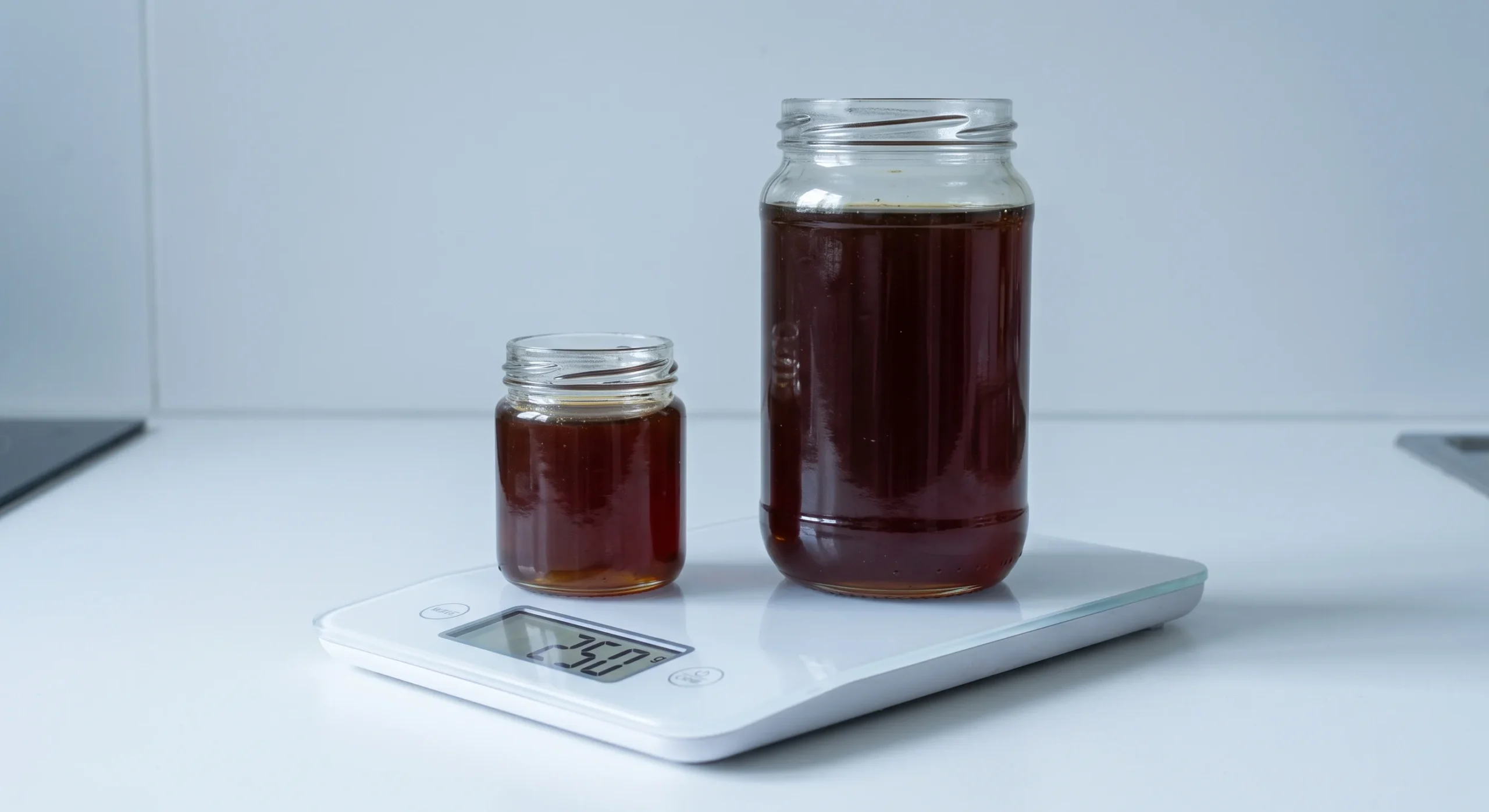
None of these on its own proves anything is wrong, but several together mean you are being sold a story rather than a product. Every item below was observed on a live seller page on 8 September 2026.
- No gram weight stated anywhere on the product page.
- No size stated at all, so a per-gram price cannot be worked out.
- A guarantee that sounds broad but is narrow.
- “Lab tested” with nothing published.
- A lab page with no lab results on it.
- A test of the wrong thing, presented as a test of potency.
- An FAQ that does not answer its own questions.
- Psychedelic, medicinal, or therapeutic framing in the product copy.
- Prices that contradict each other on the same site.
- Dosing guidance that contradicts itself on the size of a serving.
On weights and sizes
Maddest Mad Honey sells a “3.5oz Personal Set” and never states a weight in grams, and 3.5 oz is about 100 g. Royal Mad Honey stated no size at all on 8 September, which made a per-gram price impossible to calculate; it now lists both of its products at 250 g. Strong Mad Honey, which is otherwise the most forthcoming company here on contact details, lists a Rare Harvest at $199 with no size stated, and Magaranger sells single-serve sticks with no weight given. The defect is not confined to the least transparent sellers.
On guarantees
Maddest’s “100% Refund Guarantee” is qualified in its own copy as covering the case where you do not receive your order, which is a delivery guarantee rather than a product one. Original Mad Honey’s 30-day money-back is conditioned on effects not being experienced, which is a promise about potency rather than about quality or satisfaction. Sherpa Honey’s 30-day refund requires 80% of the product returned in the original jar.
On testing claims
Medicinal Mad Honey, Strong Mad Honey, and Royal Mad Honey all claim batch testing. None has a lab-report page in its sitemap or navigation; none names a laboratory anywhere on the site, and none publishes a figure, a date, or a certificate.
Medicinal does list the parameters it says it tests, including moisture, acidity, HMF, ash, sugar ratios, and grayanotoxin level, and it claims QR-based traceability to harvest and batch records, but nothing on the site lets an outsider check any of it.
On lab pages that carry no results
Original Mad Honey’s lab page names its partner only as “NAST NEPAL AUTHORIZED”, with no facility address or registration details. It shows one batch code, N-LTM-2026-B81, which reads as a sample or placeholder.
It states that batch-specific reports are available for download; on the date checked, the download button and the batch-lookup tool both returned nothing. Sherpa Honey’s Lab Reports page carried one bare certificate reference, SH000A, and the remainder of the page was a mandatory-arbitration clause.
On the wrong test
Maddest Mad Honey states that each batch must pass a minimum 87% rhododendron pollen rating. That is a pollen-share test, and it speaks to floral origin rather than to strength.
On prices that disagree with themselves
Sherpa Honey’s product page lists 50 g at $49.95, 150 g at $119.95 and 300 g at $194.95, while its homepage advertises a different range entirely, at 100 g for $49.99, 250 g for $89.99, 500 g for $139.99 and 1000 g for $229.99. On the date checked, those two did not match. We do not know which is correct, and neither will you until you ask.
On dosing that disagrees with itself
Original Mad Honey tells buyers to start with a half-teaspoon and also states that a 250 g jar is 15-20 servings, which implies a serving of roughly 12-16 g. Both statements cannot describe the same serving.
Why “lab tested” is not a lab report
“Lab tested” is a claim. A lab report is a document. The gap between them is where most of this market lives.
A claim costs nothing to make and cannot be checked. A report names a laboratory that has a reputation to protect, carries a date and a batch, states a method, and gives numbers with units. Three of the nine sellers here make the claim and publish nothing at all. A fourth, Maddest Mad Honey, publishes nothing for the test it does claim, and the test it names measures floral origin rather than potency, which our page on mad honey and rhododendron explains. Two more publish a page built to look like evidence that carries none.
The key point is that you should treat “lab tested” as marketing copy until a document appears, in the same way you would treat “premium” or “authentic”. If you want a fuller test of whether a product is what it says, our guide on how to tell if mad honey is real goes further than a listing ever will.
Price: what is normal and what is not
Prices in this category look chaotic until you convert everything to a per-gram figure. A fairly clear structure appears once you do.
The middle of the market
Across every product recorded on 29 September 2026, the cheapest verifiable figure was Bee-licious Honey’s 1000 g jar at $170, which is $0.17 per gram. Among sellers that state worldwide shipping, it was Medicinal Mad Honey’s 1000 g jar at $260, which is $0.26 per gram.
We set that against Sherpa Honey’s homepage range, which advertises a 1000 g jar at $229.99 and is contradicted by Sherpa’s own product page; we do not know which of the two is correct, so we do not treat it as the floor.
The dearest was Best Mad Honey’s Rare Harvest, 220 g at $399, which is $1.81 per gram. That is roughly a tenfold spread within one product category, or sevenfold among the worldwide shippers.
The bulk of the market sits between $0.36 and $0.52 per gram. Medicinal Mad Honey’s 500 g at $180 is $0.36. Strong Mad Honey’s 500 g Trip at $179 is also $0.36, and its 250 g Medicinal at $99 is $0.40.
Original Mad Honey’s 500 g at $199 is $0.40, and its 250 g at $119 is $0.48. Best Mad Honey’s Autumn Harvest, 200 g at $89, is $0.45. If a listing is far outside that band in either direction, there should be a reason on the page.
Small sizes are usually the worst value, because you are buying packaging and shipping alongside the honey. Magaranger’s 30 g pouch lists at $29.99, which is $1.00 per gram, and its single-serve stick at $9.99 states no weight at all. Best Mad Honey’s 30 g Try Pack at $49 is $1.63 per gram.
That premium is what a small format costs in any packaged-food category, and it is not by itself evidence of anything about the honey. The exception sits at the top of the range rather than the bottom: Best Mad Honey’s Rare Harvest, a 220 g jar at $1.81 per gram, is dearer per gram than any starter size here.
Why the cheapest jar and the dearest jar both deserve a second look
At the cheap end, price alone does not tell you much. Premium food honeys are not cheap, as our comparison with manuka sets out, and a low per-gram figure can be a genuine bulk discount.
The way to tell is not the price. It is whether the seller can produce a certificate for the batch you are being sent. Bee-licious Honey and Medicinal Mad Honey sell the two cheapest jars recorded here, and on the pages checked neither publishes a certificate or names a laboratory. That is an evidence gap, and it is the only thing we can say about it.
At the other end, price is not a potency measurement either. Best Mad Honey’s Rare Harvest at $1.81 per gram is at least internally consistent. Its product-page figure matches its published certificate, and that is the difference between a number you can check and a number you cannot. A high price with no certificate behind it does not buy that.
Be careful with discount framing too. Real Mad Honey runs the heaviest of any seller recorded, showing struck-through list prices against four of its five Nepal sizes with “53% OFF”, “44% OFF” and “Save $185.05” among them.
Original Mad Honey showed 40% and 60% off list on its two products on the date checked. Medicinal Mad Honey showed a $140 list price against a $120 price. Maddest showed $139 against $114. Each of those displayed a higher list price beside the sale price on the date checked. A list price that is never actually charged is not a price, and we have not established what any of these sellers charged historically.
Sticker price is not landed price
For a US buyer using a domestic seller, the sticker is close to the landed cost. Magaranger offers free US shipping over $50, and Sherpa offers free USPS Priority.
For everybody else, there are three additional lines. Shipping, which several exporters state as free worldwide, including Medicinal, Original, and Maddest. Import VAT, GST, or duty, calculated on the value of the goods and sometimes on the shipping too. And a courier clearance or handling fee, which is charged by DHL or FedEx rather than by the seller, and which typically arrives as a message asking for payment before delivery.
In plain terms, a buyer outside the United States should expect the delivered cost to be meaningfully above the checkout total. Work out what you are willing to pay landed, then work backward.
After it arrives
The box turning up is not the end of the transaction. Two things are worth doing in the first ten minutes, and one thing matters for the next year.
Check it against what was described
Look at the jar, then look at the listing you bought from. Is the net weight printed on the jar, and does it match? Is there a batch code, and does it correspond to anything the seller published? Is the seal intact? If the seller promised a certificate of analysis with the order, as Sherpa Honey states it provides, is it in the box, and does the batch on it match the batch on the jar?
If any of that does not line up, raise it immediately and in writing, while the parcel and the packaging are still intact. Refund policies vary widely. Magaranger offers a 30-day money-back guarantee and tells buyers to keep the pouch. Sherpa requires 80% of the product to be returned in its original jar. Strong Mad Honey states a 100% money-back guarantee, and Royal Mad Honey states a 30-day full refund. Best Mad Honey states no returns or guarantee policy on its homepage at all.
Storage
Honey is forgiving but not indestructible. Keep it sealed, cool, dark, and away from a window; use a dry spoon, and do not decant it into something that does not close properly. Crystallization is normal and is not spoilage. Our guide to storing mad honey has the details, including what heat can do and why the microwave is a bad idea.
Why a darker jar does not mean a stronger jar
A great deal of folklore attaches to the color. Buyers open the jar, see a deep reddish-amber, and conclude they have received something potent.
Color can come from floral source, mineral content, age, and how the honey was handled. It tracks potency only loosely, and it is easy for a honey to be dark for reasons unrelated to grayanotoxin. Our page on red mad honey unpicks where the belief came from.
This is why chasing intensity is the wrong approach. The only thing that measures grayanotoxin content is a laboratory measuring grayanotoxin content.
Before you buy: the safety part
This belongs before the purchase rather than after it, because two of these questions can make the purchase a bad idea regardless of which seller you pick. Our overview on whether mad honey is safe is the fuller treatment.
Some people should not take it at all
Grayanotoxins are reported to act on the cardiovascular system, and the reported effects include a slowed heart rate and lowered blood pressure. That puts several groups in a different category from the general reader, including people with existing heart conditions, people already managing low blood pressure, older adults, and people who are pregnant. Our page on who should not take mad honey sets the list out, and our pages on mad honey and blood pressure and mad honey and heart rate explain the mechanism as far as it is understood.
If you are in one of those groups, the answer to “where should I buy it” is that you should not be buying it, and no seller’s grade or certificate changes that.
The medication question
Blood pressure medication, heart-rate medication, and several other classes may interact with the reported effects in ways that can compound them. This is a conversation to have with a doctor or a pharmacist before you order, not after the box arrives. Our page on medication interactions covers what is known and, importantly, what is not.
Why “natural” does not settle the medication question
A large part of this market’s marketing rests on the word natural, and Royal Mad Honey’s “Pure & Medicinal” framing is a clean example of where that leads.
Natural describes an origin. It says nothing about a dose, a mechanism, or an interaction. Grayanotoxin is entirely natural, and it is also what hospital case reports describe after people eat too much of this honey.
The key point is that a substance with a pharmacological effect has a pharmacological interaction profile, whether it came from a cliff or a factory. If a seller uses “all natural” where you expected an answer about medication, you have not been given an answer.
If something goes wrong
Our page on overdose symptoms describes reported presentations, including nausea, sweating, dizziness, blurred vision, a slowed heart rate, and fainting. Sherpa Honey carries a full disclaimer naming seizures and cardiac issues among the risks. Strong Mad Honey prints, in capitals, “MAXIMUM 1 TABLESPOON PER 24 HOURS. SEEK MEDICAL ATTENTION IF HEART RATE DROPS OR VISION BLURS.” That is one of the more responsible lines any of these sellers publish.
If you or someone with you is unwell after taking it, contact emergency services or your national poison control center. Do not wait it out and do not attempt to treat it yourself. Our page on what to do about mad honey poisoning is written for that moment.
On amounts, the sellers do not agree with one another, and the disagreement is not small. Magaranger tells buyers “1/2 teaspoon (2-3 g) – start here” and calls “1 teaspoon (5-6 g) – the maximum”. Sherpa Honey tells buyers to “start with 2.5 grams” and to “not exceed 5 grams per day”, which is the strictest published ceiling recorded here.
Strong Mad Honey’s tier table puts its “Advanced maximum” at “1 tablespoon (15g) per 24 hours DO NOT EXCEED”. Royal Mad Honey tells buyers to “begin with a single teaspoon (5g)”. Medicinal Mad Honey tells buyers to “begin consumption with one teaspoon, slowly increasing it to one tablespoon”. Maddest Mad Honey tells buyers to start with “1 to 2 tablespoons” and to take “no more than 3 tablespoons per serving”. Real Mad Honey tells buyers to “Start with one small teaspoon” on its product page and “start with half a teaspoon” on its dosage page, and publishes no maximum anywhere: no per-serving ceiling and no daily limit.
That gap matters most for this seller, because its own four certificates run from 2,512.73 to 19,823 micrograms per kilogram and it prints no figure on any page, so a fixed teaspoon cannot be scaled to a batch that may be eight times the last one.
A US teaspoon of honey is about 7 g and a tablespoon about 21 g. On that conversion, Maddest’s stated starting amount is larger than the maximum daily amount Strong Mad Honey prints in capital letters. Its stated maximum single serving is roughly three times that ceiling, and roughly ten times Magaranger’s stated maximum.
Medicinal Mad Honey’s stated ceiling of one tablespoon sits in the same place as Maddest’s starting point. The sellers also disagree about what a teaspoon weighs: Magaranger calls it 5-6 g, and Royal Mad Honey calls it 5 g. Original Mad Honey disagrees with itself, telling buyers to start with a half-teaspoon while stating a serving count that implies roughly 12-16 g.
We do not issue amounts in our own voice. Read our beginner’s guide to dosage, and treat a seller whose guidance sits far above the others as a reason for concern rather than as a selling point.
Conclusion
The honest answer to “where can I buy mad honey” is that you first decide which of three routes your country allows: locally held stock, which in practice means the United States and, from one seller, the EU; an international courier; or a counter in Nepal or Turkey.
Then you pick a seller inside that route, and you pick on evidence rather than on adjectives. The border is a food question far more often than it is anything else, and the paperwork that gets a parcel through is the paperwork that describes it accurately.
Three principles are worth carrying out of this.
- Route before brand: Where you live decides what is available to you, and it decides roughly half of what you will pay. Settle the route first, and the brand question gets much smaller.
- Declare, document, keep the paper: A jar described plainly and accurately as honey, with an invoice that matches, is the lower-friction path everywhere in this guide. Accuracy is the standard, and no seller who suggests otherwise is worth buying from.
- Match the report to the jar: A brand having published a certificate is not the same as your jar having been tested. The date on the certificate and the batch on the lid are the two things that matter. One seller in this guide maps certificates to order numbers, which is the nearest thing to an answer on a page, though we could not audit it from outside; everywhere else, asking before you pay tells you more about a seller than any product page will.
FAQs – buying mad honey and getting it home
Can I bring mad honey back in my luggage?
Sometimes, and it depends on the destination country’s food and biosecurity rules rather than on drug law. The UK operates a 2 kg personal allowance for honey; Australia and New Zealand are far more restrictive, and the EU restricts personal consignments of animal products from outside the bloc. Check your own country’s rules and our travel guide before you pack it.
Will customs open my parcel?
They may, and there is nothing unusual about it. Imported food is routinely inspected, and a parcel described accurately as honey with a matching invoice is usually a short conversation. We give no advice on avoiding inspection.
What if it is seized?
Depending on the country, the consignment can be held, treated, re-exported, or destroyed, and you may be liable for storage or disposal fees. Whether you get your money back is a matter of the seller’s policy, and one seller here, Maddest Mad Honey, sells lost-package insurance as a separate $8 add-on rather than covering it in the guarantee.
Is it cheaper direct from Nepal?
Usually, though, it’s less than it used to be. Shipped from abroad, the recorded range ran $0.26 to $1.81 per gram with a mid-market of $0.36 to $0.52, while US-held stock ran $0.48 to $1.00 per gram, or down to $0.17 counting Bee-licious Honey’s larger jars. Add import tax and any courier handling fee before you compare.
Can I buy mad honey on a general marketplace?
You can, and the usual problem is that marketplace listings carry the least origin and batch information, because the format has nowhere to put it. If a listing cannot tell you the district, the harvest season, and the batch, you are buying on trust rather than on evidence.
Is it legal to resell mad honey?
Selling it commercially is a much heavier obligation than buying it personally, in every country covered here. Canada requires a Safe Food for Canadians license, the Philippines requires a License to Operate and a Certificate of Product Registration, Singapore requires SFA registration, and commercial consignments into the EU are routed through a Border Control Post. Treat reselling as a regulated food business, because that is what it is.
Do I have to declare it if it is a gift?
Yes. A gift is still an imported food product, and gift status can affect a tax threshold rather than the food or biosecurity rules. Declare it either way.
How long does an international order take?
On the sellers’ own stated figures: Best Mad Honey quotes 3-7 days to the US and 10-15 to Europe, Strong quotes 7-12 to the US and 7-10 to the UK and EU, Original quotes 5-12 business days worldwide, and Maddest quotes 5-7 working days by DHL Express. Clearance time sits outside all of those, and we have not verified delivery into any particular country.
Do I have to pay VAT or duty?
Outside the United States, usually yes. VAT or GST is assessed on the value of the goods, and the courier typically collects it along with its own clearance fee before delivery. Free shipping does not mean free of tax.
Is honey bought in person in Nepal the same product?
It is often the same honey and almost never the same purchase. Market honey is frequently unlabelled, unweighed, undated, and untested, so you gain on price and lose most of the means of checking what you have.
Does a lab report on the seller’s website mean my jar was tested?
Usually not. Grayanotoxin content is a property of a batch rather than of a brand, and two of the three sellers publishing genuine certificates are publishing ones dated 2024 and April 2025, which describe honey you are not being sent.
The exception is Real Mad Honey, which maps its four certificates to order-number ranges so a buyer can identify which one is meant to cover their jar. Everywhere else, ask whether there is a report for the batch being shipped to you, and treat a straight answer as a strong signal.
What should I do if someone is unwell after taking it?
Contact emergency services or your national poison control center. Do not wait it out and do not attempt to treat it yourself.