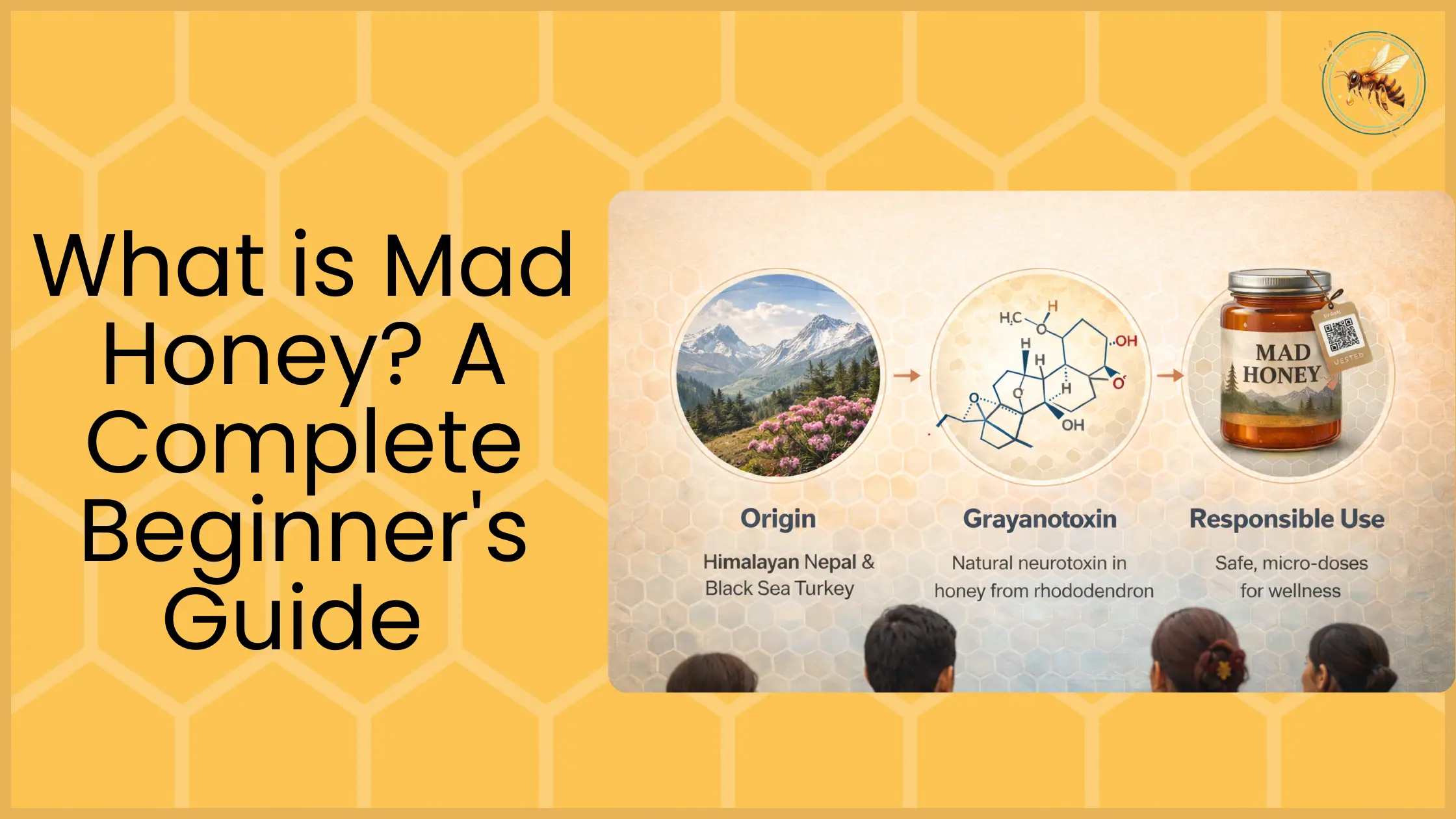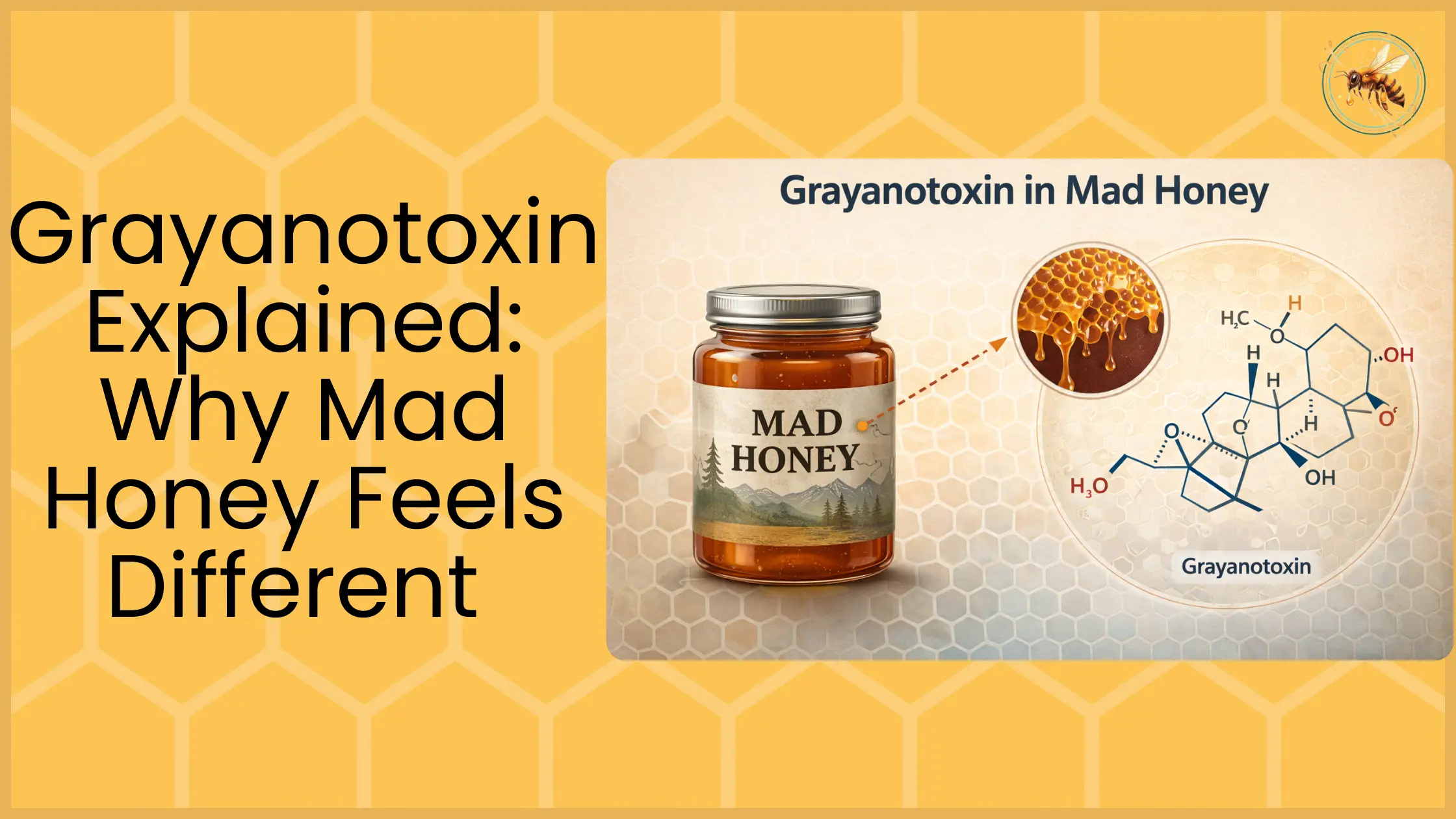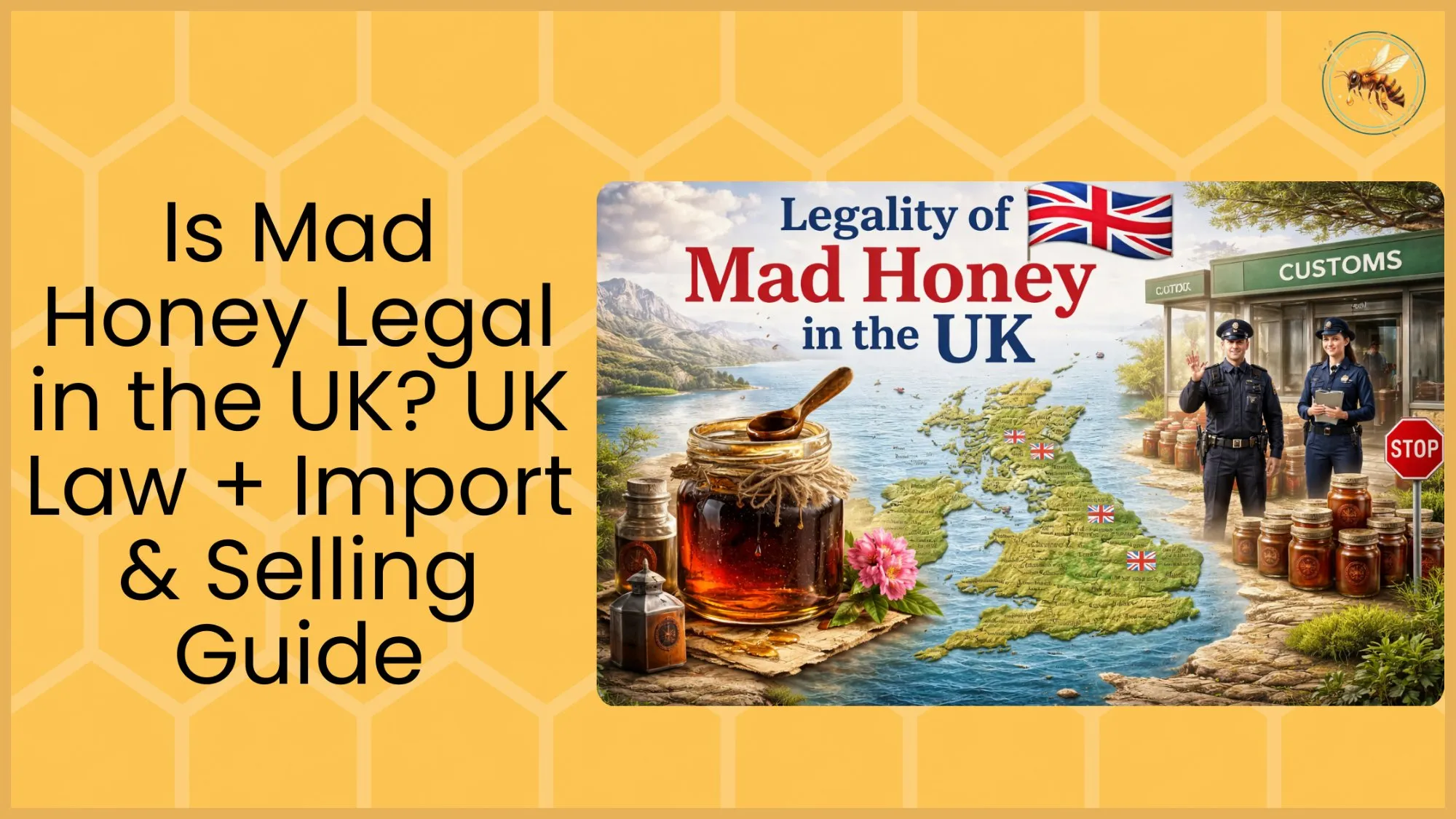
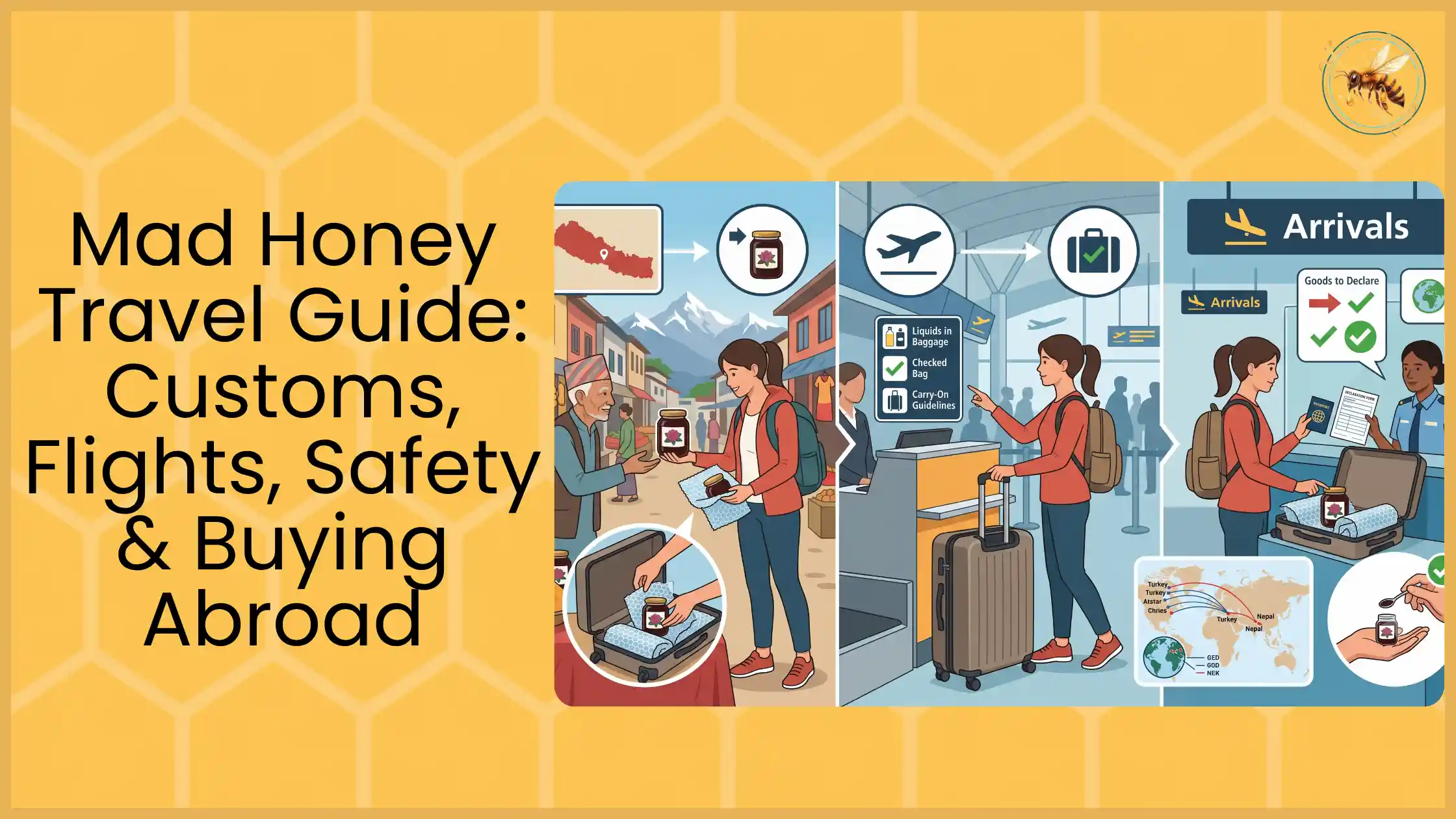
Mad honey can be a memorable travel souvenir, especially for people visiting Nepal, Turkey, or regions where rhododendron honey has a local tradition. But traveling with mad honey is not as simple as packing a normal jar of honey. It sits at the overlap of airport security rules, customs rules, food import restrictions, local legality, packaging, and personal safety.
The most important thing to understand is that different authorities care about different things. Airport security may care about whether honey is a liquid or gel in your carry-on bag. Customs may care about food imports, animal-derived products, agricultural risk, value, taxes, and whether the quantity looks personal or commercial. Health and safety concerns are separate again, especially because mad honey may contain grayanotoxins and can affect blood pressure, heart rate, nausea, dizziness, and fainting risk in some people.
Mad honey travel is possible in some situations, but it needs planning. The safest approach is to keep it sealed, labeled, documented, and declared when required. It is also smart not to sample it in risky travel settings, such as before a flight, long drive, trek, border crossing, or night out.
tl;dr
- Mad honey may be food, but travel rules can still apply because honey is usually treated as a liquid/gel for airport security and as an animal-derived food for customs purposes. TSA’s liquid rule recommends packing liquids, gels, and aerosols over 3.4 oz / 100 ml in checked baggage.
- Customs rules depend on where you are traveling from and to. For example, EU guidance allows travelers entering from non-EU countries to bring limited quantities of products such as honey, while the UK government lists honey under animal-product food rules with a 2 kg per person allowance from countries outside specified European areas.
- The biggest travel mistake is treating mad honey like a casual souvenir. It can contain grayanotoxins, so safety, dosage, medication interactions, local laws, and travel context matter.
- The safest approach is to keep it sealed, labeled, declared when required, packed carefully, and used only in a calm setting, never before driving, hiking, flying, drinking alcohol, or crossing borders.
Quick Answer: Can You Travel With Mad Honey?
Usually, it may be possible, but it is not always simple. The answer depends on where you are traveling, where the honey was purchased, whether you are flying domestically or internationally, how much you carry, and whether the destination allows honey or animal-derived food products.
Usually possible, but not always simple
Mad honey may be treated as honey, but that does not mean every border will allow it in every situation. If it is sealed, labeled, for personal use, and within the destination’s food import limits, it may be easier to travel with. If it is unlabeled, opened, repacked, described with drug-like language, or carried in large quantities, it can raise more questions.
The word “mad” can also create confusion. A border officer may not know what it means, and marketing terms like “intoxicating,” “psychoactive,” “trip,” or “guaranteed high” can make a food product look more suspicious than it needs to.
Domestic travel vs international travel
Domestic travel is usually simpler because you are not crossing a customs border. The main concern is baggage screening, airline rules, and whether the honey is packed properly.
International travel adds a second layer. Once you cross a border, customs rules apply. The destination country can restrict food, honey, animal-derived products, agricultural goods, or goods that appear to be for resale.
For the rules country by country, see our table of honey customs rules for travelers. It covers 20 destinations plus leaving Nepal or Turkey, and links to the official source for each.
Carrying honey bought abroad is different from carrying honey inside your own country. Shipping honey instead of carrying it can also trigger import rules, courier requirements, taxes, and documentation.
Best simple rule
Before traveling with mad honey, check three things: airline or airport security rules, destination customs rules, and local legality or product-claims rules. If any one of those creates a problem, the jar may be delayed, inspected, refused, or confiscated.
Can You Bring Mad Honey on a Plane?
Plane travel involves baggage rules first. Even before customs, you need to think about whether the jar belongs in carry-on luggage or checked luggage.
Carry-on luggage
In many airport systems, honey is treated like a liquid, gel, paste, or spreadable item for carry-on screening. That means the container may need to fit the airport’s liquids rule for cabin baggage. For example, TSA carry-on rules limit liquids, aerosols, gels, creams, and pastes to travel-sized containers of 3.4 ounces or 100 milliliters per item in a quart-sized bag.
A full-size jar of mad honey is usually not a good carry-on item unless it fits the relevant travel-size rule or is allowed under a specific airport exception. Security staff can also make final screening decisions at the checkpoint.
Checked luggage
Larger jars usually make more sense in checked luggage, assuming the honey is legal to import at your destination. Checked luggage does not remove customs rules. It only avoids the carry-on liquids issue.
If you pack mad honey in checked luggage, protect it carefully. Honey is heavy, sticky, and difficult to clean if it leaks. A broken jar can ruin clothes, documents, electronics, and other items.
Duty-free and sealed bags
Duty-free liquids may be treated differently in some situations if they are sealed in official tamper-evident bags with proof of purchase. However, those rules are specific and can still involve screening. They are also not a customs guarantee. A duty-free purchase can still be questioned when entering another country.
Practical packing note
Use sealed jars, leak-proof secondary bags, padding, original labels, and upright placement. If the jar is glass, add hard-sided protection. Keep the receipt or product page screenshot if available.
Airport Security vs Customs: What’s the Difference?
Many travelers confuse airport security with customs, but they are not the same.
Airport security checks the flight-safety side
Airport security focuses on what can go on the aircraft. This includes liquids, gels, container sizes, bag screening, sharp items, batteries, tools, sprays, and other cabin-safety concerns.
For mad honey, the main airport-security question is usually simple: is this container allowed in carry-on luggage, or should it be checked?
Customs checks the border/import side
Customs checks what can enter the country. This includes food import rules, animal products, agricultural risk, taxes, duties, controlled goods, false declarations, commercial quantities, and restricted items.
A jar can pass airport security and still be refused by customs. The opposite can also happen: a food may be legal to import, but not allowed in carry-on because of liquid rules.
Why mad honey can raise questions
Mad honey is food, but the way it is described can create confusion. Words like “mad,” “intoxicating,” “psychoactive,” “high,” or “trip” can make it sound less like honey and more like a regulated substance. That does not help at borders.
Travel wording tip
Keep labels and explanations factual: honey, country of origin, ingredients, batch number, and lab information if available. Avoid hype-style wording on labels, inserts, or travel documents.
Can You Bring Mad Honey Through Customs?
Customs rules are country-specific. They can also change, which means travelers should check official government sources before each trip.
Rules vary by destination
One country may allow a small sealed jar for personal use. Another may require declaration, inspection, or documentation. Another may restrict honey from certain origins because of animal-health or biosecurity concerns.
Do not rely on a blog post, seller comment, or travel forum as your only source. Use official customs, agriculture, or food-safety pages for the destination.
Honey as an animal-derived food product
Honey can fall under food or animal-product rules because it is produced by bees. Even when the jar is for personal use, border agencies may still treat it as an agricultural or animal-derived product.
This does not automatically mean it is banned. It means it may be regulated, limited, inspected, or subject to declaration.
Personal use vs commercial quantity
A single sealed jar in personal luggage is not the same as ten jars intended for resale. Many jars, repeated trips, invoice quantities, or mixed packaging can make customs treat the goods as commercial.
Once the product looks commercial, the rules can become more serious. Food registration, business import procedures, labeling, duties, testing, and local compliance may apply.
When to declare it
Declare honey when the customs form or officer asks about food, agricultural products, animal products, goods bought abroad, or items for commercial use. It is better to declare and have the item inspected than to hide it and risk penalties.
Examples of Travel Rules Readers Should Check
These examples show the kind of official rules travelers should look up before flying. They are not a replacement for checking the latest government guidance before travel.
United States
Travelers flying in or through the United States should check TSA rules for baggage screening and CBP or USDA rules for customs and agriculture. TSA rules matter for whether the jar can go in carry-on luggage. CBP rules matter when entering the country.
U.S. Customs and Border Protection tells travelers to declare food and agricultural items, and notes that animal products and by-products can be restricted or require permits depending on the item and origin. This is why travelers should not assume that any honey from any country is automatically fine.
European Union
The EU has personal import rules for animal-derived products when travelers enter from outside the EU. EU guidance allows travelers to bring limited quantities of certain other animal products, such as honey, up to 2 kilograms per person in specific personal-use contexts.
The details depend on where the traveler is coming from and whether the item is for personal use. Travelers entering the EU should check official EU and destination-country guidance before packing honey.
Great Britain
Great Britain has its own food import guidance. GOV.UK states that travelers entering from countries outside the EU, Switzerland, Norway, Iceland, Liechtenstein, the Faroe Islands, and Greenland can bring in up to 2 kilograms per person of honey for personal use. It also explains that rules depend on the country the food is being brought from.
Travelers should check the live GOV.UK page before flying because food rules can change, especially around animal disease outbreaks and border controls.
Countries with stricter food or honey controls
Some destinations are known for stricter biosecurity or food import enforcement. These may include Australia, New Zealand, Singapore, and some Gulf countries. Rules may involve declaration, inspection, treatment requirements, proof of origin, or refusal.
Do not assume that a sealed jar will pass simply because it is small. In stricter biosecurity countries, the safest approach is to check the official customs or food-import page before buying or packing honey.
Traveling to Nepal for Mad Honey
Nepal is one of the most famous mad honey destinations because it is tied to Himalayan cliff honey, giant bees, and traditional honey hunting.
Nepal as the Himalayan cliff honey origin story
Nepal mad honey is often associated with Apis laboriosa, the Himalayan giant honey bee, and with cliff-harvesting communities such as Gurung honey hunters. The honey is linked to rhododendron bloom zones, seasonal harvests, and remote mountain regions.
This origin story is powerful, but it should be approached with respect. The harvest is dangerous work, not just a tourist spectacle.
Buying locally in Nepal
If you buy mad honey locally in Nepal, ask where it was harvested, which season it came from, whether it is spring or autumn harvest, whether it has a batch number, and whether there is any safety or testing information.
Avoid unlabeled mystery jars, tourist-market claims, and sellers who only talk about strength. Do not chase the “strongest” jar. Stronger is not safer, and it is not automatically more authentic.
Honey-hunting tourism
Honey hunting tourism should be treated as cultural heritage, not a dangerous show for visitors. Ethical tourism respects local communities, pays fairly, avoids pressuring hunters into unsafe demonstrations, and does not reduce the practice to a viral cliff video.
Traveling to Turkey for Mad Honey
Turkey is another major mad honey destination, especially through its Black Sea deli bal tradition.
Turkey and deli bal
Turkish mad honey is commonly linked to the Black Sea region and the term “deli bal.” The region is known for rhododendron honey and a long tradition of mad honey use.
Turkish deli bal also appears often in medical discussions because cases of grayanotoxin intoxication have been documented in Turkey. That does not mean every Turkish jar is dangerous. It means the product should be approached with realistic safety expectations.
Buying locally in Turkey
When buying locally in Turkey, ask for origin, region, harvest details, and product labeling. Avoid exaggerated sexual-performance claims, unlabeled jars, or sellers promising instant effects.
Understand that deli bal strength varies. A small amount from one jar may not behave like the same amount from another jar.
Bringing Turkish mad honey home
The country where you bought the honey is not the only rule that matters. Your destination country’s import rules decide whether you can bring it home. Always check the rules of the country you are entering.
Should You Use Mad Honey While Traveling?
Travel is usually not the best setting for first-time mad honey use. Too many variables can change how the body feels.
Travel is not the best setting for first-time use
New food, dehydration, altitude, jet lag, alcohol, poor sleep, stress, heat, and medication changes can all affect how someone feels. If you add mad honey to that mix, it can be harder to know what is causing dizziness, nausea, weakness, or fatigue.
First-time use is better reserved for a calm, private, low-risk setting at home, with no travel obligations.
Avoid using it before risky activities
Do not take mad honey before flying, driving, hiking, swimming, motorbike riding, climbing, long bus rides, border crossings, nightlife, drinking, or any situation where dizziness or nausea would be dangerous.
A mild effect at home can become a serious problem on a mountain road, in airport security, on a trek, or in a remote lodge.
Why symptoms are harder to manage while abroad
Dizziness, nausea, low blood pressure, fainting, or vomiting are more stressful in unfamiliar places. Language barriers, remote locations, different medical systems, travel insurance limits, and transportation delays can all make a bad reaction harder to handle.
Safer travel rule
Only consider mad honey in a calm, private, low-risk setting, and only if you already know how you respond to that specific batch.
Mad Honey, Altitude, Heat, and Dehydration
Travel conditions can overlap with mad honey side effects. This is especially important in Nepal, Turkey, and other warm or mountainous destinations.
Altitude travel
Altitude travel can cause fatigue, headache, nausea, dizziness, poor sleep, and weakness. Those symptoms can overlap with mad honey side effects. Do not mix unfamiliar mad honey use with trekking, mountain roads, high passes, or altitude sickness concerns.
If you are in the Himalayas, prioritize acclimatization and hydration instead of experimenting with a bioactive honey.
Hot climates and dehydration
Heat and dehydration can worsen dizziness, weakness, and low blood pressure. A traveler who is already dehydrated may react more strongly or recover more slowly.
Mad honey should not be taken after a hot day of walking, drinking alcohol, sweating, or skipping meals.
Jet lag and exhaustion
Tired travelers may misread the body’s signals. Jet lag can make someone feel heavy, dizzy, foggy, or nauseous even without mad honey. Adding a variable honey can make those signals harder to interpret.
Practical advice
When traveling, prioritize hydration, food, sleep, stable conditions, and safe transport over experimentation.
Medication and Travel Health Considerations
Travel often changes routines, and small changes can affect safety.
Medication routines often change during travel
Travelers may shift time zones, miss meals, take sleep aids, use anti-nausea tablets, drink more alcohol, take altitude medication, use anxiety medication for flights, or change hydration habits. These changes can complicate how mad honey feels.
Mad honey interaction concerns
Be especially careful with blood-pressure medication, heart-rate medication, sedatives, sleep aids, anxiety medication, alcohol, erectile dysfunction medication, and strong calming supplements.
If a medication can affect dizziness, sedation, heart rate, blood pressure, nausea, or balance, mad honey may complicate the situation. Avoid combining unless medically cleared.
How to Pack Mad Honey for Travel
Good packing reduces avoidable questions and prevents leaks.
Keep it in the original container
Original containers help identify the product as honey. A proper label may show origin, ingredients, batch number, net weight, brand information, and safety guidance.
A labeled jar looks more credible than an anonymous container of amber liquid.
Seal it against leaks
Tighten the lid, use tape around the lid if appropriate, place the jar in a zip bag, wrap it in padding, keep it upright where possible, and protect glass with hard-sided support.
Do not assume a jar lid will survive baggage handling.
Keep documents if available
Carry the receipt, invoice, batch information, COA, or product page screenshot if crossing borders. These may help explain what the product is and show that it is for personal use.
Avoid repackaging into mystery containers
Do not pour mad honey into an unlabeled travel bottle or random jar. Unlabeled liquids create unnecessary airport and customs questions.
What to Say If Customs Asks About It
The best approach is simple, truthful, and calm.
Keep it simple and truthful
A practical phrase is: “It is honey for personal use.”
If asked for more detail, provide the country of origin, receipt, ingredient label, sealed packaging, and personal-use quantity.
Do not hide or over-explain
Do not joke about intoxication, drugs, tripping, or getting high. Do not describe it as a psychoactive product at the border. Do not hide it if asked about food or agricultural products.
Have supporting details ready
Useful details include country of origin, receipt, ingredients, sealed packaging, personal-use quantity, batch information, and lab information if available.
If it is refused
Do not argue. Ask whether it can be surrendered, returned, disposed of, or documented. Customs officers usually have authority to make the final decision.
Buying Mad Honey Abroad: Authenticity Checklist
Buying abroad can feel more authentic, but it can also be riskier if the product is unlabeled or overhyped.
What to ask the seller
Ask where it was harvested, which season it came from, whether it is from Nepal or Turkey, whether there is a batch number, whether there is any lab testing, and whether it is intended for personal consumption or resale.
A good seller should not be offended by basic origin and safety questions.
Red flags
Avoid sellers using “guaranteed trip,” “strongest in the world,” “instant high,” “natural Viagra,” or medical claims. Also be cautious with no label, no origin, no safety guidance, no batch details, suspiciously cheap price, or inconsistent packaging.
The more dramatic the claim, the more careful the buyer should be.
Traveling With Mad Honey for Resale or Business
Personal use and commercial import are completely different.
Personal use is not the same as commercial import
Many small jars can be treated as commercial goods even if they are packed in personal luggage. Customs may ask whether the items are for resale, gifting, sampling, or business use.
Business import requirements
Commercial import can involve food registration, importer licensing, labeling rules, taxes, duties, health certificates, testing, traceability, and local compliance. Some countries may require specific approval before honey can be sold.
Why “I carried it in my suitcase” is not a business model
A suitcase is not a compliant supply chain. Commercial mad honey needs lawful import, traceability, batch control, food safety documentation, and clear labeling.
Mad Honey Travel Safety Checklist
Use this checklist before buying, packing, or taking mad honey during travel.
Before the trip
Check airline or security rules. Check destination customs rules. Check local legality. Keep the product sealed and labeled. Keep receipt, invoice, or COA if available.
During the trip
Do not use mad honey before transport or risky activities. Do not mix it with alcohol. Do not take it while dehydrated, exhausted, jet-lagged, or at altitude. Do not share casually with travel companions. Keep it away from children.
Returning home
Declare honey if required. Keep within personal-use limits. Avoid carrying unlabeled jars. Understand that customs can still inspect, question, refuse, or confiscate items.
Best safety reminder
Mad honey is not the souvenir to sample casually in an airport hotel, trekking lodge, taxi, bus station, or before a long drive.
Conclusion
Mad honey travel is possible in some situations, but it needs more planning than a normal souvenir. A sealed jar of honey can still raise questions because food imports, animal-product rules, customs declarations, airport liquid limits, local legality, and product claims all matter.
The practical travel rule is simple: check airport, customs, and destination rules before packing it. Keep it sealed, labeled, documented, and declared when required. Avoid repackaging it into mystery containers, and do not carry commercial quantities casually.
The safety rule is just as important: do not use mad honey in risky travel settings. Avoid it before flying, driving, trekking, swimming, drinking, riding motorbikes, crossing borders, or handling long travel days. Mad honey is best approached, if at all, in a calm, private, familiar setting where you already understand your response to that specific batch.
FAQs: Mad Honey Travel
Can you bring mad honey on a plane?
Usually, yes in some contexts, but baggage rules apply. Carry-on rules may treat honey like a liquid or gel, and customs rules still apply when crossing borders.
Can mad honey go in carry-on luggage?
Only if it meets the relevant carry-on liquid or gel rules. For TSA, that means containers of 3.4 ounces or 100 milliliters or less inside the liquids bag.
Should mad honey be packed in checked luggage?
For larger jars, checked luggage usually makes more sense if the destination allows honey imports. Pack it carefully to prevent leaking or breakage.
Do you have to declare mad honey at customs?
Declare it if the customs form or officer asks about food, agricultural products, animal products, or goods bought abroad. Declaring is safer than hiding it.
Can you bring mad honey into the United States?
Travelers should check CBP and USDA guidance before travel. Food and agricultural items should be declared, and animal products or by-products may be restricted depending on origin.
Can you bring mad honey into the EU?
EU personal import guidance allows limited quantities of some other animal products, such as honey, up to 2 kilograms per person in relevant personal-use contexts. Check current EU and destination-country rules before traveling.
Can you bring mad honey into the UK?
GOV.UK guidance says travelers from countries outside the EU, Switzerland, Norway, Iceland, Liechtenstein, the Faroe Islands, and Greenland can bring up to 2 kilograms per person of honey for personal use. Check current GOV.UK rules before traveling.
Can you buy mad honey in Nepal and bring it home?
Possibly, but your home country’s import rules decide whether it can enter. Keep it sealed, labeled, documented, and declared when required.
Can you buy mad honey in Turkey and bring it home?
Possibly, but check the destination country’s import rules first. Turkish origin does not automatically guarantee entry into another country.
Is mad honey safe to take while traveling?
Travel is not the best setting for first-time use. Dehydration, jet lag, altitude, heat, alcohol, and medication changes can make effects harder to manage.
Can you take mad honey before a flight?
No. Avoid mad honey before flying because dizziness, nausea, low blood pressure, or anxiety would be difficult to manage in an airport or aircraft.
Can you take mad honey while trekking?
No. Trekking adds altitude, dehydration, fatigue, terrain risk, and limited access to medical help. Mad honey should not be used during trekking.
What happens if customs takes your honey?
It may be surrendered, destroyed, returned, or documented depending on the country and situation. Do not argue. Ask for the process and keep any paperwork.