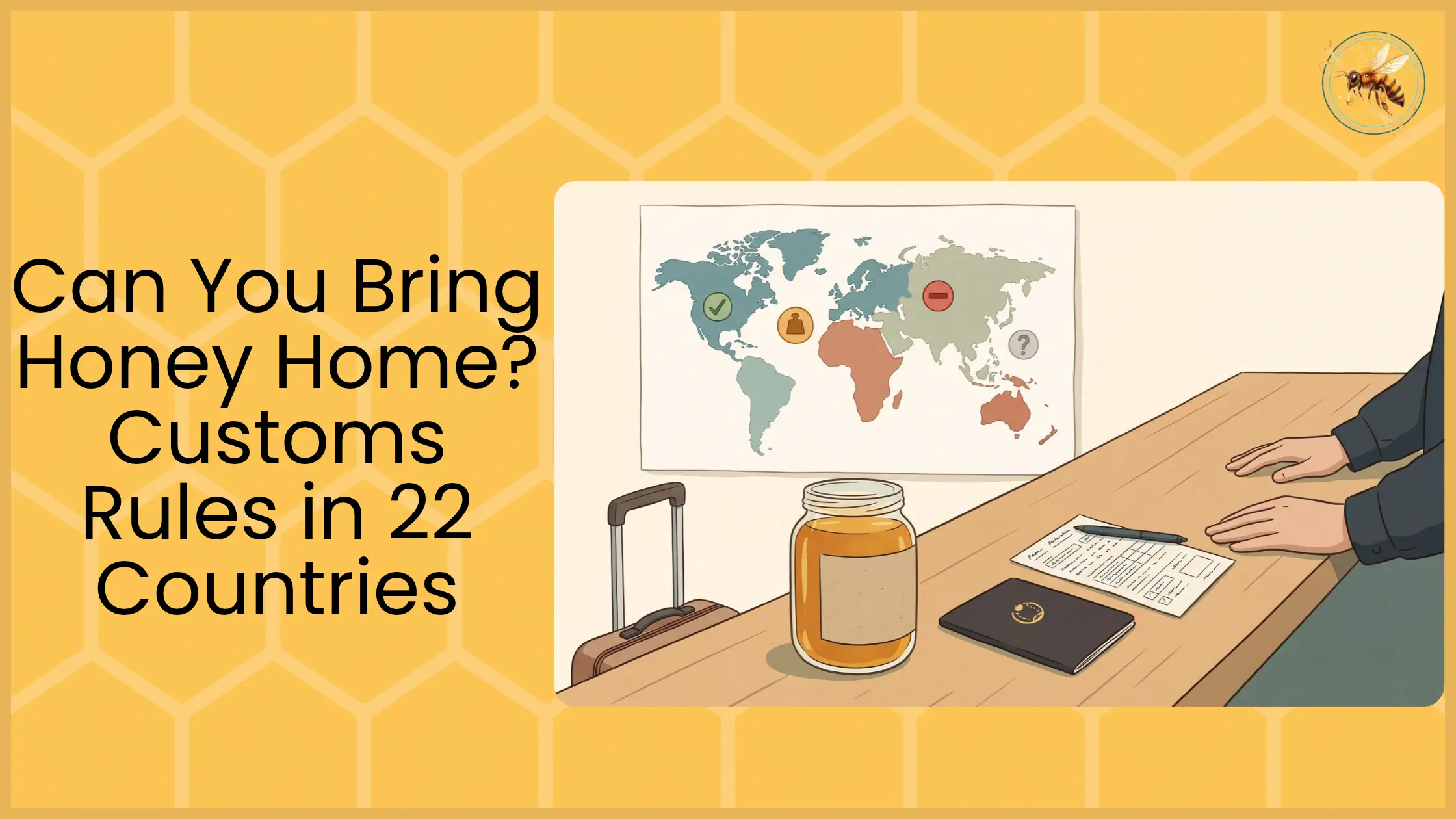
Plenty of countries let you bring a jar of honey home, but not all of them do, and the rules can be hard to find. They often sit on agriculture or food-safety websites, not the customs site you would look at first, and a few list honey in the same line as snails and frogs’ legs.
We read the official rules for 20 destinations, and for leaving Nepal and Turkey, where most mad honey comes from. The table below gives what each one says, a link to the page, a short quote from it and the date we read it.
tl;dr
- In the US and Japan we found no limit on honey in your luggage.
- Canada allows 20 kg. Great Britain, the EU and Switzerland allow 2 kg from most non-EU countries, and Norway allows 1 kg from outside the EU/EEA.
- Australia and Malaysia inspect honey at the border. South Korea caps farm products at 5 kg per item, and Hong Kong only asks for a “reasonable quantity”.
- New Zealand and South Africa are the hardest. New Zealand accepts only its own honey, or honey from six Pacific islands with a certificate. South Africa wants a permit.
- For nine places we could not find an official rule on honey for travelers: Israel, the UAE, Qatar, Saudi Arabia, China, Singapore, India, and leaving Nepal or Turkey.
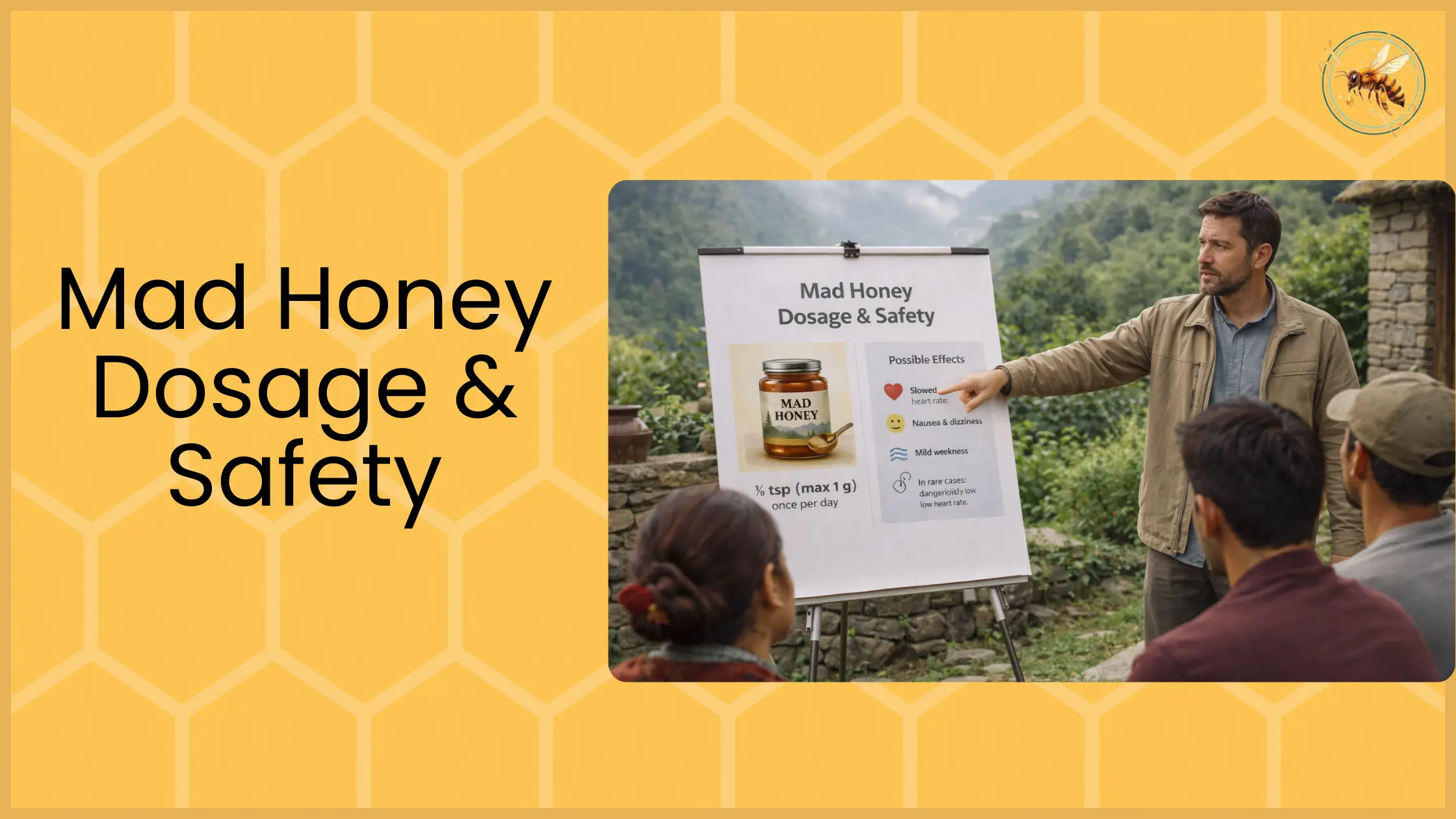
- South Korea is the only one with a rule that names mad honey, a 2008 ban on Nepalese wild honey containing grayanotoxin.
Honey in your luggage, country by country
Rules change; check the official source before you travel. This is not legal advice.
| Country | Honey in luggage | Limits and conditions | Declare it? | Official source |
|---|---|---|---|---|
| Australia | Allowed, inspected on arrival | A biosecurity officer must inspect honey on arrival; honey that fails is exported or destroyed at your cost. No quantity limit stated. Western Australia has its own entry rules for honey and bee products. | Yes | Department of Agriculture, Fisheries and Forestry“Honey products are permitted into most Australian states and territories.”Checked 8 Oct 2026 |
| Canada | Allowed with limits | Up to 20 kg per person, for personal use. No other restrictions listed for honey. The same limit applies arriving from the US or anywhere else. | Yes (all food) | Canadian Food Inspection Agency“Honey | None | 20 kg/44.09 lbs”A row of the agency’s table: product, restrictions, maximum per person.Checked 8 Oct 2026 |
| China (mainland) | No official rule found | Honey is not on China’s list of animal and plant products banned from luggage and post. Arriving travelers must declare animal and plant products in writing; whether honey counts is not stated. No personal limit published. | Animal products: yes (honey not named) | General Administration of Customs“携带动植物、动植物产品和其他检疫物的”In English: Carrying animals, plants, animal and plant products and other quarantine objects.Checked 9 Oct 2026 |
| European Union | Allowed with limits | From outside the EU: up to 2 kg per person, a limit shared with infant milk, infant food and special medical foods. No limit from another EU country, Andorra, Iceland, Liechtenstein, Norway, San Marino or Switzerland. From the Faroe Islands or Greenland: 10 kg. The Netherlands also bars honeycomb from outside the EU. | Not stated within the limit | European Commission (Regulation (EU) 2019/2122)“other animal products, such as honey … combined weight does not exceed 2 kg per person”Checked 8 Oct 2026 |
| Hong Kong | Allowed, “reasonable quantity” | Food for personal use in your baggage, in a reasonable quantity, is generally not controlled. Honey is not on the list of controlled foods (game, meat, poultry, eggs, rice, powdered formula). | Not stated | Customs and Excise Department“in a reasonable quantity, are generally not subject to control”Checked 9 Oct 2026 |
| India | No official rule found | India’s traveler guide (Baggage Rules 2026) does not name honey, either as banned or on the declaration form. Natural honey is not on the list of goods that need animal quarantine clearance. | Not stated | Central Board of Indirect Taxes and Customs“(iv) Meat and meat products/dairy products/fish/poultry products”The closest food item on the arrival declaration form. Honey is not listed.Checked 9 Oct 2026 |
| Israel | No official rule found | No official page found that names honey. The customs guide for returning travelers lists items that need another authority’s approval (plants, seeds, pets) but not food or honey. | Not stated | Israel Tax AuthorityNo official text on honey found.Checked 9 Oct 2026 |
| Japan | Allowed | Honey is excluded from animal quarantine (bee products that contain bees are not). No other rule for honey found. | Not stated | Animal Quarantine Service (MAFF)“みつばち(虫体を含むもの)*はちみつは含みません。”In English: Honeybees (including items containing bee bodies). *Honey is not included.Checked 8 Oct 2026 |
| Malaysia | Allowed after inspection | Natural honey may be imported only after inspection and approval by the quarantine service (MAQIS; the Department of Agriculture in Sabah and Sarawak). Comb honey is banned outright. Food for your own use must be declared in writing to the health officer at the entry point. No traveler quantity stated. | Yes, in writing | Royal Malaysian Customs (Prohibition of Imports Order 2023)“Subject to inspection and approval by the Department of Malaysian Quarantine and Inspection Services (MAQIS)”Checked 9 Oct 2026 |
| New Zealand | Not allowed, narrow exceptions | Allowed only if it is New Zealand honey (commercially packed, unopened) or comes from Niue, Samoa, Solomon Islands, Pitcairn Island, Tonga or Tuvalu with a zoosanitary certificate, up to 2 kg. Honey from anywhere else, Nepal and Turkey included, has no allowed route. | Yes | Ministry for Primary Industries“raw honey and honey spread are allowed if the honey was produced in New Zealand”Checked 8 Oct 2026 |
| Norway | Allowed with limits | From outside the EU/EEA (the UK included): up to 1 kg of animal foods other than meat and dairy products, for example honey, eggs, fish and seafood, for your own use. From the EU/EEA, Switzerland, Northern Ireland, Andorra or San Marino: no honey limit stated. | Not stated | Norwegian Food Safety Authority (Mattilsynet)“Du kan ta med inntil 1 kg av andre animalske næringsmidler enn kjøtt”In English: You may bring up to 1 kg of animal foods other than meat.Checked 8 Oct 2026 |
| Qatar | No official rule found | Traveler rules do not name honey. Natural honey is on Customs’ list of goods restricted by tariff (a Ministry of Public Health control), and a Gulf food-import guide published by Qatar Customs exempts food for personal use if the packaging is intact and labeled. How either applies to a jar in your luggage is not stated. | Not stated | General Authority of Customs“Foods imported for personal use are not subject to the requirements in this guideline”Checked 9 Oct 2026 |
| Saudi Arabia | No official rule found | No traveler rule names honey, and it is not on the customs list of banned items travelers commonly carry. Luggage and gifts must be personal and non-commercial; duty-free up to SAR 3,000. | Only banned, restricted or over-allowance goods | Zakat, Tax and Customs Authority“Gifts and luggage shall have personal traits with non-commercial quantities.”Checked 9 Oct 2026 |
| Singapore | No official rule found | Honey is not named. If it counts as “all other processed food”, the allowance is 5 kg or 5 liters in total and S$100 per traveler, for private use only; more needs an import license and permit. | Not stated | Singapore Food Agency“All other processed food that is not meat, fish, eggs, or fruits and vegetables”Checked 9 Oct 2026 |
| South Africa | Not allowed without a permit | Honey may be brought in only with a permit from the Department of Agriculture; a health certificate from the country of origin may also be needed. No personal allowance. Not declaring it can mean a fine of up to R20,000 or prison. | Yes | South African Revenue Service“Animals, plants and their products (e.g. animal skins, dairy products, honey)”Checked 9 Oct 2026 |
| South Korea | Allowed with limits | Within the duty-free allowance, farm products are limited to 5 kg per item, 40 kg in total and KRW 100,000 in value. Nepalese wild honey (“seokcheong”) containing grayanotoxin has been banned since 2008, and honey sold in Korea must have no detectable grayanotoxin III. | Yes | Korea Customs Service“농축수산물 품목당 5kg, 총량 40kg 이내, 전체 해외취득가격 10만원 이내 포함”In English: Agricultural, livestock and fishery products: 5 kg per item, 40 kg in total, total overseas purchase price within KRW 100,000.Checked 8 Oct 2026 |
| Switzerland | Allowed with limits | From outside the EU, Norway, Iceland and Northern Ireland: up to 2 kg (honey is listed with eggs, snails, frogs’ legs, gelatine, collagen and insects). From Greenland or the Faroe Islands: animal products up to 10 kg. From the EU, Norway, Iceland or Northern Ireland: own use, no honey limit stated. | Not stated | Federal Food Safety and Veterinary Office“Honey, eggs, snails (not live), frogs’ legs, gelatine, collagen, insects (not live): maximum 2kg”Checked 8 Oct 2026 |
| United Arab Emirates | No official rule found | Honey is not named. Dubai Customs says food may not be brought in commercial quantities, lists cooked and home-made food as banned, and says food can need a permit from the relevant authority. | Not stated | Dubai Customs“Food items are not allowed to be brought in by a traveler (commercial quantity)”Checked 9 Oct 2026 |
| United Kingdom (Great Britain) | Allowed with limits | From outside the EU, Switzerland, Norway, Iceland, Liechtenstein, the Faroe Islands and Greenland: up to 2 kg per person. From those countries: personal use, no quantity stated. Northern Ireland has its own rules.Since 4 September 2026, honeycomb from Turkey cannot enter Great Britain, under special measures against the Tropilaelaps bee mite. Extracted honey is not on the banned list. (GOV.UK) | Not stated for allowed amounts | GOV.UK (Defra, Border Force)“You can bring in up to 2kg per person of: honey”Checked 9 Oct 2026 |
| United States | Allowed | Generally admissible for personal use; no quantity limit stated. All agricultural products must be declared. The USDA suggests keeping receipts and the original packaging as proof of origin. | Yes | U.S. Customs and Border Protection“As a general rule, condiments, vinegars, oils, packaged spices, honey, coffee and tea are admissible.”Checked 8 Oct 2026 |
The full data is in a CSV file (22 rows, version 2026-10-09.2). It has the columns we left out of the table: rules by country of origin, rules for honey sent by post, and our notes on each source. You are free to reuse it under CC BY 4.0 as long as you credit All About Mad Honey and link back to this page.
Taking honey out of Nepal or Turkey
Most mad honey comes from Nepal and from Turkey’s Black Sea coast, so we also looked for rules on taking honey out of both countries. We did not find one for travelers in either.
| Country | Honey in luggage | Limits and conditions | Declare it? | Official source |
|---|---|---|---|---|
| Nepal | No official rule found | No official page says whether a traveler may take honey out of Nepal, or whether a permit or certificate is needed. Nepal’s animal health law does not mention honey. | Not stated | Department of CustomsNo official text on honey found.Checked 9 Oct 2026 |
| Turkey | No official rule found | No exit rule for honey found. In June 2026 the Ministry of Agriculture and Forestry warned people not to buy or eat products made with rhododendron flowers (jam, syrup, paste, tea); honey is not named. | Not stated | Ministry of Agriculture and Forestry“reçel, şurup, macun, çay ve benzeri ürünlerin satın alınmaması ve tüketilmemesi gerekmektedir”In English: Jam, syrup, paste, tea and similar products should not be bought or consumed.Checked 9 Oct 2026 |
Where mad honey is named
South Korea is the only place on the list with a rule that names it. In April 2008 the Korea Food and Drug Administration (now the Ministry of Food and Drug Safety) banned the import and distribution of Nepalese wild honey containing grayanotoxin, known in Korean as seokcheong, and told people travelling to Nepal and the Himalaya not to buy or eat it. Korea’s Food Code also says honey must contain no detectable grayanotoxin III. We could not find a current ministry page that repeats the 2008 ban, and grayanotoxin is not on the ministry’s present list of ingredients stopped at the border.
Elsewhere we only found warnings. Hong Kong’s Centre for Health Protection reported a suspected case linked to honey from Nepal in October 2025. The Singapore Food Agency wrote about grayanotoxins in honey in January 2026, Japan’s Food Safety Commission put out a fact sheet in 2012, and Germany’s Federal Institute for Risk Assessment advises people not to eat rhododendron honeys. Turkey’s warning from June 2026 is about jam, syrup and tea made from rhododendron flowers, and does not mention honey.
In the EU, the food alert system lists four grayanotoxin notifications for honey since 2024, three of them for honey from Nepal. EU law still has no limit for grayanotoxin.
Whether mad honey itself is legal in a given country is a separate question, and our guide to mad honey’s legal status covers it. For packing, airport security and declaring food, see the mad honey travel guide.
How we checked
We only used pages from customs, agriculture, biosecurity and food-safety agencies. No travel blogs, forums or shops. Each row quotes its source in 15 words or fewer, and we translated the quotes that are not in English.
Where a page does not cover something, the table says “not stated” and leaves it there. Where we could not find any official page that mentions honey for travelers, the row says so.
“Allowed” means the official page lets you bring honey for personal use without a stated limit. Border officers can still inspect it, hold it or destroy it. Limits are per person unless the page says otherwise, and some are shared with other foods. The EU’s 2 kg, for example, also covers baby food and medical foods.
The date in each row is the day we last read that page. We plan to check every row again every three months and note any changes below. If you spot a rule that has changed, let us know and we will look at it.
Changelog
- 9 October 2026: Added Great Britain’s ban on honeycomb from Turkey, which has applied since 4 September 2026.
- 9 October 2026: First version, covering 20 destinations plus leaving Nepal and Turkey. Rows checked on 8 and 9 October 2026.