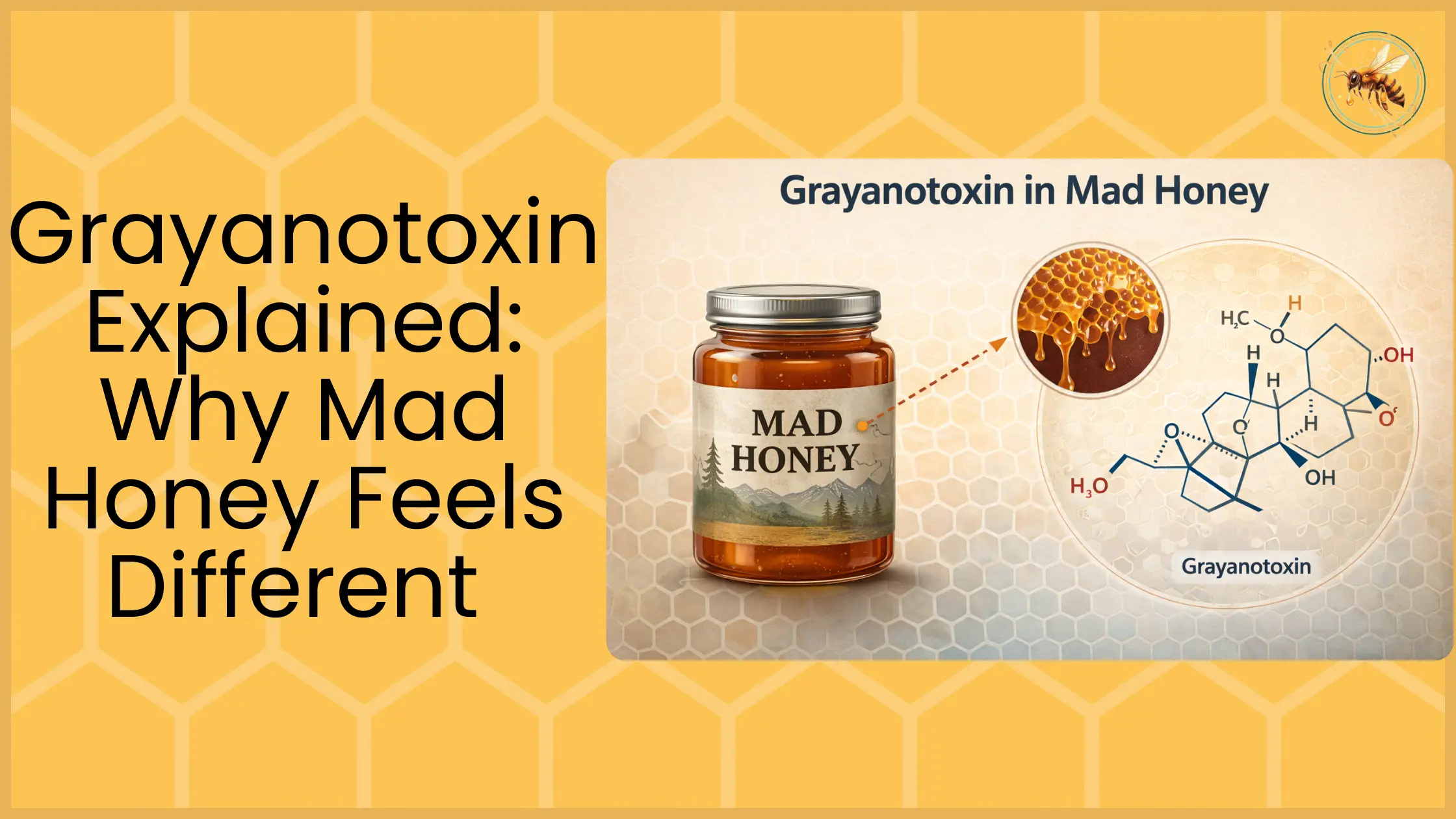
Mad honey rat studies help explain why mad honey should be treated as a biologically active honey rather than a normal sweetener. These studies are not written to make mad honey sound exciting. They are designed to test what grayanotoxin-containing honey, or isolated grayanotoxins, can do inside the body under controlled conditions.
The main lesson from animal research is that mad honey is dose-sensitive. In rats and other laboratory models, grayanotoxins have been linked with cardiovascular effects, behavioral changes, oxidative stress, biochemical changes, and organ-level findings under experimental exposure. These results help scientists understand possible risk patterns, but they do not prove that mad honey is safe for everyday human use or that it has proven benefits for blood pressure, libido, sleep, metabolism, or wellness.
Rat studies are useful because they allow researchers to control the dose, exposure time, route of administration, and measurement endpoints. Human use is messier. Real mad honey varies by batch, grayanotoxin level, origin, season, and serving size. That is why animal findings should be used to support caution, lab testing, and responsible education, not exaggerated consumer claims.
tl;dr
- Rat studies show that mad honey and grayanotoxins are biologically active, especially in the cardiovascular, nervous, oxidative-stress, and organ-safety areas.
- Animal studies do not prove human benefits, human dosage, daily-use safety, aphrodisiac effects, or medical treatment claims.
- Rat research is strongest when used to understand dose response, toxicity mechanisms, affected organs, cardiovascular effects, possible biomarkers, and safety thresholds.
- Whole mad honey studies and isolated grayanotoxin studies are not identical because whole honey contains sugars, phenolics, minerals, and variable toxin profiles.
- The best human interpretation is caution: batch testing, conservative use, clear warnings, and no hype-based marketing.
Quick Answer: What Do Rat Studies Say About Mad Honey?
Rat studies show that mad honey can affect the body in measurable ways. The clearest findings are related to cardiovascular function, behavior, oxidative stress, biochemical markers, and possible tissue-level changes under experimental conditions. But these studies do not give a simple green light for human use.
Rat studies show biological activity
Animal research helps show that grayanotoxins are not just a flavor feature or folklore detail. They can affect heart rate, blood pressure, nerve signaling, behavior, oxidative balance, and organ markers.
Depending on the study design, researchers may measure cardiovascular changes, clinical signs, locomotor behavior, biochemical markers, antioxidant enzymes, ECG changes, tissue structure, or signs of DNA damage. These endpoints are important because they show that mad honey is not an inert food when grayanotoxins are present at meaningful levels.
Rat studies do not prove human benefits
Rat studies do not prove that mad honey is beneficial for humans. They do not prove that it lowers blood pressure safely, improves libido, supports sleep, treats anxiety, improves endurance, or works as a daily wellness product.
A biological effect in a rat is not the same as a safe or useful effect in a human. The dose may be different, the metabolism may be different, and the route of administration may not match real consumer use.
The strongest research use
The strongest use of rat studies is safety science. They help researchers understand dose response, toxicity mechanisms, affected organs, cardiovascular effects, safety thresholds, and possible biomarkers.
In other words, rat studies are most useful for answering the question: what could go wrong, at what exposure, and through what biological pathway?
Why Scientists Study Mad Honey in Rats
Rats are commonly used in toxicology because they allow researchers to study biological effects in a controlled way before human research is considered.
Rats are common toxicology models
Wistar and Sprague-Dawley rats are often used in toxicology, physiology, cardiovascular, reproductive, and behavioral studies. They are large enough for repeated measurement, blood collection, organ examination, and ECG monitoring, while still being practical for controlled laboratory research.
Because rats are well understood as laboratory models, researchers can compare new findings with existing toxicology literature. This makes them useful for studying compounds such as grayanotoxins.
Mad honey is difficult to standardize in humans
Human mad honey research is difficult because real mad honey is naturally variable. One jar may contain a different grayanotoxin profile than another. The concentration can depend on region, season, rhododendron species, nectar mix, harvest timing, and post-harvest handling.
This variability makes uncontrolled human interpretation risky. If two people take the same spoon size from different batches, they may not receive the same grayanotoxin exposure.
Animal models allow controlled exposure
Animal models allow researchers to control dose, timing, route of administration, and endpoints. Researchers can decide exactly how much whole honey or isolated toxin is given, how long the exposure lasts, and what measurements are collected.
This level of control is important for understanding biological patterns. It does not make the results automatically transferable to consumer behavior, but it helps build the safety foundation.
Ethical note
Modern animal studies should follow ethical guidelines, institutional approval, and reporting standards such as ARRIVE where relevant. Animal research is justified only when it is designed carefully, minimizes suffering, and answers questions that cannot be responsibly answered in humans first.
What Compounds Are Rat Studies Really Testing?
Not every animal study tests the same thing. Some studies use whole mad honey. Others use isolated grayanotoxins. That distinction matters.
Mad honey vs isolated grayanotoxins
Whole mad honey studies test the product as a complex natural matrix. The animals receive honey that may contain grayanotoxins along with sugars, phenolic compounds, minerals, organic acids, enzymes, and other plant-derived components.
Isolated grayanotoxin studies test a specific compound, such as GTX I, GTX II, or GTX III. These studies are useful for understanding mechanism and potency, but they do not represent the full complexity of honey.
Why GTX I and GTX III matter most
GTX I and GTX III are often discussed as key toxicologically relevant grayanotoxins. They are frequently measured because they are associated with the biological activity of mad honey and are important for risk interpretation.
GTX III is often treated as especially important in mechanistic and toxicological research because it has shown strong biological effects in animal models.
Why whole honey is more complex
Whole mad honey is not just a purified toxin dissolved in sugar. It contains multiple compounds that can vary by batch. This makes it more realistic as a consumer product, but also harder to interpret scientifically.
If an animal study uses whole honey, researchers must consider both the honey dose and the actual grayanotoxin concentration. A high honey dose with low grayanotoxin content may not be equivalent to a lower honey dose with higher toxin concentration.
Example Rat Study Design: How Mad Honey Is Tested
A typical mad honey rat study uses controlled groups, measured dosing, and repeated observation to detect biological effects.
Experimental animals
One internal study design uses Wistar albino rats, both male and female, 8 to 10 weeks old, weighing 150 to 200 grams, with 48 total animals. This type of design allows researchers to compare treated animals with untreated controls and evaluate dose-related changes.
Using both male and female animals can help identify whether effects differ by sex, although larger studies are usually needed to make strong sex-specific conclusions.
Treatment groups
A basic treatment design includes a control group, a low-dose group, a medium-dose group, and a high-dose group. The control group receives distilled water or a comparable vehicle. The treatment groups receive different mad honey doses.
This structure helps researchers look for dose response. If effects increase from low to medium to high dose, that supports the idea that exposure level matters.
Administration method
In the internal protocol, mad honey is diluted in distilled water and given orally by gavage for 14 consecutive days. Oral gavage means the dose is delivered directly into the stomach using a feeding needle.
This method ensures each animal receives a known dose. That is useful for toxicology, but it does not perfectly match normal human consumption, where people lick honey from a spoon, mix it into tea, take it with food, or consume it at different speeds.
Why oral gavage matters
Oral gavage gives precision, but it can also create a more controlled and artificial exposure than real-world use. It removes some human variables, such as taste, self-limiting behavior, meal timing, and accidental underdosing or overdosing.
That is why gavage studies are valuable for science but should not be turned into direct consumer instructions.
Dose Levels Used in Rat Studies
Rat doses can look high compared with normal human serving sizes. That does not mean they should be copied or directly converted.
Dose groups in the internal protocol
The internal protocol uses 0.5 g/kg, 1.0 g/kg, and 2.0 g/kg mad honey doses over 14 days. These are body-weight-based doses, meaning the amount is adjusted according to each animal’s weight.
A body-weight-based approach is standard in toxicology because it allows researchers to compare exposure across animals of different sizes.
Repeated-dose study examples
Some repeated-dose animal research has used higher exposure models, including examples such as 5 g/kg/day for 60 days or acute, subacute, and chronic designs in male Wistar rats. These designs are often intended to stress the system and reveal toxicity patterns over time.
Repeated-dose studies are especially important because one-time exposure may not show the same effects as ongoing exposure.
Why rat doses sound high
Rat doses often sound high because toxicology studies are designed to identify thresholds, effects, and safety margins. They are not designed to imitate a casual human serving.
Body-weight scaling is also not simple. A rat is not a small human, and g/kg conversion cannot be used casually to create a human dose recommendation.
Cardiovascular Findings in Rat Research
Cardiovascular effects are among the most important findings in grayanotoxin animal research.
Heart rate effects
Animal studies using GTX III have shown dose-dependent and time-dependent heart-rate reduction in rats. Higher exposure can produce stronger or faster changes.
This helps explain why bradycardia, or slow heart rate, is one of the main warning themes in mad honey toxicology.
Blood pressure effects
Grayanotoxin exposure has also been associated with blood-pressure lowering in animal models. When blood pressure drops too much, the result can be weakness, dizziness, faintness, or collapse.
This is one reason mad honey should be avoided by people with low blood pressure, heart conditions, fainting history, or medication that affects cardiovascular function.
ECG monitoring
The internal methodology includes heart rate and ECG tracking, with parameters such as PR interval, QRS duration, and QT interval. ECG monitoring helps researchers detect changes in electrical activity, conduction, and rhythm-related signals.
These measurements are important because grayanotoxins affect electrical signaling in nerves and muscles, including heart tissue.
Human relevance
Rat cardiovascular findings help explain why human safety pages focus heavily on bradycardia, hypotension, fainting, and heart-risk groups. Animal data should not replace human clinical case data, but it supports the biological plausibility of those human symptoms.
Behavioral and Clinical Observation in Rats
Behavioral observation is one of the earliest ways researchers can detect toxicity.
What researchers watch for
Researchers may observe posture, coat condition, locomotor activity, grooming, feeding behavior, tremors, convulsions, salivation, breathing pattern, and mortality. These observations can be recorded at set times or monitored throughout the study.
Behavioral changes can appear before major blood or tissue findings are available.
Why behavior matters
Behavior matters because toxicity is not always visible as a single lab number. A rat that becomes less active, stops grooming, salivates, trembles, eats less, or shows breathing changes may be showing early signs of physiological stress.
In mad honey research, these observations help connect internal biochemical changes with visible whole-body effects.
Oxidative Stress Findings
Oxidative stress research looks at whether exposure shifts the body toward cellular damage or altered antioxidant defense.
Markers commonly measured
Common markers include MDA, SOD, CAT, GSH, NO, HNE, and GSH-Px. These are used to assess lipid damage, antioxidant defense, nitric oxide signaling, and cellular stress patterns.
Different studies may measure different marker combinations depending on the organ, exposure duration, and study question.
What these markers mean
MDA is a marker of lipid peroxidation, meaning it can reflect damage to fats in cell membranes.
SOD, CAT, GSH, and GSH-Px are part of the body’s antioxidant defense system. Changes in these markers can suggest that cells are responding to oxidative pressure.
NO and HNE can be connected to oxidative stress, inflammation, signaling changes, and cellular injury patterns.
Main findings from repeated-dose animal studies
Repeated-dose mad honey exposure has been associated with increased oxidative stress markers and altered antioxidant enzyme activity in animal research. These findings suggest that under experimental exposure, mad honey or grayanotoxins may create measurable cellular stress.
This does not mean occasional low human exposure automatically causes the same pattern. It means the possibility of biological stress is real enough to justify careful study and conservative guidance.
Liver, Kidney, Heart, Brain, and Testes Effects
Organ-level research helps scientists understand where the body may show signs of stress or toxicity.
Organs commonly studied
Animal studies have looked at the liver, kidney, heart, brain, testes, plasma, and erythrocytes. These areas matter because grayanotoxins can affect cardiovascular and nervous-system function, while repeated exposure may influence biochemical and oxidative-stress patterns in organs.
Biochemical testing
Internal methodology includes liver function markers such as ALT, AST, ALP, and bilirubin. It also includes kidney markers such as urea and creatinine, electrolytes such as sodium, potassium, and chloride, and oxidative-stress markers such as MDA, SOD, CAT, and GSH.
These markers help researchers see whether organs are responding normally or showing signs of stress.
Histopathology
Histopathology involves collecting organs, fixing tissue, embedding it, slicing thin sections, staining them with hematoxylin and eosin, and examining them under a microscope. Researchers may score changes such as necrosis, inflammation, degeneration, congestion, or structural disruption.
This is important because blood markers and tissue appearance can tell different parts of the story.
Why organ-level research matters
Organ-level research shows that mad honey science is not only about “effects.” It is also about safety, biological stress, and the difference between a noticeable experience and a harmful exposure.
DNA Damage and Genotoxicity Signals
Some animal studies go beyond organ chemistry and look for cellular or genetic stress signals.
What some animal studies measured
Some models have used comet assays, micronucleus tests, liver detoxification enzymes, and oxidative DNA damage indicators. These methods are used to look for DNA strand breaks, chromosomal damage indicators, detoxification stress, or oxidative injury.
What has been reported
Some acute, subacute, and chronic exposure models have reported oxidative stress, biochemical changes, and DNA-damage indicators. These findings raise important safety questions, especially around repeated or high exposure.
Conservative interpretation
This does not mean occasional human use equals DNA damage. It does mean that repeated high exposure should not be casually framed as harmless. The correct conclusion is caution, better research, and careful exposure modeling.
Rat Studies and Blood Pressure: Why This Matters for Safety
Blood pressure is one of the main bridges between animal research and human safety guidance.
Grayanotoxin and cardiovascular signaling
Grayanotoxins affect voltage-gated sodium channels. In simple terms, these channels help nerve and muscle cells manage electrical activity. When grayanotoxins interfere with normal channel behavior, the effects can influence the autonomic nervous system, heart rate, blood pressure, and body sensation.
Why low blood pressure is central
Rat findings help support why hypotension and bradycardia are major warning themes in human mad honey poisoning. If blood pressure drops or heart rate slows, a person may feel dizzy, weak, sweaty, nauseated, faint, or confused.
These symptoms should not be interpreted as a stronger wellness effect. They are warning signs.
Human safety bridge
Animal studies help explain mechanism. Human clinical cases help guide symptom recognition. The safest public health approach uses both: animal data for biological plausibility and human case reports for real-world presentation.
Rat Studies and Aphrodisiac Claims
Mad honey is often discussed as a traditional aphrodisiac, but rat studies should be interpreted carefully.
Why this topic comes up
Mad honey has been marketed for male vitality and sexual performance in some traditional and modern contexts. Because of that, researchers have explored reproductive hormones and sexual behavior in animal models.
What animal studies can and cannot show
Animal studies can measure hormone levels, reproductive behavior, enzyme activity, or tissue markers. They can suggest possible biological pathways. They cannot prove human sexual benefits.
A change in testosterone or reproductive behavior in rats does not prove that mad honey improves human libido, erections, stamina, or fertility.
Safety-first interpretation
Aphrodisiac claims are less established than cardiovascular and toxicology concerns. The stronger scientific message is not “mad honey improves performance.” The stronger message is “mad honey can affect the body and should be studied carefully.”
Rat Studies and Human Dosage: Why Direct Conversion Is Risky
One of the biggest mistakes is trying to convert a rat study into a simple human dose.
Different species, different metabolism
Rats are not small humans. They have different metabolic rates, body size, digestive physiology, and sensitivity patterns. A dose that produces one effect in rats may not produce the same effect in humans.
Route of administration differs
Studies may use oral gavage, intraperitoneal injection, intravenous dosing, extracts, isolated toxins, or whole honey. These routes are not interchangeable.
An injection study with isolated GTX III cannot be treated the same as eating a spoonful of honey. Oral gavage is closer to ingestion, but still more controlled than normal human use.
Grayanotoxin content varies by batch
Even if a rat dose is controlled, a consumer jar may vary significantly in grayanotoxin concentration. The spoon size tells you the amount of honey, not the exact amount of GTX I or GTX III.
This is why lab testing matters more than folk dosing rules.
Reference Point, MOE, and Risk Interpretation
Animal toxicology can help create a more structured way to think about risk.
What a reference point means
A reference point is a toxicology value used to estimate risk. It is not a recommended serving size. It is a scientific anchor that helps compare exposure levels and safety margins.
Reference points are often derived from animal data or toxicological models, then interpreted with uncertainty factors and human safety considerations.
GTX I + GTX III risk thinking
Internal methodology uses a reference point of 15.3 micrograms per kilogram of body weight for GTX I + GTX III exposure and discusses margin of exposure categories. This type of approach focuses on estimated toxin exposure rather than vague labels like “mild,” “strong,” or “premium.”
Why MOE is more useful than strong or weak claims
Margin of exposure, or MOE, gives a risk framework based on estimated exposure. It helps move the discussion away from marketing language and toward measurable safety thinking.
For consumers, the important message is simple: potency should be measured, not guessed.
What Rat Studies Do Not Prove
Rat studies are valuable, but they have limits.
They do not prove mad honey is safe for daily use
Repeated-dose studies often exist to test toxicity. They should not be interpreted as approval for daily human consumption. If a study gives mad honey repeatedly for days or weeks, the purpose may be to observe what stress appears, not to recommend that pattern.
They do not prove medical benefits
Blood sugar, blood pressure, libido, inflammation, antioxidant, or metabolic findings in animals should not be turned into human treatment claims. A rat result is a starting point for research, not a finished consumer claim.
They do not remove the need for human data
Human clinical research, case reports, pharmacokinetics, standardized products, and controlled exposure studies would still be needed to understand real human safety and possible benefits.
How to Read a Mad Honey Rat Study Without Misunderstanding It
Reading animal studies carefully prevents overclaiming.
Check the model
Look at whether the study used rats or mice, the strain, sex, age, body weight, and health status. A study in male Wistar rats may not answer the same question as a study in female mice or mixed-sex animals.
Check the route
Look at whether the exposure was oral gavage, intraperitoneal injection, intravenous injection, extract, isolated toxin, or whole honey. Route changes interpretation.
Check the dose
Honey dose and actual grayanotoxin dose are different. A study should ideally report the chemical composition of the honey or toxin exposure, not just grams of honey.
Check the exposure duration
Acute exposure, subacute exposure, repeated-dose exposure, and chronic exposure answer different questions. A single-dose cardiovascular study does not answer long-term organ safety. A chronic toxicity study does not automatically describe normal occasional use.
Check the endpoints
Important endpoints include heart rate, blood pressure, ECG, oxidative stress, organ markers, histology, behavior, and mortality. A study that measures only one endpoint cannot answer everything.
Check the conclusion carefully
A significant biological effect does not automatically mean a consumer benefit. It may be a warning sign, a toxicity marker, or an early mechanism signal.
Why These Studies Matter for Mad Honey Brands and Consumers
Rat studies should make the mad honey category more responsible, not more exaggerated.
For consumers
Animal studies explain why conservative dosing, avoiding stacking, respecting high-risk groups, and choosing tested batches matters. They show that mad honey can affect the body in measurable ways.
That should reduce reckless use, not encourage it.
For sellers
Rat studies support the need for lab testing, batch transparency, and non-hype marketing. Sellers should not use animal data to claim medical benefits. They should use it to explain why safety guidance is necessary.
A responsible seller should know the difference between education and overclaiming.
For researchers
Animal studies show where better research is needed: oral human pharmacokinetics, batch-standardized honey, dose-response thresholds, vulnerable populations, long-term safety, reproductive safety, and realistic consumer exposure.
Rat studies should support education, not exaggerated marketing claims.
Conclusion
Mad honey rat studies show that grayanotoxin-containing honey is biologically active and dose-sensitive. The clearest findings are related to cardiovascular effects, oxidative stress, biochemical changes, behavioral changes, and possible organ-level toxicity under experimental exposure.
The human interpretation should be careful. Rat studies should not be used to claim proven benefits, exact human dosing, daily-use safety, or reliable aphrodisiac effects. They should support caution, lab testing, standardized batches, and responsible consumer education.
The safest conclusion is not that mad honey is “good” or “bad.” It is that mad honey is biologically active, variable, and deserving of serious safety standards. Any brand, buyer, or researcher discussing mad honey should treat animal data as a reason to be more precise, not more promotional.
FAQs: Mad Honey Rat Studies
Why is mad honey tested on rats?
Mad honey is tested on rats because rats are common toxicology models. They allow researchers to control dose, timing, exposure route, and endpoints such as heart rate, blood markers, organ effects, and behavior.
What do rat studies say about grayanotoxins?
Rat studies show that grayanotoxins can affect cardiovascular signaling, nervous-system function, behavior, oxidative stress, and organ-level markers under experimental exposure.
Does mad honey lower heart rate in rats?
Animal studies with grayanotoxins, especially GTX III, have shown dose-dependent and time-dependent heart-rate reduction in rats.
Does mad honey affect blood pressure in rats?
Grayanotoxin exposure has been associated with blood-pressure lowering in animal models, which supports why hypotension is a major safety concern in human mad honey intoxication.
Do rat studies prove mad honey is safe for humans?
No. Rat studies do not prove human safety. They help identify biological effects and possible risks, but human data and standardized products are still needed.
Can rat studies tell us the right human dose?
No. Rat doses cannot be directly converted into human serving instructions. Species differences, administration route, and batch variability make direct conversion risky.
What organs are affected in mad honey animal studies?
Animal studies have examined liver, kidney, heart, brain, testes, plasma, and erythrocytes, depending on the study design and endpoints.
What is oxidative stress in mad honey studies?
Oxidative stress refers to an imbalance between damaging reactive molecules and antioxidant defenses. Studies often measure markers such as MDA, SOD, CAT, GSH, NO, HNE, and GSH-Px.
Do rat studies prove mad honey is an aphrodisiac?
No. Animal hormone or reproductive-behavior findings do not prove human aphrodisiac effects. They only suggest areas for further research.
Why do some studies use pure GTX instead of whole honey?
Pure GTX studies help isolate the effect of a specific grayanotoxin. Whole honey studies are more realistic but more complex because honey contains many compounds and variable toxin levels.
What is the difference between acute, subacute, and chronic exposure?
Acute exposure usually means a short or single exposure. Subacute exposure means repeated exposure over a limited period, such as days or weeks. Chronic exposure means longer-term repeated exposure. Each design answers a different safety question.