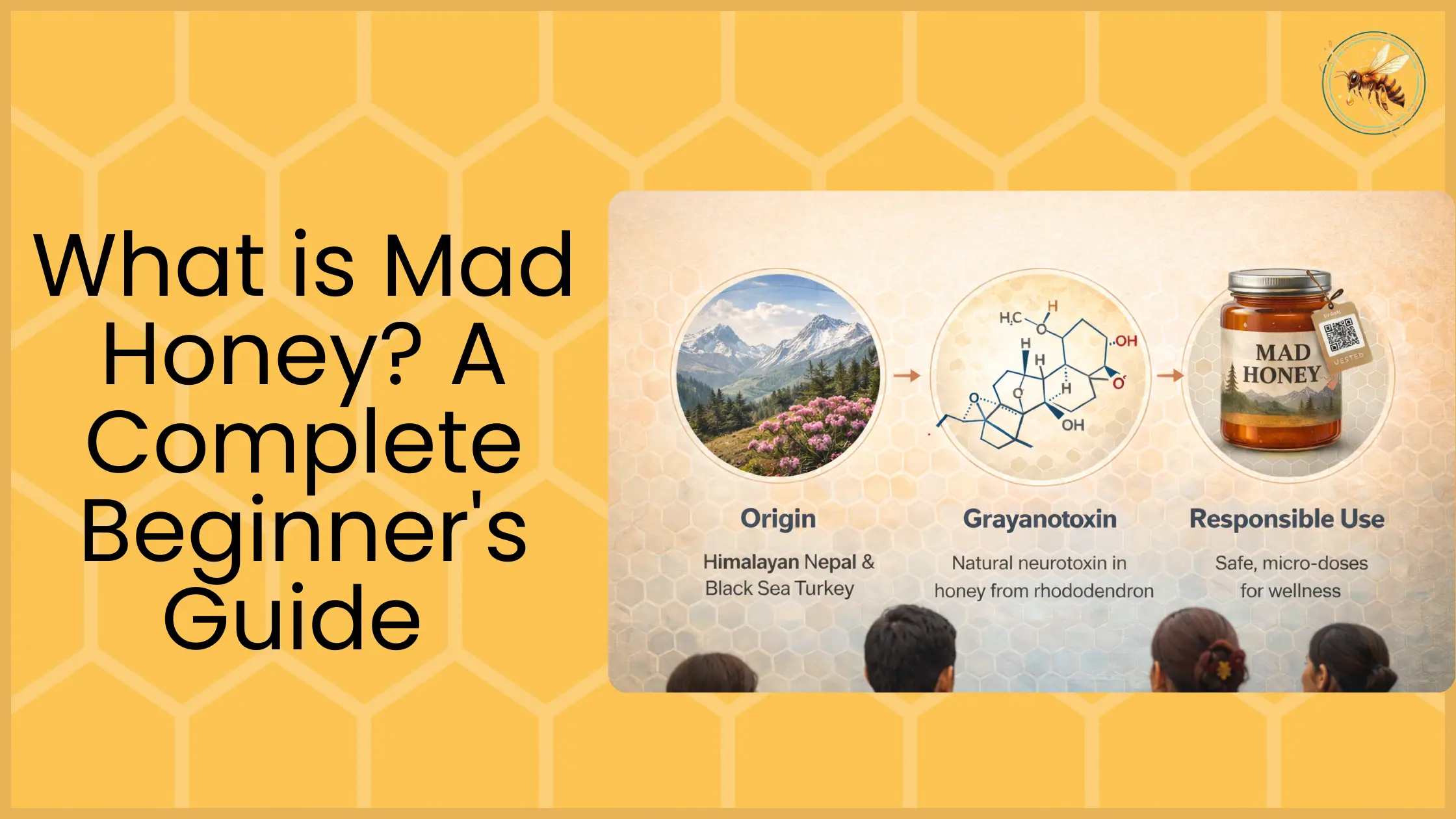
Mad honey has a long reputation as a traditional aphrodisiac, especially in regions where it has been used for generations, such as Turkey and parts of Nepal. People often associate it with warmth, vitality, body sensation, confidence, and male sexual performance. That reputation is part of mad honey’s cultural history, but it also needs careful explanation because traditional use is not the same as proven medical benefit.
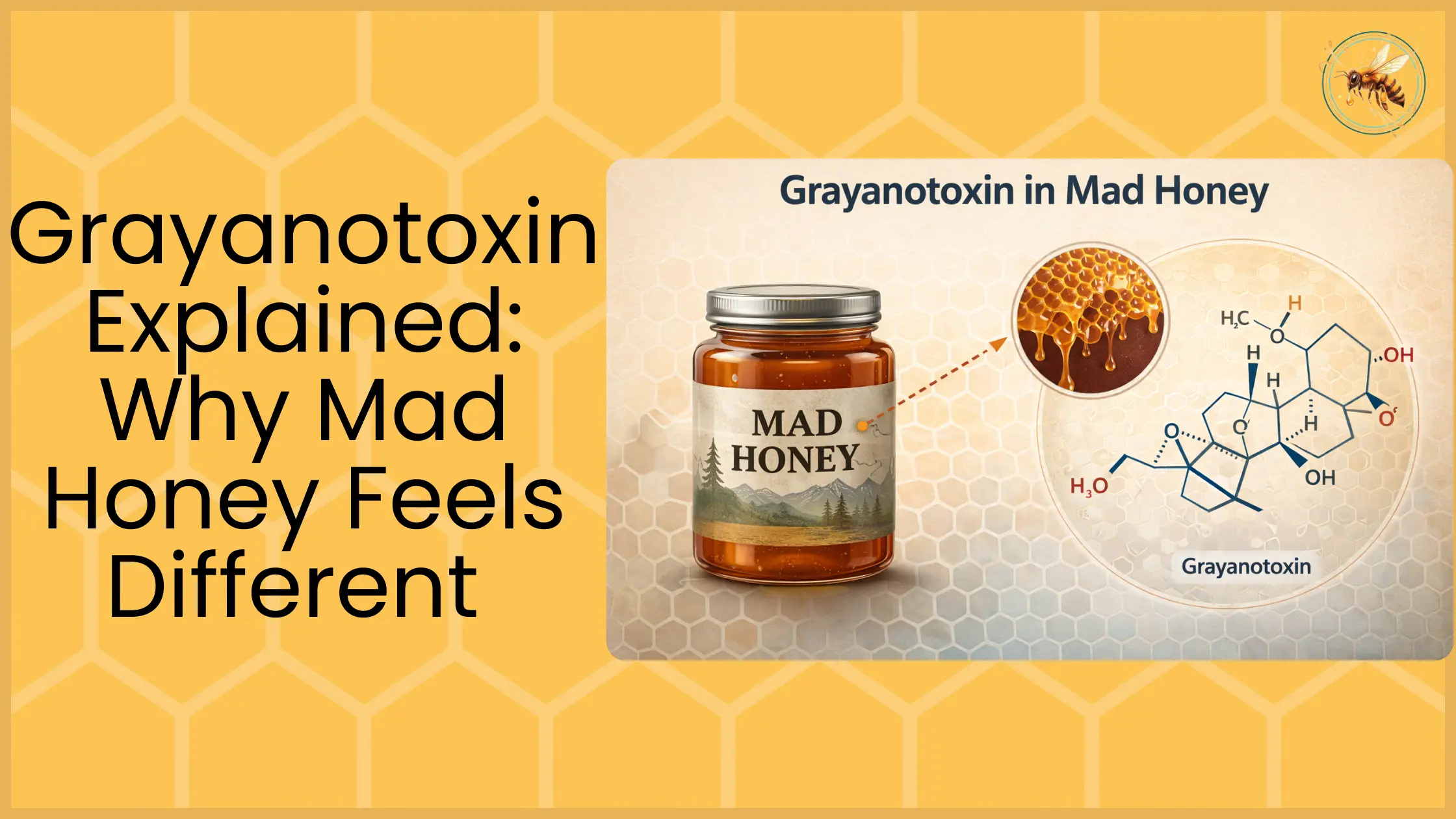
The main reason mad honey is different from regular honey is that it can contain grayanotoxins. These natural compounds come from certain rhododendron nectar sources and can affect nerve signaling, blood pressure, heart rate, and body sensation. That same biological activity is why mad honey has attracted interest as a traditional sexual stimulant, but it is also why the product can become risky when taken casually or in large amounts.
The most balanced answer is simple: mad honey is traditionally associated with sexual vitality, but human clinical evidence is still limited, and the cardiovascular risks are much better documented than the aphrodisiac benefits. It should not be treated like a guaranteed sexual-performance product, an erectile dysfunction treatment, or a “natural Viagra.”
tl;dr
- Mad honey has a real traditional reputation as an aphrodisiac, especially in Turkey and Nepal, but that reputation is not the same as proven clinical evidence.
- Current evidence includes traditional use, toxicology knowledge, clinical observations, and animal research, but there is not enough human research to claim that mad honey reliably improves libido, erections, or sexual performance.
- The same grayanotoxins linked to mad honey’s body effects are also linked to dizziness, nausea, low blood pressure, slow heart rate, weakness, and fainting risk.
- Mad honey should not be used to self-treat erectile dysfunction or diagnosed sexual dysfunction.
- Avoid “aphrodisiac honey” products that promise instant erections, guaranteed sexual power, or “natural Viagra” effects, especially if they do not provide transparent ingredients, batch information, and safety warnings.
Quick Answer: Is Mad Honey an Aphrodisiac?
Mad honey is traditionally used as an aphrodisiac, but it is not a proven sexual-performance treatment. Its reputation comes from folk use, body sensations, reported warmth, and possible cardiovascular or nervous-system effects. However, the science is still not strong enough to say that mad honey reliably increases libido, improves erections, boosts testosterone in humans, or treats erectile dysfunction.
Traditional answer
Traditionally, mad honey has been used as a sexual stimulant in regions where the honey is locally known and culturally familiar. In Turkey, deli bal has long been associated with male vitality and sexual performance. In Nepal, mad honey is more often discussed through the lens of mountain harvest, vitality, warmth, and traditional use.
This traditional reputation matters because it explains why the aphrodisiac claim exists in the first place. It is not a random internet invention. People have connected mad honey with sexual vitality for a long time.
Scientific answer
Scientifically, the aphrodisiac claim remains unproven in humans. Reviews and case discussions mention traditional use for sexual dysfunction or as a sexual stimulant, but those references do not equal human clinical proof.
The most relevant research includes toxicology reviews, case reports, mechanism studies, and animal research. Some animal studies suggest possible effects on androgen-related parameters, but animal findings cannot be directly translated into human sexual performance claims.
Safety answer
Mad honey should not be treated like a casual bedroom supplement. It can affect blood pressure and heart rate, and those effects can become uncomfortable or dangerous. A product that can make someone dizzy, nauseated, weak, faint, or bradycardic should not be marketed like a harmless libido booster.
The best one-sentence takeaway is this: mad honey is traditionally used as an aphrodisiac, but the evidence is still limited and the safety risks are real.
Why People Associate Mad Honey With Sexual Performance
The aphrodisiac reputation did not appear out of nowhere. It likely developed from a combination of traditional use, noticeable body sensations, and the way mad honey can change how people feel physically.
Traditional use in Turkey and Nepal
In Turkey, mad honey has a long history as deli bal, a regional honey linked to vitality, warmth, and sexual performance. In Nepal, mad honey is more often connected to wild Himalayan harvesting and traditional mountain use, but it is also sometimes framed as a vitality product.
In both contexts, the language around mad honey is usually broad. People may describe it as warming, energizing, relaxing, strengthening, or stimulating. These traditional descriptions can overlap with how people talk about aphrodisiacs.
Middle-aged male use and global demand
Aphrodisiac positioning is one reason mad honey became known outside its local regions. Many buyers searching for mad honey are not only curious about the “mad” effect. Some are looking for a natural product connected to male vitality, confidence, libido, or sexual performance.
This demand creates a problem. When people buy a product for performance reasons, they may be more likely to take too much, combine it with alcohol, or mix it with erectile dysfunction medication. That is exactly where the risk increases.
Warmth, blood flow, and body sensation
Many aphrodisiac traditions are built around body sensation. If a product creates warmth, heaviness, relaxation, flushing, or a change in perceived blood flow, people may interpret that as sexual support.
Mad honey can also affect blood pressure. Some users may feel warmth or relaxation, while others may feel lightheaded or weak. These are very different outcomes, and they can be easy to confuse if the person expects a sexual effect.
Avoid medical claims
The safest language is “traditionally used” or “traditionally associated with sexual vitality.” It is not accurate to say that mad honey treats erectile dysfunction, cures sexual dysfunction, or reliably improves sexual performance.
What Does “Aphrodisiac” Actually Mean?
The word “aphrodisiac” is often used too loosely. Before evaluating mad honey, it helps to separate the different things people may mean.
Libido vs performance vs erection support
Libido means sexual desire. Arousal means the body and mind becoming sexually responsive. Performance may refer to endurance, confidence, erection quality, or the ability to stay relaxed. Erection support is more specific and is often connected to blood flow, cardiovascular health, hormones, nerves, and psychological factors.
These are not the same thing. A product that makes someone feel relaxed does not automatically improve erection quality. A product that affects blood pressure does not automatically improve sexual function. A product that influences hormones in rats does not automatically increase libido in humans.
Why online claims blur these categories
Many sellers use “aphrodisiac” as a catch-all word because it sounds attractive and vague. It can imply libido, erections, stamina, confidence, and testosterone without proving any of them.
This is especially common in the honey category, where “royal honey,” “honey packets,” and male enhancement products are often promoted with aggressive claims. Mad honey can get pulled into the same search space, even though it is a different product.
Why this matters for mad honey
A person searching for libido support may have a completely different need than someone searching for erectile dysfunction treatment. Someone with diagnosed ED, heart disease, low blood pressure, or medication use should not use mad honey as a substitute for medical care.
What Science Says So Far
The science around mad honey and sexual performance is still early. The strongest evidence is not that mad honey is a proven aphrodisiac. The strongest evidence is that mad honey contains bioactive compounds that can affect the body, sometimes in risky ways.
Traditional and clinical literature
Scientific reviews often mention that mad honey has been traditionally used as a sexual stimulant or for sexual dysfunction. This supports the existence of the traditional claim, but it does not prove the effect.
Clinical literature is much stronger on intoxication patterns than aphrodisiac benefits. Case reports commonly focus on dizziness, nausea, low blood pressure, slow heart rate, fainting, and recovery after supportive care.
2026 rat study on reproductive hormones and behavior
A 2026 male rat study explored mad honey’s effects on reproductive hormones and sexual behavior. The study involved sexually experienced male rats and compared mad honey with control conditions. Researchers measured testosterone, follicle-stimulating hormone, luteinizing hormone, 5-alpha-reductase, and sexual behavior parameters.
The findings suggested changes in serum testosterone and 5-alpha-reductase, while some other hormone measures and behavioral outcomes were not globally or consistently improved. In simple terms, the study suggests that mad honey may influence some androgen-related biological markers in rats, but it does not prove that mad honey reliably improves sexual performance.
The cautious interpretation is important. A signal in rats is not the same as a proven human benefit. Dose, metabolism, species differences, study design, and safety margins all matter.
Why animal research does not prove human benefits
Animal research can help identify possible mechanisms, but it cannot be used as a direct marketing claim for human sexual performance. Rats are not humans. Hormonal changes in a controlled animal study do not automatically translate into better libido, stronger erections, improved stamina, or safer use in people.
For human claims, controlled human studies would be needed. Until then, the aphrodisiac claim should remain in the category of traditional use and early scientific interest, not proven treatment.
Possible Mechanisms People Talk About
Several mechanisms are often discussed when people try to explain mad honey’s aphrodisiac reputation. These mechanisms are plausible areas of interest, but they should not be presented as proof.
Grayanotoxins and nervous-system effects
Grayanotoxins affect voltage-gated sodium channels. These channels help regulate electrical signaling in nerves and muscles. When grayanotoxins interfere with normal channel behavior, they can change body sensation, autonomic activity, heart rate, and blood pressure.
This may help explain why mad honey can feel noticeable even at relatively small amounts. But noticeable does not always mean beneficial. The same mechanism that creates body effects can also create toxicity.
Vasodilation and blood-pressure effects
Mad honey has traditionally been associated with blood-pressure effects. Some people connect this with warmth, circulation, or sexual performance. The problem is that lowering blood pressure is not automatically helpful. If blood pressure drops too much, the result can be dizziness, weakness, fainting, nausea, or danger.
For sexual performance, stable cardiovascular function matters. A product that may lower blood pressure unpredictably should be approached carefully, especially by anyone taking blood-pressure medication or erectile dysfunction medication.
Parasympathetic effects and relaxation
Some users may interpret calm, heaviness, warmth, or reduced tension as supportive of intimacy. Relaxation can matter for sexual confidence, especially when stress or anxiety plays a role.
But this does not make mad honey a reliable anxiety or sexual-performance product. If the amount is too high, relaxation can quickly become weakness, dizziness, nausea, or faintness.
Testosterone and androgen pathways
Animal data suggests possible modulation of circulating androgen-related parameters, including testosterone and 5-alpha-reductase in specific experimental settings. This is scientifically interesting, but the human significance remains uncertain.
It would be misleading to claim that mad honey “boosts testosterone” in men based on current evidence. The better wording is that early animal research has explored androgen-related effects, but human clinical relevance is not established.
Mechanism does not equal recommendation
A plausible mechanism is not the same as safe or proven use. Many substances have measurable biological effects, but that does not mean they are appropriate, reliable, or safe for sexual performance.
Why the Aphrodisiac Claim Can Be Misleading
The aphrodisiac claim becomes risky when it encourages people to take more, ignore warning signs, or combine mad honey with other products.
“More” does not mean better
With mad honey, a larger amount can quickly shift from subtle body effects to unpleasant or dangerous symptoms. The problem is not only intensity. The problem is direction. More mad honey may not mean more desire or better performance. It may mean dizziness, nausea, sweating, weakness, low blood pressure, slow heart rate, or fainting.
This is why mad honey does not fit the usual “take more for stronger results” mindset.
Sexual-performance anxiety can encourage risky dosing
People who feel pressure to perform may take more than intended because they want a stronger or faster effect. This is a bad match for mad honey because delayed onset and batch variability can make overuse more likely.
A person may take a small amount, feel nothing immediately, then take more. If the batch is strong or the person is sensitive, symptoms can build later.
Batch variability makes results unpredictable
Mad honey is not standardized by default. The same spoon size can contain different grayanotoxin exposure depending on region, season, rhododendron source, harvest conditions, and batch handling.
That means someone’s experience with one jar does not guarantee the same experience with another jar.
Strong safety line
Mad honey should not be used to self-treat erectile dysfunction or diagnosed sexual dysfunction. ED can be connected to cardiovascular disease, diabetes, medication effects, hormones, psychological stress, or other medical issues. It deserves proper medical guidance.
Mad Honey vs “Royal Honey” and Honey Packets
Mad honey is often confused with other honey-based sexual enhancement products. This confusion is important for both SEO and safety.
They are not the same product
Real mad honey is rhododendron-linked honey that may contain grayanotoxins. “Royal honey,” “honey packets,” and male enhancement honey products may be completely unrelated. Some are marketed as sexual supplements and may contain herbs, sweeteners, royal jelly, flavorings, or hidden pharmaceutical ingredients.
A person searching “aphrodisiac honey” may actually be looking for honey packets, not mad honey.
Hidden drug ingredient problem
Regulators have found honey-based sexual enhancement products containing undeclared sildenafil or tadalafil, the active ingredients in Viagra and Cialis. This is a major safety issue because consumers may think they are taking a natural product while unknowingly taking a prescription drug.
This is especially dangerous for people taking nitrates, certain heart medications, or blood-pressure medication because the combination can cause a dangerous drop in blood pressure.
Why this matters for SEO and safety
Mad honey content should clearly separate real mad honey from honey packets. Otherwise, readers may assume all aphrodisiac honey products are the same. They are not.
Buyer warning
Avoid any honey product promising guaranteed sexual performance, instant erection effects, “natural Viagra” results, or no side effects. These are red flags, not trust signals.
Safety Risks: The Part Most Aphrodisiac Articles Ignore
Most aphrodisiac articles focus on desire and performance. Mad honey needs a different approach because the safety risks are real and biologically connected to the same compounds people are curious about.
Cardiovascular risks
The most important risks involve the cardiovascular system. Mad honey can be associated with hypotension, which means low blood pressure, and bradycardia, which means slow heart rate. Symptoms may include dizziness, weakness, sweating, nausea, faintness, confusion, or feeling suddenly “wiped out.”
These effects are especially concerning during sexual activity because physical exertion, dehydration, alcohol, stress, or medication can add more strain.
Medication interaction concerns
Mad honey should be approached very cautiously by anyone taking medication that affects blood pressure, heart rhythm, sedation, anxiety, or sexual performance. The most important categories include nitrates, blood-pressure medication, heart medication, erectile dysfunction medication, sedatives, sleep aids, anxiety medication, and alcohol.
This does not mean every interaction is fully studied. It means the risk logic is strong enough to be conservative.
Why ED medication overlap is especially important
Sildenafil and tadalafil can affect blood pressure. Nitrates can also lower blood pressure. Mad honey may also influence blood pressure and heart rate. Combining these without medical guidance is not a responsible experiment.
A person using Viagra, Cialis, nitrates, or heart medication should not casually add mad honey for sexual performance.
Who Should Not Use Mad Honey for Aphrodisiac Purposes
Some people should avoid mad honey entirely, especially when the motivation is sexual performance.
People with low blood pressure
Mad honey may lower blood pressure further. People who already feel dizzy when standing, have low baseline blood pressure, or have a fainting tendency should avoid it.
People with heart conditions or arrhythmia history
Because grayanotoxin exposure can involve heart-rate and rhythm concerns, people with heart disease, arrhythmias, bradycardia, fainting history, or unexplained chest symptoms should avoid mad honey unless medically cleared.
People taking BP, heart, nitrate, ED, anxiety, sleep, or sedative medication
Medication users should be especially cautious. Blood-pressure medications, heart rhythm drugs, nitrates, erectile dysfunction medications, sedatives, sleep aids, anxiety medication, and alcohol can all complicate the risk picture.
Pregnant or breastfeeding women and children
Mad honey is not suitable for pregnant or breastfeeding women or children. The risk-to-benefit logic does not support use in these groups.
People trying to “perform” under alcohol
Alcohol plus mad honey is a poor combination. Alcohol can increase dizziness, nausea, dehydration, impaired judgment, and fall risk. It can also make it harder to notice early warning signs.
How to Discuss Dosage Without Encouraging Risk
An aphrodisiac article should not give a “sexual performance dose.” That framing encourages misuse.
Do not give a sexual-performance dose
There is no validated aphrodisiac dosage for mad honey. Any seller or article claiming a specific dose for erections, libido, or sexual stamina is overreaching.
Link to the safety dosage guide
If dosage is discussed, it should be discussed as general safety guidance, not sexual-use instruction. Readers should be directed to a dedicated dosage guide that explains conservative use, batch variability, waiting time, and high-risk groups.
Emphasize start-low, wait, don’t stack
The safest frame is consistent: start low, wait long enough, do not stack with alcohol or other substances, and do not re-dose quickly. This is not about chasing an effect. It is about avoiding a bad experience.
What Users Might Actually Feel
Mad honey experiences vary. Some people report subtle effects, while others may feel uncomfortable symptoms, especially if the amount is too high or the batch is strong.
Low-dose reports
At low amounts, some users report warmth, calm, light body sensation, relaxation, or mild euphoria. Others may feel little or nothing. These reports are subjective and should not be treated as guaranteed outcomes.
In an intimacy context, some people may interpret calm or warmth as supportive. That does not make it a proven aphrodisiac.
Too much
Too much mad honey can cause dizziness, nausea, sweating, weakness, low blood pressure, slow heart rate, faintness, and confusion. These are not signs that the product is “working better.” They are warning signs.
Important distinction
Feeling faint, dizzy, overwhelmed, weak, or nauseated is not an aphrodisiac effect. It is a safety warning. Stop taking more and seek medical help if symptoms are severe, persistent, or worsening.
Traditional Aphrodisiac Claim vs Modern Wellness Framing
Mad honey’s traditional aphrodisiac reputation should be acknowledged, but it should not be exaggerated into a medical claim.
Traditional claim
Traditionally, mad honey has been associated with libido, sexual warmth, male vitality, and performance. This cultural association is real and historically relevant.
Modern responsible framing
A responsible modern framing is different. Mad honey should be positioned as a rare, bioactive honey with cultural history and possible body effects. It should not be positioned as a sexual-performance treatment, testosterone booster, ED cure, or pharmaceutical alternative.
Why this protects trust
Overclaiming turns a nuanced traditional product into a risky ED-style supplement. It also attracts the wrong buyer mindset: people chasing guaranteed performance rather than people trying to understand a traditional honey responsibly.
Suggested wording
Use “traditionally associated with sexual vitality” instead of “boosts testosterone,” “treats ED,” or “works like Viagra.”
Authenticity and Buying Red Flags
Aphrodisiac marketing is one of the highest-risk areas in the honey category because exaggerated claims are common.
Red flags in aphrodisiac marketing
Avoid products or sellers using claims like “natural Viagra,” “guaranteed erection,” “instant sexual power,” “no side effects,” “strongest honey,” or “works every time.” Also avoid products with hidden ingredients, no batch information, no origin detail, no safety warnings, or no contact information.
If a seller is making medical-style promises but cannot explain sourcing, batch identity, or safety guidance, that is a serious red flag.
What responsible mad honey sellers provide
Responsible sellers provide origin information, harvest or batch details, conservative use guidance, safety warnings, and lab reports or COAs where possible. They do not promise disease treatment, ED treatment, guaranteed arousal, or guaranteed sexual performance.
Good sellers reduce risk instead of using risk as a marketing hook.
Conclusion
Mad honey’s aphrodisiac reputation is real as a traditional claim. In Turkey and Nepal, it has been associated with vitality, warmth, libido, and sexual performance for a long time. But traditional reputation is not the same as proven human clinical benefit.
The scientific evidence is still limited. Animal research has explored reproductive hormones and sexual behavior, and reviews mention traditional use as a sexual stimulant, but there is not enough human evidence to claim that mad honey reliably improves libido, erections, testosterone, or sexual performance.
The safety picture is clearer. Mad honey can affect blood pressure, heart rate, and body sensation. Too much can cause dizziness, nausea, sweating, weakness, faintness, hypotension, and bradycardia. Those risks matter more than the hype.
The safest takeaway is this: mad honey can be discussed as a traditional aphrodisiac, but it should be framed with caution, transparency, and realistic expectations. Avoid “natural Viagra” style products, avoid guaranteed sexual-performance claims, and treat mad honey as a dose-sensitive bioactive honey, not a casual bedroom supplement.
FAQs: Mad Honey Aphrodisiac
Is mad honey really an aphrodisiac?
Mad honey is traditionally used and marketed as an aphrodisiac in some regions, especially Turkey. However, human clinical evidence is limited, so it should not be treated as a proven sexual-performance product.
Does mad honey increase libido?
There is no strong human evidence proving that mad honey reliably increases libido. Some users may report warmth, calm, or body sensation, but that is not the same as a proven libido effect.
Does mad honey increase testosterone?
Animal research has explored testosterone and androgen-related markers, but this does not prove that mad honey increases testosterone in humans. Claims like “boosts testosterone” are too strong based on current evidence.
Can mad honey help erectile dysfunction?
Mad honey should not be used to self-treat erectile dysfunction. ED can be connected to cardiovascular, hormonal, psychological, or medication-related issues and should be discussed with a healthcare professional.
Is there a proven aphrodisiac dose?
No. There is no validated mad honey dose for libido, erections, or sexual performance. Any article or seller giving a “sexual performance dose” is overclaiming.
Is mad honey safe with Viagra or Cialis?
Do not casually combine mad honey with sildenafil, tadalafil, or similar ED medication. The overlap with blood-pressure effects can be risky, especially without medical guidance.
Is mad honey safe with blood pressure medication?
People taking blood-pressure medication should avoid mad honey unless medically cleared. Mad honey may affect blood pressure and heart rate.
Why is mad honey marketed for men?
Mad honey is often marketed to men because of its traditional reputation around male vitality, sexual confidence, and performance. This marketing often exaggerates what the evidence can support.
Is “royal honey” the same as mad honey?
No. Real mad honey is rhododendron-linked honey that may contain grayanotoxins. Royal honey or honey packets marketed for sexual enhancement may be unrelated and may carry different risks, including hidden drug ingredients.
What are the risks of aphrodisiac honey products?
The risks include hidden pharmaceutical ingredients, exaggerated claims, medication interactions, blood-pressure problems, dizziness, nausea, fainting, and lack of batch transparency.
What should I do if I feel dizzy after taking mad honey?
Stop taking more, sit or lie down, avoid alcohol or other substances, and seek medical help if symptoms are severe, persistent, or include fainting, chest pain, trouble breathing, confusion, repeated vomiting, or a very slow pulse sensation.