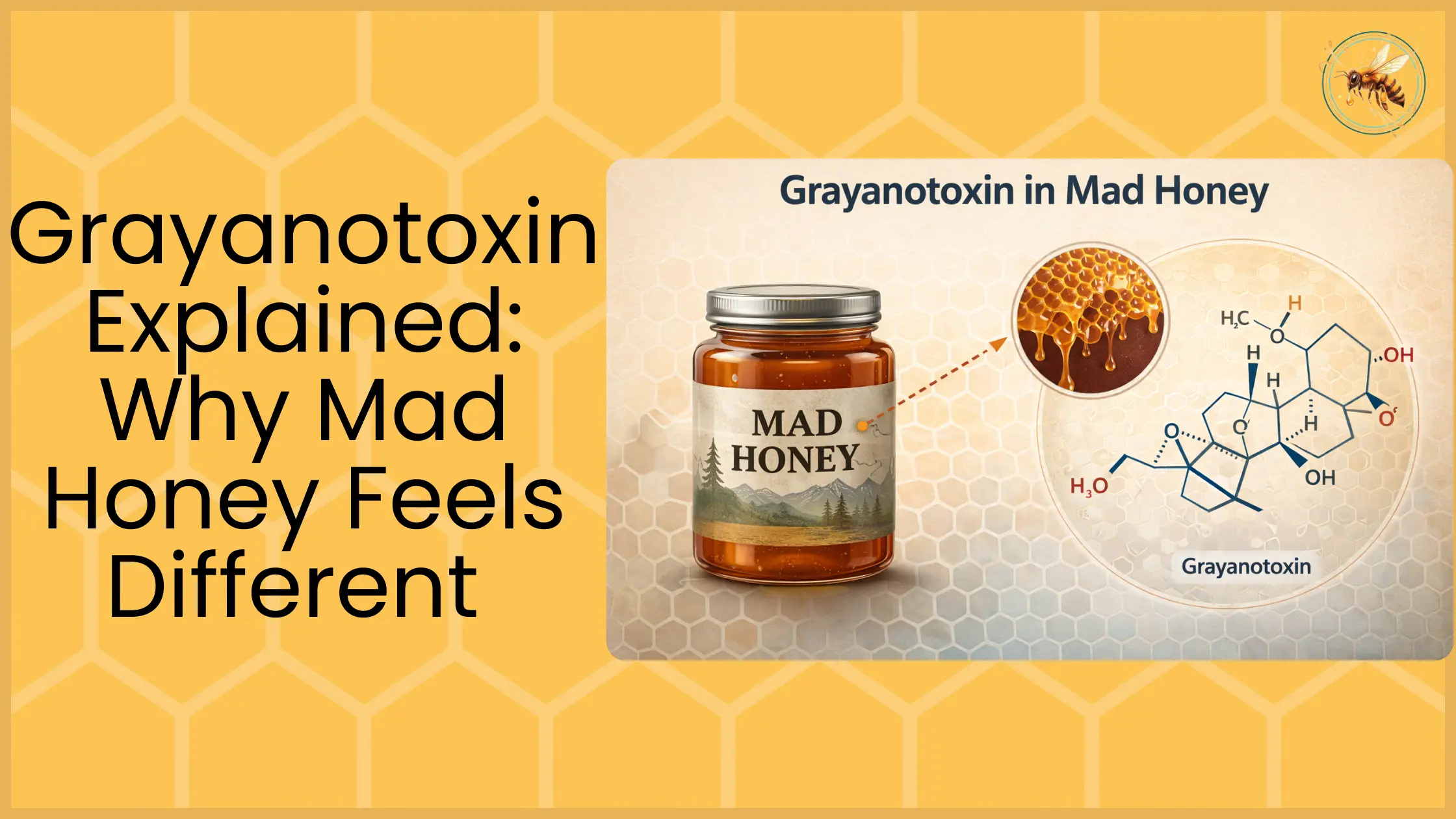
Mad honey is often talked about online as if it’s just “strong honey.” In reality, it behaves differently from regular honey because some authentic batches can contain grayanotoxins, naturally occurring compoundsis this safe linked to certain rhododendron flowers.
Those compounds are associated with a very specific pattern of effects: what starts as a mellow, body-forward “wind-down” for some people can become intoxication-like if the amount is too high or the person is sensitive.
This page is built for real-world use, not hype. People typically land here for one of two reasons:
- They want to understand what mad honey effects normally feel like, so they don’t overreact.
- They already took some and are thinking, “Is this normal… or did I take too much?”
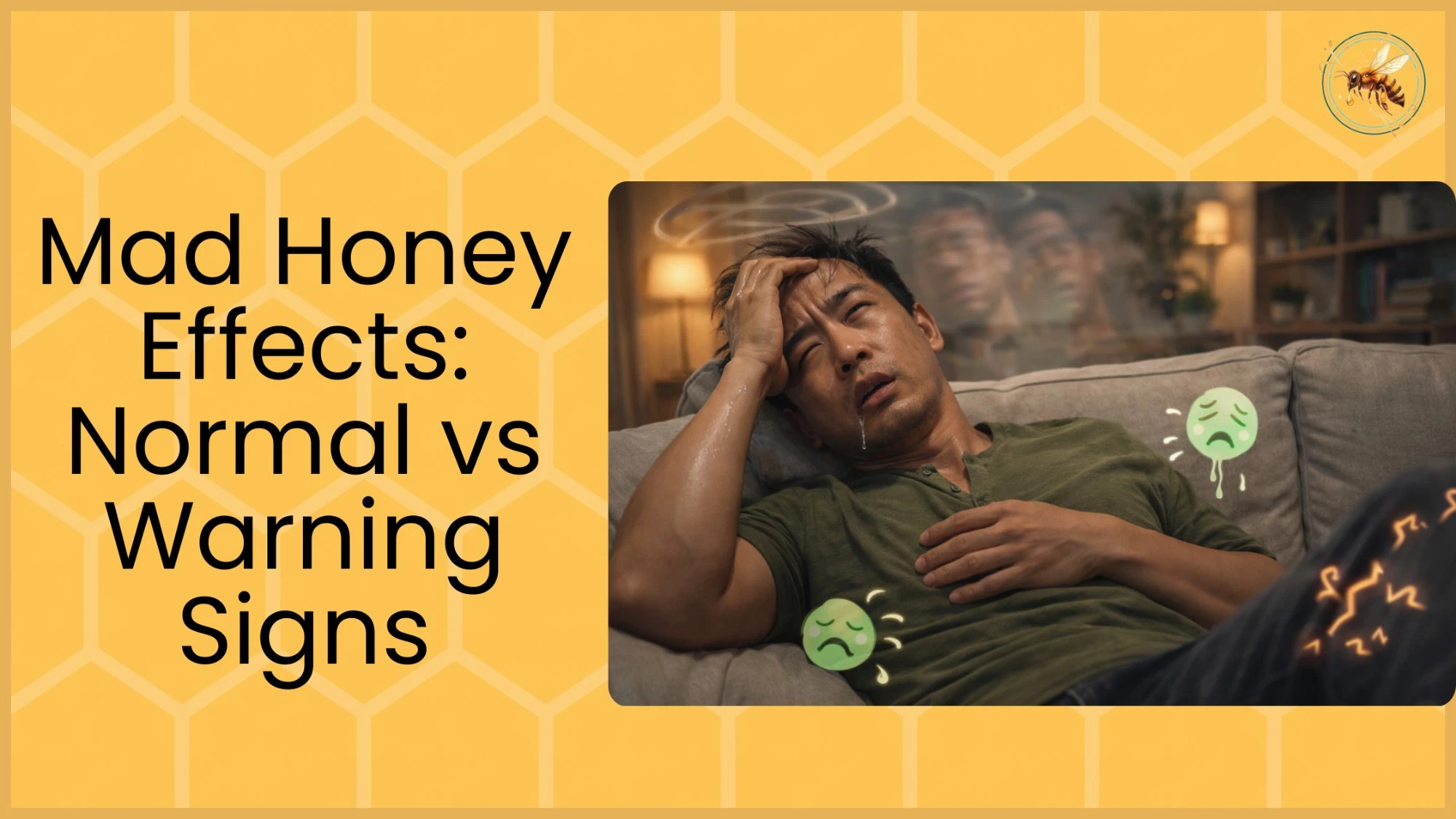
The key theme is control. “Normal” effects should still feel manageable and stable. If you feel like your body is becoming unstable, especially with strong dizziness, sweating, weakness, or faintness, treat that as a warning sign.
Clinical/toxicology summaries of mad honey intoxication commonly describe symptoms including dizziness, nausea/vomiting, sweating, weakness, and cardiovascular effects such as hypotension (low blood pressure) and bradycardia (slow heart rate) in stronger reactions.
tl;dr
- After taking Mad Honey, a gentle calm, heaviness, or mild relaxation can be normal for some people. If symptoms are worsening, you feel faint, or you’re struggling to stand or think clearly, you’re no longer in the “normal” lane.
- The most common “took too much” pattern is body-first: nausea + dizziness + weakness.
And stronger reactions often involve nausea/vomiting, dizziness, sweating, and weakness. - Effects have been reported from ~20 minutes up to 4 hours after ingestion of Mad Honey. Re-dosing because “nothing is happening” is how people accidentally stack into an uncomfortable zone.
- Batch variability (season/region/processing) and personal sensitivity (food, hydration, baseline BP, meds) explain why two people can take the same amount and report completely different outcomes.
- Chest pain, fainting, severe weakness/confusion, very slow pulse sensations, or persistent vomiting should be treated seriously. In severe cases, medical support may be needed.
Common Mad Honey Effects (Mild to Moderate)
This section covers effects that people commonly report when they’re in the mild-to-moderate range. It’s important to read this with the right mindset:
- “Common” does not mean “safe for everyone.”
- “Common” does not mean “what you should chase.”
It means: these are the experiences people most often describe before things cross into discomfort.
Here are some common benefits and risks that have mostly been reported after they’ve consumed mad honey
1) A calm, heavy wind-down
This is the classic “ritual” effect people talk about. It’s not usually a sharp jolt. It tends to feel like a slow exhale: your body feels heavier, your pace drops, and you feel less “wired.” Some people describe it as a quieting of physical tension.
Also Read: Mad Honey vs Kava: What’s Different and Which One Should You Choose?
2) Warmth or a gentle body buzz
Some people notice warmth in the chest or limbs, or a mild “body buzz.” It’s typically described as physical rather than mental. Think: “I feel it in my body,” not “my mind is altered.” These warming, relaxing effects also feed mad honey’s traditional reputation as an aphrodisiac.
3) Mild sleepiness/slowed energy
Because mad honey is often associated with parasympathetic-style “settling,” some people get sleepy. This can feel pleasant in the right setting, but it’s also a sign you shouldn’t combine it with alcohol or sedatives.
4) Mild nausea or stomach unease
This matters because nausea can be a fork in the road. Mild nausea can be “part of the experience” for some, but it can also be an early warning that you’re heading toward “too much.” If nausea appears, the safest move is always: stop there and do not take more.
5) Lightheadedness (especially when standing up quickly)
Some people experience mild lightheadedness. If it’s mild and resolves quickly with rest/hydration, it may not be alarming. But if it’s intense, worsening, or paired with sweating/weakness, treat it as a warning sign.
A useful rule: “Normal” effects stay stable or fade. “Not normal” effects escalate.
Why it happens (high-level mechanism)
Mad honey’s unusual effects are linked to grayanotoxins, which are associated with certain rhododendron species. These compounds can affect voltage-gated sodium channels, altering how excitable cells behave in nerves and the heart. These body-level effects are supported by rat studies.
You don’t need the biochemistry to understand the practical implication:
- At lower exposure, some people feel calm/heavy/relaxed.
- At higher exposure, the body can tip into a stronger reaction profile, often involving nausea, dizziness, weakness, sweating, and cardiovascular effects (hypotension/bradycardia) in intoxication reports.
Also read: Mad Honey Tea: How to Prepare It, Effects, Safety & Dosage
Normal vs Warning Signs (Quick Table)
| What you feel | Usually Normal / Mild (monitor + don’t take more) | Warning Signs (stop + get help) |
| Overall feeling | Calm, “wind-down,” heavy/relaxed body; stable and not escalating | Feeling unstable, “something is wrong,” symptoms worsening over time |
| Dizziness/lightheadedness | Mild, brief lightheadedness that improves with sitting/lying down | Strong dizziness, trouble standing/walking, spinning sensation, repeated near-fainting |
| Nausea | Mild stomach unease that stays mild and doesn’t progress | Persistent vomiting, can’t keep fluids down, severe nausea that keeps worsening |
| Sweating/chills | Mild clamminess that passes | Profuse sweating, shaking, feeling faint, symptoms escalating |
| Weakness | Mild tiredness/sleepiness; still coordinated | Severe weakness, can’t walk normally, collapsing, extreme fatigue + confusion |
| Heart sensations | Slightly slower “settled” feeling with no distress | Feeling like your pulse is very slow, irregular, chest tightness, palpitations, or faintness |
| Blood pressure-type feelings | Slight head rush that resolves quickly | Fainting, tunnel vision, gray-out, repeated “about to pass out” feeling |
| Mental state | Calm, slightly “floaty,” fully oriented | Confusion, agitation, delirium, can’t answer basic questions, unusually drowsy/unresponsive |
| Breathing/chest | Normal breathing | Chest pain, pressure, shortness of breath (urgent) |
Red Flags (Stop + Get Help)
This is the section people often skip because they want reassurance. But if you’re symptom-checking, this is the most important part of the page.
The moment your body feels unstable, the correct move is not “let’s see if it gets more intense.” The correct move is: stop and shift to safety mode.
What to Do Right Now (Flowchart for Symptom Checkers)
Step 1: Are any emergency red flags present?
If YES → get urgent medical help now. Red flags include:
- fainting or repeated near-fainting
- chest pain/pressure or trouble breathing
- severe confusion, inability to stay awake, or unusual agitation
- severe weakness (can’t stand/walk safely)
- persistent vomiting (can’t keep fluids down)
- symptoms rapidly worsening
If NO → go to Step 2.
Step 2: Are your symptoms moderate but not severe?
Examples: noticeable dizziness, nausea, sweating, weakness, “I feel off,” but you’re still alert and not collapsing.
If YES → do the “stabilize” protocol below, then go to Step 3.
If NO (only mild effects) → skip to Step 4.
Stabilize protocol (10–30 minutes)
- Stop taking any more. Do not “top up.”
- Sit or lie down (preferably on your side if nauseous).
- Hydrate slowly (small sips of water).
- Cool, quiet environment (avoid heat, showers, exercise).
- Do not mix substances (no alcohol, sedatives, stimulants).
- Don’t stand up quickly. Move slowly.
- Have someone stay with you if possible—especially if dizzy.
Then go to Step 3.
Step 3: After 30–60 minutes: Are you improving?
If improving → continue resting + hydration, and do not take more.
- Keep activity low.
- Avoid driving or risky activities for the rest of the day.
If not improving or worsening → escalate to medical advice/urgent care.
- If you’re getting weaker, more dizzy, more confused, vomiting repeatedly, or close to fainting, treat it as a warning sign.
- If any emergency red flags appear at any point, skip straight to emergency care.
Step 4: If effects are mild (calm/heavy/relaxed)
You’re likely in the “normal/mild” zone if it feels stable.
Do this:
- Do not take more (most overshoots happen from re-dosing).
- Wait it out in a calm setting.
- Hydrate and eat lightly if needed.
- Plan for delayed onset (effects can show up later than expected).
- Avoid alcohol and driving if you’re not sure how you’ll feel later.
Step 5: Special caution: higher-risk situations
If any of these apply, be quicker to seek help:
- history of low blood pressure or fainting
- heart rhythm issues or heart medications
- pregnancy/breastfeeding
- mixing with alcohol/sedatives
- symptoms feel “cardiac” (very slow pulse, chest symptoms)
Symptoms that warrant urgent care
Seek urgent medical attention if you experience any of the following:
- Fainting or repeated near-fainting: If you can’t stand without feeling like you’ll pass out, that’s not “part of the ritual.”
- Chest pain, pressure, shortness of breath, or a racing/irregular heartbeat: Cardiovascular symptoms should never be treated casually.
- Severe weakness or inability to walk normally: If your legs feel like they won’t hold you up, or you can’t move safely, the situation is no longer mild.
- Severe confusion, agitation, or altered consciousness: If someone can’t answer basic questions, can’t stay awake, or seems disoriented, get help.
- Persistent vomiting (especially if you can’t keep fluids down): This increases dehydration risk and can worsen dizziness/weakness.
- Symptoms that keep worsening instead of stabilizing: Escalation is the sign that you shouldn’t “wait it out” without support.
These warnings matter because stronger mad honey intoxication is associated with a pattern that includes dizziness, nausea/vomiting, weakness, sweating, and cardiovascular effects such as hypotension and bradycardia in clinical descriptions.
If you believe someone is in danger, contact local emergency services. This page is not medical advice; it’s practical risk guidance.
Who is at higher risk
Some people are more likely to have unpleasant or dangerous reactions. Higher-risk groups include:
- People with low blood pressure, fainting history, or a “I get dizzy easily” baseline
- People with heart rhythm conditions
- People taking medications that affect blood pressure or heart rate
- People who are pregnant or breastfeeding
- Anyone under 18
- People mixing mad honey with alcohol, sedatives, or other substances
Even among healthy adults, sensitivity varies, both due to personal physiology and because batch variability is real.
How to Reduce Side Effects Next Time
This section assumes you had a mild-to-moderate experience and want to be safer going forward. If you experienced any red flag symptoms, the best “next time” strategy may be: don’t do it again, or only do so with medical guidance.
Dose strategy
The safest approach to mad honey is not “find the perfect dose.” It’s to build a controlled ritual.
A safe dose strategy is behavioral: Start low → wait long enough → don’t stack.
This matters because grayanotoxin effects can be delayed and dose-sensitive. Intoxication symptom onset has been reported from ~20 minutes to 4 hours, which is exactly why early re-dosing becomes a problem.
A useful mindset shift: One session = one decision.
If you already took some, the next “decision” should be time, not more honey.
If you want a dedicated dosing guide, read this: Mad Honey Dosage & Safety: How Much to Take, Side Effects, and Who Should Avoid It
Timing + environment tips
Small environmental choices strongly affect how “manageable” the experience feels:
- Hydration first: Dehydration makes lightheadedness worse. If you’re already dehydrated, your risk of dizziness and weakness increases.
- Avoid taking it when you’re exhausted or stressed: A stressed nervous system amplifies sensation. If you’re anxious, you’re more likely to misinterpret normal changes and spiral into worry.
- Be seated and calm during onset: Standing quickly, heat exposure, and physical exertion can amplify dizziness.
- Don’t mix substances: Alcohol and sedatives can increase unpredictability and impair judgment. Stimulants can also complicate body sensations.
- Plan your window: If you’re uncertain how you respond, don’t schedule it before driving, workouts, swimming, or anything risky.
Quality matters more than people think
Buying random “mad honey” from hype listings increases risk, because misrepresented products can be unpredictable and often lack safety guidance.
Better signals:
- clear sourcing and origin transparency
- conservative safety language
- batch identifiers
- specific testing language (not vague “lab tested” claims)
Conclusion
Mad honey effects exist on a spectrum. Mild calm and a controlled “wind-down” can be normal for some people, but the moment you feel unstable, especially with strong dizziness, sweating, weakness, nausea, or any sign that your heart rate/blood pressure feels “off,” you should treat it as a warning sign and stop.
To keep the experience safer, the beginner guiding principles are simple:
- start low
- wait long enough
- don’t stack
- don’t mix substances
- respect red flags
Also read: What is mad honey?, How long does mad honey last?
FAQs on Mad Honey Side Effects
Is nausea normal?
Mild nausea can happen. But nausea is also your body’s way of saying, “don’t escalate.” If nausea appears, the safest move is always to stop and not take more. Persistent or severe vomiting is a red flag.
Why do I feel dizzy?
Dizziness is one of the most commonly described symptoms in stronger reactions and can be associated with changes linked to blood pressure/heart rate in intoxication patterns.
If it’s mild and fades with rest, it may not be alarming. If it’s intense, worsening, or paired with sweating/weakness/faintness, treat it as a warning.
Can it affect blood pressure?
Yes, this is one of the hallmark concerns in stronger intoxication descriptions. Clinical summaries often mention hypotension and bradycardia patterns in mad honey poisoning.
How long until I feel normal?
Onset has been reported from ~20 minutes to 4 hours, and stronger symptom cases can last up to 24 hours. If symptoms are severe, not improving, or escalating, don’t rely on time alone; seek care.