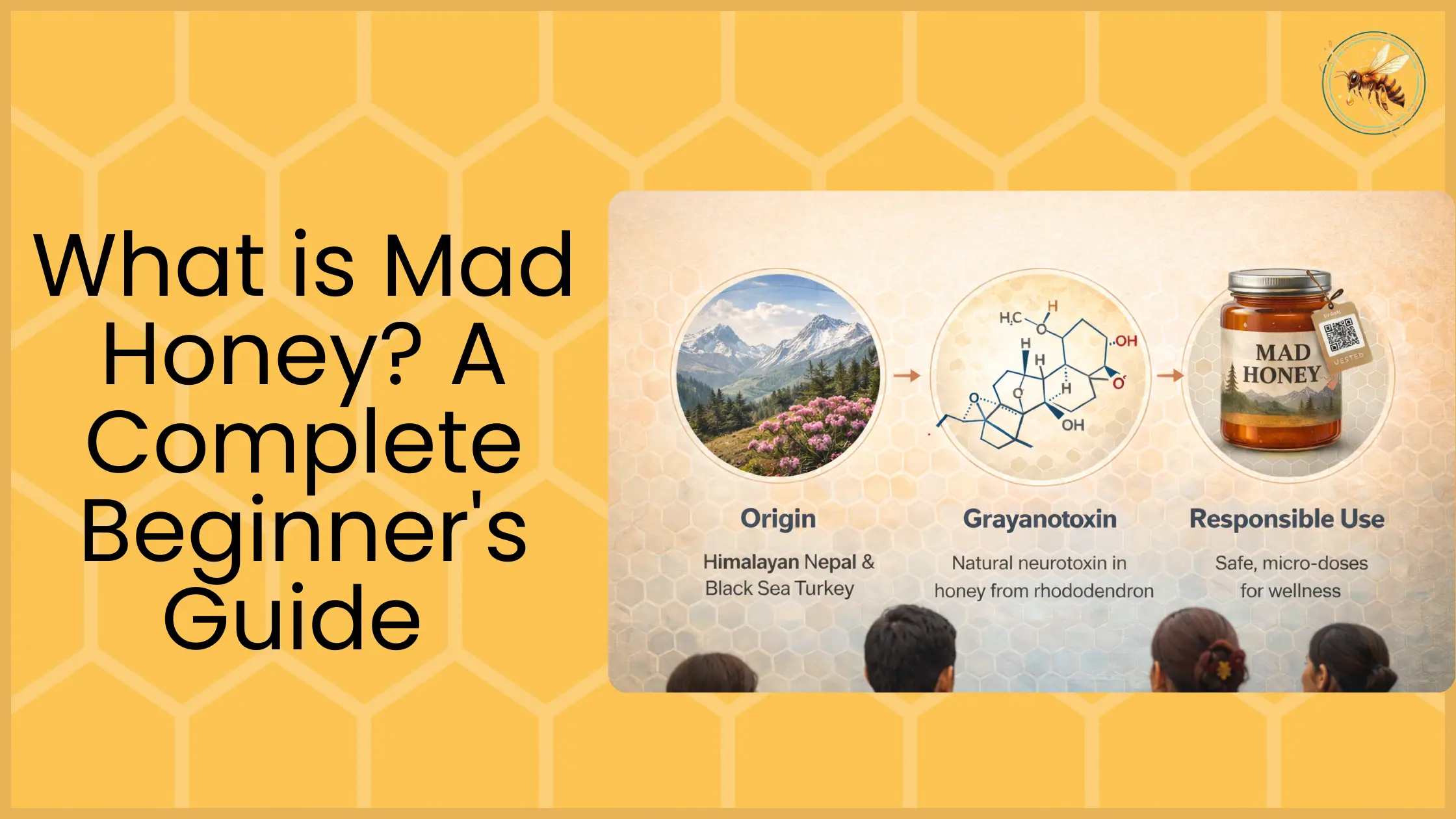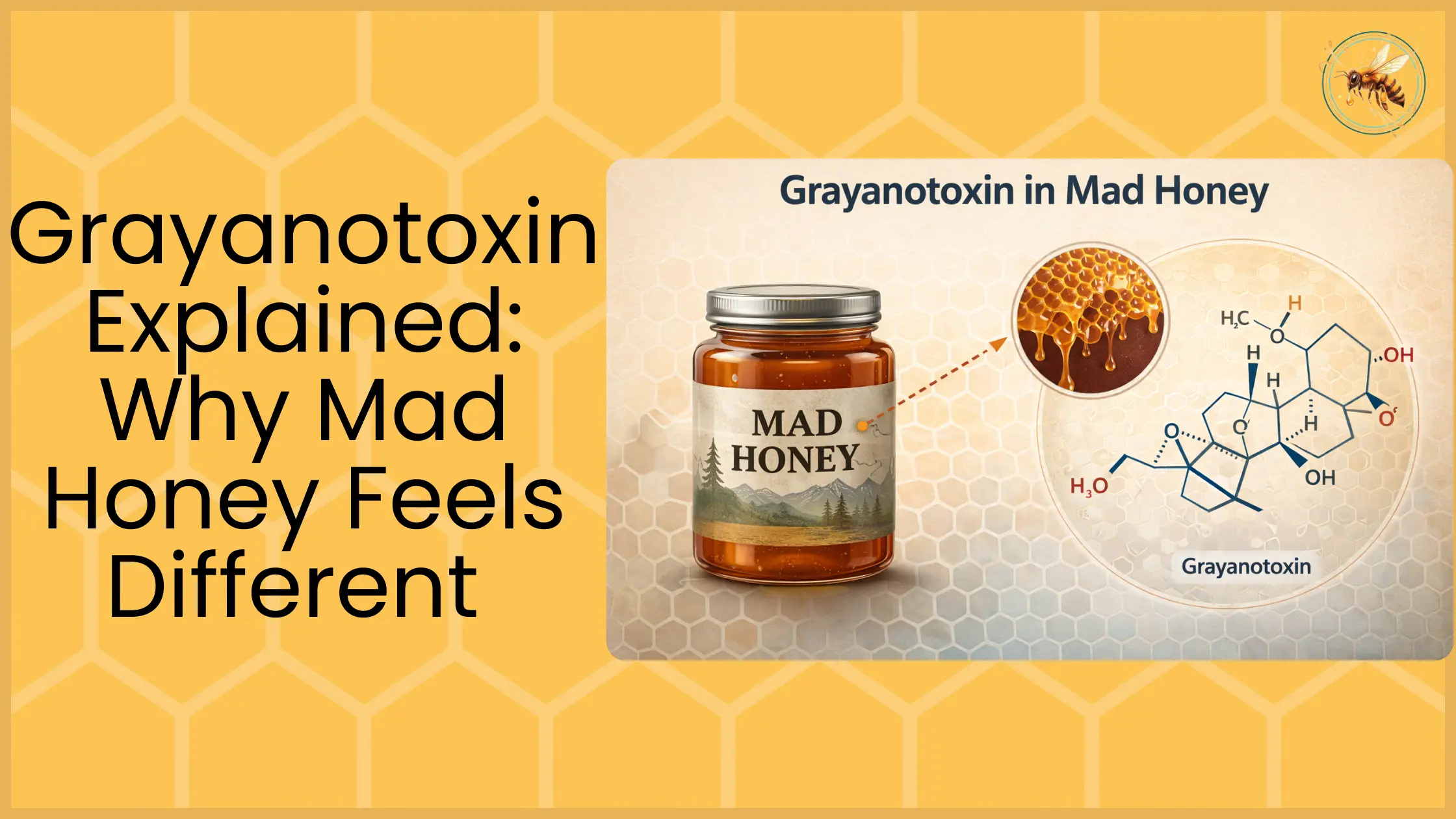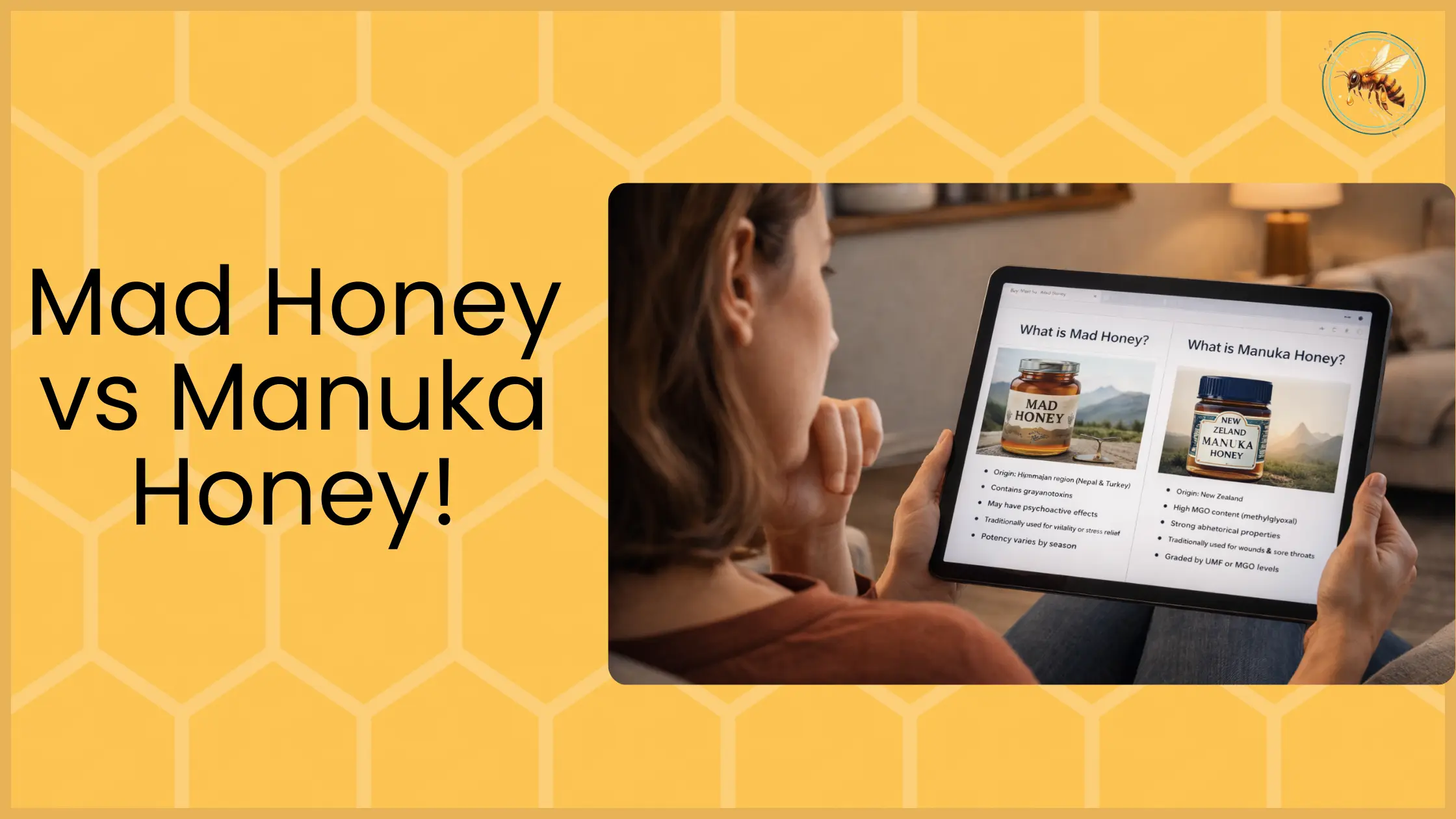
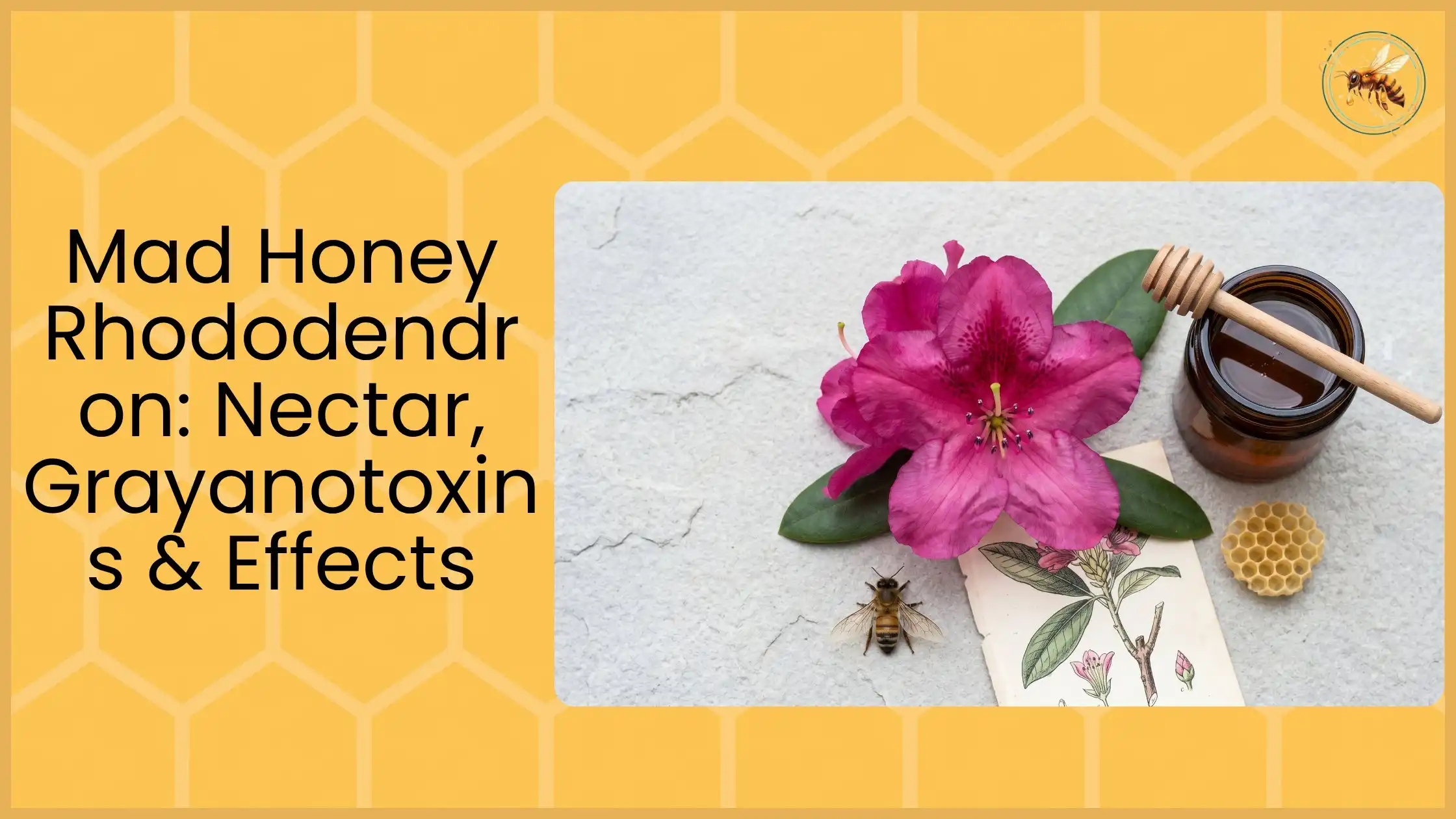
Mad honey gets its name from the unusual effects it can produce, but the story starts with a plant: rhododendron. In the right regions, during the right bloom periods, bees collect nectar from certain rhododendron species. That nectar can contain naturally occurring compounds called grayanotoxins, which may remain in the honey and give mad honey its distinctive dose-sensitive effects.
This does not mean all rhododendron honey is “mad honey,” and it does not mean every rhododendron species creates the same type of honey. The relationship is more specific: certain rhododendron species, certain environments, certain seasons, and certain harvesting conditions can create honey with meaningful grayanotoxin content. That is why origin, batch information, and responsible dosing matter so much.
tl;dr
- Rhododendron is the botanical source behind mad honey’s unusual effects, but not every rhododendron plant produces nectar that leads to potent mad honey.
- The key compounds are grayanotoxins, which can influence nerve, heart, and blood-pressure signaling in a dose-sensitive way.
- Mad honey is usually linked with specific rhododendron-rich regions, especially parts of Nepal/Himalayan areas and Turkey’s Black Sea region.
- Color, taste, or the word “rhododendron” on a label does not prove potency, safety, or authenticity.
- The safest way to evaluate rhododendron mad honey is through origin transparency, batch information, conservative guidance, and, where available, specific lab testing.
Quick Answer – What Does Rhododendron Have to Do With Mad Honey?
Rhododendron matters because some species produce nectar containing grayanotoxins. When bees collect enough of that nectar and convert it into honey, the final honey may carry those compounds. That is what gives mad honey its unusual reputation.
Rhododendron nectar is the main botanical link
Mad honey is not made by adding anything to regular honey. It forms naturally when bees forage in areas where certain rhododendron plants are blooming. The bees collect nectar, process it into honey, and store it in combs. If the nectar source contains grayanotoxins, the honey may contain them too.
Not all rhododendron equals “mad”
The rhododendron family is large and diverse. Some species are associated with grayanotoxin-containing nectar, while others are not strongly associated with mad honey production. Even within a region, nectar composition can vary depending on species, bloom timing, altitude, weather, and how much bees rely on that nectar compared with other flowers.
It explains the “why” behind the effects
Mad honey’s effects are not random. They are tied to the botanical source. The rhododendron-to-grayanotoxin link explains why mad honey can feel different from regular honey, why batch strength varies, and why responsible sellers focus on sourcing and safety rather than hype.
What Is Rhododendron?
Rhododendron is a large genus of flowering shrubs and trees known for its colorful blooms. Many species grow in mountainous or forested regions, and some are important nectar sources for bees.
A large plant genus with many species
Rhododendron is not one single plant. It includes many species with different flowers, habitats, chemical profiles, and ecological roles. Some are ornamental garden plants, while others grow wild in mountainous landscapes. Because of this diversity, the phrase “rhododendron honey” can mean different things depending on the region and the species involved.
Why only some species matter
Only certain rhododendron species are strongly associated with grayanotoxins. These are the species that matter most for mad honey. If bees collect nectar from non-relevant rhododendron species, or from many mixed flowers where rhododendron is only a small part of the nectar profile, the final honey may not have the same effect profile.
Avoid this mistake
Do not assume that any honey connected to rhododendron is automatically mad honey. A product can be floral, dark, bitter, or regionally interesting without being meaningfully grayanotoxin-active. The botanical source matters, but it must be paired with context: species, region, season, and batch.
Which Rhododendron Species Are Most Associated With Mad Honey?
The exact species can vary by region, but a few are repeatedly discussed in connection with traditional mad honey areas.
Rhododendron ponticum
Rhododendron ponticum is one of the species most commonly associated with Turkish “deli bal,” especially in the Black Sea region. This area has a long history of rhododendron-linked honey production and is often cited in both historical and modern discussions of mad honey.
In Turkey, the connection between rhododendron-rich landscapes and honey with unusual effects is especially strong. Local ecology, dense bloom zones, and long-standing honey traditions all contribute to the reputation of Black Sea mad honey.
Rhododendron luteum
Rhododendron luteum is another species often discussed in the context of grayanotoxin-containing honey. It is also associated with regions around the Black Sea and can contribute to honey with mad honey characteristics when bees forage heavily from it.
The important point is not that one species is “the strongest” or “the best.” The more useful point is that species composition helps explain why some regions repeatedly appear in mad honey history and modern sourcing.
Himalayan rhododendron species
In Nepal and the Himalayan regions, the picture can be more complex because multiple rhododendron species may grow across different altitudes and bloom zones. Nepal’s mad honey reputation is also shaped by its cliff-harvesting culture, giant honey bees, and mountainous ecology.
The Himalayan framing should not be used loosely. A honey described as “Himalayan” should still provide more detail: country, region, harvest season, and ideally batch context. “Himalayan” alone is not proof of mad honey activity.
Why species identification matters
Species identification matters because it helps separate real botanical explanations from marketing. A seller who can explain the regional rhododendron context is more credible than one who simply says “rhododendron honey” or “Himalayan honey” with no details.
That said, species naming should not replace lab testing. Even if the source region is credible, potency still varies by batch.
How Bees Turn Rhododendron Nectar Into Mad Honey
Mad honey is not artificially made. It begins with normal bee foraging behavior in an unusual floral environment.
Nectar collection
During bloom periods, bees collect nectar from available flowers. In rhododendron-rich areas, certain bees may collect a significant amount of nectar from grayanotoxin-containing rhododendron species. If those flowers dominate the nectar flow, the final honey is more likely to carry noticeable grayanotoxin levels.
Honey production
Bees convert nectar into honey by reducing moisture, adding enzymes, and storing it in combs. This process concentrates the nectar sugars and creates a stable food source for the colony.
The key point is that honey-making does not magically remove all plant-derived compounds. If the nectar contains grayanotoxins, the honey may retain them.
Apis laboriosa and Himalayan cliff honey
In Nepal, mad honey is often connected with Apis laboriosa, the Himalayan giant honey bee. These bees build large combs on cliffs, and traditional honey hunters harvest the combs using ropes, smoke, ladders, and coordinated team methods.
The dramatic cliff-harvesting story is part of why Nepal’s mad honey attracts global attention. But the bee species alone does not make honey “mad.” The honey’s effect still depends on the nectar source, season, and batch.
Why bee species alone is not enough
A bee species can influence where honey is made and how it is harvested, but the botanical source is what explains the grayanotoxin connection. In plain terms, the bees collect the nectar; the rhododendron provides the compounds.
Grayanotoxins: The Compounds Behind Rhododendron Mad Honey
Grayanotoxins are the main reason rhododendron mad honey is discussed differently from regular honey.
What grayanotoxins are
Grayanotoxins are naturally occurring compounds found in certain plants, including some rhododendron species. In mad honey, the most discussed compounds are often GTX I and GTX III, though profiles can vary.
These compounds are not added to honey. They originate from the plant nectar and may pass into the honey through the bees’ foraging.
How they affect the body
Grayanotoxins can affect voltage-gated sodium channels, which are involved in nerve and muscle signaling. In practical terms, this can influence autonomic body functions such as heart rate, blood pressure, sweating, nausea response, and dizziness.
That is why mad honey effects are often described as “body-first.” At low amounts, some people report calm, warmth, heaviness, or subtle mood changes. At higher amounts, the experience can become uncomfortable or dangerous, with dizziness, nausea, weakness, low blood pressure, slow heart rate, or fainting.
Why they can create both “effects” and risks
The same compounds that make mad honey unusual also create a safety concern. This is the key point many people miss. There is no separate “good compound” and “bad compound” in simple terms. The effect depends on amount, batch strength, individual sensitivity, and context.
Why “high grayanotoxin” is not a quality claim
Some sellers imply that stronger or higher-grayanotoxin honey is better. That is a risky framing. Higher grayanotoxin content may mean stronger effects, but it also means less room for error. For buyers, the better goal is not “highest potency.” It is known for its potency, responsible guidance, and conservative use.
Where Rhododendron Mad Honey Is Found
Mad honey is associated with regions where grayanotoxin-containing rhododendron species grow and where bees forage heavily during bloom.
Turkey/Black Sea region
Turkey’s Black Sea region is one of the most famous mad honey areas in the world. Turkish mad honey is often called deli bal, and it has a long history in regional use, folklore, and clinical case reports.
The landscape matters. Rhododendron-rich hillsides, local bee activity, and traditional honey practices help explain why this region appears so often in mad honey discussions.
Nepal/Himalayan regions
Nepal is another major region associated with mad honey, especially because of its cliff-harvesting tradition. The honey is often collected from remote high-altitude or mid-altitude areas where rhododendron bloom cycles shape nectar availability.
Nepal mad honey is also strongly tied to cultural storytelling. Buyers often associate it with Gurung honey hunters, Himalayan cliffs, and giant honey bees. Those details matter culturally, but the actual effect still depends on botanical and batch factors.
Other regions
Rhododendron species grow in many places, but not every rhododendron-rich region is a major mad honey source. For mad honey to form, several conditions must align: relevant rhododendron species, bee foraging behavior, bloom timing, limited alternative nectar sources, and harvesting practices that preserve the honey.
Why “made from flowers” is not a useful claim
All honey comes from flowers. A serious mad honey claim needs more detail. The relevant question is not “Did bees visit flowers?” but “Which flowers, in which region, during which season, and does the batch have evidence to support its claims?”
Why Rhododendron Mad Honey Varies So Much
Variation is normal in mad honey. It is not a flaw by itself; it is part of the category.
Plant species
Different rhododendron species can produce different nectar profiles. Some may contain more relevant grayanotoxins than others. If the dominant floral source changes, the honey can change too.
Bloom season
Bloom timing matters because bees collect what is available. A spring harvest may differ from an autumn or late-season harvest. Weather can also shift bloom intensity and nectar availability.
Weather and environment
Rain, temperature, altitude, and local ecology affect nectar flow. A season with dense rhododendron bloom and fewer alternative flowers may produce different honey than a season with mixed nectar sources.
Bee foraging patterns
Bees do not follow marketing categories. They forage according to availability, distance, colony needs, and environmental conditions. Even in the same region, the final honey may differ from comb to comb or batch to batch.
Product blending
Some sellers blend honey to create a consistent flavor or dilute intensity. Others sell smaller wild batches with more natural variation. Neither approach is automatically good or bad, but it should be disclosed clearly.
Is Rhododendron Honey Always Dangerous?
No, but it should be treated with respect.
No – risk depends on toxin concentration
Rhododendron-linked honey is not automatically dangerous in every case. Risk depends on grayanotoxin concentration, serving amount, individual sensitivity, and whether someone has health risks or medication interactions.
A mild batch used cautiously by a healthy adult is not the same as a strong batch taken recklessly by someone with low blood pressure or heart medication.
Traceability and testing reduce uncertainty
The safest sellers provide origin details, batch or harvest information, conservative guidance, and, where possible, lab testing. Testing does not make mad honey risk-free, but it helps replace guesswork with measurable information.
Why natural does not mean harmless
Rhododendron mad honey is natural, but “natural” is not the same as safe for everyone. Many potent compounds are natural. The safety question is dose, sensitivity, and context.
What Rhododendron Mad Honey Can Feel Like
Effects vary widely, and it is important to keep expectations realistic.
Low exposure
At low exposure, some people describe:
- calm
- warmth
- body heaviness
- mild relaxation
- subtle mood shift
- slight sensory change
Some people feel very little. That does not automatically mean the honey is fake. It may reflect a small amount, a mild batch, food timing, or lower individual sensitivity.
Too much exposure
When someone takes too much for their body or batch, the experience can shift into:
- dizziness
- nausea
- sweating
- weakness
- stomach upset
- confusion
- feeling faint
- slow pulse sensation
- low blood pressure symptoms
This is why chasing intensity is the wrong approach.
Why it should not be framed as a typical psychedelic
Mad honey is often called “hallucinogenic honey” online, but that label can mislead beginners. Its effects are not best understood as a classic psychedelic experience. The main safety pattern is physical and autonomic, especially blood pressure and heart-rate related symptoms at higher exposure.
Safety: What Readers Need to Know
Rhododendron mad honey requires a safety-first mindset because the active compounds can be unpredictable.
Dose sensitivity
Small changes in amount can create noticeably different effects. This is why starting low and waiting matters. Re-dosing quickly is one of the easiest ways to accidentally take too much.
Batch-specific risk
Each batch should be treated as different. Even if someone has used mad honey before, a new jar can feel different. That is especially true if the origin, harvest, or seller changes.
Who should avoid it
Mad honey is not suitable for:
- people with low blood pressure
- people with heart conditions or rhythm concerns
- people prone to fainting
- pregnant or breastfeeding women
- children
- people taking blood pressure, heart-rate, sedative, sleep, or anxiety medication
- anyone planning to mix with alcohol or other substances
Red flags
Seek help if symptoms include:
- fainting or near-fainting
- chest pain
- trouble breathing
- persistent vomiting
- severe weakness
- confusion
- very slow pulse with symptoms
Rhododendron, Red Mad Honey, and Color Myths
Color is one of the most common sources of confusion.
Why people read honey color as proof
Some buyers assume redder or darker honey must be stronger or more authentic. This is an easy myth to believe because mad honey is often described as dark, reddish, amber, or bitter.
Why color does not prove potency
Color can be affected by nectar mix, age, storage, processing, and region. A darker jar is not automatically stronger. A lighter jar is not automatically fake.
Why “red” + rhododendron is not enough
A seller may use “red,” “Himalayan,” or “rhododendron” in marketing without proving origin or batch. Those words are not proof. They must be backed by traceability, harvest details, and responsible safety information.
Authenticity: How to Verify Rhododendron-Linked Mad Honey
Authenticity is not just about avoiding scams. It is also about reducing safety uncertainty.
Look for origin details
A responsible seller should provide the country, region, and harvest context. “Himalayan” or “Turkish” alone is not enough. Better descriptions mention regional sourcing and explain why that region is associated with rhododendron honey.
Look for batch transparency
Batch or harvest information matters because mad honey varies. A seller who acknowledges variation is usually more credible than one promising identical effects every time.
Look for honest lab reporting
If a seller claims lab testing, the report should be specific. A useful report includes batch identifiers, grayanotoxin results, contaminant testing where available, and enough detail to verify that the report belongs to the product being sold.
Look for realistic effect language
Trust sellers who say effects vary and who emphasize conservative use. Be cautious with sellers who promise “guaranteed high,” “instant trip,” “strongest,” or “highest potency.”
Red flags
Avoid listings with:
- vague origin
- no batch information
- no safety warnings
- dramatic psychoactive claims
- suspiciously cheap pricing
- “lab tested” with no report
- photos or labels that change from listing to listing
Rhododendron Mad Honey vs Regular Honey
The difference is not just taste or color. It is botanical chemistry.
Botanical source
Regular honey can come from many floral sources: wildflower, clover, acacia, orange blossom, forest honey, and more. Rhododendron mad honey comes from nectar sources associated with grayanotoxins.
Active-compound difference
Regular honey is primarily a food. Rhododendron mad honey can contain compounds that affect the body beyond ordinary nutrition or sweetness.
Safety difference
Regular honey safety concerns are usually about food quality, contamination, infant safety, storage, or sugar intake. Mad honey adds dose sensitivity, batch variability, cardiovascular risk, and medication-interaction concerns.
Conclusion
Rhododendron is the botanical starting point for mad honey’s unusual effects. Certain rhododendron species can produce nectar containing grayanotoxins, and bees can turn that nectar into honey with dose-sensitive body effects.
The safest way to understand rhododendron mad honey is through three principles:
- Botanical source matters. Not all rhododendron honey is the same.
- Response is variable. Region, season, species, batch, and person all affect the outcome.
- Responsible sourcing matters. Origin transparency, batch information, lab reporting, and conservative safety guidance are more important than color, hype, or “strongest” claims.
FAQs – Mad Honey and Rhododendron
What does rhododendron have to do with mad honey?
Certain rhododendron species can produce nectar containing grayanotoxins. Bees collect that nectar and turn it into honey, which may retain those compounds.
Is all rhododendron honey mad honey?
No. It depends on species, region, season, nectar dominance, and grayanotoxin content.
Is rhododendron honey poisonous?
It can be risky if it contains enough grayanotoxins and someone takes too much or has personal risk factors. Not every rhododendron-linked honey has the same potency.
Why is rhododendron linked to Turkey and Nepal?
Turkey’s Black Sea region and parts of Nepal/Himalayan regions have rhododendron-rich landscapes and long-standing traditions around unusual honey.
Is Nepal mad honey from rhododendron?
Nepal mad honey is often linked to rhododendron bloom zones, but authenticity depends on sourcing details, season, and batch evidence.
Is Turkish mad honey from rhododendron?
Turkish “deli bal” is strongly associated with rhododendron species in the Black Sea region.
Can I tell if honey has rhododendron nectar by taste?
Taste may offer clues, bitter, herbal, earthy, or medicinal notes, but taste cannot prove authenticity, potency, or safety.
Does rhododendron nectar make honey stronger?
It can contribute grayanotoxins, but “stronger” depends on concentration, batch, and amount consumed. Stronger is not automatically better.
Is rhododendron honey legal?
Legality depends on the country, import rules, labeling, and claims. The product is often treated as honey/food, but marketing it as a drug-like product creates problems.
What can make mad honey from rhododendron unsafe?
High grayanotoxin concentration, large serving size, re-dosing too quickly, mixing with alcohol or sedatives, underlying health conditions, medication interactions, and lack of batch transparency.